
An 18th-century dignitary reputedly said that it would puzzle a monkey to climb this tree, hence its common name the Monkey puzzle (Araucaria araucana). Whether or not that’s true, it makes a good story, and the tree’s sharp branches and spiky leaves would certainly make its climbing by any creature almost impossible.
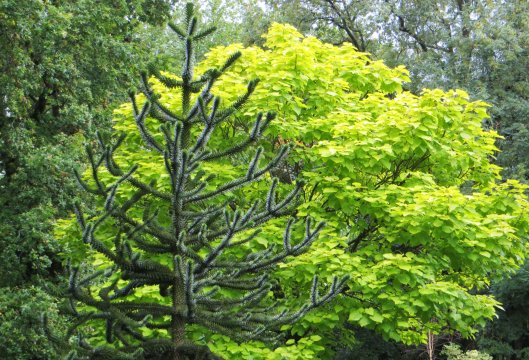
The Monkey puzzle’s shape stands out well against the vibrant Lime tree
An evergreen conifer that is native to Argentina and Chile, the Monkey puzzle was introduced to Britain in 1795 by Archibald Menzies, one of a generation of naval officers and plant collectors who brought back all manner of flora and fauna from their global voyages. One of Menzies’ Monkey puzzles survived at Kew for almost a hundred years, until it died in 1892, and the Monkey puzzle was a popular planting in Victorian parks and gardens because of its unique appearance.
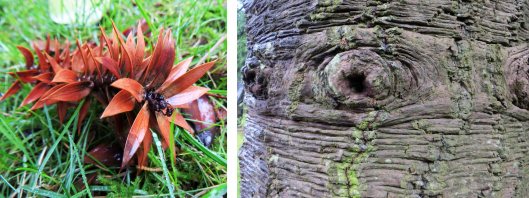
The dead branch shows the spiny leaves, and the bark is also quite unique
In Chile, the tree is now a protected species, its population having been severely threatened by human activity, especially the burning of native forests for conversion to agricultural use. The Amerindian tribe, the Araucanos (from whom the tree gets its scientific name), consider the tree sacred, and their assistance and indigenous knowledge are helping to protect the tree for the future.
 earthstar
I loved reading this post, what a wonderful story, and a great name for a tree. Loved it!
LikeLiked by 1 person
You’re very kind, Laura, thank you. It is a fascinating tree, quite prehistoric in a way. Glad you enjoyed reading about it.
LikeLike