
Although this stunning fungus is apparently found in my native New Zealand – as well as in much of Europe, North America and some countries in Asia, I had never seen it until a few weeks ago. This is the appropriately named Cobalt crust (Terana caerulea), a fungus many books and websites report as a rare sight in England and Wales yet many of my fungi friends have seen it. We assume it is not actually rare but rather rarely reported or, perhaps, not recognised, as it is often to be found lurking on the undersides of fallen branches and dead trees, and it turns almost black when past its best.
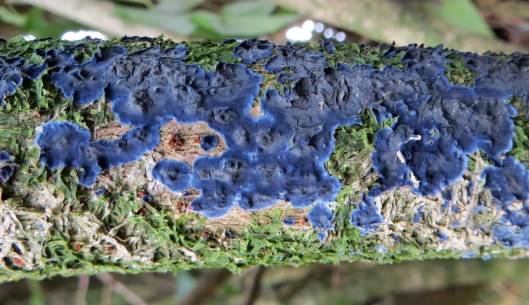
When it’s young and fresh, its vibrant cobalt colour is instantly recognisable and a real highlight of any woodland wander. With a soft, almost waxy feel when moist, it’s no wonder it’s been described as ‘blue velvet on a stick’. As its name implies, this fungus is a member of the corticiord group of fungi – that’s crust fungi in layman’s terms, a fungus that adheres to something, rather than growing on a stem like a normal mushroom.

 earthstar
Is this fungus common in dying trees? I found this on a limb that broke out of our oak in the yard. And I’m curious if this is the cause of the internal rot that caused the breakage.
LikeLiked by 1 person
As per my reply to your other comment, this fungus feeds on wood that is already dead so it is highly unlikely to have caused the branch to rot and break. You can read more about it on the First Nature website: https://www.first-nature.com/fungi/terana-caerulea.php
LikeLike
Pingback: Fungi Friday: The Cobalt crust challenge | earthstar
What a surprisingly pretty fungus!
LikeLiked by 1 person
There are many beautiful fungi, Debbie, but the colour on this one is definitely a surprise. Glad you like it!
LikeLike
How lovely, it looks almost too exotic to be found in this country. You certainly have knack for finding the best of our fungi and even better is that you know what they are.
LikeLiked by 1 person
Aha! I have a secret weapon! I have made some wonderful friends through joining the Glamorgan Fungi Club’s Facebook page. We now go on forays together and they are a huge help with identifying finds. 🙂
LikeLiked by 1 person