
Tags
ascospores, asexual reproduction in fungi, Chaetosphaerella phaeostroma, conidia, fungus, mycelium, sexual reproduction in fungi
When I first found this fungus a month ago, I thought the wee grey orbs might be a type of slime mould but I was puzzled by the black fuzz that surrounded them. Turns out it was not a slime mould at all but rather the fungus Chaetosphaerella phaeostroma. The fuzz (more correctly, the subiculum) is a dense mat of hyphae (the branching filaments that make up the mycelium, the vegetative part of the fungus that is usually hidden below the ground) and the grey orbs are the fruiting bodies (a mushroom is the more usual form of fungal fruiting body).
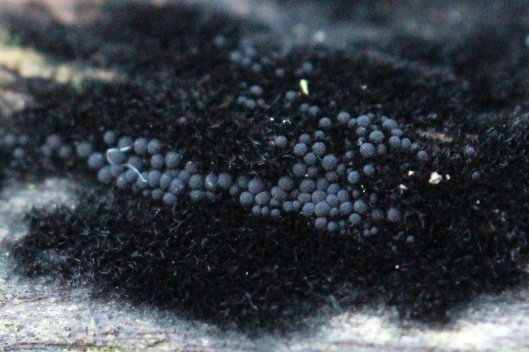
If you think that’s confusing, it gets even more tricky! This particular fungus has two methods of reproducing as it’s capable of producing both sexual and asexual spores – it’s not surprising that this led scientists in the past to believe it was two separate fungi. The hyphae (the fuzzy stuff) can produce conidia (below left), which are asexual (so they can create new fungi but these would be exactly the same as the parent), and the spherical fruiting bodies (called perithecia) produce ascospores (below right), which are sexual (so they need to interact with another fungus in order to produce a new organism which would then have characteristics of both parents).


I am exceedingly grateful to my friend from the Glamorgan Fungus Group, Mark Evans, who examined the sample I gave him and produced not only the identification of this fungus but also the wonderful microscopic images. His detailed explanations also helped me understand what was going on with Chaetosphaerella phaeostroma, and if I’ve got any of this wrong, it’s entirely my own fault!
 earthstar
Great microscopy. Interesting read
microbiables.com
LikeLiked by 1 person
Thanks!
LikeLike
You describe it far, far better than I can ;¬)
LikeLiked by 1 person
You’re too kind, Mark. And thanks again for your help. After today’s microscope course, I’ll be trying the next mystery myself … but will probably still need help! 🙂
LikeLike
Loved reading about this! Although I think many people out there would think we were weird for finding fungi so fascinating and wonderful, but obviously we are not alone! 😄
LikeLiked by 1 person
Thanks, Laura. Hope it made sense.
Our fungi group on Facebook is a closed group so we can enthuse about fungi without our friends and family seeing and therefore thinking we’re weird. 😉
LikeLiked by 1 person