
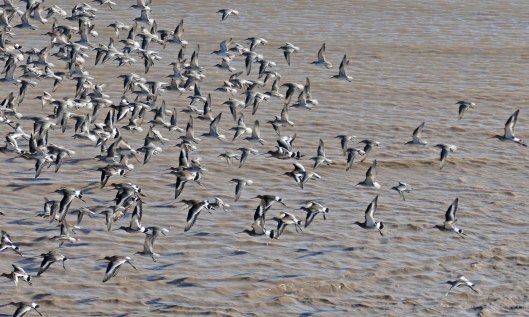
The most numerous bird species in Monday’s murmuration (see Wednesday’s blog for photos) was undoubtedly the Black-tailed godwit (Limosa limosa). With their long legs, necks and beaks and well-proportioned bodies, these are elegant birds.

We have two species of godwit in Britain, Black-tailed and Bar-tailed (Limosa lapponica), and, at first glance, they can be difficult to tell apart but, as you can see in some of my photos, the Black-tailed have broad white wing-bars and their white tails finish with a black band, hence their name.

Some of these local birds are starting to change in to their breeding plumage of brick-red heads, necks and breasts, which is why the birds’ colours pictured here are so different. Only a very small number of Black-tailed godwits breed in the UK; most, if not all, of the birds pictured will soon be heading north-west to their breeding grounds in Iceland.

And that breeding location is one of the reasons Black-tailed godwits are now on the British red list, as the lowland Icelandic grasslands these birds favour are increasingly being converted to arable production and forestry. Climate change and environmental pressures are also affecting the locations in Britain where the birds over-winter, so they are facing pressure all year round. I feel privileged to have seen so many of these stunning creatures at such close quarters and to see their incredibly well synchronised aerial display earlier this week.
 earthstar
You must be logged in to post a comment.