
During the Springs of 2022 and 2023, birders throughout Wales volunteered their time to check suitable locations for rookeries, the multi-nest colonies where Rooks raise their young. The survey, organised by the Welsh Ornithological Society, was conducted to establish concrete information about the breeding population in Wales because Rooks are now red-listed, their numbers threatened by changing land use and human occupation, amongst other things.
I didn’t take part in the survey as one of my birding friends had already put his hand up for my local area and, as I don’t drive, getting around an alternative 2-square-kilometre tetrad would have proven difficult, but I did chat about where I’d seen Rooks with my friend. His searches of the local area only produced one rookery, which is well known locally and has been established for a very long time – the street where it’s located is called Rookery Lane!
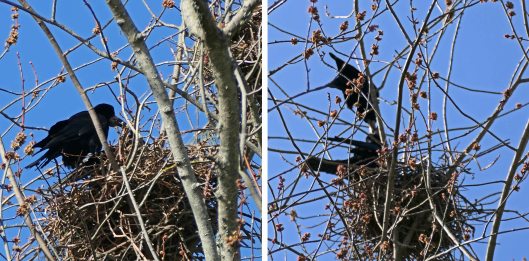
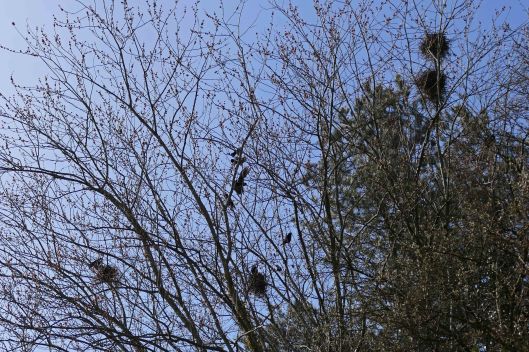
So, you can perhaps imagine my surprise and delight when, during Sunday’s local meander, I spotted a new rookery. It’s adjacent to a series of fields where horses graze and where I’ve often seen Rooks feeding – in fact, the photo and video I included in my post Rook pair-bonding behaviour, 18 February, were taken at that location. I think this new Rookery has only been established very recently, perhaps even this year, as it certainly wasn’t around in Spring 2023 when the survey took place, and I’ve never noticed it when I’ve walked that way previously.

I counted just 5 nests, and at least 8 Rooks – others may have been off looking for food. Not being familiar with Rook breeding behaviour, I initially thought the adult birds were feeding well-grown young but I’ve since been informed that, as Rooks only begin breeding in March, this was more likely to be adults feeding their partners so they don’t have to leave the nest when they’re sitting on eggs or raising their young. I’ll certainly be keeping a close eye on these trees during the next couple of months, hoping to catch glimpses of any chicks as they grow and fledge.
 earthstar
You must be logged in to post a comment.