• ABOUT
  • BIRDING 2018
  • Birding 2019
  • BLOG POSTS
  • Butterflies 2018
  • Resources

earthstar

~ a celebration of nature

earthstar

Category Archives: trees

Hello, Blossom

22 Friday Apr 2016

Posted by sconzani in nature, spring, trees

≈ 7 Comments

Tags

blackthorn, blossom, Bute Park, Cathays Cemetery, cherry trees, magnolias, prunus species

‘Tis that time of year when everywhere you look there are trees in blossom. The whites and pinks of the various prunus species grace the lawns in Bute and the various other public parks, and line the pathways at Cathays Cemetery. In wilder places, blackthorns are covered in their snow-like blooms, providing a feast for the bees and hoverflies now emerging in huge numbers from their winter hibernation. And, here in Cardiff, magnolias are often used as street trees – I take my hat off to the urban planner who made that decision! – and are currently making a gorgeous spectacle of themselves.
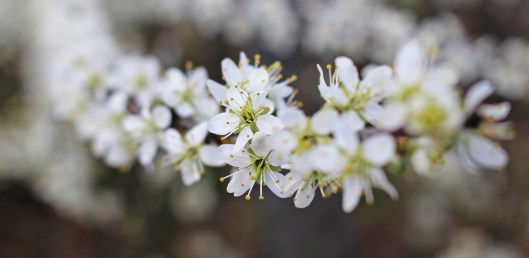
160422 blossom (1)

On my daily walks I seem constantly to be smiling at the beauty of the blossom all around me, and I ignore the strange looks of those who appear to think that stopping to admire a tree means I’m a crazy woman. I often think the world would be a better place if more people took the time to drink in the beauty all around them – so, please, if it’s spring where you are, stop, look and love the blossom!

160422 blossom (2)
160422 blossom (3)
160422 blossom (4)
160422 blossom (5)
160422 blossom (6)
160422 blossom (7)
160422 blossom (8)
160422 blossom (9)
160422 blossom (10)
Like Loading...

I’m following a tree: month 3

09 Saturday Apr 2016

Posted by sconzani in nature, spring, trees

≈ 9 Comments

Tags

Dawn redwood, I'm following a tree, Metasequoia glyptostroboides, Spring growth, tree following

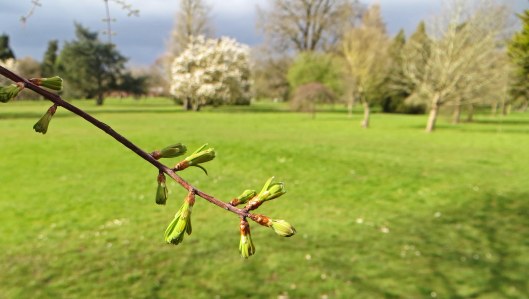
Spring has sprung, the grass is riz, I wonder where Dawn’s leaf growth is? From a distance, Dawn Redwood looks much the same as she did last month. It’s only when you get closer that you can see the fresh green buds just beginning to open now that the days are getting warmer and brighter.

160409 dawn redwood (1)160409 dawn redwood (3)

Having said that, it was blowing a gale when I visited a few days ago, a cold howling wind that prevented me from getting better close up photos of the new growth. That wind did, however, make me admire how well Dawn copes with such conditions. She has her feet well and truly planted in the ground, which is a good thing when you consider how tall and slender she is, and I’m sure her broad strong base helps anchor her when those strong winds are blasting.

160409 dawn redwood (2)

She has a light covering of bright green moss on the lowest metre or so of her trunk but no lichens or fungi that I could see with the naked eye, which is probably a good thing, as they can be indicators of disease or cause a tree to die – and I certainly don’t want that to happen. I’m looking forward to seeing a very different Dawn next month.

Tree following is fun. Why not join in? You can find out more here. https://squirrelbasket.wordpress.com/tree-following/

Like Loading...

Flowering Yew trees

21 Monday Mar 2016

Posted by sconzani in nature, trees

≈ Leave a comment

Tags

male yew flowers, male yew tree, yew tree

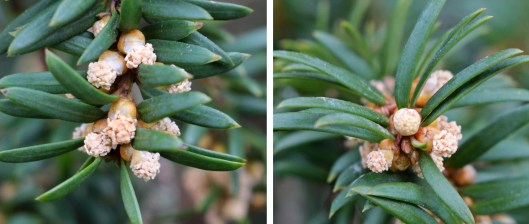
I bumped against a branch of a yew tree at the local cemetery today, then spent the next 10 minutes brushing myself down. Why? Because March and April are the months the male yew trees shed their yellow pollen. The yew is dioecious (‘di’ meaning two and ‘oikos’, from the Greek, meaning house), so the male and female flowers grow on separate trees. The male flowers, called cones, start as small green buds, then develop into yellowish-white globes that open to release their pollen from tiny florets.

160321 yews flowering 1160321 yews flowering 2

The yew tree is very long-lived – I have yet to visit the 4000-year-old tree that grows in a North Wales churchyard but it’s certainly on my list. In fact, the yew can frequently be seen in churchyards, though this association may have a pre-Christian origin – the evergreen yew provides dense shade so was often planted at pagan sites of worship, which were then taken over by the early Christians to build their churches. There is a more practical reason for yews in churchyards, too – the leaves are poisonous to the sheep that were used to ‘mow’ the grass around the graves so the trees survived the sheep’s eager grazing.

160321 yew tree heath

A yew tree that’s not in a churchyard!

Like Loading...

I’m following a tree: month 2

08 Tuesday Mar 2016

Posted by sconzani in nature, spring, trees

≈ 10 Comments

Tags

Bute Park, Cardiff, Dawn redwood, I'm following a tree, tree following

160308 dawn redwood (4)

Though I have strolled past Dawn Redwood a couple of times this month, I hadn’t really noticed any change in her, until today – and then it was only when I was reviewing this afternoon’s photos and zoomed in on one or two. Note to self: next time, choose a shorter tree to follow, the better to see what’s happening up top – because it’s at the top of the tree that all the action is happening.

160308 dawn redwood (2)160308 dawn redwood (1)

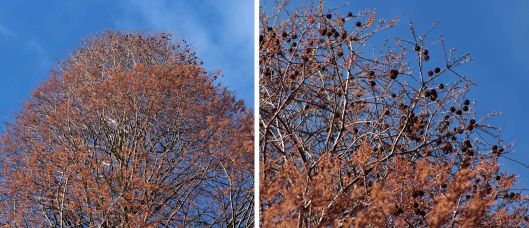
Not only is Dawn still carrying last season’s cones up there, she also still has more of a flush of this spring’s flowers higher up and, at the very top, the green of this year’s foliage is just beginning to burst out. I find each of these things surprising – the cones and the flowers because the top of the tree must be the most windblown so I’d have expected both to have been blown off more at the top than lower down the tree, and the budding foliage because I thought the tree would green from the bottom as the sap rose upwards with the warmer weather.

This is exactly why following a tree is so very interesting. The more closely you look, the more you see and learn.

160308 dawn redwood (3)

small cones for such a large tree, and very tiny seeds (bottom of photo, left of centre)

Why not join the tree following community. You can find out more here.

Like Loading...

Fungi finger prints

06 Sunday Mar 2016

Posted by sconzani in fungi, nature, nature photography, trees

≈ Leave a comment

Tags

fungus, Rhytisma acerinum, sulphur dioxide air pollution, sycamore, Tar spot

Well, they look a bit like finger prints to me – or, perhaps, the wax seals people used to stamp on their communications and documents. But no! These are, in fact, the signs of Tar spot, a disease that most often affects sycamore trees but can also occur in other species of acer, and is caused by the fungus Rhytisma acerinum.

Rhytisma acerinum Sycamore Tarspot (1)

The spots start out yellow in the springtime, then eventually morph into the slightly raised bumpy black spots you can see in my photos. Although they look a little ugly, the spots don’t affect the health of the trees – they merely cause the leaves to drop a little earlier than normal in the autumn.

Rhytisma acerinum Sycamore Tarspot (2)
Rhytisma acerinum Sycamore Tarspot (3)

Though you might not like the look of them, there is one big benefit to seeing these spots on your sycamore tree: as the fungus is particularly sensitive to sulphur dioxide air pollution, its presence indicates your air is relatively clean and healthy.

Rhytisma acerinum Sycamore Tarspot (4)

Like Loading...

Ancient oak in Brynna Woods

25 Thursday Feb 2016

Posted by sconzani in nature, nature photography, trees

≈ 6 Comments

Tags

Ancient Oak, ancient tree, Brynna Woods

160225 brynna ancient oak (4)

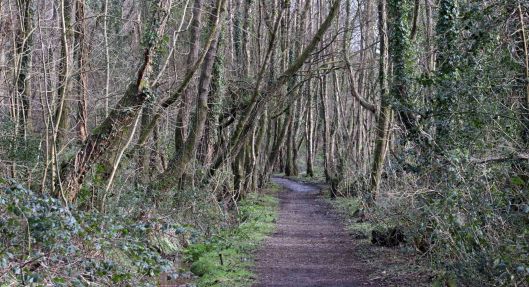
Brynna Woods was once a busy coal-mining area, with up to three shafts operating and as many as 400 men toiling underground, a tramway trundling away coal and spoil, coke ovens carbonising coal, and an engine house belching out smoke. Fortunately for today’s visitors, those processes had all ceased by 1934 and the woodland has been allowed to regenerate, becoming a tranquil area for walking and wildlife watching.

160225 brynna ancient oak (2)
160225 brynna ancient oak (3)

Adjacent to the main trail in the woods there sits an old man of the forest, the aptly named Ancient Oak. Its actually age is the subject of much speculation – some say it’s 400 years old, I read in a Cardiff Naturalists’ newsletter that it’s 300, and was told by a local that it’s more likely 250 years old. And there is also speculation about whether it is one single tree or two trees that have grown together. Certainly, when you look at its trunk, you can see where the two-tree theory arose as there is a dark line of vertical bark seemingly separating the two halves of the tree. Whatever the truth, it is a stately representative of nature’s majesty that deserves to be cherished and admired and protected for future generations to enjoy.

160225 brynna ancient oak (1)

Like Loading...

I’m following a tree: month 1

12 Friday Feb 2016

Posted by sconzani in nature, nature photography, trees

≈ 5 Comments

Tags

Bute Park, Cardiff, Dawn redwood, I'm following a tree, Metasequoia glyptostroboides, tree following

dawn feb 2

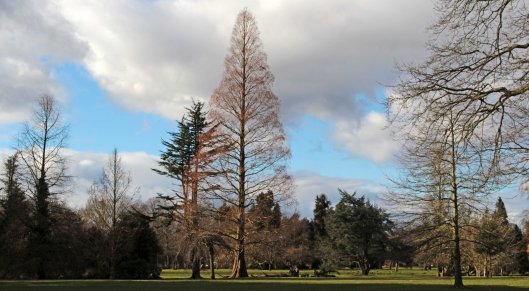
She is a statuesque beauty, tall for her 67 years, but with a very slight lean to one side – I blame the strong winds blasting inshore from the mighty Atlantic Ocean. Her name is Dawn Redwood (Metasequoia glyptostroboides, to be precise) and her kind was thought to be extinct, having only been identified in fossils until some time between 1941 and 1944 when she was rediscovered, growing in the town of Moudao, in Hubei, in south-western China. Long ago, her family and her cousins, the sequoias, could be found right across Europe, in Asia and in the Americas but all were killed off during the last ice age.

dawn feb 1

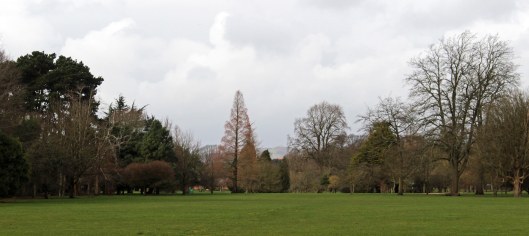
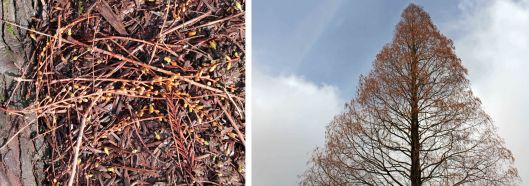
My Dawn came from the first shipment of international seeds to arrive in Britain in 1949. She grows in Bute Park, in the Welsh capital of Cardiff. She was a champion tree, the tallest of her kind in Britain, in 2005, but she has since been surpassed. Still, she has a regal air and a wonderful pyramidal shape.

dawn feb 4

Flowers blown off during recent stormy weather

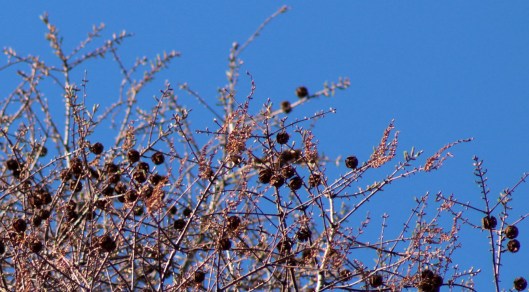
Dawn is deciduous, which is unusual for a conifer, but at the moment she is flowering, which has given her a rusty tinge – perhaps she’s blushing! In fact, she is monoecious, which means she has separate male and female flowers on the same tree. The male flowers hang in clusters at the end of her branches, while the female flowers are solitary. Over the next 12 months, I will be visiting Dawn often and will blog about her monthly.

Why not join the tree following community. You can find out more here.

dawn feb 3

Male flowers

Like Loading...

‘It would puzzle a monkey to climb that tree’

16 Saturday Jan 2016

Posted by sconzani in leaves, nature, nature photography, trees

≈ 2 Comments

Tags

Argentinian tree, Chilean tree, Monkey puzzle

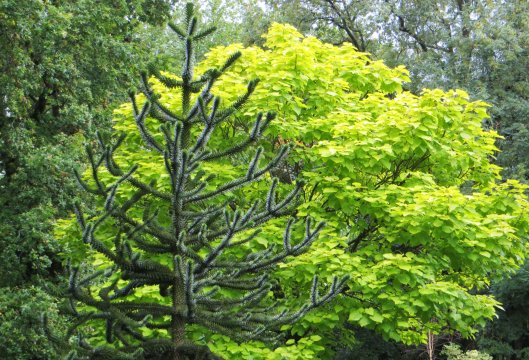
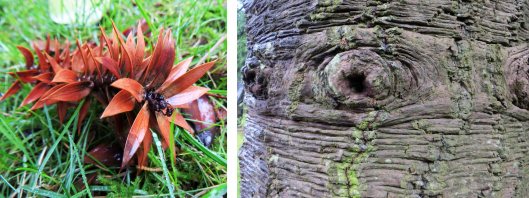
An 18th-century dignitary reputedly said that it would puzzle a monkey to climb this tree, hence its common name the Monkey puzzle (Araucaria araucana). Whether or not that’s true, it makes a good story, and the tree’s sharp branches and spiky leaves would certainly make its climbing by any creature almost impossible.

160116 monkeypuzzle

The Monkey puzzle’s shape stands out well against the vibrant Lime tree

An evergreen conifer that is native to Argentina and Chile, the Monkey puzzle was introduced to Britain in 1795 by Archibald Menzies, one of a generation of naval officers and plant collectors who brought back all manner of flora and fauna from their global voyages. One of Menzies’ Monkey puzzles survived at Kew for almost a hundred years, until it died in 1892, and the Monkey puzzle was a popular planting in Victorian parks and gardens because of its unique appearance.

160116 monkeypuzzle (2)

The dead branch shows the spiny leaves, and the bark is also quite unique

In Chile, the tree is now a protected species, its population having been severely threatened by human activity, especially the burning of native forests for conversion to agricultural use. The Amerindian tribe, the Araucanos (from whom the tree gets its scientific name), consider the tree sacred, and their assistance and indigenous knowledge are helping to protect the tree for the future.

Like Loading...

Paper, bark or both?

11 Monday Jan 2016

Posted by sconzani in nature, nature photography, trees

≈ 3 Comments

Tags

bark, cemetery, Paper birch, parks

During a recent walk through the cemetery after a particularly stormy night, I noticed paper strewn around amongst the graves and was angrily muttering to myself about disgusting humans when I realised it wasn’t paper but bark. The Paper birch (Latin name: Betula papyrifera; other common names: white birch and canoe birch) has quite striking white, sometimes pinkish, bark that peels to reveal a pale orange bark underneath.

160111 paper birch bark (2)

The Paper birch was introduced to Europe in the mid 18th century and is still a popular ornamental addition to parklands and large gardens, but it is native to North America, where its oil-rich bark has been used by the indigenous peoples to make various items, from cartons and boxes to canoes and tepees. As the bark will even ignite well when wet, it is a useful fire starter, and it also has medicinal uses, as a poultice on wounds, as a cast for broken bones and for treating respiratory problems. More recently, it has been used to make ice-block sticks and toothpicks, and strips of bark are used to make handicrafts and to decorate floral arrangements. I think I’ll be picking up all that ‘paper’ and bringing it home next time!

160111 paper birch bark (1)

Like Loading...

Cedar of Lebanon

02 Saturday Jan 2016

Posted by sconzani in nature, trees

≈ 4 Comments

Tags

Cedar of Lebanon, cemetery, trees

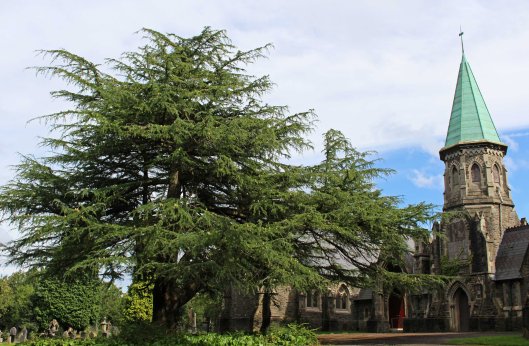
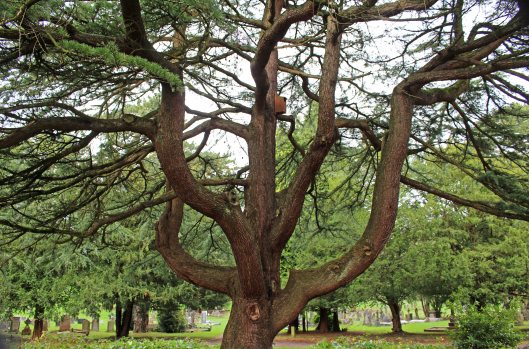
According to the guide’s commentary during a recent heritage walk around Cathays Cemetery in Cardiff, this magnificent Cedar of Lebanon (Cedrus libani) was planted when the cemetery first opened in 1859 so it is now more than 156 years old. It is, however, a mere teenager when you consider these cedars can survive for more than 1000 years!

160102 cathays cemetery cedar (1)

As the name implies, the Cedar of Lebanon (also known as the Atlas cedar and Deodar cedar) is native to Lebanon, the eastern Mediterranean coast and parts of Asia Minor, where it has long had a special significance to the local people. Its resin was used by the ancient Egyptians in their mummification process; the Phoenicians used its timber for building ships, palaces and temples; and its wood was burned by Jews to celebrate the New Year. Nowadays, the tree features as the national emblem of Lebanon, adorning both its flag and its coat of arms.

160102 cathays cemetery cedar (2)

In Britain, the Cedar of Lebanon was popular as a feature tree in the plantings surrounding stately homes and mansions from the mid-18th century onwards, as well as in later Victorian parks and cemeteries, like Cathays.

Like Loading...
← Older posts
Newer posts →

About me

sconzani

sconzani

I'm a writer and photographer; researcher and blogger; birder and nature lover; countryside rambler and city strider; volunteer and biodiversity recorder.

View Full Profile →

Follow earthstar on WordPress.com

Enter your email address to follow this blog and receive notifications of new posts by email.

Recent blog posts

  • Singing Dunnocks March 21, 2026
  • New cat: Large yellow underwing March 20, 2026
  • Curious Coal tit March 19, 2026
  • A huddle of 7-spots March 18, 2026
  • Busy Blue tits March 17, 2026

From the archives

COPYRIGHT

Unless otherwise acknowledged, the text and photographs on this blog are my own and are subject to international copyright. Nothing may be downloaded or copied without my permission.

Fellow Earth Stars!

  • Unknown's avatar
  • Unknown's avatar
  • Unknown's avatar
  • Unknown's avatar
  • Unknown's avatar
  • Unknown's avatar
  • Unknown's avatar
  • Unknown's avatar
  • Unknown's avatar
  • Unknown's avatar
  • Unknown's avatar
  • Unknown's avatar
  • Unknown's avatar
  • Unknown's avatar
  • Unknown's avatar
  • Unknown's avatar
  • Unknown's avatar
  • Unknown's avatar
  • Unknown's avatar
  • Unknown's avatar
  • Unknown's avatar
  • Unknown's avatar
  • Unknown's avatar
  • Unknown's avatar
  • Unknown's avatar
  • Unknown's avatar
  • Unknown's avatar
  • Unknown's avatar
  • Unknown's avatar
  • Unknown's avatar
  • Unknown's avatar
  • Unknown's avatar
  • Unknown's avatar
  • Unknown's avatar
  • Unknown's avatar
  • Unknown's avatar
  • Unknown's avatar
  • Unknown's avatar
  • Unknown's avatar
  • Unknown's avatar
  • Unknown's avatar
  • Unknown's avatar
  • Unknown's avatar
  • Unknown's avatar
  • Unknown's avatar
  • Unknown's avatar
  • Unknown's avatar
  • Unknown's avatar
  • Unknown's avatar
  • Unknown's avatar

Blog at WordPress.com.

Privacy & Cookies: This site uses cookies. By continuing to use this website, you agree to their use.
To find out more, including how to control cookies, see here: Cookie Policy
  • Subscribe Subscribed
    • earthstar
    • Join 668 other subscribers
    • Already have a WordPress.com account? Log in now.
    • earthstar
    • Subscribe Subscribed
    • Sign up
    • Log in
    • Report this content
    • View site in Reader
    • Manage subscriptions
    • Collapse this bar
 

Loading Comments...
 

You must be logged in to post a comment.

    %d