• ABOUT
  • BIRDING 2018
  • Birding 2019
  • BLOG POSTS
  • Butterflies 2018
  • Resources

earthstar

~ a celebration of nature

earthstar

Tag Archives: African birds

The Yellow-billed stork

08 Wednesday Mar 2017

Posted by sconzani in birds, nature

≈ 4 Comments

Tags

African birds, birding, birdwatching, Kuala Lumpur Bird Park, Mycteria ibis, stork, Yellow-billed stork

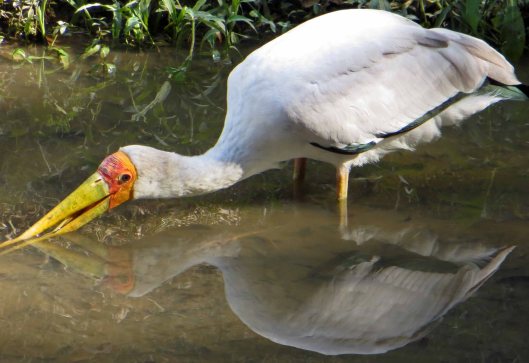
Today’s World Wildlife Wednesday comes to you from Kuala Lumpur, in Malaysia, though that is not the homeland of the Yellow-billed storks (Mycteria ibis). I found these storks in KL’s world-famous Bird Park but they are natives of sub-Saharan Africa, though most numerous in the swamps and marshlands, lagoons and mudflats of the east African countries of Zambia, Zimbabwe and Madagascar.
170309-yellow-billed-stork-1

The storks in my photos may look a bit odd, as if they’re drinking an awful lot of water, but they are, in fact, fishing. Rather than using their vision to see their prey, of small fish and frogs, crustaceans, worms and insects, they use their sense of touch, detecting movement and vibrations through their bills and then quickly snapping shut those bills to secure their food before gulping it down whole.

170309-yellow-billed-stork-2
170309-yellow-billed-stork-3

The Yellow-billed stork – also known as the Wood stork or the Wood ibis – stands about a metre tall when fully grown, and, just like us humans, their foreheads seem to get more and more wrinkly with age. The bird shown below left is a juvenile, so it is still wearing its mottled brown baby feathers.

170309-yellow-billed-stork-4
170309-yellow-billed-stork-5
Like Loading...

Walk like an Egyptian

27 Saturday Feb 2016

Posted by sconzani in birds, nature, nature photography

≈ 5 Comments

Tags

African birds, Alopochen aegypticus, birding, birds, birdwatching, British birds, Egyptian Goose, Serengeti National Park, Tanzania

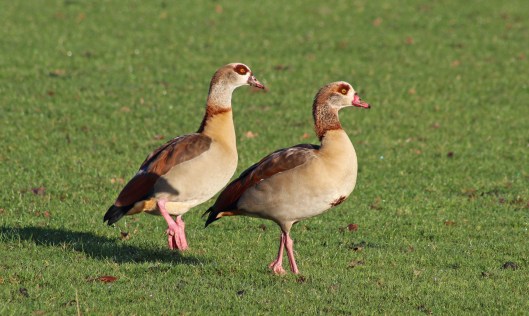
It might look like a goose and be called a goose but the Egyptian Goose (Alopochen aegypticus) is not really a goose at all. It’s more closely related to the Shelduck and occasionally shares that duck’s habit of nesting in a burrow or hole in the ground, though it has also been known to build a nest as high as 80 feet above the ground in a tree. The bird was introduced to Britain as an ornamental wildfowl species, for the king’s collection of birds in St James’s Park in London in 1678, but has since established itself in the wild, though it does still have a penchant for the grounds of large halls and estates, with their perfect habitat combination of old woodland and extensive areas of water.

160227 egyptian goose (2)

My first photo here was taken at just such a place, the wonderful Tatton Park Estate, near Knutsford in Cheshire. But the second photo was taken in the Serengeti National Park in Tanzania. Although it’s called an Egyptian Goose, it is actually native to Africa south of the Sahara and the Nile Valley, but it was considered sacred by the ancient Egyptians, which I presume is how it got its common name.

160227 egyptian goose (1)

Like Loading...

About me

sconzani

sconzani

I'm a writer and photographer; researcher and blogger; birder and nature lover; countryside rambler and city strider; volunteer and biodiversity recorder.

View Full Profile →

Follow earthstar on WordPress.com

Enter your email address to follow this blog and receive notifications of new posts by email.

Recent blog posts

  • O is for Odonata December 20, 2025
  • N is for nest December 19, 2025
  • M is for mite December 18, 2025
  • L is for lepidopteran lifers December 17, 2025
  • K is for Keeled skimmers December 16, 2025

From the archives

COPYRIGHT

Unless otherwise acknowledged, the text and photographs on this blog are my own and are subject to international copyright. Nothing may be downloaded or copied without my permission.

Fellow Earth Stars!

  • Unknown's avatar
  • Unknown's avatar
  • Unknown's avatar
  • Unknown's avatar
  • Unknown's avatar
  • Unknown's avatar
  • Unknown's avatar
  • Unknown's avatar
  • Unknown's avatar
  • Unknown's avatar
  • Unknown's avatar
  • Unknown's avatar
  • Unknown's avatar
  • Unknown's avatar
  • Unknown's avatar
  • Unknown's avatar
  • Unknown's avatar
  • Unknown's avatar
  • Unknown's avatar
  • Unknown's avatar
  • Unknown's avatar
  • Unknown's avatar
  • Unknown's avatar
  • Unknown's avatar
  • Unknown's avatar
  • Unknown's avatar
  • Unknown's avatar
  • Unknown's avatar
  • Unknown's avatar
  • Unknown's avatar
  • Unknown's avatar
  • Unknown's avatar
  • Unknown's avatar
  • Unknown's avatar
  • Unknown's avatar
  • Unknown's avatar
  • Unknown's avatar
  • Unknown's avatar
  • Unknown's avatar
  • Unknown's avatar
  • Unknown's avatar
  • Unknown's avatar
  • Unknown's avatar
  • Unknown's avatar
  • Unknown's avatar
  • Unknown's avatar
  • Unknown's avatar
  • Unknown's avatar
  • Unknown's avatar
  • Unknown's avatar

Blog at WordPress.com.

Privacy & Cookies: This site uses cookies. By continuing to use this website, you agree to their use.
To find out more, including how to control cookies, see here: Cookie Policy
  • Subscribe Subscribed
    • earthstar
    • Join 667 other subscribers
    • Already have a WordPress.com account? Log in now.
    • earthstar
    • Subscribe Subscribed
    • Sign up
    • Log in
    • Report this content
    • View site in Reader
    • Manage subscriptions
    • Collapse this bar
 

Loading Comments...
 

You must be logged in to post a comment.

    %d