• ABOUT
  • BIRDING 2018
  • Birding 2019
  • BLOG POSTS
  • Butterflies 2018
  • Resources

earthstar

~ a celebration of nature

earthstar

Tag Archives: Bolivia

Salt as far as the eye can see

15 Wednesday Mar 2017

Posted by sconzani in nature

≈ 1 Comment

Tags

Bolivia, Bolivian Altiplano, Lago Minchin, Salar de Tunupa, Salar de Uyuni, salt, salt mining, salt-block construction, Uyuni

I’m running out of world wildlife to share every Wednesday so I thought I’d simplify my theme to plain old world Wednesday instead, sharing little parts of the world I’ve visited but still with an overall ‘Isn’t Nature amazing?’ theme. The first lies near Uyuni, in Bolivia.

170315 Salar de Uyuni (7)

Covering a massive 10,582 square kilometres, the Salar de Uyuni, or Salar de Tunupa as it’s also called, contains the world’s largest area of salt flats. In prehistoric times, this area was Lago Minchín, a huge lake with very high salinity levels, but, over thousands of years, a combination of no drainage and the super strong sunlight of the Andean Altiplano has caused the lake to dry up, leaving the salt pans, springs and seasonal shallow ponds that today bring tourists in their thousands to gaze in wonder.

170315 Salar de Uyuni (1)
170315 Salar de Uyuni (3)
170315 Salar de Uyuni (2)

The salt is still mined by enterprising locals, who also use blocks of salt to construct everything from furniture and buildings – I stayed in a salt-block hotel and slept on a salt-block bed – to artworks. You can read about and see more of my adventures in this area on my sconzani blog.

170315 Salar de Uyuni (6)
170315 Salar de Uyuni (4)
170315 Salar de Uyuni (5)
170315 Salar de Uyuni (8)
170315 Salar de Uyuni (9)


Like Loading...

El culpeo

21 Wednesday Sep 2016

Posted by sconzani in animals, nature

≈ 2 Comments

Tags

Andean fox, Andean wolf, Bolivia, Bolivian Altiplano, Culpeo, fox, Fuegian dog, Lycalopex culpaeus, Red Planet Expedition

For world wildlife Wednesday we head back to Bolivia for a closer look at this character, the Culpeo, Lycalopex culpaeus, also known as the Andean fox or wolf. True to the characterisation of foxes as wily, this one knew a tourist vehicle when it saw it and, though its normal diet would include rabbits, birds, rodents and whatever other small beasties it could hunt down, this fox obviously equated tourists with food. And it was not disappointed. On our Red Planet Expedition, in 4-wheel-drive vehicles deep in the remote regions of the Bolivian Altiplano, we carried food with us and our drivers prepared our lunches each day. El culpeo dined on chicken bones as we drove slowly off to our next destination.

160921-andean-fox

The Andean fox can be found in many South American countries, ranging from parts of Ecuador, Peru and Colombia in the north down to Patagonia and Tierra del Fuego in the south, though is mostly found on the western side of the mighty Andes mountain range. Just as today’s domesticated dogs all have a common ancestor in the wild wolf, there was once a breed of domesticated dog (the Fuegian dog) that was derived from this fox, but it became extinct some time in the late 19th or early 20th century.

160921-andean-fox-3
160921-andean-fox-1
160921-andean-fox-2
Like Loading...

Pink flamingos

14 Wednesday Sep 2016

Posted by sconzani in birds, nature, parks

≈ 6 Comments

Tags

Andean altiplano, Andean flamingo, Bolivia, Chilean flamingo, flamingo, James's flamingo, Laguna Colorada, pink flamingo, Red Lake, Reserva Nacional de Fauna Andina Eduardo Avaroa

160914-flamingos-8

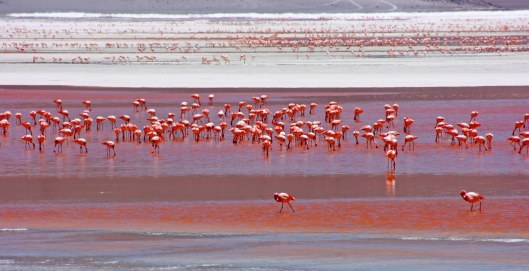
If you ever get the chance, you absolutely must visit the Reserva Nacional de Fauna Andina Eduardo Avaroa in south-western Bolivia, a massive 1.7-million-acre reserve full of active volcanoes, thermal springs, erupting geysers, huge lakes and, incredibly, three species of flamingos (the Andean, Chilean and, one of the world’s rarest, the James’s flamingo).

160914-flamingos-5
160914-flamingos-4

The lakes are breathtakingly beautiful, not only because of their remote mountainous settings but also because of their colours, a result of the chemicals associated with the region’s volcanic activity. In the winter months it is very cold in this part of the Andean Altiplano, with temperatures frequently in the minus twenties and thirties. It seems incredible that flamingos could survive such extreme cold but, apparently, they have the ability to control their heartbeat, to allow themselves to sleep in the chilly water to try to avoid their enemies, the fox and the puma. However, when it’s extremely cold and the water has frozen, the flamingos can become trapped and are then almost literally sitting ducks.

160914-flamingos-1
160914-flamingos-2

At 4300 metres above sea level and with an area of 60km2, Laguna Colorada, or Red Lake, really is red. This is due in part to the volcanic minerals and sediments it contains and also because of the microscopic algae that thrive in its waters. The lake is shallow, only 30 to 50cm deep, which makes it the perfect habitat for flamingos. And, except for the grey and white juveniles, the plumage of these flamingos is more reddish than normal because of the algae in the lagoon – these really are pink flamingos!

160914-flamingos-6
160914-flamingos-7

160914-flamingos-3

Like Loading...

About me

sconzani

sconzani

I'm a writer and photographer; researcher and blogger; birder and nature lover; countryside rambler and city strider; volunteer and biodiversity recorder.

View Full Profile →

Follow earthstar on WordPress.com

Enter your email address to follow this blog and receive notifications of new posts by email.

Recent blog posts

  • Weevil: Mecinus pyraster January 10, 2026
  • Red in beak and claw January 9, 2026
  • Who’s watching who? January 8, 2026
  • Springtail: Orchesella cincta January 7, 2026
  • A good year for Redwings January 6, 2026

From the archives

COPYRIGHT

Unless otherwise acknowledged, the text and photographs on this blog are my own and are subject to international copyright. Nothing may be downloaded or copied without my permission.

Fellow Earth Stars!

  • Unknown's avatar
  • Unknown's avatar
  • Unknown's avatar
  • Unknown's avatar
  • Unknown's avatar
  • Unknown's avatar
  • Unknown's avatar
  • Unknown's avatar
  • Unknown's avatar
  • Unknown's avatar
  • Unknown's avatar
  • Unknown's avatar
  • Unknown's avatar
  • Unknown's avatar
  • Unknown's avatar
  • Unknown's avatar
  • Unknown's avatar
  • Unknown's avatar
  • Unknown's avatar
  • Unknown's avatar
  • Unknown's avatar
  • Unknown's avatar
  • Unknown's avatar
  • Unknown's avatar
  • Unknown's avatar
  • Unknown's avatar
  • Unknown's avatar
  • Unknown's avatar
  • Unknown's avatar
  • Unknown's avatar
  • Unknown's avatar
  • Unknown's avatar
  • Unknown's avatar
  • Unknown's avatar
  • Unknown's avatar
  • Unknown's avatar
  • Unknown's avatar
  • Unknown's avatar
  • Unknown's avatar
  • Unknown's avatar
  • Unknown's avatar
  • Unknown's avatar
  • Unknown's avatar
  • Unknown's avatar
  • Unknown's avatar
  • Unknown's avatar
  • Unknown's avatar
  • Unknown's avatar
  • Unknown's avatar
  • Unknown's avatar

Blog at WordPress.com.

Privacy & Cookies: This site uses cookies. By continuing to use this website, you agree to their use.
To find out more, including how to control cookies, see here: Cookie Policy
  • Subscribe Subscribed
    • earthstar
    • Join 669 other subscribers
    • Already have a WordPress.com account? Log in now.
    • earthstar
    • Subscribe Subscribed
    • Sign up
    • Log in
    • Report this content
    • View site in Reader
    • Manage subscriptions
    • Collapse this bar
 

Loading Comments...
 

You must be logged in to post a comment.

    %d