• ABOUT
  • BIRDING 2018
  • Birding 2019
  • BLOG POSTS
  • Butterflies 2018
  • Resources

earthstar

~ a celebration of nature

earthstar

Tag Archives: British birds

Wild word: mnemonic

23 Wednesday May 2018

Posted by sconzani in birds, nature

≈ 4 Comments

Tags

#WildWords, birding, birdwatching, British birds, mnemonic, mnemonic for bird song, ways to remember bird songs, wild words

Mnemonic: Noun; a system such as a pattern of letters, ideas, or associations which assists in remembering something; from the Greek mnēmonikos, from mnēmōn, meaning ‘mindful’ (Oxford Dictionary).

I’ve found mnemonics particularly useful when trying to remember bird songs. Apart from the very obvious sounds, where the bird is, in fact, named for its song – I’m thinking here of the Chiffchaff and the Kittiwake – there are also some well-known phrases that many birders know, like ‘a little bit of bread and no cheeeeese’ for the song of the Yellowhammer, ‘chissick’ for the Pied wagtail, and ‘teacher, teacher’ for the Great tit. Do you have any bird song mnemonics you can share?
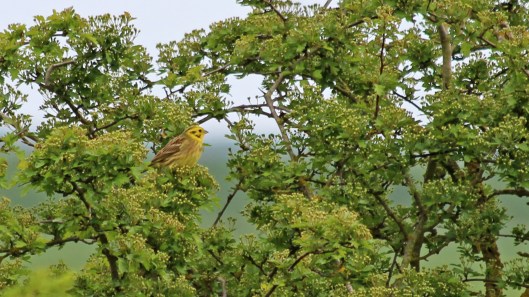
yellowhammer

The yellowhammer: ‘a little bit of bread and no cheeeeese’

Like Loading...

Gorgeous Guillemots

21 Monday May 2018

Posted by sconzani in birds, nature

≈ 2 Comments

Tags

birding, birdwatching, Bridled form of Guillemot, British birds, dimorphism in Guillemot, Farne Islands, Guillemot

180521 Guillemot (10)

What gorgeous birds the Guillemots are! A delicious combination of crisp white and rich chocolate brown, a smile that beams contentment, a look of gentleness despite that fierce-looking beak….

180521 Guillemot (1)180521 Guillemot (4)

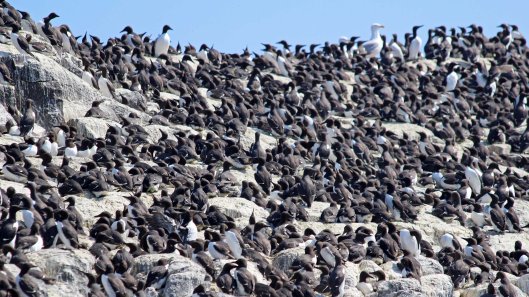
Guillemots spend most of their lives at sea, only moving on to land to breed, so May was the perfect time to see them on the Farne Islands, where they breed in their thousands each year. The densely packed breeding colonies are called loomeries.

180521 Guillemot (2)

180521 Guillemot (8)
180521 Guillemot (9)

Reciprocal grooming is part of their bonding process and was delightful to watch.

180521 Guillemot (3)

Some Guillemots have an additional white marking around their eyes, like the two you can see in this photo. These are officially known as the ‘bridled’ form, though they look like they’re wearing glasses to me. The bridling is, apparently, caused by a genetic mutation, and there seems to be a correlation with temperature – the bridled form is more common in cooler areas.
180521 Guillemot (5)

I’m not sure what was happening in the top of this photo: bouncing for joy? Jumping off the cliff? Coming in to land?

180521 Guillemot (7)
180521 Guillemot (6)

Sleepy in the sunshine. Just beautiful!

Like Loading...

Shags are surprising

19 Saturday May 2018

Posted by sconzani in birds, nature

≈ 6 Comments

Tags

birding, birdwatching, British birds, Farne Islands, Phalacrocorax aristotelis, Shag, Shag behaviour, Shag nesting

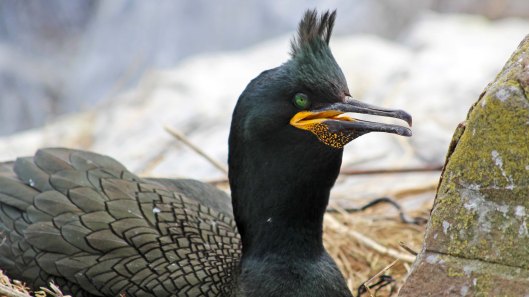
I always thought the Shag was all black, but I was wrong: its adult plumage is an intricate combination of vibrant metallic greens, browns and black, and it has beautiful patterning on its wings. As you can see, the Shag also has soulful green eyes, and, during the breeding season, the adult birds have a very punky crest on the tops of their heads, a combination which, obviously, makes them irresistible …. to other Shags.

180519 shag (1)
180519 shag (2)
180519 shag (3)
180519 shag (4)

Shags have a superb Latin name too, Phalacrocorax aristotelis, which is derived from Ancient Greek. Phalacrocorax is a combination of φαλακρός (phalakros) meaning bald and κόραξ (korax) meaning raven, and the epithet commemorates Aristotle. Did that Greek philosopher look like a bald raven, I wonder?

180519 shag (5)180519 shag (9)

Shags build their stick nests on rocks, sometimes on top of very high cliffs, and, on the Farne Islands, separated only by a rope barrier and monitored by a local ranger, we were able to get very very close to a couple of Shags that had chosen to nest right next to the path.

180519 shag (6)

One of the Shags was making odd motions with its head and puffing out its neck as if breathing heavily (I should’ve taken a video!). The ranger said this was to warn people off getting too close, and I’ve since found a paper that explains some aspects of the displays Shags make:

At the lowest intensity of stationary aggressiveness, the bird on the nest or nest-site points its bill at the object of aggression with gular pouch slightly distended, and at the same time makes slight lateral head-shakes without taking its eyes off the intruder.

180519 shag (8)

It was being close enough to observe such behaviour, as well as get a better look at the physical characteristics of the birds that made our visit to the Farnes so special for me.

180519 shag (7)

Like Loading...

I love Puffins!

15 Tuesday May 2018

Posted by sconzani in birds, nature

≈ 6 Comments

Tags

birding, birdwatching, British birds, Farne Islands, Puffin, Puffins guarding burrows, Puffins in the water, Puffins on cliff tops, Puffins on Farne Islands

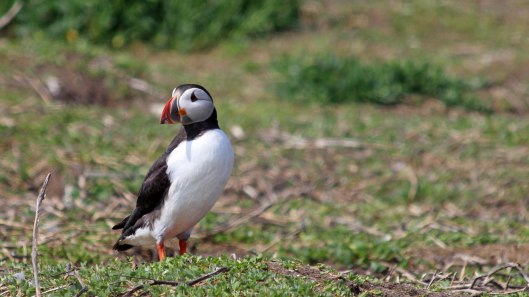
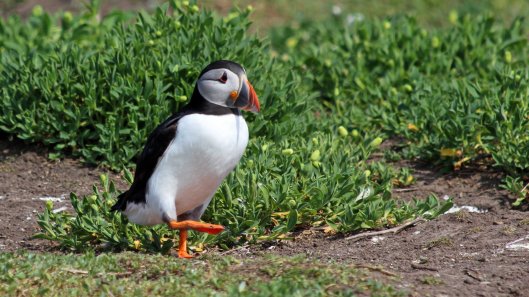
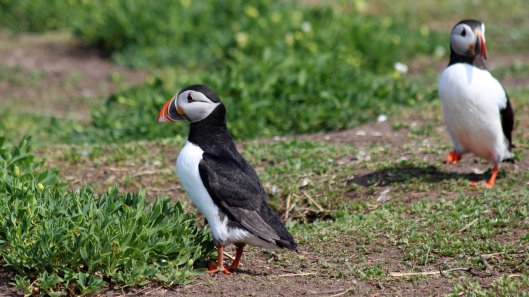
It’s taken me almost 62 years to see my first Puffins (yes, I am that old!) but they were worth the wait. What magnificent little characters they are!
First I saw them in the water, from the boat en route to the Farne Islands …

180515 puffins in the water (2)
180515 puffins in the water (1)

Next I saw them on the cliff tops, craning my neck and lens to look up from the boat …

180515 puffins on the cliff tops (1)180515 puffins on the cliff tops (2)

Then we were on the island, for a very brief 60 minutes that went by so very quickly, and I saw them marching around defending their burrows, trying ever so hard to look stern and menacing …

180515 puffins protecting their burrows (1)180515 puffins protecting their burrows (2)180515 puffins protecting their burrows (3)180515 puffins protecting their burrows (4)180515 puffins protecting their burrows (5)

I also saw them – well, one of them – trying very hard to impress the Puffin of his dreams, but she was having none of it …

180515 puffin trying to impress (1)180515 puffin trying to impress (2)180515 puffin trying to impress (3)

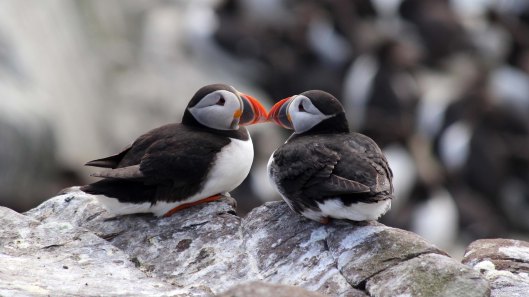
And, finally, I saw a couple in love. So very sweet!

180515 puffins in love

Like Loading...

Glossy ibis

13 Sunday May 2018

Posted by sconzani in birds, nature

≈ 3 Comments

Tags

birding, Birding in Druridge Bay, birdwatching, British birds, Druridge Pools, Glamorgan Bird Club, Glossy ibis, Northumberland birding, Plegadis falcinellus

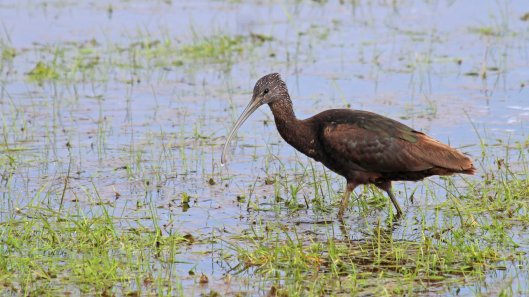
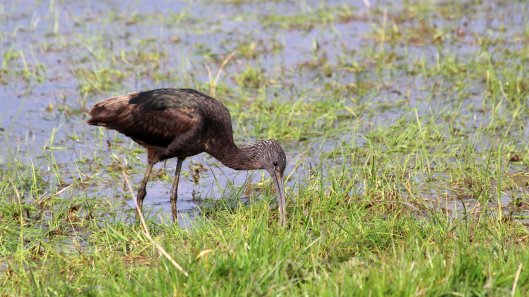
One of the nearest and clearest avian encounters on my recent birding trip to England’s north east was our sighting of a Glossy ibis (Plegadis falcinellus) at Druridge Pools.

180512 glossy ibis (2)

This is a large bird, similar in many ways to a heron, but the Glossy ibis has a beautifully rich plumage in vibrant shades of bronze and green. The Glossy is not strictly speaking a British bird – it can be found in the warmer parts of Europe, Asia and the Americas – but these birds have been visiting Britain more frequently in recent years (I saw my first at RSPB Ham Wall last year).

180512 glossy ibis (1)

This particular Glossy ibis eluded us when we first arrived at Druridge – it had been scared off by photographers getting too close and a tractor driving by – but, luckily for us, it later returned to the site and was grazing within a few yards of the fence so we had outstanding views of it. I even managed to take a short video.

Like Loading...

Eleven go birding in a minibus

12 Saturday May 2018

Posted by sconzani in birds, nature

≈ 2 Comments

Tags

barn owl, birding, birdwatching, British birds, Glossy ibis, Tree sparrow, Wood duck

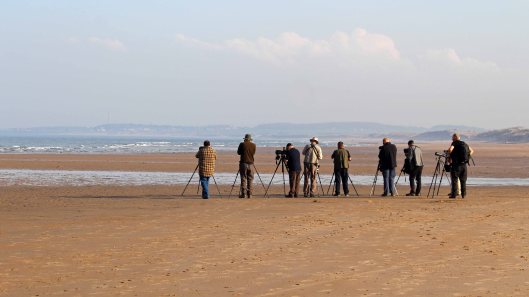
180512 Seawatching at Musselburgh

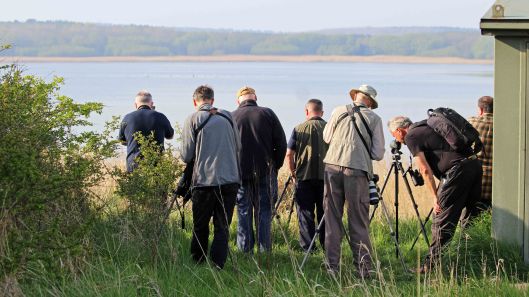
From 4 to 9 May, I joined a group of my fellow Glamorgan birders on a 6-day, multi-location, dawn-to-dusk, exhilarating (if a little exhausting), absolutely incredible birding blast to Northumberland and beyond.

180512 At East Chevington Nature Reserve

As a group we saw 149 different species of bird, I added 52 birds to my year list, of which 18 were first-in-my-lifetime sightings, and I increased my knowledge of birds well beyond my initial expectations. And I saw a wide range of magnificent sites and stunning scenery in England and Scotland that I hadn’t seen before. Huge thanks to my birding buddies Ade, Alan, Andrew, Ceri, John, Rob, Stuart, Tim, Trevor, and Trish. You’re the best!!!

180512 Seawatching at Druridge Bay

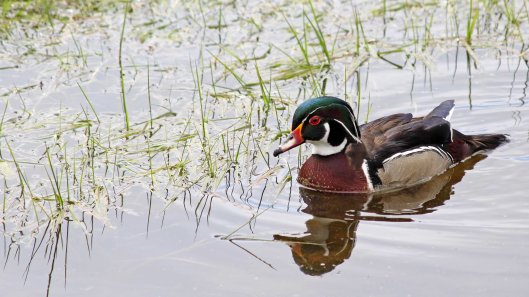
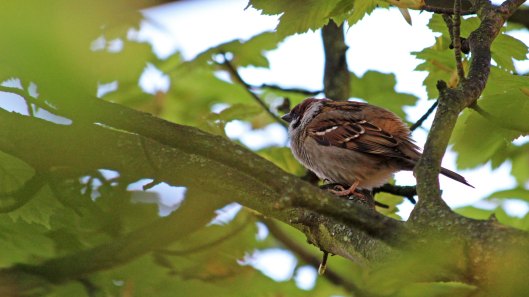
The photos below show just a few of the birds we saw – there will be blogs on individual species as soon as I get through processing my 1100+ photos. In the meantime, here’s a link to my updated birding list. I’ve now got 176 of the 200 species I’m aiming to see this year (though a couple of these are dubious ticks and I should probably aim for 204 to compensate). With most of the more common birds now ticked off and this trip done and dusted, the task of finding the final 24 (or 28) species becomes a whole lot harder.

133 wood duck139 barn owl147 tree sparrow164 glossy ibis


Like Loading...

Gone birding: Starling

08 Tuesday May 2018

Posted by sconzani in birds, nature

≈ Leave a comment

Tags

birding, birdwatching, British birds, drudwy, starling, starling in Welsh mythology, Sturnus vulgaris

In Welsh, the word for Starling (Sturnus vulgaris) is drudwy, and a drudwy featured in one of the many ancient tales that now form The Mabinogion. The princess Branwen, who was ill-treated by her Irish husband, trained a starling to speak so the bird could carry messages to her brother Bendigeidfran, the king of Britain. Such clever birds!

180508 starling

Like Loading...

Gone birding: Blackcap

07 Monday May 2018

Posted by sconzani in birds, nature, spring

≈ 2 Comments

Tags

birding, birdwatching, Blackcap, Blackcap singing, Blackcap video, British birds, Sylvia atricapilla

Before I moved to Britain, I associated the word Blackcap with cricket: it’s the name of the New Zealand national men’s cricket team. Now, the word means bird, Sylvia atricapilla to be precise, the male with his black cap, the female with her brown one, and I look forward to their return migration each Spring.

180507 blackcap male (1)
180507 blackcap male (2)
180507 blackcap female (1)
180507 blackcap female (2)

The RSPB website notes that the Blackcap’s ‘delightful fluting song has earned it the name “northern nightingale”.’ If you haven’t heard the song, here’s a little video I shot recently of the male bird in action. British birds’ve got talent!

Like Loading...

Gone birding: Blue tit

06 Sunday May 2018

Posted by sconzani in birds, nature

≈ Leave a comment

Tags

birding, birdwatching, Blue tit, British birds

180506 Blue tit

Oh, how I long to quit the throng
Of human forms and faces:
The vain delights, the empty shows,
The toil and care bewild’rin’,
To feel once more the sweet repose
Calm Nature gives her children.
At times the thrush shall sing, and hush
The twitt’ring yellow-hammer;
The blackbird fluster from the bush
With panic-stricken clamour;
The finch in thistles hide from sight,
And snap the seeds and toss ’em;
The blue-tit hop, with pert delight,
About the crab-tree blossom;

~   extract from the poem ‘Letter From The Town Mouse To The Country Mouse’, Horace Smith (1779-1849), English poet and novelist

Like Loading...

Gone birding: Mistle thrush

05 Saturday May 2018

Posted by sconzani in birds, nature

≈ Leave a comment

Tags

birding, birdwatching, British birds, Mistle thrush, Turdus viscivorus

I was alerted to the presence of two Mistle thrushes in Cosmeston’s Cogan Wood by the unmistakable screech of their football-rattle alarm call. It seems they had been enjoying a spot of seed foraging at an old tree the locals call the Dragon tree when they were interrupted by Magpies with the same idea in mind. Luckily for me, once the Magpies had departed, one of the Mistles sat quietly preening on a low branch.

180505 Mistle thrush

Like Loading...
← Older posts
Newer posts →

About me

sconzani

sconzani

I'm a writer and photographer; researcher and blogger; birder and nature lover; countryside rambler and city strider; volunteer and biodiversity recorder.

View Full Profile →

Follow earthstar on WordPress.com

Enter your email address to follow this blog and receive notifications of new posts by email.

Recent blog posts

  • Little owl March 31, 2026
  • Distant seabirds March 30, 2026
  • Thrift March 29, 2026
  • The day of the Wheatears March 28, 2026
  • Cetti’s warblers March 27, 2026

From the archives

COPYRIGHT

Unless otherwise acknowledged, the text and photographs on this blog are my own and are subject to international copyright. Nothing may be downloaded or copied without my permission.

Fellow Earth Stars!

  • Unknown's avatar
  • Unknown's avatar
  • Unknown's avatar
  • Unknown's avatar
  • Unknown's avatar
  • Unknown's avatar
  • Unknown's avatar
  • Unknown's avatar
  • Unknown's avatar
  • Unknown's avatar
  • Unknown's avatar
  • Unknown's avatar
  • Unknown's avatar
  • Unknown's avatar
  • Unknown's avatar
  • Unknown's avatar
  • Unknown's avatar
  • Unknown's avatar
  • Unknown's avatar
  • Unknown's avatar
  • Unknown's avatar
  • Unknown's avatar
  • Unknown's avatar
  • Unknown's avatar
  • Unknown's avatar
  • Unknown's avatar
  • Unknown's avatar
  • Unknown's avatar
  • Unknown's avatar
  • Unknown's avatar
  • Unknown's avatar
  • Unknown's avatar
  • Unknown's avatar
  • Unknown's avatar
  • Unknown's avatar
  • Unknown's avatar
  • Unknown's avatar
  • Unknown's avatar
  • Unknown's avatar
  • Unknown's avatar
  • Unknown's avatar
  • Unknown's avatar
  • Unknown's avatar
  • Unknown's avatar
  • Unknown's avatar
  • Unknown's avatar
  • Unknown's avatar
  • Unknown's avatar
  • Unknown's avatar
  • Unknown's avatar

Blog at WordPress.com.

Privacy & Cookies: This site uses cookies. By continuing to use this website, you agree to their use.
To find out more, including how to control cookies, see here: Cookie Policy
  • Subscribe Subscribed
    • earthstar
    • Join 642 other subscribers
    • Already have a WordPress.com account? Log in now.
    • earthstar
    • Subscribe Subscribed
    • Sign up
    • Log in
    • Report this content
    • View site in Reader
    • Manage subscriptions
    • Collapse this bar
 

Loading Comments...
 

You must be logged in to post a comment.

    %d