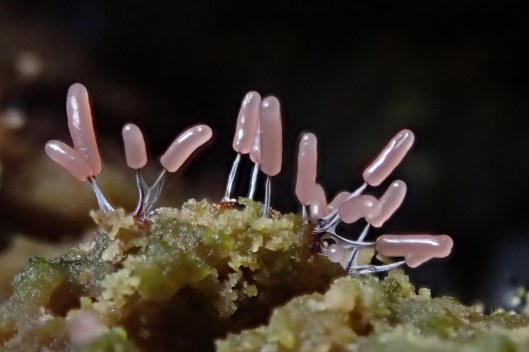
In the nicest possible way, here’s wishing you all a sublimely slimy Friday!


16 Friday Aug 2024
Posted in fungi
In the nicest possible way, here’s wishing you all a sublimely slimy Friday!
19 Friday Apr 2024
Posted in fungi
Tags
British slime moulds, Lycogala species, Red raspberry slime, slime, slime mould, Tubifera ferruginosa
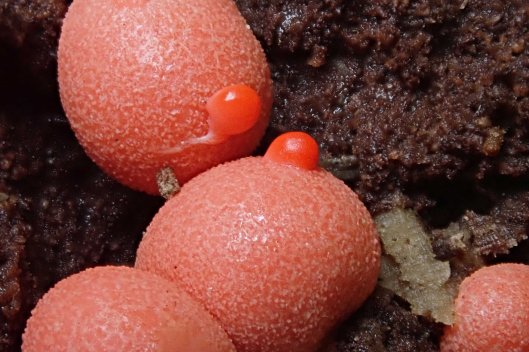
This fallen log was half covered in slime, balls and balls of orange-red-coloured slime. At first I thought they were all the same species but, after looking more closely at my photos, I think there are two. The majority were these Red raspberry slime balls (Tubifera ferruginosa).

And the others were one of the Lycogala species of slime. Both looked delicious … but you wouldn’t want to eat them.
16 Thursday Nov 2023
Posted in fungi
Tags
British slime moulds, Dog sick, Dog sick slime on grass, Dog vomit, Dog vomit slime on wood, Fuligo septica, Mucilago crustacea, slime mould
There are two slime moulds that are named for their resemblance to dogs’ vomit. One is called Dog sick (Mucilago crustacea), which starts off yellow but fades to white, then eventually looks much darker due to its mass of black spores. The key thing with this slime mould is that it grows on grass or other vegetation.

The other is Fuligo septica, commonly known as the Dog vomit or Scrambled egg slime (though, obviously, it’s not something anyone would ever want to eat, regardless of how much its yellow lumpy appearance resembles scrambled egg). Although it can look very similar to Mucilago crustacea, it grows on wood, on dead trees and branches in woodland areas but also on wood chip and bark mulches, according to the Naturespot website.

The Dog sick shown here was found in a cemetery last week; the Dog vomit image is from my photo library. (I hope you weren’t having your breakfast when you read this!)
19 Friday May 2023
Posted in fungi
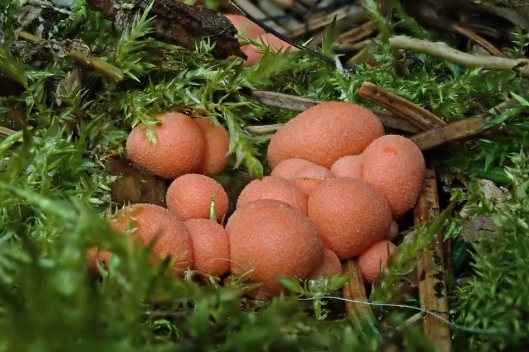
A train journey to a woodland in the next county earlier this week didn’t turn up the butterflies I was hoping for but I took consolation in the fact that I did see several things I don’t usually see locally. The first of these (the next couple of blogs will feature others) is usually found on rotting trees, so there’s no real reason I don’t see it in local woodlands – maybe it’s just a matter of timing. This is the enigmatic slime mould, Wolf’s milk. It could either be Lycogala epidendrum or L. terrestre but I won’t know which unless I revisit the site in a week or so. I explained the reason for this in two previous blogs (the initial find featured in Wolf’s milk, 16 June 2021, followed by the species reveal Wolf’s milk update, 2 July 2021).
15 Friday Oct 2021
Tags
British slime moulds, Ceratiomyxa fruticulosa, Coral slime, slime mould, slime mould on dead tree
While out walking on Wednesday I spotted this large expanse of something white on the side of a huge old fallen tree and, of course, I had to investigate.
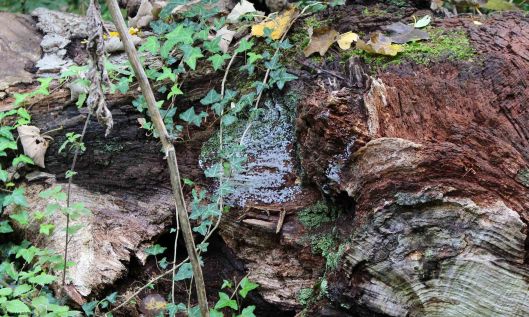
As I got closer, I realised it was the slime mould Ceratiomyxa fruticulosa, a mass of tiny translucent white tubes, often branched, clustered together like terrestrial coral or sea anemones.
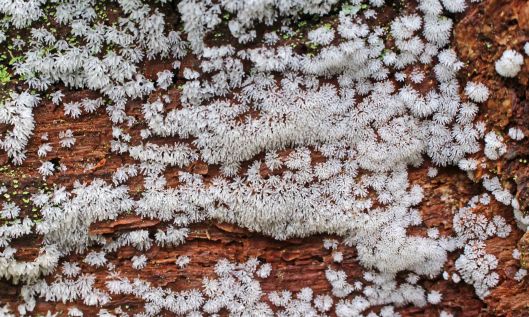
As this plasmodium stage of a slime mould often only lasts a day or two, the timing of my walk was very lucky indeed.

02 Friday Jul 2021
Posted in fungi
You might remember that on 18 June I blogged about Wolf’s milk, one of the Lycogala species of slime moulds, and noted that I couldn’t positively identify it until I saw the colour of its spores. Well, I’ve been back to recheck these slime balls. They took a bit of finding, as the dense tree canopy of the woodland makes the area quite dark and their change of colour as the slime balls have matured made them blend in with the log they were growing on, as you can see below.
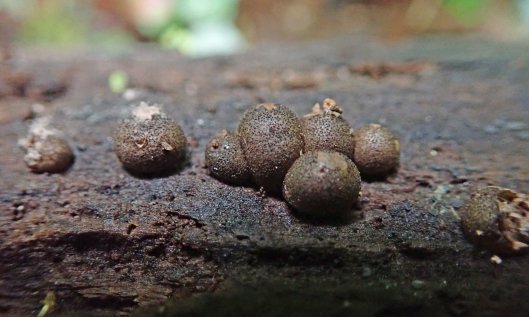
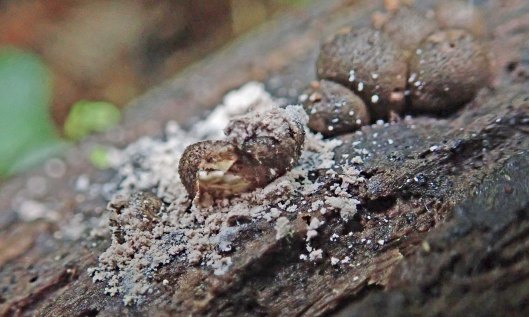
The good news is that I have been able to identify them. I ‘popped’ one – not a bad thing for the slime as this released its spores for distribution – and found the spore colour to have a pinkish hue, which confirmed the species as Lycogala terrestre.
 earthstar
You must be logged in to post a comment.