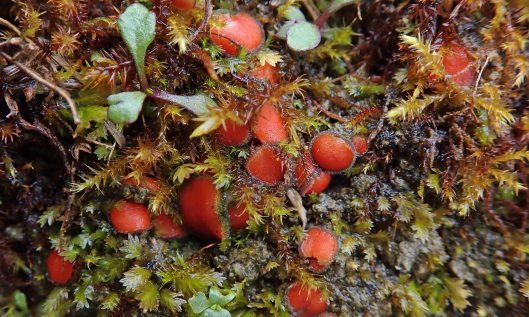
I’ve never been able to work out which of the Scutellinia species the Eyelash fungi at Cosmeston Lakes Country Park belong to but it’s always a joy to spot these tiny orange-red gems in the grass.


15 Friday Mar 2024
Posted in fungi
I’ve never been able to work out which of the Scutellinia species the Eyelash fungi at Cosmeston Lakes Country Park belong to but it’s always a joy to spot these tiny orange-red gems in the grass.
24 Friday Sep 2021
Fluttering at me from a log in the woodland … well, not really, but you get the picture. It’s always a delight to spot one of the Eyelashes, the Scutellinia species of fungi.

17 Tuesday Mar 2020
Tags
British fungi, Cosmeston Lakes Country Park, Eyelash fungi, Scutellinia fungi, Scutellinia olivascens
As you can see from my photos, the aptly named Eyelash fungi have hair-like bristles around their outer edges.

These particular Eyelashes can currently be found in large numbers in the west paddock at Cosmeston Lakes Country Park, where I presume they are enjoying the soggy muddy conditions, though they are growing on banks and slightly raised areas rather than in the completely sodden soil of the flatter parts.


When compared to the Eyelash fungi I blogged about back in May 2016 (see ‘Fluttering their eyelashes’ here), these latest examples have much shorter lashes. They are probably one of the Scutellinia species – possibly Scutellinia olivascens – but there are many very similar species of Eyelash fungi and you need to examine them under a microscope to be able to identify them correctly.
17 Tuesday May 2016
It’s easy to see how the Scutellinia fungi got their common name of Eyelash fungi – the long dark hairs that grow around their rims would be any girl’s dream – and some of their other vernacular names are delightful: Eyelash cup, Eyelash pixie cup and, my favourite, Molly eye-winker.

The fungi in my photos may be Scutellinia scutellata, the Common Eyelash fungi, but, as there are around 50 species of cup-shaped eyelash-fluttering fungi (Scutellinia and Cheilymenia) and they’re all rather tiny (usually no more than 3 to 5 mm across), you need a microscope to tell them apart.


Though very common in Britain, Europe and North America, and also found in much of South America, Australasia and Asia, the Eyelash fungi are easily overlooked because of their small size, and because they’re often obscured by their mossy surroundings. They have a preference for moist places where there’s plenty of rotten timber to eat, so next time you walk through a soggy woodland, kept a look out for these little dots of orangey-red. They’re around from late spring to late autumn.

 earthstar
You must be logged in to post a comment.