• ABOUT
  • BIRDING 2018
  • Birding 2019
  • BLOG POSTS
  • Butterflies 2018
  • Resources

earthstar

~ a celebration of nature

earthstar

Tag Archives: fungus

It’s Fungi Friday!

17 Friday Nov 2017

Posted by sconzani in autumn, fungi, nature

≈ 4 Comments

Tags

#FungiFriday, Apricot Club, Candlesnuff fungi, Cathays Cemetery, Clouded funnel, club fungi, Cortinarius, fungi, fungus, Heath Park, Stump puffballs, Trooping funnel

I needed a fungi fix so went for a wander around a couple of my old haunts, Heath Park and Cathays Cemetery, both in Cardiff. Here’s what I found …

171117 fungi (2)
171117 fungi (3)
171117 fungi (4)
171117 fungi (5)
171117 fungi (6)
171117 fungi (7)
171117 fungi (8)
171117 fungi (9)
171117 fungi (10)
171117 fungi (11)
171117 fungi (12)
171117 fungi (13)
171117 fungi (14)
171117 fungi (1)
Like Loading...

It’s waxcap time!

10 Friday Nov 2017

Posted by sconzani in autumn, fungi, nature

≈ Leave a comment

Tags

Cathays Cemetery, fungi, fungus, grassland fungi, unimproved grassland, waxcaps

Look what I found hiding in the grass at Cathays Cemetery during a recent walk around: gorgeous fungal gems!

171110 Waxcaps (2)171110 Waxcaps (1)

Like Loading...

Happy UK Fungus Day!

07 Saturday Oct 2017

Posted by sconzani in fungi, nature

≈ 4 Comments

Tags

bracket fungus, fungi, fungus, National Fungus Day, Trametes versicolor, Turkey tail, Turkeytail, UK Fungus Day

Sadly, I don’t see a lot of fungi in my local parks and nature reserves, and I’ve found this year that other events have clashed with the fungi forays organised by the Glamorgan Fungus Group so I haven’t been out with them much either. However, I have been taking photos of the fungi I do find and so, in honour of today being National Fungus Day here in Britain, I thought I’d share these photos of Turkeytail (Trametes versicolor).

171007 Turkeytail Trametes versicolor (8)

Turkeytail is one of the most common bracket fungi and you can find it growing on dead logs and fallen trees in almost every forest and woodland but what I love about this fungus is its incredible variation. With colours ranging from beige, yellow and orange through to green, brown and even blue, each bracket is a work of art.

171007 Turkeytail Trametes versicolor (1)
171007 Turkeytail Trametes versicolor (2)
171007 Turkeytail Trametes versicolor (3)
171007 Turkeytail Trametes versicolor (4)
171007 Turkeytail Trametes versicolor (5)
171007 Turkeytail Trametes versicolor (6)
171007 Turkeytail Trametes versicolor (7)
171007 Turkeytail Trametes versicolor (9)
Like Loading...

Bird’s-nests with eggs!

31 Thursday Aug 2017

Posted by sconzani in fungi, nature

≈ 4 Comments

Tags

bird's nest fungus, British fungi, Common bird's-nest fungus, Crucibulum laeve, fungus, peridiole

How cool are these?

170831 Common bird's-nest fungus (1)

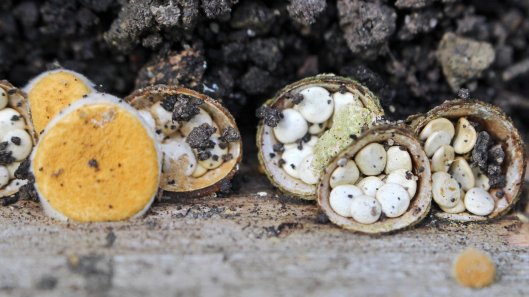
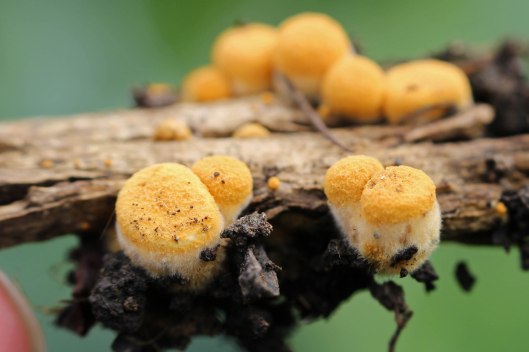
Of course, you’ve guessed it – I’m not talking about eggs in the nests of birds with feathers: these are fungi, but one of the most amazing types of fungi I know. And this was the first time I’d seen them with eggs in the nests and, indeed, it was the first time I’d seen them before the eggs were exposed. And there must have been hundreds of them, all growing along the planks of wood around a raised garden bed.

170831 Common bird's-nest fungus (3)170831 Common bird's-nest fungus (2)

This is the Common bird’s-nest fungus (Crucibulum laeve) and I think you can see where it got its common name. It starts off looking like small blobs of yellowy orange fur, then the furry membrane falls off to reveal its inner cupcake-shaped fruiting body and that’s where the eggs sit. Of course, they’re not eggs at all: the scientific name for them is peridioles. They’re effectively capsules full of spores that are activated when rain drops hit them, causing them to ‘leave the nest’ and begin the germination process. (If you’re as fascinated by these as I am, you can read more here.)

170831 Common bird's-nest fungus (5)170831 Common bird's-nest fungus (4)

Like Loading...

Fungi at Cefn Onn

08 Tuesday Aug 2017

Posted by sconzani in fungi, nature

≈ 2 Comments

Tags

bracket fungus, Cefn Onn, fungi, fungus, mushroom, slime mould, Smut on Red campion

I braved the rain showers and intermittent rumbles of thunder for a wander around Cefn Onn Park, in north Cardiff, last weekend. I hadn’t been there for quite a while and, after the recent rains, I had an inkling there might be some fungi around. I was right! There were actually rather a lot of crusty, brackety, slimy, smutty and generally mushroomy things to be found. (No, I’m not going to ID them – I just enjoyed seeing some fungi again.)

170808 Bolete (1)
170808 Bracket (2)
170808 Bracket (3)
170808 Bracket
170808 Ganoderma sp
170808 Marasmius rotula
170808 Mushroom (2)
170808 Mushroom (3)
170808 Mushroom (4)
170808 Mushroom (6)
170808 Mushroom
170808 Slime Ceratiomyxa fruticulosa
170808 Slime Fuligo septica
170808 Smut on Red campion
Like Loading...

A master of camouflage

15 Saturday Apr 2017

Posted by sconzani in fungi, nature

≈ 4 Comments

Tags

Cosmeston Lakes Country Park, fungus, Helvella acetabulum, Helvella fungi, Vinegar cup

170415 Helvella acetabulum Vinegar Cup (4)

I found these little fungi at Cosmeston Lakes Country Park during a long ramble on Thursday. So well camouflaged were they amongst the leaf litter and fallen branches that it wasn’t until I bent down to pick up a rotting branch to check for slime moulds that I spotted the first one. These are Vinegar cups (Helvella acetabulum) and, according to the Welsh biodiversity recording database, this is only the fourth recorded find in Wales. I imagine they’re not as rare as that makes them sound, but simply under-recorded – I blame their camouflage!

170415 Helvella acetabulum Vinegar Cup (3)
170415 Helvella acetabulum Vinegar Cup (2)
170415 Helvella acetabulum Vinegar Cup (1)

Luckily (actually, a huge relief!) these fungi could be identified using an excellent key on the Fungi of Great Britain and Ireland website (thanks to Brian Douglas of Kew for pointing that out). The key check went as follows:

(1) Stipe (stem) ribbed and furrowed over its entire length, internally chambered, quite short, but with ribs present on the underside of the cap; (2) cap cupulate; (3) Ribs on stipe extending conspicuously to the underside of the cap, usually to at least half way (4) Hymenium (interior of the cup) brown; cap externally dark brown above (these were partly eaten so hard to tell), (definitely) paler below. Ribs of stipe branching, sharp-angled, not interconnected by cross-veins, not reaching the margin of the cap. Fruiting in spring.

170415 Helvella acetabulum Vinegar Cup (5)
170415 Helvella acetabulum Vinegar Cup (6)

If only all fungi were that easy to identify! These lovely Helvellas can be found from April through to June, mostly on rich mouldy soil in deciduous forests, though they do also like calcareous soil conditions.

Like Loading...

Belonidium mollissimum

31 Friday Mar 2017

Posted by sconzani in fungi, nature

≈ 9 Comments

Tags

ascomycete, Belonidium mollissimum, cup fungi, fungi on umbellifers, fungus

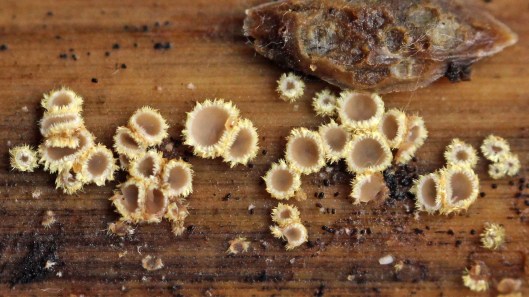
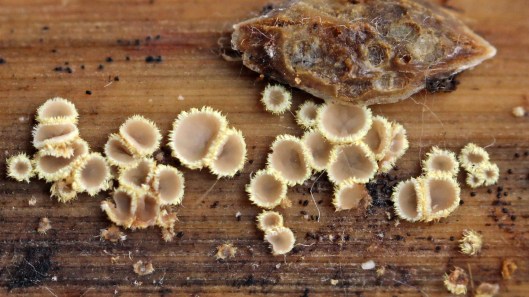
I’ve been finding a lot of fungi recently on the bottoms of the dead stalks of last year’s umbellifers. They’re all exceedingly small and difficult to identify (which I find rather frustrating) but also rather gorgeous (which is why I have so far kept looking for them). This is one I was able to identify with help from my fungi friends and associates and a little microscope work. Its current name is Belonidium mollissimum (but it’s had a long list of other names – fungi keep being re-classified and renamed as researchers examine them and their DNA more carefully!) and the largest of its cups is just 1mm wide. This is a series of photos taken over the past two weeks to show how this tiny fungus has changed in that time.

170331 Belonidium mollissimum 17March

17 March, when first discovered

170331 Belonidium mollissimum 19March

19 March

170331 Belonidium mollissimum 25March

25 March

170331 Belonidium mollissimum 31March

31 March

Like Loading...

Golden ears and Yellow brains

10 Friday Feb 2017

Posted by sconzani in fungi, nature

≈ 8 Comments

Tags

fungus, Golden ear fungus, jelly fungus, Tremella aurantia, Tremella mesenterica, Yellow Brain Fungus

170210-tremella-mesenterica-yellow-brain-3
170210-tremella-mesenterica-yellow-brain-1

These two fungi may look different but they may actually be exactly the same – in theory, it should be possible to tell without resorting to a microscope. There are two possibilities: Tremella aurantia (known to the Americans as Golden ears; the British Mycological Society hasn’t assigned it a common name), which is parasitic on the fruit bodies of the Hairy curtain crust fungus (Stereum hirsutum), and Tremella mesenterica (Yellow brain), which is parasitic on the mycellium of the Peniophora species of fungi. However, those Peniophora fungi are not always easy to spot as the Tremella may have smothered the lot, so identification can still be tricky.

I’ve only knowingly seen Golden ears the once and, if you take a look at the top right corner of my image (below), you can just spot the brackets of Hairy curtain crust that helped me confirm what it was. (So, the two photos above and the very bottom photo probably all show Yellow brain but I can’t be 100% certain.)

170210-tremella-aurantia-golden-ear-1

The word Tremella means trembling, a reference to the jelly-like constituency of these fungi; aurantia means orange coloured or golden; and mesenterica joins two Ancient Greek words together: meso means middle and enteron means intestine, so maybe the title of this post should really be Golden ears and Yellow intestines. Ew!

170210-tremella-mesenterica-yellow-brain-2

Like Loading...

Introduction to fungal microscopy

05 Sunday Feb 2017

Posted by sconzani in fungi, nature

≈ 1 Comment

Tags

fungal microscopy, fungus, learning to use a microscope, SEWBReC, spores

Yesterday I dipped my toes into the fungal microscopy waters and it was good! In fact, it was more than good. Funded by the Wales Biodiversity Partnership, hosted and organised by SEWBReC, and led by Mr Glamorgan Fungi Mike Bright, ably assisted by SEWBReC’s fungi whizz Amy Hicks, the whole day was simply excellent!

170205-microscopy-course

One of the most frustrating things about fungi can be trying to identify them and/or differentiate between visually similar species. Now I have the basic skills needed to do this. I’m under no illusions, though – I do realise that IDing my finds will still be difficult: I might not have collected a good specimen, I might not be able to find what I need under the microscope, I might not be able to find the information in books or online to compare with what I’m seeing, and, something that I hadn’t expected, the floaters I have in my right eye (a problem that comes from the vitreous gel in my eye hardening with age) interfere with what I see down the microscope.

170205-fungi-spores-1
170205-fungi-spores-2

So, I’m not rushing out to spend hundreds of pounds on a good ’scope just yet. Luckily, as a regular biodiversity recorder, I’m able to borrow the equipment they hold at SEWBReC, my local biodiversity records centre. Now I just need to find my first sample to identify!

Many thanks to my friend Graham Watkeys for the photo of me studiously peering down the ’scope, and sorry for the poor quality of my ’scope images – I now know photos of microscope camera photos shown on a laptop screen don’t reproduce very well.

Like Loading...

Fungi Friday: The black fuzz

03 Friday Feb 2017

Posted by sconzani in fungi, nature

≈ 6 Comments

Tags

ascospores, asexual reproduction in fungi, Chaetosphaerella phaeostroma, conidia, fungus, mycelium, sexual reproduction in fungi

When I first found this fungus a month ago, I thought the wee grey orbs might be a type of slime mould but I was puzzled by the black fuzz that surrounded them. Turns out it was not a slime mould at all but rather the fungus Chaetosphaerella phaeostroma. The fuzz (more correctly, the subiculum) is a dense mat of hyphae (the branching filaments that make up the mycelium, the vegetative part of the fungus that is usually hidden below the ground) and the grey orbs are the fruiting bodies (a mushroom is the more usual form of fungal fruiting body).

170203-chaetosphaerella-phaeostroma

If you think that’s confusing, it gets even more tricky! This particular fungus has two methods of reproducing as it’s capable of producing both sexual and asexual spores – it’s not surprising that this led scientists in the past to believe it was two separate fungi. The hyphae (the fuzzy stuff) can produce conidia (below left), which are asexual (so they can create new fungi but these would be exactly the same as the parent), and the spherical fruiting bodies (called perithecia) produce ascospores (below right), which are sexual (so they need to interact with another fungus in order to produce a new organism which would then have characteristics of both parents).

170203-chaetosphaerella-phaeostroma-conidia-x-400
170203-chaetosphaerella-phaeostroma-asci-with-ascospores

I am exceedingly grateful to my friend from the Glamorgan Fungus Group, Mark Evans, who examined the sample I gave him and produced not only the identification of this fungus but also the wonderful microscopic images. His detailed explanations also helped me understand what was going on with Chaetosphaerella phaeostroma, and if I’ve got any of this wrong, it’s entirely my own fault!

Like Loading...
← Older posts
Newer posts →

About me

sconzani

sconzani

I'm a writer and photographer; researcher and blogger; birder and nature lover; countryside rambler and city strider; volunteer and biodiversity recorder.

View Full Profile →

Follow earthstar on WordPress.com

Enter your email address to follow this blog and receive notifications of new posts by email.

Recent blog posts

  • City Hall Peregrine January 12, 2026
  • Blackthorn in bloom January 11, 2026
  • Weevil: Mecinus pyraster January 10, 2026
  • Red in beak and claw January 9, 2026
  • Who’s watching who? January 8, 2026

From the archives

COPYRIGHT

Unless otherwise acknowledged, the text and photographs on this blog are my own and are subject to international copyright. Nothing may be downloaded or copied without my permission.

Fellow Earth Stars!

  • Unknown's avatar
  • Unknown's avatar
  • Unknown's avatar
  • Unknown's avatar
  • Unknown's avatar
  • Unknown's avatar
  • Unknown's avatar
  • Unknown's avatar
  • Unknown's avatar
  • Unknown's avatar
  • Unknown's avatar
  • Unknown's avatar
  • Unknown's avatar
  • Unknown's avatar
  • Unknown's avatar
  • Unknown's avatar
  • Unknown's avatar
  • Unknown's avatar
  • Unknown's avatar
  • Unknown's avatar
  • Unknown's avatar
  • Unknown's avatar
  • Unknown's avatar
  • Unknown's avatar
  • Unknown's avatar
  • Unknown's avatar
  • Unknown's avatar
  • Unknown's avatar
  • Unknown's avatar
  • Unknown's avatar
  • Unknown's avatar
  • Unknown's avatar
  • Unknown's avatar
  • Unknown's avatar
  • Unknown's avatar
  • Unknown's avatar
  • Unknown's avatar
  • Unknown's avatar
  • Unknown's avatar
  • Unknown's avatar
  • Unknown's avatar
  • Unknown's avatar
  • Unknown's avatar
  • Unknown's avatar
  • Unknown's avatar
  • Unknown's avatar
  • Unknown's avatar
  • Unknown's avatar
  • Unknown's avatar
  • Unknown's avatar

Blog at WordPress.com.

Privacy & Cookies: This site uses cookies. By continuing to use this website, you agree to their use.
To find out more, including how to control cookies, see here: Cookie Policy
  • Subscribe Subscribed
    • earthstar
    • Join 669 other subscribers
    • Already have a WordPress.com account? Log in now.
    • earthstar
    • Subscribe Subscribed
    • Sign up
    • Log in
    • Report this content
    • View site in Reader
    • Manage subscriptions
    • Collapse this bar
 

Loading Comments...
 

You must be logged in to post a comment.

    %d