• ABOUT
  • BIRDING 2018
  • Birding 2019
  • BLOG POSTS
  • Butterflies 2018
  • Resources

earthstar

~ a celebration of nature

earthstar

Tag Archives: fungus

‘Blue velvet on a stick’

29 Monday Feb 2016

Posted by sconzani in fungi, nature

≈ 7 Comments

Tags

Cobalt crust, fungus, Terana caerulea

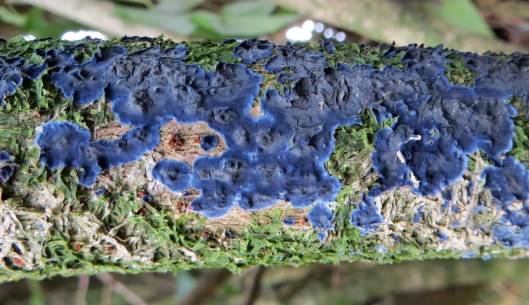
Although this stunning fungus is apparently found in my native New Zealand – as well as in much of Europe, North America and some countries in Asia, I had never seen it until a few weeks ago. This is the appropriately named Cobalt crust (Terana caerulea), a fungus many books and websites report as a rare sight in England and Wales yet many of my fungi friends have seen it. We assume it is not actually rare but rather rarely reported or, perhaps, not recognised, as it is often to be found lurking on the undersides of fallen branches and dead trees, and it turns almost black when past its best.

Terana caerulea Cobalt crust (1)

When it’s young and fresh, its vibrant cobalt colour is instantly recognisable and a real highlight of any woodland wander. With a soft, almost waxy feel when moist, it’s no wonder it’s been described as ‘blue velvet on a stick’. As its name implies, this fungus is a member of the corticiord group of fungi – that’s crust fungi in layman’s terms, a fungus that adheres to something, rather than growing on a stem like a normal mushroom.

Terana caerulea Cobalt Crust (2)

Like Loading...

Pulling itself up by the bootstraps

17 Wednesday Feb 2016

Posted by sconzani in fungi, nature, nature photography

≈ 2 Comments

Tags

Armillaria mellea, bootlace fungus, bootstrap fungus, fungus, honey fungus, rhizomorphs

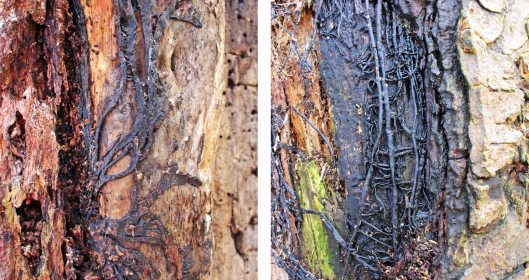
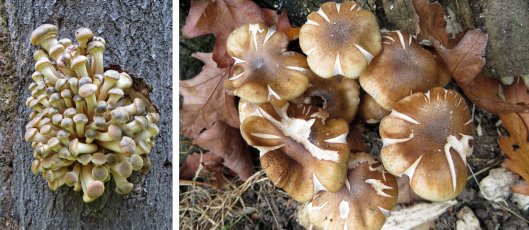
I had never seen these ‘bootstraps’ or ‘bootlaces’ until my friend Mark pointed them out to me on a recent fungi foray. They are what remains of an infestation of Honey fungus (Armillaria mellea) which may sound sweet but, believe me, is anything but. Honey actually refers to its colour, not its habits, as this fungus is a parasite and a killer.

160216 Armillaria mellea (Honey fungus) bootlaces (rhizomorphs)

It lives on live wood and sends forth these extensive rhizomorphs, root-like filaments, between the affected tree’s inner core and its bark. When fresh, the bootstraps are a cream colour but they blacken over time. They cause the tree to rot and die so by the time the Honey fungus mushroom-like fruiting bodies emerge through holes in the bark, the tree is a goner.

160216 Armillaria mellea Honey fungus

This fungus will attack almost any type of tree from conifer to broad-leaf, softwood and hardwood. It can cause enormous damage to forests and woodlands because those rhizomorphs have been recorded up to nine metres long and they can extend through soil from one tree to the next, invading and killing as they spread.

Like Loading...

An essential piece of traveller’s kit

08 Monday Feb 2016

Posted by sconzani in fungi, nature, nature photography

≈ 2 Comments

Tags

birch polypore, fungus, Otzi the Iceman, Razor strop fungus

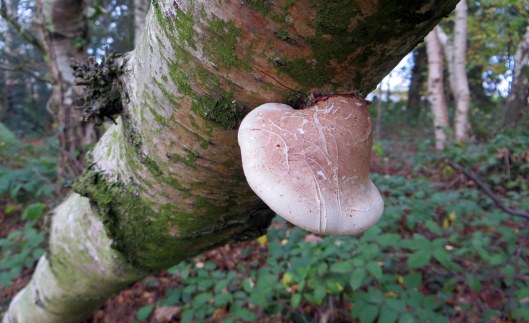
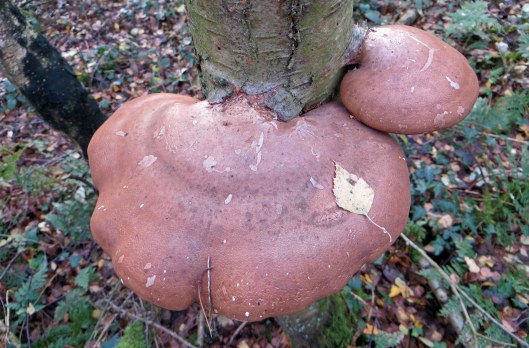
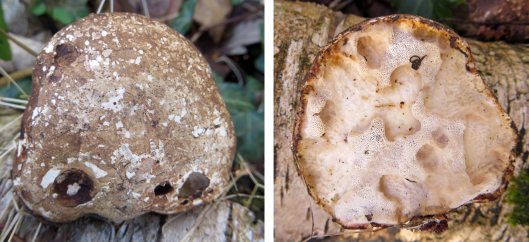
Do you remember the news about Ötzi the Iceman, the 5000-year-old mummified man found in a glacier in the Ötztal Alps in Italy in September 1991? Amongst his meagre possessions, Ötzi was carrying two types of fungi, one of which was Birch polypore (Piptoporus betulinus). It’s one of the most common bracket fungi and grows, as you might guess from the name, on birch trees.

160206 birch polypore (1)

Archaeologists speculate that Ötzi was carrying the bracket fungus for medicinal reasons – this was his first aid kit. Birch polypore is known to have both anti-inflammatory and antibacterial properties – various modern survivalist websites even advise using strips of it as plasters on wounds. Some herbalists recommend it in tea to soothe the nerves and eliminate fatigue but, be warned, it can act as a laxative!

160206 birch polypore (2)

Another of this fungus’s common names is Razor strop as barbers used to sharpen their cut-throat razors on it, and ancient people like Ötzi also used it as tinder. One spark from a flint and they could start a new campfire, and they could even carry a slowly smouldering piece of dry fungus with them as they travelled.

160206 birch polypore (3)

the underside, shown on the right, has been much nibbled, probably by slugs

Like Loading...

Cramp balls

28 Thursday Jan 2016

Posted by sconzani in fungi, nature, nature photography

≈ 1 Comment

Tags

Cramp balls, Daldinia concentrica, fungi, fungus, King Alfred's Cakes, tinder

In my recent post about the fungi King Alfred’s Cakes, I mentioned that one of its other common names is cramp balls. It seems, in times past, folk believed that if you carried around these little fungi you wouldn’t suffer from night cramps. No one seems to know why they believed this!

160127 king alfreds cakes (1)

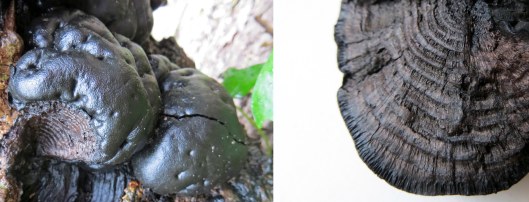
There is, however, another reason to carry cramp balls – they make good tinder. For this reason, cramp balls are also known as coal fungus and carbon balls, though they won’t light just by holding a match to them. The balls first need to be mature and very dry, and then it’s best to slice them in half and use something like a flint and steel to produce a spark. The cramp ball will smoulder, rather than produce a flame – for that you need something like straw or small twigs to start your fire.

160127 king alfreds cakes (2)

When you cut open the cramp ball, you will see concentric rings of grey and black inside (hence its scientific name Daldinia concentrica). These are similar to the growth rings inside a tree, though here they each represent a season of reproduction. Who would think that a small black lump of fungus could be so interesting?

Like Loading...

King Alfred’s cakes

23 Saturday Jan 2016

Posted by sconzani in fungi, nature, nature photography

≈ 1 Comment

Tags

Daldinia concentrica, fungi, fungus, King Alfred's Cakes

Do you know the story? Alfred became king of the West Saxons on the death of his brother Aethelred in April 871, at a time when the Vikings had conquered most of what is now England. Alfred retained his kingdom of Wessex by negotiating a peace treaty with the Vikings but, in 878, their King Gudrum attacked unexpectedly, forcing Alfred and his loyal supporters to flee into the Somerset levels. There, Alfred was sheltered by the local people while he planned how to regain his kingdom. The story goes that he was asked by the woman he was staying with to keep an eye on the cakes (small loaves of bread) she was baking while she did some chores. Alfred’s mind wandered off to his rather more important worries and he allowed the cakes to burn, much to his hostess’s annoyance.

King Alfreds Cakes (2)

The immature fungi are a wonderful rich brown colour

Whether or not it’s true, it’s a wonderful story and a very apt common name for Daldinia concentrica, a fungus that, when mature, looks very like a small round burnt cake. You’ll find it growing most often on hardwood trees, in particular beech and ash, throughout Britain and in many other countries. One of its other common names is cramp balls, but that’s a story for another day.

King Alfreds Cakes (1)

Like Loading...

Tales of Turkey tails

19 Tuesday Jan 2016

Posted by sconzani in fungi, nature, nature photography

≈ 2 Comments

Tags

fungi, fungus, Trametes versicolour, Turkey tail

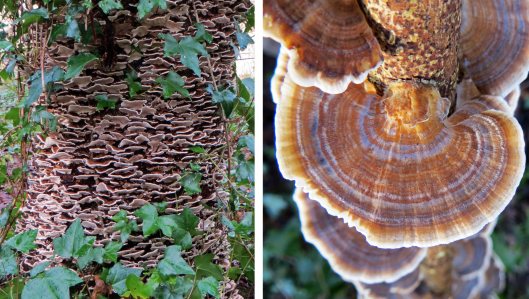
The Turkey tail (Trametes versicolour) is surely the multi-storey condominium of the fungus world. This is one of a huge range of bracket fungi and, as the name suggests, bracket fungi resemble shelves or brackets growing from the sides of tree trunks, branches and logs in forests and woodlands (or condominiums, with large balconies, ranging down the sides of cliffs, if you have an imagination like mine).

160119 Trametes versicolour Turkey Tail (1)

Turkey tail brackets range in size from 20 to 100mm wide and display concentric zones of colour in shades of beige, yellow, orange, brown and even blue. The common name of Turkey tail originated in North America, as these bands of colour apparently resemble the multi-hued tail of their wild turkey, and this is an extremely variable fungus so no two groupings have the same colour patterns (see slideshow below).

Not only lovely to look at, the Turkey tail is also useful medicinally. Asian people have long extolled the virtues of Turkey tail tea, and science has now proven that this fungus contains polysaccharides, derivatives of which have proven effective both in boosting the body’s immune systems in the fight against cancer and in the actual treatment of certain types of cancer.

This slideshow requires JavaScript.

Like Loading...

Split gill fungi

14 Thursday Jan 2016

Posted by sconzani in fungi, nature, nature photography

≈ Leave a comment

Tags

fungi, fungus, Schizophyllum commune, Split Gill

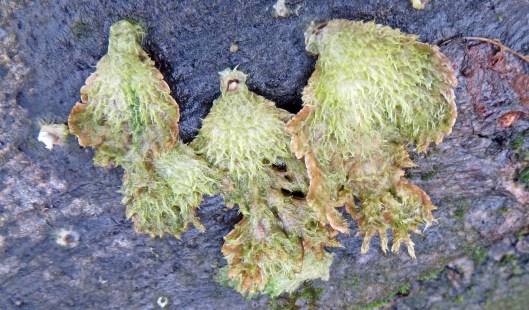
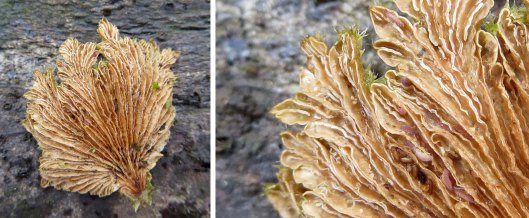
Ten days ago I was out on a fungi foray with friends when we came across this mysterious organism. Was it a lichen? Was it a fern? Was it some other kind of plant? Although we were searching for fungi, we had no idea this was one! Consultations with experts and two return visits later, I can confirm we had found the Split Gill fungus (also known as Schizophyllum commune), one of the most widely distributed mushrooms on earth. It can be found on every continent except Antarctica (no trees).

160114 Schizophyllum commune Split Gill (3)

Although its tough rubbery consistency looks totally unappetising, the Split Gill is a favourite food in many parts of the world, particularly in the tropics where the heat and humidity affect it less than more fleshy mushrooms. In the Congo it is eaten after much boiling and the addition of peanuts; in north-east India it’s a favourite ingredient in pancakes; and in Thailand, where the Split Gill is also valued for its medicinal properties, it’s used to make a hot spicy curry. If you do decide to cook up a feast, please be very careful as the Split Gill can cause disease in humans with immune deficiency issues.

160114 Schizophyllum commune Split Gill (2)

The underside, with a close up showing lots of tiny creatures amongst the gills

160114 Schizophyllum commune Split Gill

Like Loading...

The Jelly ear

07 Thursday Jan 2016

Posted by sconzani in fungi, nature, nature photography

≈ 1 Comment

Tags

fungi, fungus, Jelly ear

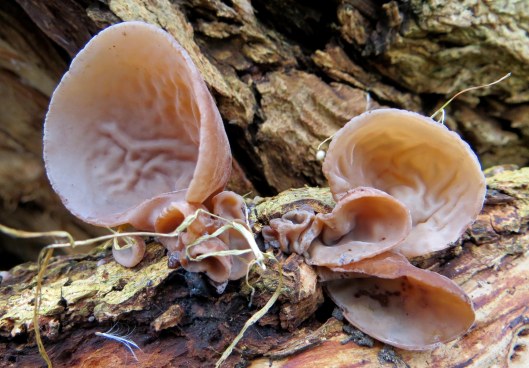
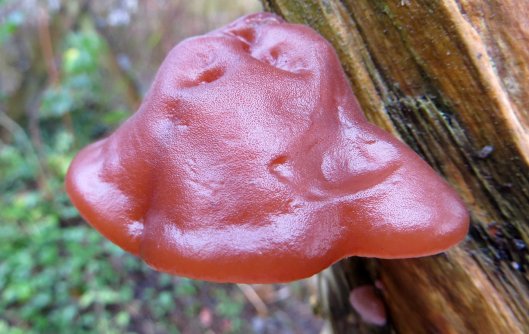
Who needs 3-D printers to produce replacement human body parts when you could use a fungus instead? Not exactly a practical solution to gaining a new ear I admit but, you have to agree, this fungus is definitely the right shape, if not the ideal colour or texture.

Auricularia auricula-judae Jelly Ear

The Jelly ear (Latin name Auricularia auricular-judae) can be rather gelatinous, hence its common name. It is a very common and easily recognisable fungus that grows on standing and fallen dead broadleaf trees, in parks and gardens and forest areas. It can reach up to 100mm across, though its shape becomes more contorted and undulating as it ages. In my native New Zealand, the Jelly ear was of considerable economic importance around the turn of the 20th century when large quantities were exported to China for food.

Auricularia auricula-judae Jelly Ear (1)

Jelly ears can often be found growing on the elder tree and it seems the fungus got its original common name of Judas’s Ear from the belief that Judas Iscariot hung himself from an elder tree. Over time, the epithet Judas’s Ear changed to Jew’s Ear, though in these days of political correctness, that epithet is rarely used.

160107 jelly ear (2)

Like Loading...

Elfcups and Fairies’ baths

04 Monday Jan 2016

Posted by sconzani in fungi, nature, nature photography

≈ 10 Comments

Tags

Elfcups, fungi, fungus, winter

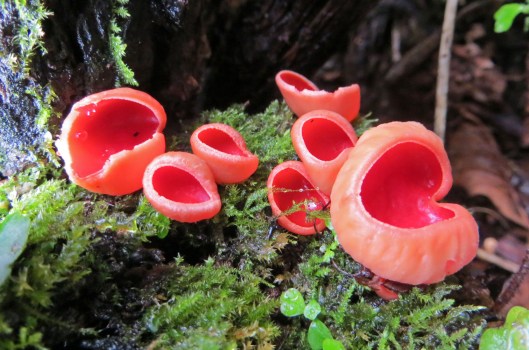
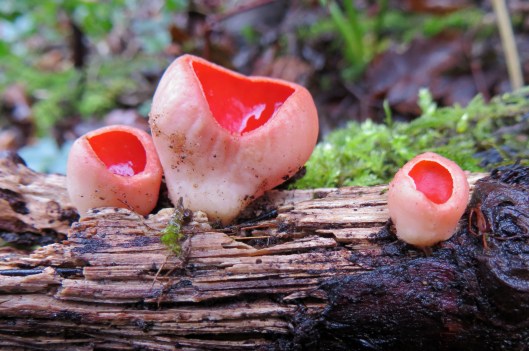
Just as the Scarlet waxcaps are the jewels of the autumn meadows so the Elfcups are the jewels of the wet winter woodlands. Though they’re tiny (no more than 7cm across) and frequently half buried in moss, their eye-catching bright red colour makes them easy to spot in the damp shady places where they live on dead wood, particularly beech, hazel, hawthorn, willow and elm.

160104 elfcups (3)

Two Elfcups can be found in Britain – the Scarlet Elfcup (Sarcoscypha austriaca) and the Ruby Elfcup (Sarcoscypha coccinea). They are so similar in outward appearance that a microscope is required to distinguish between them and, even then, it’s not easy. With a goblet-shaped cup and short stem when young, which flattens into a cup shape as they mature, it’s not difficult to see where they got the name Elfcup, nor their other common name of Fairies’ Baths.

160104 elfcups (1)

In fact, that ‘bath’ is where the spores can be found. These fungi don’t drop their spores from gills like regular mushrooms; instead, they fire spores from structures called asci, a bit like a cannon fires cannon balls and, apparently, they make a tiny puffing sound when that happens. So, listen closely next time you see them.

160104 elfcups (2)

Like Loading...

The waxcap of the meadows

01 Friday Jan 2016

Posted by sconzani in fungi, nature, nature photography

≈ Leave a comment

Tags

fungi, fungus, meadow waxcap, waxcap

Though a very pretty and quite delicate shade of apricot, the Meadow waxcap is one of the less colourful waxcaps. Yet what it lacks in vibrancy it more than makes up for in the sculptural elegance of its shape, even more so as it ages. From a straight robust stem, its gills soar skywards, like a sharp-edged version of the fluting on a Greek temple column, and the edge of its cap undulates like the rolling of the ocean waves.

151231 meadow waxcap (2)

Hygrocybe (‘watery head’) pratensis (‘of meadows’) is one of the larger mushrooms in the waxcap family and is also more tolerant of fertilisers than most, so is a relatively common find in Britain and Europe on mown grassland and cropped pastures where the soil tends towards the acidic. It can also be found growing in woodland areas in northern Asia, in Australia and New Zealand, and in both South and North America – in the latter, it is more commonly known as the butter meadowcap or the salmon waxy cap.

151231 meadow waxcap (1)

Like Loading...
← Older posts
Newer posts →

About me

sconzani

sconzani

I'm a writer and photographer; researcher and blogger; birder and nature lover; countryside rambler and city strider; volunteer and biodiversity recorder.

View Full Profile →

Follow earthstar on WordPress.com

Enter your email address to follow this blog and receive notifications of new posts by email.

Recent blog posts

  • City Hall Peregrine January 12, 2026
  • Blackthorn in bloom January 11, 2026
  • Weevil: Mecinus pyraster January 10, 2026
  • Red in beak and claw January 9, 2026
  • Who’s watching who? January 8, 2026

From the archives

COPYRIGHT

Unless otherwise acknowledged, the text and photographs on this blog are my own and are subject to international copyright. Nothing may be downloaded or copied without my permission.

Fellow Earth Stars!

  • Unknown's avatar
  • Unknown's avatar
  • Unknown's avatar
  • Unknown's avatar
  • Unknown's avatar
  • Unknown's avatar
  • Unknown's avatar
  • Unknown's avatar
  • Unknown's avatar
  • Unknown's avatar
  • Unknown's avatar
  • Unknown's avatar
  • Unknown's avatar
  • Unknown's avatar
  • Unknown's avatar
  • Unknown's avatar
  • Unknown's avatar
  • Unknown's avatar
  • Unknown's avatar
  • Unknown's avatar
  • Unknown's avatar
  • Unknown's avatar
  • Unknown's avatar
  • Unknown's avatar
  • Unknown's avatar
  • Unknown's avatar
  • Unknown's avatar
  • Unknown's avatar
  • Unknown's avatar
  • Unknown's avatar
  • Unknown's avatar
  • Unknown's avatar
  • Unknown's avatar
  • Unknown's avatar
  • Unknown's avatar
  • Unknown's avatar
  • Unknown's avatar
  • Unknown's avatar
  • Unknown's avatar
  • Unknown's avatar
  • Unknown's avatar
  • Unknown's avatar
  • Unknown's avatar
  • Unknown's avatar
  • Unknown's avatar
  • Unknown's avatar
  • Unknown's avatar
  • Unknown's avatar
  • Unknown's avatar
  • Unknown's avatar

Blog at WordPress.com.

Privacy & Cookies: This site uses cookies. By continuing to use this website, you agree to their use.
To find out more, including how to control cookies, see here: Cookie Policy
  • Subscribe Subscribed
    • earthstar
    • Join 669 other subscribers
    • Already have a WordPress.com account? Log in now.
    • earthstar
    • Subscribe Subscribed
    • Sign up
    • Log in
    • Report this content
    • View site in Reader
    • Manage subscriptions
    • Collapse this bar
 

Loading Comments...
 

You must be logged in to post a comment.

    %d