
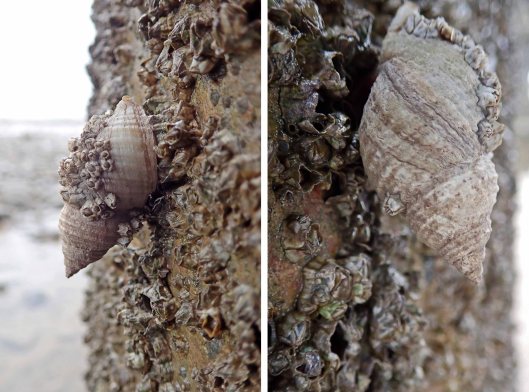
Following Thursday’s post about Common periwinkles, it occurred to me that I should probably have explained more clearly where I found them … or, even better, show you. So, the photo below, taken a few years ago, shows Penarth Pier. As the Severn Estuary has the second greatest tidal range in the world, at high tide the water usually covers the stony beach (and almost comes up to the pier’s walkway at the very highest tides) and at low tide you can walk out on the sand and rocks under the end of the pier, sometimes further. The periwinkles were found under the pier, living on the support structures, as was today’s subject.

The Dog whelk (Nucella lapillus) is common around Britain’s coastline, found in particular where its food, mussels and barnacles, live. The Marine Life Information Network’s website goes in to gory detail about this gastropod’s feeding methods, how it uses its proboscis to push or bore a hole in its prey’s shell, how it drugs its prey then injects it with digestive enzymes to turn its victim in to a mush that can be sucked out. I never knew the Dog whelk was like the Hannibal Lecter of the marine world.


 earthstar
You must be logged in to post a comment.