I wish I could’ve got better images of this gorgeous but tiny Goldcrest that I spotted at its ablutions this morning. It was super cute as it happily splished and splashed its way to cleanliness.


10 Saturday Oct 2020
Posted in birds
I wish I could’ve got better images of this gorgeous but tiny Goldcrest that I spotted at its ablutions this morning. It was super cute as it happily splished and splashed its way to cleanliness.
19 Saturday Oct 2019
Tags
birding, birdwatching, Britain's smallest bird, British birds, Europe's smallest bird, Goldcrest
Goldcrests always look sad to me – something to do with their big eyes and that dark, downturned line at the side of their beaks, perhaps.

Should they be sad? Being Europe’s littlest birds means life must be quite tough, especially as hundreds of these tiny creatures regularly migrate across the North Sea from Scandinavia to northern and eastern parts of Britain. According to Fauna Britannica, large numbers of Goldcrests used to be trapped in the rigging of North Sea fishing boats, which is why their vernacular names include ‘herring spink’ and ‘tot o’er the seas’.

I was delighted to see a good number of Goldcrests in trees along the south Wales coast this week. Their constant peeping indicated their presence – luckily for me, I can still hear their calls: the high pitch means many birders ‘lose’ the calls of Goldcrests as their hearing deteriorates with age. I certainly hope that doesn’t happen to me.

Goldcrests are not easy to photograph as they’re hyperactive little creatures, constantly flitting from leaf to branch and back again in their search for tasty tiny morsels, so I was pleased to get these few images, even though they’re not the sharpest.
18 Thursday Jan 2018
Weighing in at just 6 grams and measuring a miniscule 9cm from top of head to tip of tail, the Goldcrest (Regulus regulus) holds the title of Britain’s smallest bird. And it’s a cutie!
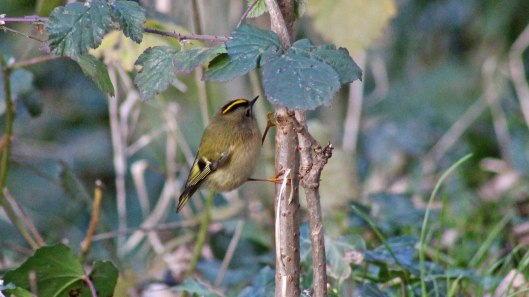
Though its overall plumage is a somewhat dull green, its distinguishing feature is the Mohawk-style stripe on the top of its head – it’s a vibrant yellow that’s easy to spot, and the stripe has an orange centre in male birds.

Goldcrests are most often found in coniferous woodland but they can also be found in urban settings. The birds in my photos were at Cosmeston Lakes Country Park (which is not primarily coniferous), along part of the south Wales coastal path (where there were no conifers to be seen) and in Cardiff’s Cathays Cemetery (where the wee bird was doing a grand job of cleaning up the old gravestones).

Goldcrests are completely insectivorous so are not able to feed from garden bird feeders, putting them at risk in very cold winters when there are no insects to be found. Fortunately, though, their numbers are stable, and their delightful antics can be enjoyed throughout Britain.
 earthstar
You must be logged in to post a comment.