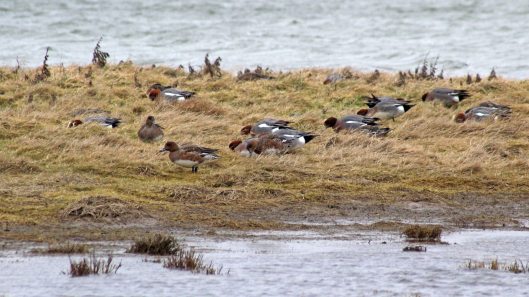
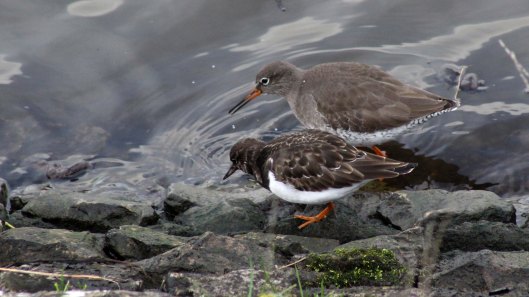
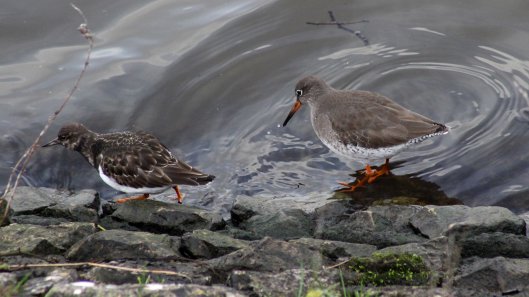
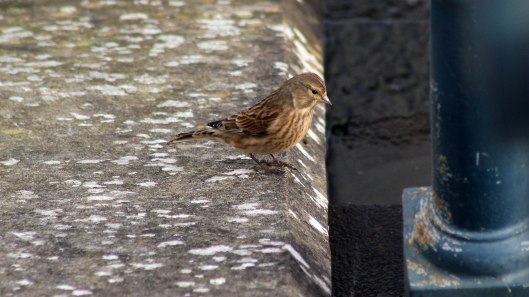
T: ‘Found anything tasty?’

R: ‘Nothing to see here. Move along.’

15 Thursday Feb 2018

T: ‘Found anything tasty?’

R: ‘Nothing to see here. Move along.’

30 Tuesday Jan 2018
Tags
birding, birdwatching, British birds, Carrion crow, Ely embankment, Goosander, Grey wagtail, little grebe, Pied wagtail, Redshank, River Ely, Rock pipit, Turnstone
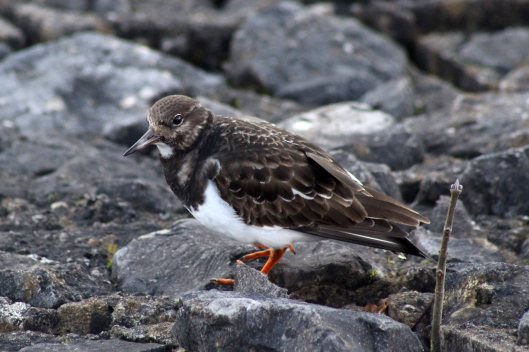
31 December 2017 I’m being a bit sneaky here as I managed to fit in one last walk along the embankment before the start of 2018 but after I’d written my December summary. So, on the last day of last year there were 5 Turnstones, 2 Redshanks, 2 Pied wagtails and 2 Grey wagtails, 1 Rock pipit and a couple of Crows.
1 January 2018 The very next day, New Year’s Day, I passed this way as part of a complete circuit of Cardiff Bay. It was a glorious blue-sky day but there were just 3 Turnstones present.

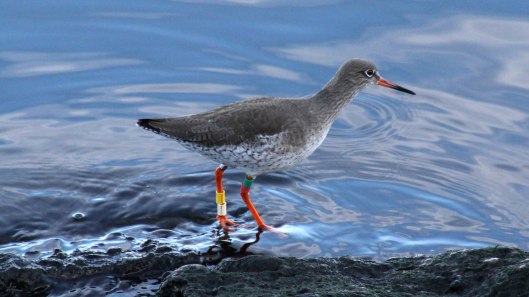
11 January This was another glorious day and another circuit of Cardiff Bay, though in the opposite direction. And it was a bumper day for the Ely embankment, with four Redshanks (including the ringed bird, shown above, which I’ve seen and written about previously), 6 Turnstones, 1 Pied and 4 Grey wagtails, and a Rock pipit.
16 January With 40-mph winds blasting down from snow-covered areas further north, the air temperature was hovering below zero when I walked along the embankment late morning. I wasn’t surprised, then, to find very few birds around – a single Turnstone that was wandering along half way up the embankment (not wanting to put its feet in the chilly water?), which was good for me as it was closer for photos, and just two Grey wagtails. There weren’t many birds on the river either, just a couple of coots, one Great crested grebe and several Black-headed gulls looking hopefully in my direction.

20 January I didn’t get out till late afternoon as it had rained most of the day, so the light was going as I strolled along the embankment path. But I was pleasantly surprised to see a few birds: my friends the Grey wagtails never disappoint (two of those); just one Turnstone poking away amongst the stones; and two Redshanks, including my little buddy the colour-ringed bird. Floating along the river were a Little grebe, a Great crested grebe and a pair of Goosanders – the latter were scared away by a boat cruising by and flew off towards the other side of Cardiff Bay, where I had seen a pair a week or so previously – perhaps the same birds.
25 January I detoured along the embankment on my return from a longer walk and was delighted to find six Turnstones (lovely to see so many), two Redshanks (but not my little ringed mate), two Grey and two Pied wagtails.
30 Thursday Nov 2017
Tags
birding, birdwatching, British birds, Cardiff Bay, Coot, Ely embankment, Lesser black-backed gull, Linnet, long-tailed tit, Redshank, River Ely, Rock pipit, Turnstone

The 9th of November was a ‘5 Turnstone, 2 Rock pipit, 1 Grey wagtail’ kind of day at Cardiff Bay, with a cool wind blowing through huge banks of clouds and the odd rain shower. That didn’t deter the birds browsing along the embankment edge though.
On the 15th, a beautifully marked Song thrush was feasting on berries in the small front garden of one of the apartments that sits on the edge of the embankment (see Berries and Birds a few days ago), and, as well as 2 Rock pipits and 6 Turnstones, there were 3 Redshank grazing along the water’s edge – a nice treat. Also, a Lesser black-backed gull was looking exceedingly pleased with itself for finding a huge dead fish and vociferously defending its prize with loud screeching.
On the 17th – a ‘3 turnstone’ day – the star of the show was a lovely little Linnet. I’d seen a family party of parents and two fledglings grazing amongst the rocks here back in August so perhaps this bird was one of those.
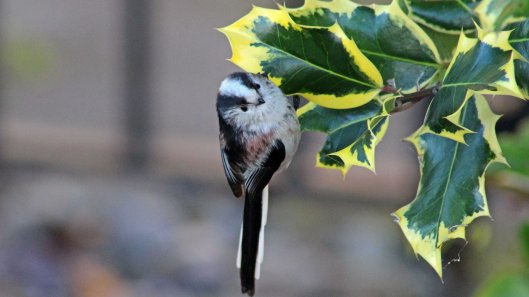
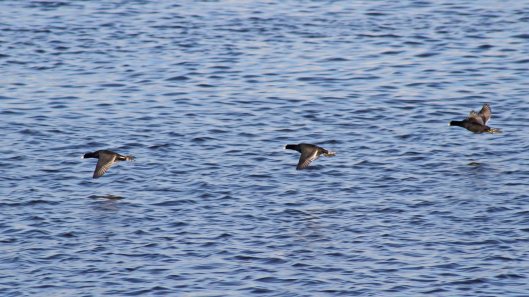
My last November wander by the Ely was on the 25th, when 3 Turnstones, 2 Linnets (nice to see them again), 2 Pied and 2 Grey wagtails, and 1 Redshank were joined by a Dunnock and a small flock of Long-tailed tits passing through the shrubs edging the walkway. Also, something freaked out a group of Coots and, rather than ‘run’ rapidly across the top of the water as they usually do, they actually flew. I’d never seen coots fly before.


31 Tuesday Oct 2017
Posted in birds, coastal fauna, nature, walks
Tags
birding, birdwatching, British birds, Cardiff Bay, Ely embankment, Great Crested Grebe, Linnet, little grebe, Pied wagtail, Redshank, River Ely, Rock pipit, Turnstone, Wheatear
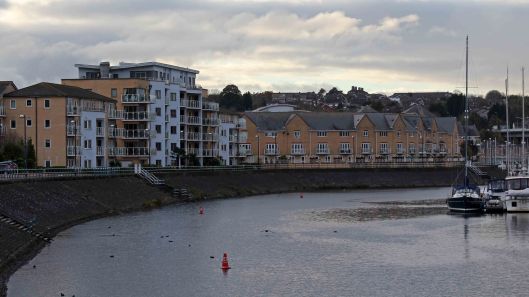
At least once a week I take a turn along the embankment where the River Ely flows out into Cardiff Bay as it makes a nice circular walk from my home on the cliff-top above in Penarth. (It’s good exercise too, as what goes down there must walk back up!) I always record what I see – usually birds – so thought I would share my sightings in an end-of-monthly post.
A variety of birds make their home in this stretch of water, which they share with a yachting marina and associated water traffic coming and going. There are almost always Turnstones in varying quantities (from one to nine), Mallards, Mute swans, one or two Great Crested Grebes (including their progeny this year), a proliferation of Coots, the occasional Cormorant fishing, usually a couple of Grey wagtails and a couple of Pieds. Gulls fly overhead and there are plenty of hirundines, in the season.
2 October: A Wheatear, an unusual visitor, almost certainly on a migration stopover, was dotting about on the embankment stones; a Pied wagtail was doing its morning stretches, and a Rock pipit was browsing for titbits.

16 October: This was the day before ex-hurricane Ophelia made her presence felt, the day of the jaundiced yellow sky and the rusty red sun, which you can see reflected in my photo of the four Little grebes that were sheltering from the incoming weather. A juvenile Grey wagtail was dotting along the embankment, calling incessantly for its parent; and a Great crested grebe was enjoying a very successful fishing session, coming up with fish in two successive dives.

22 October: The day after Storm Brian I walked the embankment to see if any unusual birds had been blown in. The usual suspects were present, except that, most unusually, there wasn’t a single Turnstone. A solitary Linnet flitted back and forth from pavement to stones, and three rather exhausted-looking Redshanks dozed warily along the water line. One of these was colour-ringed and might possibly be the bird I saw back in March but I couldn’t see its rings well enough to be sure.

16 Thursday Mar 2017
Tags
bird-ringing, birding, birdwatching, British birds, BTO, colour rings on Redshank, European Colour-ring birding, Redshank
I first spotted this ringed Redshank on 27 January, near Penarth Marina in Cardiff Bay, and I saw it again, in almost the exact same location, on 11 March. I reported my initial sighting through the European Colour-ring Birding website – it’s really easy to do this and excellent for long-term research into bird behaviour so please do report any ringed birds you see. As the website is totally run by volunteers, it’s taken a little while to get information back on my bird but, today I got this email report from Emily at BTO (British Trust for Ornithology):

This bird was ringed (DK10753) as an adult on 22/2/2016 at Peterstone Great Wharf, and has been re-sighted a number of times at/around Cardiff Bay (on 3/3/16, 3/1/17 and 22/1/17). It was also seen at St Thomas Head on 11/3/16. It was ringed as part of a study examining the winter movements of Redshank, Curlew, Dunlin, Wigeon, Teal and Shelduck in relation to the proposed tidal lagoon (see HERE for more details).

So, my Redshank has spent his winter months – all the sightings were between January and March – in locations not very far from that initial ringing spot but I wonder where he goes in the summer to breed? Previous BTO research has shown that British-ringed Redshanks breed in Iceland and along the coastline of north-western Europe, so this little bird may soon be heading off on rather a long flight.
You must be logged in to post a comment.