• ABOUT
  • BIRDING 2018
  • Birding 2019
  • BLOG POSTS
  • Butterflies 2018
  • Resources

earthstar

~ a celebration of nature

earthstar

Monthly Archives: September 2016

Beetle mania!

20 Tuesday Sep 2016

Posted by sconzani in insects, nature

≈ 5 Comments

Tags

Bishop's mitre, British beetles, British bugs, Click beetle, Mint Leaf beetle, Potato capsid, Red lily beetle, Wasp beetle

Sorry, this has nothing to do with the Fab Four and, in fact, includes bugs as well as beetles but, as many of these cute little mini-beasties will soon disappear for the winter, I wanted to celebrate all those that have entertained me through the summer months but haven’t yet had their very own blog post (not because they’re boring, simply because I haven’t gathered enough good photos of them scurrying about their business in the flowers and bushes).

Little bugs and beetles, your time will come … but not till next year!
These have not all been identified to species but my list to date is: Bishop’s Mitre (Aelia acuminata); Click beetle (Elateridae family); Deraeocoris flavilinea; Heterotoma planicornis; Mint Leaf beetle (Chrysolina herbacea); Potato Capsid (Closterotomus norwegicus); Red lily beetle (Lilioceris lilii); four little unknowns; and, to finish, a Wasp Beetle (Clytus arietis).

160920-bishops-mitre
160920-click-beetle
160920-deraeocoris-flavilinea
160920-heterotoma-planicornis
160920-mint-leaf-beetle-chrysolina-herbacea
160920-potato-capsid-closterotomus-norwegicus
160920-red-lily-beetle-lilioceris-lilii
160920-unknown-1
160920-unknown-2
160920-unknown-3
160920-unknown-4
160920-wasp-beetle-clytus-arietis
Like Loading...

Spiders

19 Monday Sep 2016

Posted by sconzani in insects, nature

≈ 4 Comments

Tags

Araneus diadematus, Cross spider, Crowned orb weaver, Diadem spider, European garden spider, Garden spider, spiders

I don’t often share images of spiders because I don’t care for them much. I don’t mind large spiders because you can see them – most of the time you know exactly where they are. It’s the smaller spiders I don’t like, the ones that sneak around, hiding in dark corners or walking upside down on the bathroom ceiling, ready to abseil down when I’m having a shower. However, I know my feelings towards these mostly harmless little creatures are irrational so I’ve been making more of an effort lately to photograph them. And they can be really rather handsome.

160919-garden-spiders-1
160919-garden-spiders-3

Take this creature, for instance. This is the European garden spider, Araneus diadematus, also known as the Crowned orb weaver, the Diadem spider or the Cross spider. Although, as you can see from my photos, its colours are quite variable, the white markings on its abdomen form a distinctive cross pattern. And, although it’s called a garden spider, really much of Europe and North America is its garden. Also, from what I’ve seen of them, these spiders don’t try to hide – they sit quite blatantly in the centres of their webs, with that ‘I don’t know what you are. I don’t know what you want. But I will catch you. And I will suck the juices out of you’ kind of attitude!

160919 garden spiders (2)
160919 garden spiders (4)
Like Loading...

The wizard’s tree

18 Sunday Sep 2016

Posted by sconzani in autumn, nature, trees

≈ 3 Comments

Tags

berries, berry, Celtic beliefs, Greek mythology, Hebe, Mountain Ash, Norse mythology, Rowan, Rowan tree, Sorbus aucuparia

It’s berry time, and some of the loveliest berries to be seen at this time of year are those of the enigmatic Rowan tree (Sorbus aucuparia) or Mountain Ash, as it’s also commonly known.

160918-rowan-1

Why enigmatic? Well, the Rowan is surrounded by millenia of myths and legends. In Ancient Greek myth, Hebe, the beautiful young goddess who served ambrosia to the gods, lost her cup to demons and, when the gods sent an eagle to recover the cup, each one of the eagle’s feathers and drops of blood that fell to earth during the ensuing battle produced a Rowan tree. This also explains the Rowan’s red berries and its feather-shaped leaves.

The ancient Norse people believed the first woman was created from a Rowan tree, and a Rowan rescued the god Thor from drowning in a river in the Underworld. The Rowan also features in the ancient wisdom of the Celtic people. Fid na ndruad, its ancient Celtic name, means wizard’s tree; the Irish planted the Rowan near houses for protection against evil; the Scots believed that felling a Rowan would bring bad luck; and the Welsh planted Rowans in their graveyards to keep evil spirits at bay.

160918-rowan-2
160918-rowan-4
160918-rowan-3
Like Loading...

The Creature from the Black Stump

17 Saturday Sep 2016

Posted by sconzani in fungi, nature

≈ 5 Comments

Tags

fungus, Mycoacia uda, resupinate fungus, resupinate tooth fungus, tooth fungus

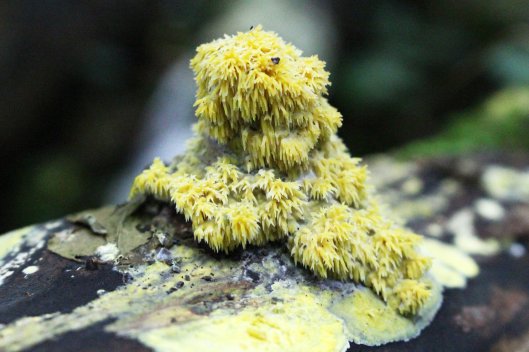
160917-mycoacia-uda

I’ve decided to name it Stumpy, this ‘creature’ that appears to be growing out of a fallen tree at one of my local nature reserves. Its scientific name is Mycoacia uda but that’s a bit of a mouthful.

Last Thursday was the first time I’d encountered one of these but, luckily, one of my Glamorgan Fungi group friends was able to identify it for me. It’s a resupinate tooth fungus and can be found growing on the fallen branches of deciduous trees in Britain, Europe and North America.

But, at night, when no one’s looking, it emerges from its fallen branch and roams the woodland eating stray dogs, howling at the moon, and searching for a mate … Just kidding!

Like Loading...

Hydrangeas and heartbeats

16 Friday Sep 2016

Posted by sconzani in flowers, nature

≈ 4 Comments

Tags

#FloralFriday, flower meanings, hydrangea, Hydrangea serrata

I mentioned to a co-worker that I was going to Bute Park to take photos of hydrangeas after I’d finished my voluntary work and got this response: ‘Hydrangeas? Bleh! They’re so boring!’ Well, I beg to differ.

160916-hydrangea-1

Not only are they relatively hardy and widespread around the world, they also come in a range of gorgeous colours (whites, blues, pinks and purples and every shade in between) and forms (shrubs, small trees and even climbers).

160916-hydrangea-2
160916-hydrangea-3
160916-hydrangea-4
160916-hydrangea-5
160916-hydrangea-6
160916-hydrangea-7

They are much loved plants in Asian countries, where a tea made from one particular variety, Hydrangea serrata, features in celebrations for Buddha’s birthday on 8 April – the tea is both poured over statues of Buddha and consumed by those attending the ceremonies. And, as with many flowers, the pink hydrangea has a range of special meanings, the loveliest of which I think is ‘You are the beat of my heart’. What could be more special than that?

160916-hydrangea-8


Like Loading...

A (shield)bug’s life

15 Thursday Sep 2016

Posted by sconzani in insects, nature

≈ 14 Comments

Tags

Common Green Shieldbug, instar, Palomena prasina, shieldbug, shieldbug lifecycle

If you thought your life was complicated, think again.

160915-green-shieldbug-6-3rdinst

Though it has just one generation each year, like many bugs Palomena prasina, the Common Green Shieldbug, has a very complex life cycle. Between egg and adult, it goes through five transitional phases (called instars) and at each stage, as it grows into adulthood, it looks a little different, its patterning and colouration varying each time it moults. As its name implies it is mostly green, though it can also have black markings and, as it approaches the time for winter hibernation, the adult shieldbug often changes to a bronze-brown colour.

160915-green-shieldbug-1-3rdinst

Such variation can make Palomena prasina difficult to identify and their mostly green hues also act as good camouflage on the plants and bushes they inhabit so, although these bugs are supposedly common and widespread in Britain and at 12-14mm they’re relatively large, I haven’t seen as many as I expected. These are some I did manage to detect.

160915-green-shieldbug-2-2ndinst
160915-green-shieldbug-5
160915-green-shieldbug-3-3rdinst
160915-green-shieldbug-4
Like Loading...

Pink flamingos

14 Wednesday Sep 2016

Posted by sconzani in birds, nature, parks

≈ 6 Comments

Tags

Andean altiplano, Andean flamingo, Bolivia, Chilean flamingo, flamingo, James's flamingo, Laguna Colorada, pink flamingo, Red Lake, Reserva Nacional de Fauna Andina Eduardo Avaroa

160914-flamingos-8

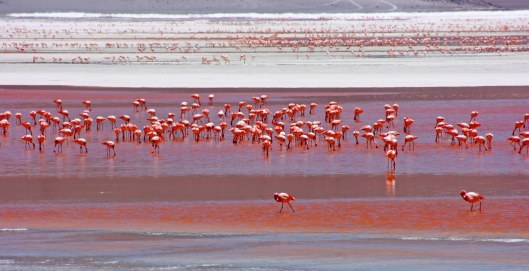
If you ever get the chance, you absolutely must visit the Reserva Nacional de Fauna Andina Eduardo Avaroa in south-western Bolivia, a massive 1.7-million-acre reserve full of active volcanoes, thermal springs, erupting geysers, huge lakes and, incredibly, three species of flamingos (the Andean, Chilean and, one of the world’s rarest, the James’s flamingo).

160914-flamingos-5
160914-flamingos-4

The lakes are breathtakingly beautiful, not only because of their remote mountainous settings but also because of their colours, a result of the chemicals associated with the region’s volcanic activity. In the winter months it is very cold in this part of the Andean Altiplano, with temperatures frequently in the minus twenties and thirties. It seems incredible that flamingos could survive such extreme cold but, apparently, they have the ability to control their heartbeat, to allow themselves to sleep in the chilly water to try to avoid their enemies, the fox and the puma. However, when it’s extremely cold and the water has frozen, the flamingos can become trapped and are then almost literally sitting ducks.

160914-flamingos-1
160914-flamingos-2

At 4300 metres above sea level and with an area of 60km2, Laguna Colorada, or Red Lake, really is red. This is due in part to the volcanic minerals and sediments it contains and also because of the microscopic algae that thrive in its waters. The lake is shallow, only 30 to 50cm deep, which makes it the perfect habitat for flamingos. And, except for the grey and white juveniles, the plumage of these flamingos is more reddish than normal because of the algae in the lagoon – these really are pink flamingos!

160914-flamingos-6
160914-flamingos-7

160914-flamingos-3

Like Loading...

That other Naked Lady

13 Tuesday Sep 2016

Posted by sconzani in flowers, nature

≈ 4 Comments

Tags

Amaryllis belladonna, Autumn crocus, Belladonna lily, Colchium autumnale, Naked Ladies, Roath Park

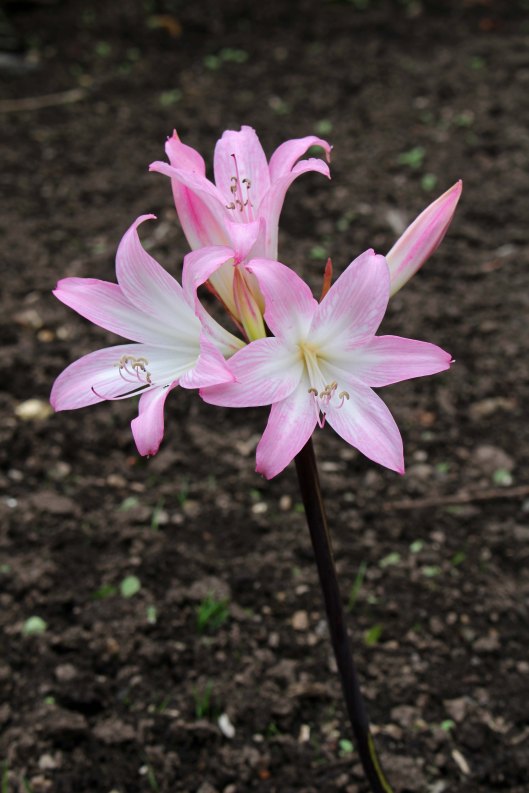
When I posted last Friday on the Naked Ladies of Roath and Bute, my gardening friends were quick to point out that, as well as the Autumn crocus, Colchium autumnale, there is another flower that also has the common name Naked Lady … and here she is, Amaryllis belladonna, found flaunting her gorgeous pinkness outside the glasshouse at Roath Park on yesterday’s walk. Though a South African native, the Belladonna lily, as she’s also commonly called, can be found in gardens and parks throughout the world. Her large showy blooms appear in the autumn, with the narrow strap-shaped leaves following a little after the flowers.

160913-belladonna-lily

Like Loading...

One autumnal day

12 Monday Sep 2016

Posted by sconzani in autumn, leaves, nature

≈ 4 Comments

Tags

autumn colour, autumn leaves

‘No spring nor summer beauty hath such grace
As I have seen in one autumnal face.’

~ John Donne, ‘Elegy IX: The Autumnal’, The Complete Poetry and Selected Prose

160912-autumn-leaves-1
160912-autumn-leaves-2
160912-autumn-leaves-3
160912-autumn-leaves-4
160912-autumn-leaves-5
160912-autumn-leaves-6
160912-autumn-leaves-7
160912-autumn-leaves-8
160912-autumn-leaves-9
Like Loading...

A Fungi-ful Friday

11 Sunday Sep 2016

Posted by sconzani in fungi, nature, parks

≈ 4 Comments

Tags

Cefn On, fungi foray, fungus

Fifty shades of brown, a soupçon of purple and a smattering of red – that about sums up my Friday fungi foray around Cefn On, one of my local Cardiff parks. A friend had posted a few finds from his walk there the previous day on the Glamorgan Fungi page on Facebook so it looked like a sure bet and, although I get the train up there, it’s a nice long walk back through Coed-y-Felin woods, around Llanishen Reservoir, through Nant Fawr woodland and alongside Roath Lake – about 7 miles all up but almost entirely through woods, parks and green places, so perfect!
160911-cefnon-fungi-1

After the recent rains and with temperatures still warm during the day but dropping now overnight, Cefn On was alive with fungi and I got lots of photographs. Unfortunately, fungi are notoriously difficult to identify. What does it smell like? What colour are the spores? How big / small / wide / tall was it? Was it slimy or dry? Where was it growing? These are just a few of the questions you need to ask. I do try to work out what I have found but some things are only identifiable through microscopic analysis so, these days, I mostly just enjoy looking at them and admiring their multitude of shapes and forms and habits and colours.

160911 CefnOn fungi (2)
160911 CefnOn fungi (3)
160911 CefnOn fungi (4)
160911 CefnOn fungi (5)
160911 CefnOn fungi (6)
160911 CefnOn fungi (7)
160911 CefnOn fungi (8)
160911 CefnOn fungi (9)
160911 CefnOn fungi (10)
Like Loading...
← Older posts
Newer posts →

About me

sconzani

sconzani

I'm a writer and photographer; researcher and blogger; birder and nature lover; countryside rambler and city strider; volunteer and biodiversity recorder.

View Full Profile →

Follow earthstar on WordPress.com

Enter your email address to follow this blog and receive notifications of new posts by email.

Recent blog posts

  • Bearded tit!!! April 3, 2026
  • A Portland Bill Kestrel April 2, 2026
  • A proliferation of Peacocks April 1, 2026
  • Little owl March 31, 2026
  • Distant seabirds March 30, 2026

From the archives

COPYRIGHT

Unless otherwise acknowledged, the text and photographs on this blog are my own and are subject to international copyright. Nothing may be downloaded or copied without my permission.

Fellow Earth Stars!

  • Unknown's avatar
  • Unknown's avatar
  • Unknown's avatar
  • Unknown's avatar
  • Unknown's avatar
  • Unknown's avatar
  • Unknown's avatar
  • Unknown's avatar
  • Unknown's avatar
  • Unknown's avatar
  • Unknown's avatar
  • Unknown's avatar
  • Unknown's avatar
  • Unknown's avatar
  • Unknown's avatar
  • Unknown's avatar
  • Unknown's avatar
  • Unknown's avatar
  • Unknown's avatar
  • Unknown's avatar
  • Unknown's avatar
  • Unknown's avatar
  • Unknown's avatar
  • Unknown's avatar
  • Unknown's avatar
  • Unknown's avatar
  • Unknown's avatar
  • Unknown's avatar
  • Unknown's avatar
  • Unknown's avatar
  • Unknown's avatar
  • Unknown's avatar
  • Unknown's avatar
  • Unknown's avatar
  • Unknown's avatar
  • Unknown's avatar
  • Unknown's avatar
  • Unknown's avatar
  • Unknown's avatar
  • Unknown's avatar
  • Unknown's avatar
  • Unknown's avatar
  • Unknown's avatar
  • Unknown's avatar
  • Unknown's avatar
  • Unknown's avatar
  • Unknown's avatar
  • Unknown's avatar
  • Unknown's avatar
  • Unknown's avatar

Blog at WordPress.com.

Privacy & Cookies: This site uses cookies. By continuing to use this website, you agree to their use.
To find out more, including how to control cookies, see here: Cookie Policy
  • Subscribe Subscribed
    • earthstar
    • Join 642 other subscribers
    • Already have a WordPress.com account? Log in now.
    • earthstar
    • Subscribe Subscribed
    • Sign up
    • Log in
    • Report this content
    • View site in Reader
    • Manage subscriptions
    • Collapse this bar
 

Loading Comments...
 

You must be logged in to post a comment.

    %d