
For the avoidance of doubt, the Raven (Corvus corax) is huge! And, no doubt, it is partly that size that accounts for the Raven’s evil reputation, together with its black colour, and its penchant for eating almost anything, animal or vegetable. In ancient Greece, it was feared as the bird that arrived soon after a battle to feed on the corpses and so became a symbol of death, symbolism that has continued throughout history in all manner of myths, legends and folklore.
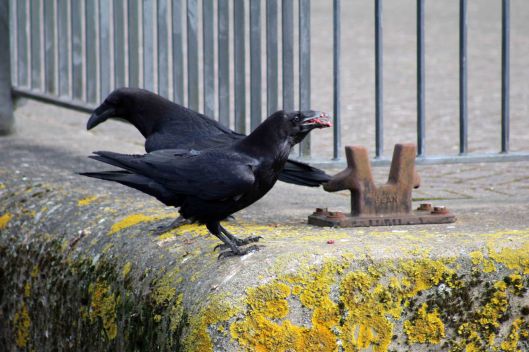
This negativity is also reflected in the collective noun for a group of Ravens, an unkindness, but, personally, I think we humans have done these beautiful birds a disservice.

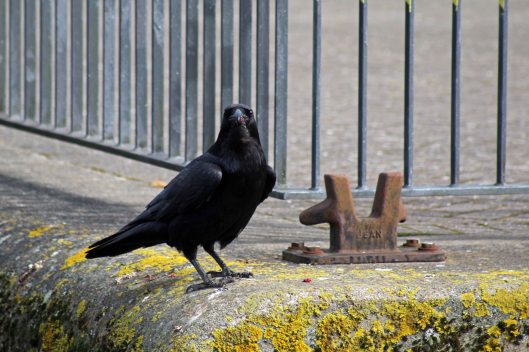
A pair of Ravens lives locally and can often be seen around the nearby cliffs and on the Cardiff Barrage, so I get to observe them quite often.

Recently, I watched what I presume was the male bird bring a piece of fruit as a gift for his mate to eat, an action that is probably a form of pair-bonding behaviour. It was delicately done, rather sweet, and certainly not unkind, and so I have a soft spot for my local Ravens.
 earthstar
I live locally to the bay and often take my son down to observe the ravens that have made the barrage their home. We are mesmerised by these birds. Not only by their sheer size, which is quite staggering when observed close up, but also their intelligence. Not to mention their array of sounds they make. Their nest can be seen from below on one of the structures in between the lock gate structures that jut out over the bay, it is a huge tangle of sticks and branches on the metal platform. We also observe the peregrines that inhabit penarth beach cliffs, another sight to behold. Last year we watched them training the fledglings to dive bomb prey. Awesome.
LikeLiked by 1 person
Hi Steve. So glad you and your boy enjoy the Ravens as much as I do. I’ve seen that nest in the gantry – I don’t think they used it last year but I know they did the previous year.
And I envy you your sightings of the Peregrines and their fledglings – amazing!
LikeLike
For your interest, there is a nesting pair of ravens at Llandough hospital on rhe metal platform at the top of the water tower. They nested here last year as we observed no less than three fledlings with the adults on numerous occasions using the hospital roofs after leaving the nest. As you have informed me the ravens at the bay didn’t use the nest on the barrage, the pair at Llanndough could be the same ones? ravens apparently alternate between two different nests. Unfortunately, it seems the nest was removed after the fledglings and adults left. I can only assume that the maintenance staff need to walk around on the platform. Last yeat they did assure me that whilst the adults and chicks are using thr nest they do not disturb them. I did see an adult perched on top of the water tower this week, so maybe they’ll rebuild their nest here this season.
LikeLiked by 1 person
That’s great to know, thanks, Steve. I’ve been walking a few of the footpaths around Llandough recently so will definitely keep an eye on that tower. I didn’t know they’d nested there previously. Nor did I know they alternate nests. It would be illegal to disturb them once they’ve started building a nest so let’s hope they get left alone to get started this year. 🙂
LikeLike
Me too – the greatest worry is that once something like that gets the go-ahead that others may see it as a licence for killing them too.
LikeLiked by 1 person
The good news is that there’s been news today of the licensing department now rethinking the idea, following pressure from prominent conservationists like Chris Packham. 🙂
LikeLike
A much-maligned, highly intelligent bird that deserves a much better reputation in this day and age. Did you hear about the proposed ‘authorised’ cull of them in Scotland? I’m still trying to find out what that’s about.
LikeLiked by 1 person
The news of the cull came out just after I’d written this post. I was / am horrified. To kill 300 birds just to see if it has any affect – it’s madness, and I will be lending my name to any campaign to stop it.
LikeLiked by 1 person