
Tags
Green shieldbug eggs, parasitic wasp, parasitised Green shieldbug eggs, Scelionidae, Trissolcus, Trissolcus sp wasp
Here’s another fascinating leaf-bothering find, this time on a willow leaf, found during a recent wander around Cardiff’s Cathays Cemetery. I was fairly sure, from their size, shape and number, that these were Green shieldbug eggs and, as their colour had changed from the usual green, that the eggs had been parasitised. And, of course, that led me to wonder whether the tiny wasp might be the parasite.
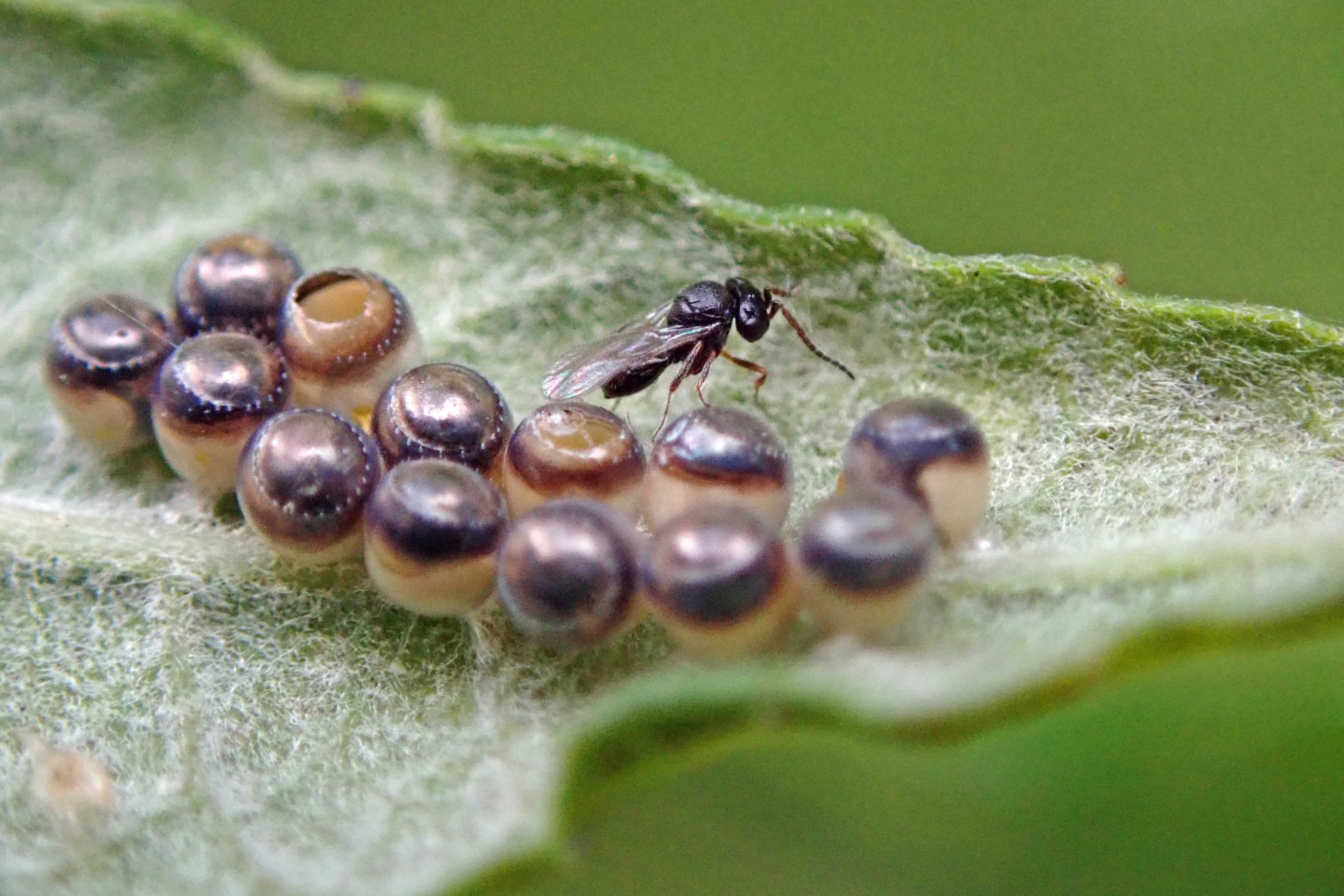
At home, my online research didn’t come up with anything in the UK but I did find information on the website of American Utah State University about ‘two families of stink bug [the American name for shieldbug] parasitoids in Utah, Eupelmidae and Scelionidae.’ The webpage provided information on and images of the two wasp genera and, from that, I decided the Scelionidae looked most promising, and that my wasp looked very similar to the Trissolcus species shown there.
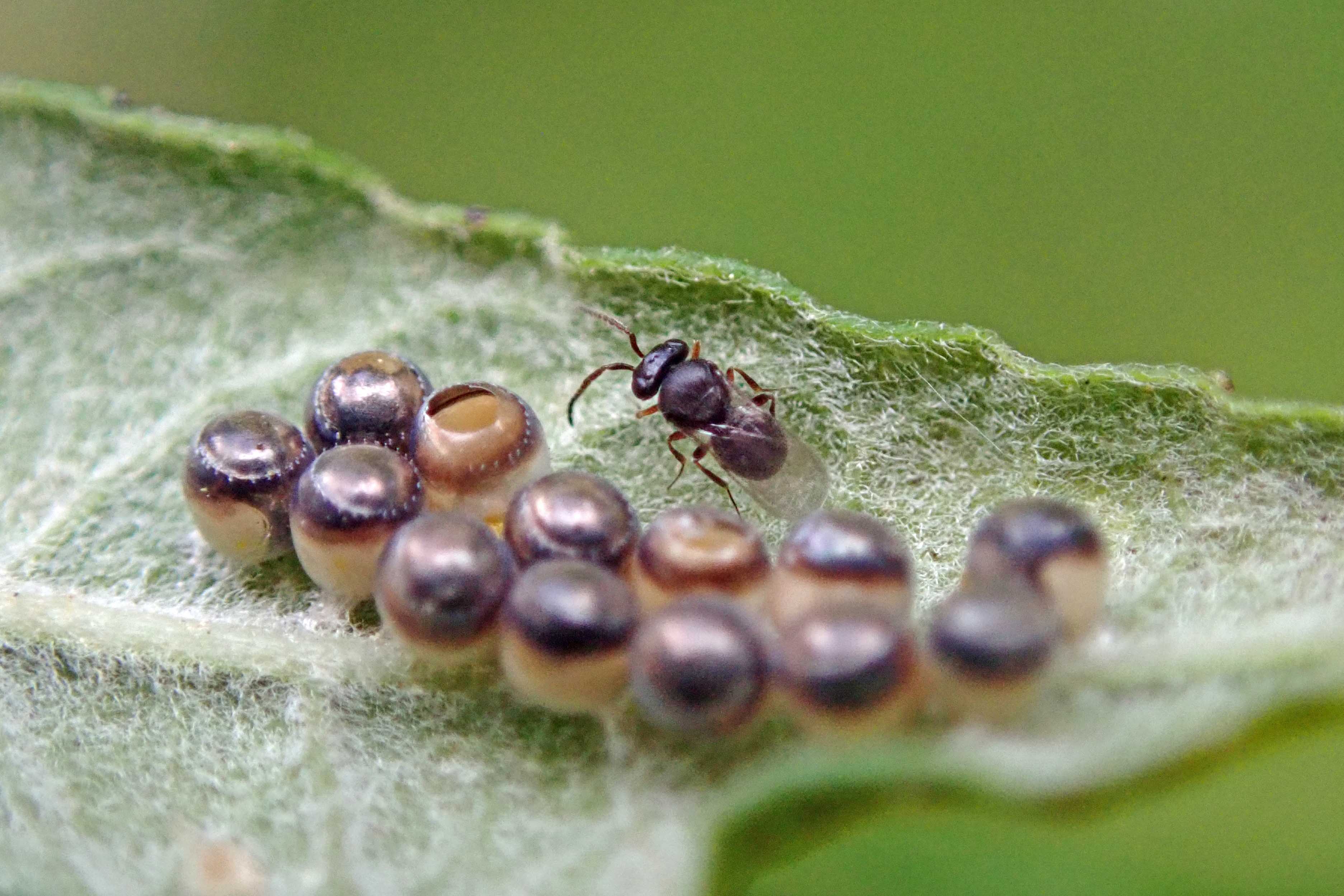
The website entry explained how the parasitic wasp lays its eggs in the shieldbug eggs, where the wasp larvae hatch, eat their hosts, and eventually pupate. Also,
There is usually a skewed sex ratio in emerging wasps. In a typical stink bug egg mass that consists of 14-28 eggs, one to three wasps will be male, and the rest will be female.
Male wasps will emerge first and wait for the females to emerge. Once mated, the females fly off in search of new egg masses to sting.
That behaviour, of the male wasp waiting by the parasitised eggs for a female to hatch, fitted with what I had observed. Despite me carefully turning the leaf this way and that to try to get better light and closer photos, the little wasp didn’t fly off – now I knew why.
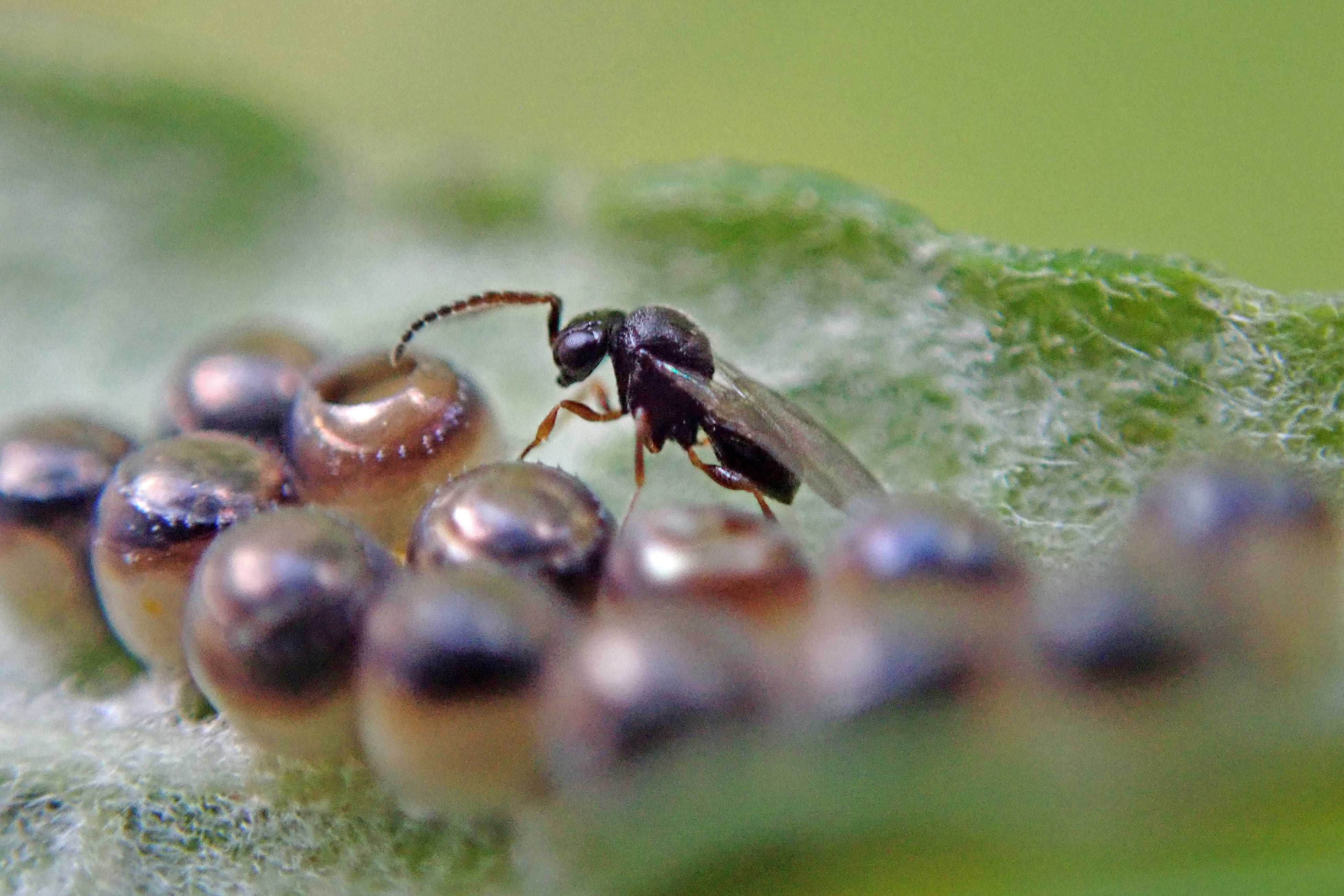
Later, after I’d posted photos and my speculation on social media, my identification of this being a Trissolcus sp. wasp was confirmed by a wasp expert on Bluesky, though I haven’t yet had official verification of my record.
 earthstar
Hi there.
i thought I’d just drop you a note of appreciation.
Earlier today i found a clutch of shieldbug eggs, which looked oddly dark to me. To cut a long research story short, I eventually found a German site which seemed to suggest my eggs had been the victims of a parasitoid wasp Trissolcus sp.
Further hunting (so to speak) led me to this page on your mightily impressive blog, where I was again able to match the host eggs and likely parasitoid.
There are only 5 records of this genus in the UK between iRecord and iNaturalist. The two records on the former site being that of Trissolcus cultratus.
While I’m not going to assume I can take the wasp to species, thank you for helping me (probably) ID the genus.
PK
LikeLiked by 2 people
Hi PK
These are the comments I love to read. Not just your kind words about my blog, for which many thanks, but about people being curious about what they’ve found and taking the time to find out more. That curiosity is very important, I think, and there are so many things in the natural world to be curious about. 🙂
LikeLike
Sent with Proton Mail secure email. I’m an amateur wildlife photographer who also posts wildlife videos (with species information on my YouTube Channel. When I photograph and film something, I always do so with the hope and intention of identifying the subject matter. You’ll be very well versed with how difficult and time consuming this can be, but also very rewarding when one discovers species one hasn’t seen before, unusual forms, scarce or rare species, and just occasionally, one’s new to a county or even the country. Now of course, I sometimes have difficulty passing the most humble of bushes without checking it over!
LikeLiked by 1 person
I agree with everything you’ve written – this is a time consuming, occasionally very frustrating, but mostly hugely rewarding occupation. I’ve been hooked since I attended my first recorder’s course in early 2016, particularly as biodiversity recording seems the most positive thing I can do to help protect Britain’s flora and fauna.
And it can often take me an hour to walk a hundred metres, so I can definitely relate to your last sentence.
Please do let me know the name of your YouTube channel so I can check it out. 🙂
LikeLiked by 1 person
Sent with Proton Mail secure email. Please ignore my comment about not being able to log in. I’ve since discovered I can reply directly via email (Proton, not Gmail) and sometimes, but not always, log-in via Reader but not via wordpress, which seems very odd? It was Another Day, another parasitic Wasp’ that i was trying to respond to, but obviously I managed to later via Proton.
LikeLiked by 1 person
Wasp on the water 🎶

LikeLiked by 1 person