
Tags
autumn migration, birding, birdwatching, British birds, Cardiff birding, Grey phalarope, Lisvane Reservoir, phalarope species, Phalaropus lobatus, Red-necked phalarope
Last week was a red-letter week for Glamorgan birds. I didn’t get to see all the rare birds on offer but I did spend several wonderful hours at the Lisvane and Llanishen reservoirs in north Cardiff last Tuesday, in the company of smiling birders and interested locals, as we feasted our eyes on the three visiting phalaropes, two Grey (more on them tomorrow) and my first ever Red-necked.

The Red-necked phalarope (Phalaropus lobatus) is a bird of contradictions: it’s a wader that prefers to swim; the female is the more brightly coloured gender; she fights other females for the most desirable males to mate with; she lays her eggs then leaves the male to raise their young, sometimes even finding another male to breed with.
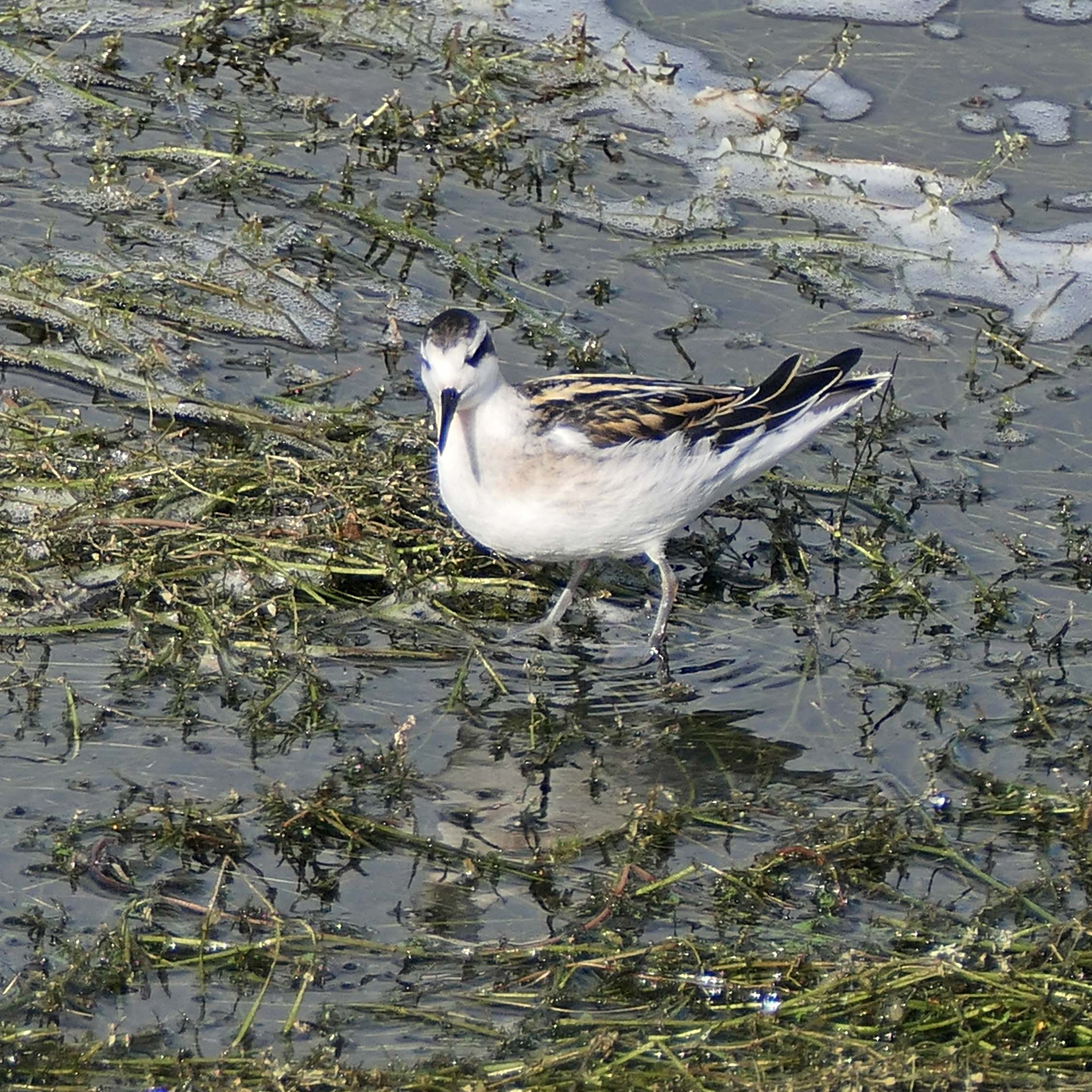
You may notice that this bird has no sign of the red neck it is named for; the characteristic rusty coloured neck band can only be seen on female birds during the breeding season. The presence of yellow stripes on this bird’s back marked it as a juvenile; in fact, looking at the illustrations in my guide book, this looks like a juvenile bird moulting to first winter colouring.

It can be difficult to tell Red-necked and Grey phalaropes apart so it was particularly informative, especially for folks like me who had not seen both species before, to see both species together. The Red-necked phalarope was noticeably smaller than the Grey, and it had a thinner, sharper bill. (There will be a photo of the two species side by side in tomorrow’s blog.)

Due to a significant decline in its breeding population in Britain, where it nests in very small numbers in northern Scotland and on the western isles, the Red-necked phalarope is red-listed. The bird also breeds in Siberia, Scandinavia, Iceland and North America, and the very rare sightings we’re lucky enough to see in southern Britain are birds on migration; apparently, European breeding birds winter in the Arabian Sea. What a wonderful treat it was to enjoy very close views of this rare bird!
 earthstar
You must be logged in to post a comment.