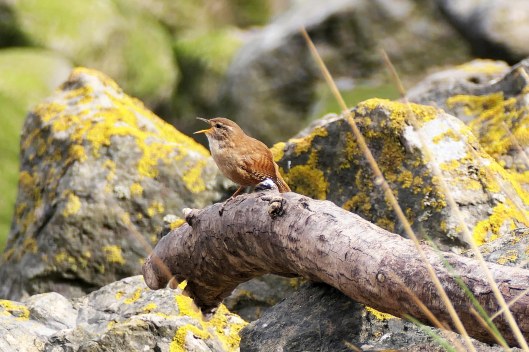
I can’t remember where I read it but I’m fairly sure the Wren has one of the loudest voices of any birds in Britain, though even its song is eclipsed by the boom of the Bittern, which can be heard around 2 miles away. At this time of year, male Wrens in particular sing regularly and loudly, to advertise themselves and their territories in order to attract any available females. The Wren in my photo has a very nice seaside territory amongst the large boulders of Cardiff Bay’s outer Barrage breakwater – if I were a female Wren, I’d certainly be interested. If you’re not familiar with the song of the Wren, you can hear it on the RSPB website.
I’ve been walking across Cardiff Bay’s Barrage and back quite frequently in the past fortnight, searching the skies and the rocks for the migrating birds that normally appear around this time: Sand martins, Wheatear, Swallows and anything else that decides to drop in for a stopover on its flight north.
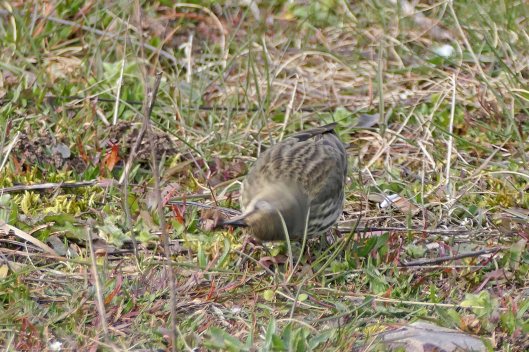
And that was what I was doing around midday today when I spotted two Rock pipits grazing on the Barrage’s grassy slopes. I sat on a conveniently placed bench and watched them for a while as they pecked and poked around the low-growing grasses and wildflowers.
Both were collecting invertebrates too tiny for me to see but then one Rockit, the birders’ abbreviation for Rock pipit, found itself an earwig. Though the little insect was squirming for its life, the Rockit had it grasped firmly and, for the earwig, there was no escaping its fate. A couple of quick whacks and down the Rockit’s hatch it went, a tasty lunchtime morsel.
A week or more has passed since I, and every other birder in south Wales, heard the exciting news that a company of Hawfinches had been found in the churchyard of St Cadoc’s in Barry. Since then, judging by the numerous posts on social media, every one of those birders has been to see these beautiful birds – or, at least, that was what I had hoped before I took my turn this morning (I’m not keen on being amongst large groups of birders all jostling for a look). But even today, though I was the first to arrive, six other birders turned up while I was there.
Of course, I can’t blame them. Up to 24 Hawfinches have been seen, flying from the churchyard’s trees to those in a nearby horse paddock, perching in the church’s tree tops, and feeding on the ground. And that’s an impressive number of these stunning birds by anyone’s count. Today, we were treated to the sight of perhaps a dozen birds feeding under trees at the far end of the churchyard.
The reason these birds have chosen St Cadoc’s is because of the many Yew trees growing around it. Though it’s too early in the year for Yew berries, there are probably seeds from last year’s berries still on the ground, and the birds seemed also to be crushing this year’s flowers in their beaks to get the tiny seeds within.
The company – the collective noun used most often for the Hawfinch, apparently – was quite skittish. I accidently sent them flying up in to the trees when I first arrived as I didn’t see them in the shade beneath the tree, and it took them 30 minutes to feel safe enough to return. Fortunately, that did mean I could warn the newly arriving birders so that we all got to enjoy this beautiful sight.
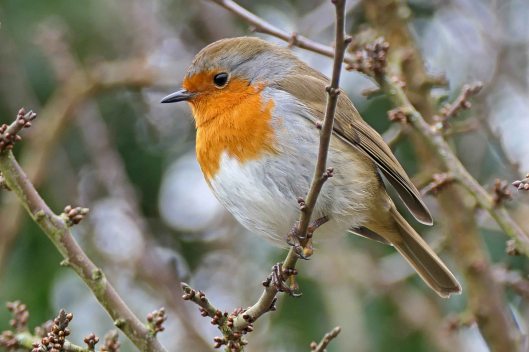
For no particular reason I am feeling the need for some good cheer today, and what better little bird to provide that cheery feeling than a cute wee Robin with its bouncy melody. Happy Saturday, everyone!
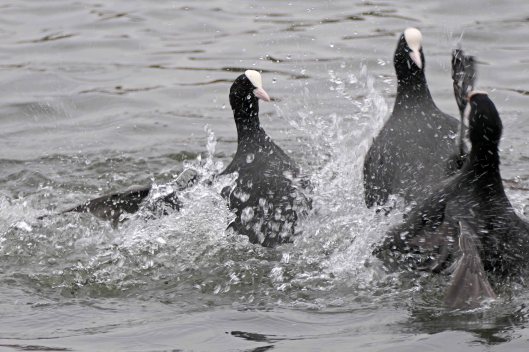
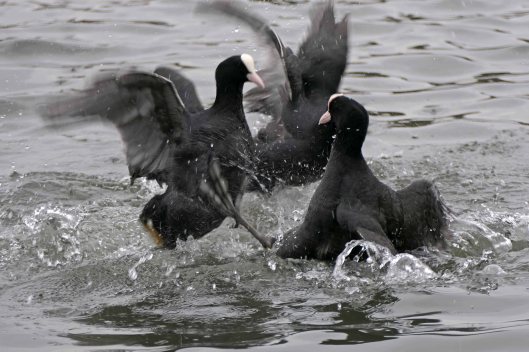
It’s that time of year when birds quarrel frequently, over territories, over females, over nest sites, and Coots are the masters of quarrelling.
First, their heads go down and their wings go up, presumably to make their profile look larger and more threatening to the opposition. And then, if the opposition doesn’t back down – and, in my experience, Coots rarely shy away from a fight, they attack.
Things can get very heated very quickly, and Coots use their large feet as weapons, hitting out at each other, latching on and pushing their opponents under the water, sometimes almost drowning them.
Fortunately, the fights rarely last very long, and I’ve never seen any injuries on the birds. So, perhaps their disputes look more vicious than they actually are.
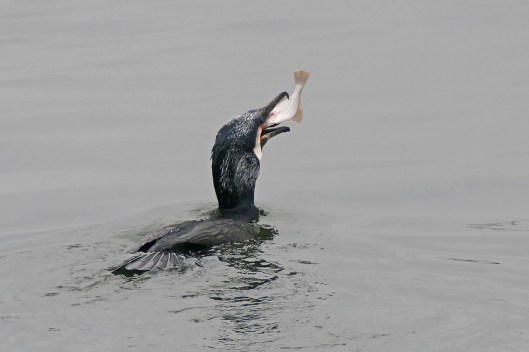
It always amazes me how flexible birds’ beaks and jaws must be for them to swallow what look like impossibly oversized fish but swallow them they do. This handsome Cormorant, already beginning to acquire the white mane of its breeding plumage, made quick work of consuming this particular fish and one other in the short time I was watching. I’m sure it thought its lunch was delicious.
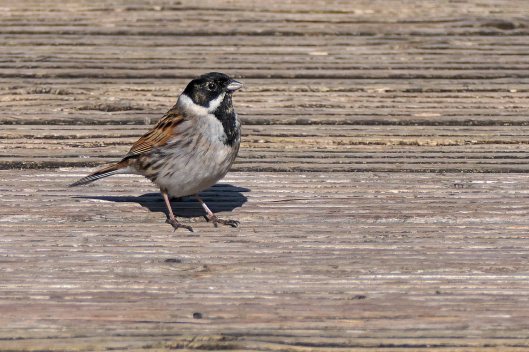
As the reed beds at Cardiff Bay Wetlands Reserve are extensive and quite dense I hear the resident Reed buntings more often than I see them so I was charmed, during yesterday’s visit, by the close proximity on the boardwalk and very confiding nature of this handsome male. I can’t help but wonder if he thought I might give him a seed reward as he strutted this way and that, with all the swagger of someone used to performing on a catwalk rather than a boardwalk.
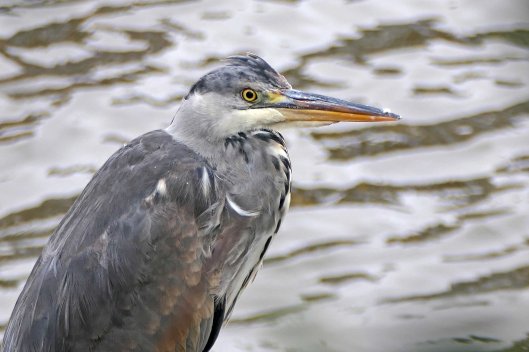
There’s a particular branch on a particular tree alongside the River Ely where a Grey heron sits and cogitates about life, the universe and, probably, where its next meal is coming from.
The heron is mostly obscured from the view of passing dog walkers by the riverside trees amongst which he sits but at least one keen-eyed photographer (moi) knows this is a favourite spot and looks for him there.
These three photos of old man heron (though it could be a female – I’m not sure how you tell the gender of Grey heron, or even if you can) were taken at the same spot, almost exactly a month apart, on 31 December, 25 January and 26 February.
And, now that I look at them together, I’m not sure if it is the same bird – I’ve always assumed it was because of the bird’s preference for this particular spot. His plumage looks a little different, though there is a pale spot near the end of his beak that is unchanged from one month to the next. What do you think?
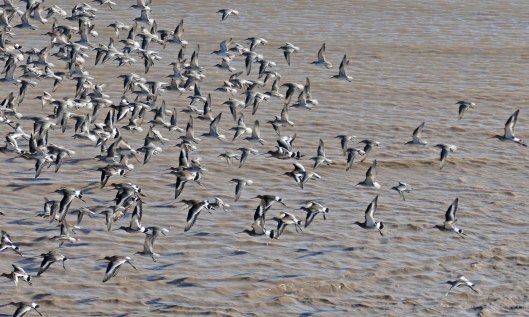
The most numerous bird species in Monday’s murmuration (see Wednesday’s blog for photos) was undoubtedly the Black-tailed godwit (Limosa limosa). With their long legs, necks and beaks and well-proportioned bodies, these are elegant birds.
We have two species of godwit in Britain, Black-tailed and Bar-tailed (Limosa lapponica), and, at first glance, they can be difficult to tell apart but, as you can see in some of my photos, the Black-tailed have broad white wing-bars and their white tails finish with a black band, hence their name.
Some of these local birds are starting to change in to their breeding plumage of brick-red heads, necks and breasts, which is why the birds’ colours pictured here are so different. Only a very small number of Black-tailed godwits breed in the UK; most, if not all, of the birds pictured will soon be heading north-west to their breeding grounds in Iceland.
And that breeding location is one of the reasons Black-tailed godwits are now on the British red list, as the lowland Icelandic grasslands these birds favour are increasingly being converted to arable production and forestry. Climate change and environmental pressures are also affecting the locations in Britain where the birds over-winter, so they are facing pressure all year round. I feel privileged to have seen so many of these stunning creatures at such close quarters and to see their incredibly well synchronised aerial display earlier this week.
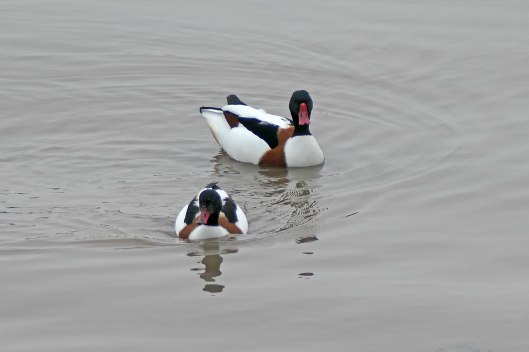
According to a research report* published on the British Trust for Ornithology’s website, the Shelduck (Tadorna tadorna) was ‘one of the most common waterbird species at Cardiff Bay prior to barrage-closure’. When the report was written, in 2003, Shelduck were still using the Bay as a roosting site between tides, albeit in small numbers. Twenty-two years later, the Bay has become so overwhelmed by human water traffic (jetboats, speedboats, water taxis, yachts, kayakers, paddleboarders) that it is rare to see Shelduck within the Bay itself.
Fortunately, there are still reasonably untouched areas of mudflat along the coast between Cardiff and Newport, and Bridgwater Bay, a National Nature Reserve renowned for its population of Shelducks, is a relatively short flight across the Bristol Channel from Cardiff Bay. So, the birds can often be seen, at a distance, feeding on the tidal mudflats outside the Barrage at low tide. And, occasionally, as happened one day last week, a pair will arrive early and wait for the lowering tide along the beach below Penarth Heads or, in this case, in the Barrage basin. This is the only time I get to see these beautiful birds up close so I sat on a rock and watched and, as the mud was exposed, took this short video of them hoovering and filtering the mud for tiny invertebrates.








 earthstar
You must be logged in to post a comment.