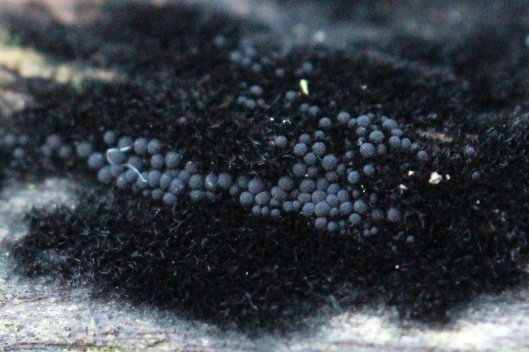
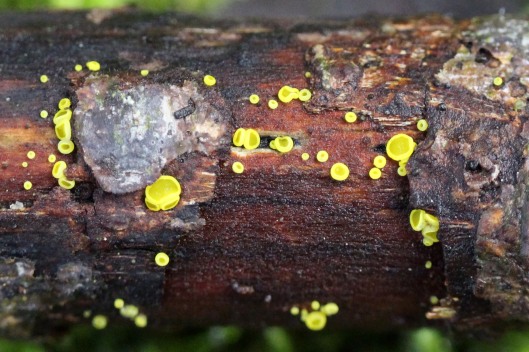
• ABOUT
  • BIRDING 2018
  • Birding 2019
  • BLOG POSTS
  • Butterflies 2018
  • Resources

earthstar

~ a celebration of nature

earthstar

Category Archives: fungi

‘The nature of brightness’

05 Sunday Mar 2017

Posted by sconzani in flowers, fungi, leaves, nature, plants, spring

≈ 7 Comments

Tags

colour in nature, effects of colour, Goethe, Johann Wolfgang von Goethe, Theory of Colours, yellow

‘We find from experience that yellow excites a warm and agreeable impression…. The eye is gladdened, the heart expanded and cheered, a glow seems at once to breathe toward us.’  ~  Johann Wolfgang von Goethe, from his Theory of Colours, published in 1810.

170305-yellow-1
170305-yellow-2
170305-yellow-3
170305-yellow-4
170305-yellow-5
170305-yellow-6
170305-yellow-7
170305-yellow-8
170305-yellow-9
170305-yellow-10
170305-yellow-11
170305-yellow-12
Like Loading...

Fungi on fungi

17 Friday Feb 2017

Posted by sconzani in fungi, nature, trees

≈ Leave a comment

Tags

fungal relationships, parasitic relationships, saprobic relationships, symbiotic relationships

Like most organisms, fungi have complicated relationships. They can be saprobic, deriving their nourishment from dead and decaying wood and leaves; they might be mutualistic, enjoying symbiotic relationships with plants, animals and cyanobacteria where both parties benefit; and they can be parasitic on plants and even other fungi. As well as being the instigator of these many complicated relationships, fungi can also be the victim, succumbing to the needs of animals, plants and other organisms that are looking for nourishment. The topic of fungal relationships is a large and incredibly complex area to cover in a short blog post so let me just show you a few images I’ve captured of fungi (and moulds) feasting on fungi.

170217-fungi-on-fungi-1
170217-fungi-on-fungi-2
170217-fungi-on-fungi-3
170217-fungi-on-fungi-4
170217-fungi-on-fungi-5
170217-fungi-on-fungi-6
170217-fungi-on-fungi-7
Like Loading...

Golden ears and Yellow brains

10 Friday Feb 2017

Posted by sconzani in fungi, nature

≈ 8 Comments

Tags

fungus, Golden ear fungus, jelly fungus, Tremella aurantia, Tremella mesenterica, Yellow Brain Fungus

170210-tremella-mesenterica-yellow-brain-3
170210-tremella-mesenterica-yellow-brain-1

These two fungi may look different but they may actually be exactly the same – in theory, it should be possible to tell without resorting to a microscope. There are two possibilities: Tremella aurantia (known to the Americans as Golden ears; the British Mycological Society hasn’t assigned it a common name), which is parasitic on the fruit bodies of the Hairy curtain crust fungus (Stereum hirsutum), and Tremella mesenterica (Yellow brain), which is parasitic on the mycellium of the Peniophora species of fungi. However, those Peniophora fungi are not always easy to spot as the Tremella may have smothered the lot, so identification can still be tricky.

I’ve only knowingly seen Golden ears the once and, if you take a look at the top right corner of my image (below), you can just spot the brackets of Hairy curtain crust that helped me confirm what it was. (So, the two photos above and the very bottom photo probably all show Yellow brain but I can’t be 100% certain.)

170210-tremella-aurantia-golden-ear-1

The word Tremella means trembling, a reference to the jelly-like constituency of these fungi; aurantia means orange coloured or golden; and mesenterica joins two Ancient Greek words together: meso means middle and enteron means intestine, so maybe the title of this post should really be Golden ears and Yellow intestines. Ew!

170210-tremella-mesenterica-yellow-brain-2

Like Loading...

My first microscope success!

08 Wednesday Feb 2017

Posted by sconzani in fungi, nature

≈ 7 Comments

Tags

fungal microscopy, Ruby elfcup, Sarcoscypha austriaca, Sarcoscypha coccinea, Scarlet elfcup

I’ve blogged about Scarlet elfcups before (here and here) but this post is a little different. A few days ago I talked about dipping my toes into the waters of fungal microscopy (and thanks to those of you who were concerned that I might end up with Athlete’s foot in the process!). Yesterday, I made my first fungus identification on my own … small steps but I’m chuffed!

170208-sarcoscypha-austriaca-scarlet-elfcup

As I’m sure I’ve mentioned before, there are two red elfcups, Scarlet (Sarcoscypha austriaca) and Ruby (Sarcoscypha coccinea), and it’s impossible to tell them apart without microscopic examination. There are two distinguishing features: the spore shape and the shape of the hairs that cover the outer surface of the cups. In Scarlet elfcups, the ends of the spores are flattened, almost square and the hairs are curly (as shown below left) whereas, in Ruby elfcups, the spores are more elliptical and the hairs are straight – sorry, no photos of those as Ruby elfcups are not that common and the specimen I examined today turned out to be a Scarlet.

170208-sarcoscypha-austriaca-scarlet-elfcup-1
170208-sarcoscypha-austriaca-scarlet-elfcup-2

Many thanks to SEWBReC for letting me use their microscope and gear for this identification and to Amy Hicks for taking the photos. Also, thanks to Mary Gillham Archives Project Officer Al and volunteer John for bringing me the elfcup present back from a local nature reserve.

Like Loading...

Introduction to fungal microscopy

05 Sunday Feb 2017

Posted by sconzani in fungi, nature

≈ 1 Comment

Tags

fungal microscopy, fungus, learning to use a microscope, SEWBReC, spores

Yesterday I dipped my toes into the fungal microscopy waters and it was good! In fact, it was more than good. Funded by the Wales Biodiversity Partnership, hosted and organised by SEWBReC, and led by Mr Glamorgan Fungi Mike Bright, ably assisted by SEWBReC’s fungi whizz Amy Hicks, the whole day was simply excellent!

170205-microscopy-course

One of the most frustrating things about fungi can be trying to identify them and/or differentiate between visually similar species. Now I have the basic skills needed to do this. I’m under no illusions, though – I do realise that IDing my finds will still be difficult: I might not have collected a good specimen, I might not be able to find what I need under the microscope, I might not be able to find the information in books or online to compare with what I’m seeing, and, something that I hadn’t expected, the floaters I have in my right eye (a problem that comes from the vitreous gel in my eye hardening with age) interfere with what I see down the microscope.

170205-fungi-spores-1
170205-fungi-spores-2

So, I’m not rushing out to spend hundreds of pounds on a good ’scope just yet. Luckily, as a regular biodiversity recorder, I’m able to borrow the equipment they hold at SEWBReC, my local biodiversity records centre. Now I just need to find my first sample to identify!

Many thanks to my friend Graham Watkeys for the photo of me studiously peering down the ’scope, and sorry for the poor quality of my ’scope images – I now know photos of microscope camera photos shown on a laptop screen don’t reproduce very well.

Like Loading...

Fungi Friday: The black fuzz

03 Friday Feb 2017

Posted by sconzani in fungi, nature

≈ 6 Comments

Tags

ascospores, asexual reproduction in fungi, Chaetosphaerella phaeostroma, conidia, fungus, mycelium, sexual reproduction in fungi

When I first found this fungus a month ago, I thought the wee grey orbs might be a type of slime mould but I was puzzled by the black fuzz that surrounded them. Turns out it was not a slime mould at all but rather the fungus Chaetosphaerella phaeostroma. The fuzz (more correctly, the subiculum) is a dense mat of hyphae (the branching filaments that make up the mycelium, the vegetative part of the fungus that is usually hidden below the ground) and the grey orbs are the fruiting bodies (a mushroom is the more usual form of fungal fruiting body).

170203-chaetosphaerella-phaeostroma

If you think that’s confusing, it gets even more tricky! This particular fungus has two methods of reproducing as it’s capable of producing both sexual and asexual spores – it’s not surprising that this led scientists in the past to believe it was two separate fungi. The hyphae (the fuzzy stuff) can produce conidia (below left), which are asexual (so they can create new fungi but these would be exactly the same as the parent), and the spherical fruiting bodies (called perithecia) produce ascospores (below right), which are sexual (so they need to interact with another fungus in order to produce a new organism which would then have characteristics of both parents).

170203-chaetosphaerella-phaeostroma-conidia-x-400
170203-chaetosphaerella-phaeostroma-asci-with-ascospores

I am exceedingly grateful to my friend from the Glamorgan Fungus Group, Mark Evans, who examined the sample I gave him and produced not only the identification of this fungus but also the wonderful microscopic images. His detailed explanations also helped me understand what was going on with Chaetosphaerella phaeostroma, and if I’ve got any of this wrong, it’s entirely my own fault!

Like Loading...

Spore prints

29 Sunday Jan 2017

Posted by sconzani in fungi, nature

≈ 3 Comments

Tags

fungus, mushroom, spore print, spores, ways to identify fungi

One of the things that helps identify types of fungi is their spore colour so, though I try to avoid collecting fungi – preferring instead to leave them for everyone to enjoy, for the fungi themselves to release their spores and thus multiply, and for insects to feast upon – I do occasionally collect a specimen to bring home to spore print. For the uninitiated, this is usually a simple matter of turning the mushroom upside down on a white or coloured piece of paper (or a glass slide, if you’re also planning microscopic examination), covering it with something like a glass jar, and waiting several hours. (If your fungus is not mushroom-shaped, the process can vary but let’s keep it simple today.)

170129-spore-print-cortinarius-cinnamomeus
170129-spore-print-tricholoma-fulvum

The reward after those several hours have elapsed is not only discovering what spore colour your mushroom has produced but also, if you’re lucky, getting the added benefit of a very pretty spore print. Spores are like tiny spots of dust so can easily be disturbed by the slightest waft of air but it is possible to preserve your print by spraying it with a very light sealant. I’m still experimenting with this process – I’ve tried hairspray but the spray droplets contained too much moisture which ruined the print. If you’ve ever tried this and have some ideas to share, please do add a comment below, and PLEASE DO NOT go out and pick every mushroom you see just to try this. Fungi are not like blackberries or apples, they need to be left where they are to send out their spores!

170129-spore-print-lepista-sordida
170129-spore-print-boletus-impolitus
Like Loading...

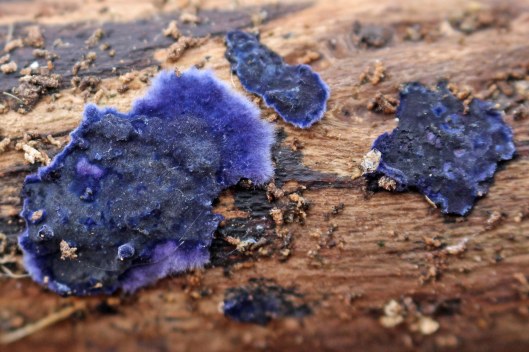
Fungi Friday: The Cobalt crust challenge

27 Friday Jan 2017

Posted by sconzani in fungi, nature

≈ 14 Comments

Tags

Cobalt crust, crust fungus, fungus, Glamorgan Fungus Group, Terana caerulea

My fellow Glamorgan Fungus Group members and I are taking part in another challenge this month, hunting far and wide within the county to see how many specimens we can find of the supposedly rare Cobalt crust fungus (Terana caerulea). You may remember that I blogged about this special, once-seen-never-forgotten fungus back in February. It’s generally classified as rare but, here in Glamorgan, it most certainly isn’t.

170127-cobalt-crust-terana-caerulea-1

Here are the latest stats: for the 14 days from 13 to 26 January inclusive, 14 of our group had made a total of 45 separate finds on 16 different host plants, ranging from elder, bramble and buddleja to hazel, oak, ivy and even Japanese knotweed. Our results just go to show that this fungus is not actually rare but rather rarely recorded, and our participation in challenges like these also highlights the benefits of ordinary folk like you and I making the effort to record the biodiversity we see around us every day. We’re helping to rewrite science!

170127-cobalt-crust-terana-caerulea-2

Like Loading...

Pick-up sticks

17 Tuesday Jan 2017

Posted by sconzani in fungi, nature, winter

≈ 8 Comments

Tags

Bleeding broadleaf crust, crust fungus, fungus, picking up sticks, Stereum rugosum, weeping crust fungus

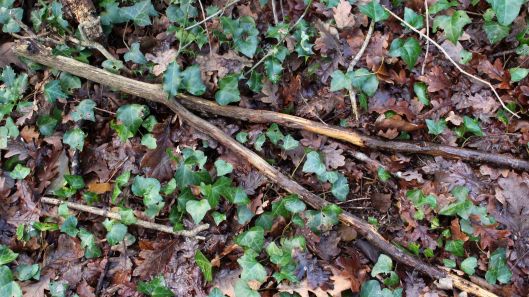
Did you play pick-up sticks as a child? Do you still play it, perhaps with your own children or your grandies? Well, I play pick-up sticks quite often too, but not quite the way you might imagine. You see I pick up sticks sometimes to find out what’s scurrying around underneath them or, especially at this rather moist time of year, to see what might be growing on them.
170117-bleeding-broadleaf-crust-1

You might’ve looked at this first stick lying on the ground in my local woodland and thought, ‘Nah! Nothing on that’ but you would’ve been wrong …

170117-bleeding-broadleaf-crust-2

… because if you had looked closer …

170117-bleeding-broadleaf-crust-3

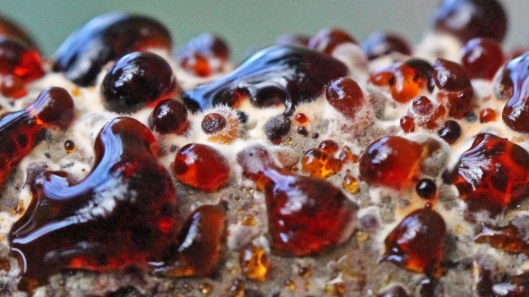
… a little bit closer, you would’ve seen this! Isn’t it gorgeous? This oozing mass of loveliness is a fungus, the Bleeding broadleaf crust fungus (Stereum rugosum) to be precise.
170117-bleeding-broadleaf-crust-4

I admit that I can sometimes spend an hour or more, bending down and examining stick after stick and finding nothing but, when I discover little gems like this, they make the effort totally worthwhile. So, next time you go to the woods, try playing a little game of pick-up sticks. You might get a pleasant surprise! (Oh, and take tissues or wet wipes, as you’ll almost certainly get a bit dirty, as well.)

Like Loading...

Fungi Friday: Disco lights

13 Friday Jan 2017

Posted by sconzani in fungi, nature

≈ 7 Comments

Tags

ascomycete, Bisporella citrina, fungus, Lachnum virgineum, Lemon disco, Snowy disco

There are 22 species of fungi called disco, according to the British Mycological Society’s list of English Names for Fungi 2016, and they have some delightful names, mostly referring to what they grow on, I think: Larch, Conifer, Larch canker, Rush, Heath sedge, Mast, Juniper, Fir and, my personal favourite, Hairy Nuts Disco!

170113 Bisporella citrina Lemon Disco.jpg

So far I’ve only found two. My excuse is that they’re tiny, only a few millimetres across, so they’re difficult to spot, and many are quite rare. This first one is probably Lemon Disco (Bisporella citrina), and is actually one of the more common discos. It’s a wood-rotter that can be found growing – often in the thousands – on decaying deciduous trees, particularly oak.

170113-lachnum-virgineum-snowy-disco-1
170113-lachnum-virgineum-snowy-disco-2

This second fungus may be Snowy disco (Lachnum virgineum) – like so many fungi, it requires microscopic examination for a definite ID, and I haven’t reached that level in my mycological evolution … yet! Snowy disco also grows on dead and decaying wood, and is said to be frequent, though I’ve only found it once in 18 months of foraying.
Like Loading...
← Older posts
Newer posts →

About me

sconzani

sconzani

I'm a writer and photographer; researcher and blogger; birder and nature lover; countryside rambler and city strider; volunteer and biodiversity recorder.

View Full Profile →

Follow earthstar on WordPress.com

Enter your email address to follow this blog and receive notifications of new posts by email.

Recent blog posts

  • Cuttlebones March 16, 2026
  • No woodland here March 15, 2026
  • Family comes first March 14, 2026
  • Local Little egrets March 13, 2026
  • Cormorants, young and old March 12, 2026

From the archives

COPYRIGHT

Unless otherwise acknowledged, the text and photographs on this blog are my own and are subject to international copyright. Nothing may be downloaded or copied without my permission.

Fellow Earth Stars!

  • Unknown's avatar
  • Unknown's avatar
  • Unknown's avatar
  • Unknown's avatar
  • Unknown's avatar
  • Unknown's avatar
  • Unknown's avatar
  • Unknown's avatar
  • Unknown's avatar
  • Unknown's avatar
  • Unknown's avatar
  • Unknown's avatar
  • Unknown's avatar
  • Unknown's avatar
  • Unknown's avatar
  • Unknown's avatar
  • Unknown's avatar
  • Unknown's avatar
  • Unknown's avatar
  • Unknown's avatar
  • Unknown's avatar
  • Unknown's avatar
  • Unknown's avatar
  • Unknown's avatar
  • Unknown's avatar
  • Unknown's avatar
  • Unknown's avatar
  • Unknown's avatar
  • Unknown's avatar
  • Unknown's avatar
  • Unknown's avatar
  • Unknown's avatar
  • Unknown's avatar
  • Unknown's avatar
  • Unknown's avatar
  • Unknown's avatar
  • Unknown's avatar
  • Unknown's avatar
  • Unknown's avatar
  • Unknown's avatar
  • Unknown's avatar
  • Unknown's avatar
  • Unknown's avatar
  • Unknown's avatar
  • Unknown's avatar
  • Unknown's avatar
  • Unknown's avatar
  • Unknown's avatar
  • Unknown's avatar
  • Unknown's avatar

Blog at WordPress.com.

Privacy & Cookies: This site uses cookies. By continuing to use this website, you agree to their use.
To find out more, including how to control cookies, see here: Cookie Policy
  • Subscribe Subscribed
    • earthstar
    • Join 668 other subscribers
    • Already have a WordPress.com account? Log in now.
    • earthstar
    • Subscribe Subscribed
    • Sign up
    • Log in
    • Report this content
    • View site in Reader
    • Manage subscriptions
    • Collapse this bar
 

Loading Comments...
 

You must be logged in to post a comment.

    %d