• ABOUT
  • BIRDING 2018
  • Birding 2019
  • BLOG POSTS
  • Butterflies 2018
  • Resources

earthstar

~ a celebration of nature

earthstar

Category Archives: lichen

Evernia prunastri

09 Tuesday Feb 2016

Posted by sconzani in lichen, nature, nature photography

≈ 2 Comments

Tags

lichen dye, Oakmoss, perfume, Staghorn lichen

What substance produces a beautiful lilac dye and is one of the raw materials in many well-known perfumes? It’s called Oakmoss (Evernia prunastri), but it’s not a moss, it’s a lichen, and it doesn’t just grow on oak trees, it grows on the bark of other deciduous trees and conifers as well, in most of the temperate regions of the northern hemisphere. Another of its common names is Staghorn lichen because its branching shape resembles the antlers of deer.
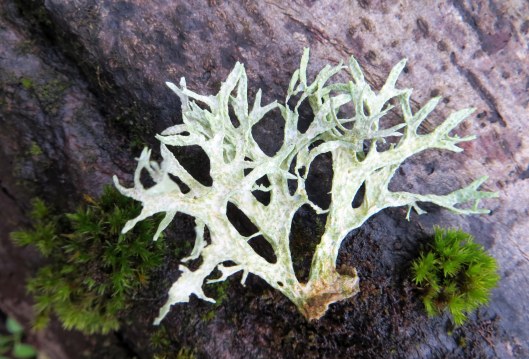
evernia prunastri (1)

At one time, Oakmoss was one of the most common base materials used in the Chypre and Fougère categories of perfumes, and was highly valued for the rich, earthy and, apparently, very sensual aroma it added to these fragrances. Unfortunately, Oakmoss can produce severe reactions in people with sensitive skin, so the IFRA (the International Fragrance Association) has now imposed restrictions on its use though, through the prudent manipulation of their recipes, it seems Oakmoss is still to be found in many well-known perfumes, like Paloma Picasso, Chanel No. 19 and Miss Dior.

evernia prunastri (2)

And, if you’re keen to use natural products to dye wool or fabric products, soaking this lichen in a mixture of water and ammonia will produce a vibrant lilac-coloured dye.

Like Loading...

The sunburst lichen

30 Saturday Jan 2016

Posted by sconzani in lichen, nature, nature photography

≈ Leave a comment

Tags

lichen, lichen on trees, Xanthoria parietina

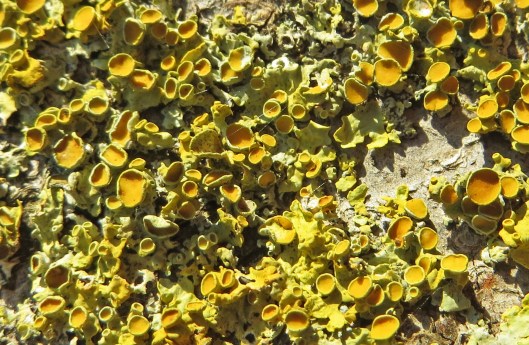
Though lichens are generally intolerant of pollution, this vibrant yellow and orange beauty is an exception and is even tolerant of heavy metal contamination. Its common names include common orange lichen, yellow scale, maritime sunburst lichen and shore lichen, from which you might correctly deduce that Xanthoria parietina is just as common on a rock at the seaside as it is on a tree in the city. It is also something of a globetrotter, being found throughout Britain and most of Europe, in North America, Africa and Asia, as well as in Australia.

xanthoria parietina (5)

Working from the belief that a plant could treat a disease it most looked like, medieval herbalists used Xanthoria parietina to treat jaundice because of its yellow colour, and scientific research has since shown that it has potent antiviral properties. And, given the intense yellow and orange colours of this lichen, it’s probably no surprise to learn that it has also been used as a dye. It is, for example, one of the traditional plant materials used to dye wool in the Scottish highlands and islands, though the colour it produces is brown, not yellow.

xanthoria parietina (1)

Like Loading...

Lecanora the lichen

22 Friday Jan 2016

Posted by sconzani in lichen, nature, nature photography

≈ Leave a comment

Tags

Lecanora chlarotera, lichen on trees

I keep thinking I see letters of the alphabet in these photographs as if this lichen is trying to tell me something but I can’t quite make out the message!

160122 lecanora chlarotera (2)

Though I’m finding lichens quite difficult to identify, even with my newly acquired guide charts, I’m fairly sure this is Lecanora chlarotera, a very common and widespread British lichen. As it will tolerate moderate amounts of air pollution, it can frequently be seen on the twigs and trunks of young semi-urban tree plantings, of the sort you might see around a shopping centre. It is also found in sparsely planted woodlands, where it benefits from more light than a densely planted forest would provide.

160122 lecanora chlarotera (1)

The lichen’s base colour ranges from cream to pale grey, it varies in texture from smooth to what one website describes as ‘strongly warted … like lumpy porridge’, and its apothecia (the little saucer-shaped fruiting bodies) range in colour from pale beige to a rusty brown. As with most lichens, you have to look closely to see how pretty it is.

160122 lecanora chlarotera (3)

Like Loading...

The sexual habits of lichen

28 Monday Dec 2015

Posted by sconzani in fungi, lichen, nature, nature photography

≈ Leave a comment

Tags

fungi, fungus, lichen

Lichen have two methods of reproduction: one is asexual – they simply expand to cover more of the surface on which they’re living; the other is sexual but, it’s not the actual lichen that is reproducing sexually, it’s the fungus the lichen is in a symbiotic relationship with.

151228 lichen sex pontcanna trees (1)

The saucer-shaped discs in my photos are apothecia, one of the two main types of sexual fruiting bodies of the fungi in the Ascomycota group, to which the majority of lichens belong. Spores (the correct term is propagules) are dispersed from these discs by air, water or attaching themselves to minibeasties, and must then meet up with an algal partner in order to form new lichen.

151228 lichen sex pontcanna trees (2)

The yellow- and orange-coloured lichen in these photographs are, I believe, Xanthoria parietina, which is very common on both tree bark and stonework throughout Britain, and has a particular liking for Elder trees and coastal rocks.

Like Loading...

Lovin’ the lichen

17 Thursday Dec 2015

Posted by sconzani in lichen, nature, nature photography, trees

≈ 2 Comments

Tags

algae, copper beech trees, lichen, winter

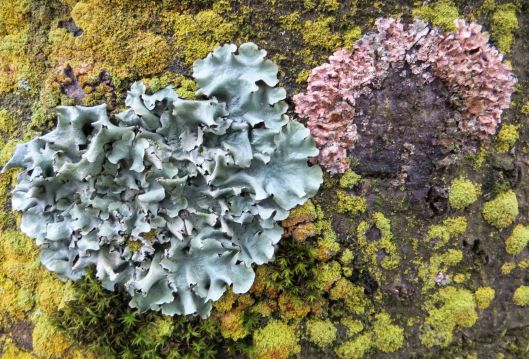
Bordering the recreation grounds opposite where I live is a magnificent long line of copper beech trees. Their leaves provide a glorious show of colour in spring, summer and autumn but the trees look rather barren during the winter months. However, if you look closer, you’ll find their bark is alive with algae, mosses and lichens, and the colours, shapes and patterns of these small organisms are, indeed, many and splendid.

151217 lichen on copper beech (2)

A lichen is a complicated entity – it is not actually one single organism but rather a fungus living in a symbiotic relationship with a photosynthetic partner, which might be a green alga or a cyanobacterium or both. The fungus is the farmer and the alga and/or bacterium produce/s the food it survives on.

151217 lichen on copper beech (1)

Next time you see a lichen, look closer and be amazed!

151217 lichen on copper beech (3)

Like Loading...
Newer posts →

About me

sconzani

sconzani

I'm a writer and photographer; researcher and blogger; birder and nature lover; countryside rambler and city strider; volunteer and biodiversity recorder.

View Full Profile →

Follow earthstar on WordPress.com

Enter your email address to follow this blog and receive notifications of new posts by email.

Recent blog posts

  • N is for nest December 19, 2025
  • M is for mite December 18, 2025
  • L is for lepidopteran lifers December 17, 2025
  • K is for Keeled skimmers December 16, 2025
  • J is for Jersey tiger December 15, 2025

From the archives

COPYRIGHT

Unless otherwise acknowledged, the text and photographs on this blog are my own and are subject to international copyright. Nothing may be downloaded or copied without my permission.

Fellow Earth Stars!

  • Unknown's avatar
  • Unknown's avatar
  • Unknown's avatar
  • Unknown's avatar
  • Unknown's avatar
  • Unknown's avatar
  • Unknown's avatar
  • Unknown's avatar
  • Unknown's avatar
  • Unknown's avatar
  • Unknown's avatar
  • Unknown's avatar
  • Unknown's avatar
  • Unknown's avatar
  • Unknown's avatar
  • Unknown's avatar
  • Unknown's avatar
  • Unknown's avatar
  • Unknown's avatar
  • Unknown's avatar
  • Unknown's avatar
  • Unknown's avatar
  • Unknown's avatar
  • Unknown's avatar
  • Unknown's avatar
  • Unknown's avatar
  • Unknown's avatar
  • Unknown's avatar
  • Unknown's avatar
  • Unknown's avatar
  • Unknown's avatar
  • Unknown's avatar
  • Unknown's avatar
  • Unknown's avatar
  • Unknown's avatar
  • Unknown's avatar
  • Unknown's avatar
  • Unknown's avatar
  • Unknown's avatar
  • Unknown's avatar
  • Unknown's avatar
  • Unknown's avatar
  • Unknown's avatar
  • Unknown's avatar
  • Unknown's avatar
  • Unknown's avatar
  • Unknown's avatar
  • Unknown's avatar
  • Unknown's avatar
  • Unknown's avatar

Blog at WordPress.com.

Privacy & Cookies: This site uses cookies. By continuing to use this website, you agree to their use.
To find out more, including how to control cookies, see here: Cookie Policy
  • Subscribe Subscribed
    • earthstar
    • Join 667 other subscribers
    • Already have a WordPress.com account? Log in now.
    • earthstar
    • Subscribe Subscribed
    • Sign up
    • Log in
    • Report this content
    • View site in Reader
    • Manage subscriptions
    • Collapse this bar
 

Loading Comments...
 

You must be logged in to post a comment.

    %d