The critters say hello!


17 Sunday Sep 2017
The critters say hello!


02 Sunday Jul 2017
Tags
biodiversity, biodiversity in Wales, biological diversity, biological recording, biological records, square-bashing

A few days ago I posted about my square-bashing adventure near Llanbeder, in Gwent. Hilary and I have now also square-bashed another under-biodiversity-recorded 1-km square, this time near St Brides Major in Glamorgan.

As the seagull flies we were within a kilometre of the sea and the geological substrate was very different, so the habitats we surveyed were more diverse. One public path led us down a heavily wooded driveway to an old house, another ran between the edge of that same woodland and fields sown with cereal crops (and there the hogweed was flowering which greatly improved my insect tally), and the third took us over paddocks of rough unimproved grassland, with patches of low rushes, all bordered by a wild old hedgerow.

Interestingly, this time Hilary’s plant list was about 20% lower than that from our previous square (though she still had around 80 species), whereas my list of everything else was about the same percentage higher (at around 100 species of insects, fungi and lichens, molluscs, etc).
30 Tuesday May 2017
Tags
Bloody-nosed beetle, Brynna, Click beetle, Glamorgan Botany Group, grasshopper, moths, Nettle weevil, rooster, sheep, slugs
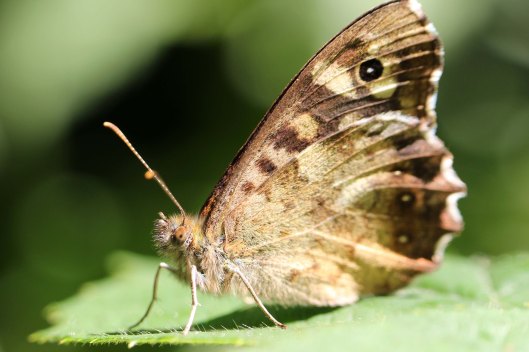
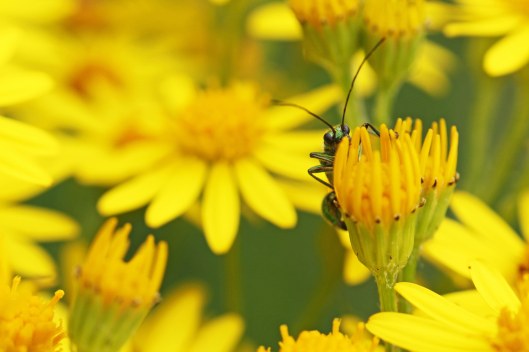
As I mentioned a couple of days ago, I returned from my last Botany Group walk with more photos of insects – and other living creatures – than plants. The Gorse weevil got a blog of its own yesterday; now here are some of our other finds.
Firstly, a couple more weevils, both on nettle and the second one is definitely a Neetle weevil (Phyllobius pomacues) but I’m not sure about the first. The Click beetle was also found on nettle.
These two were at a farm we passed through; the sheep was lording it over the home paddock and the rooster was king of the farmyard. Both handsome dudes!
A nice little grouping of slug species, with their small friend, the Granny Grey, and a grasshopper. There were lots of these hopping round on grass and rushes in a boggy field. It may be a juvenile Meadow grasshopper but I’m not 100% sure.
A little flock of Micropterix cathella moths were feasting on this grass flower, and there were lots of other small moths, probably one of the Bactra species, plus an unidentified spider with a distinctive striped body.
And last, but certainly not least, these Bloody-nosed beetles (Timarcha tenebricosa). The photo on the left shows the chubby larva and on the right is the adult beetle munching on a grass stalk.
04 Tuesday Apr 2017
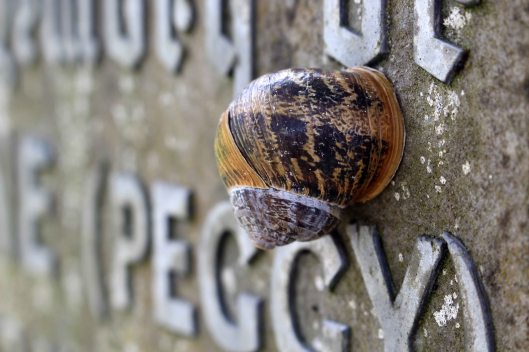
Finally, two snails that realise how much I struggle to put a name to them, and so make it easy for me. Meet William and Peggy!


29 Wednesday Mar 2017
Tags
calcareous rock, cephalopods, Erfoud, fossils, Morocco, trilobites
I’ve always been fascinated by fossils and would love to find a little something special (I’m hoping my move to the south Wales coast will help fulfil this dream as there are fossils, and even dinosaur bones, in nearby cliffs) so imagine my delight when we visited a fossil exhibition, museum, factory and shop during a tour of Morocco back in 2014.
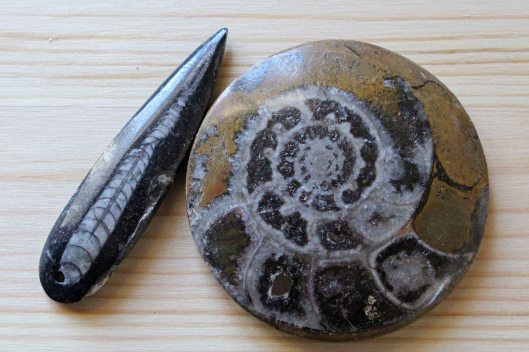
We were near the town of Erfoud, in southern Morocco, an area which is now extremely arid but 500 million years ago was under the ocean. Some of the creatures that inhabited that ocean – in particular, the cephalopod molluscs and trilobite anthropods – became stranded in muddy lagoons that gradually dried out and, over time, the mud and creatures were transformed into a fine-grained calcareous rock containing the perfectly preserved fossilised creatures.
The museum-come-shop had some wonderful specimens on display and for sale, including large items like tables and lamp bases, wash basins and fountains. I couldn’t quite fit a table-top in my backpack but I did buy a couple of small trinkets, shown in the last photo included here. And if I do manage to find anything more local, I’ll definitely be posting about it!

26 Sunday Mar 2017
Tags
Aegopinella nitidula, British snails, Clear glass snail, Discus rotundatus, Discus snail, Kentish snail, Monacha cantiana, Rounded snail, Smotth glass snail, snails, Waxy glass snail
I had no intention of sliding down the slippery slope of snail identification but I’ve found a few in recent weeks and couldn’t not try to ID them. And then a friend, who has given up on that ‘too hard’ process, gifted me his guide book. Luckily, there is also a good ‘Slugs and Snails of the British Isles’ group of very helpful folks on Facebook, though you do have to know which bits of the snail to photograph for them to be able to help. So, these little snails are hopefully correctly identified as follows:
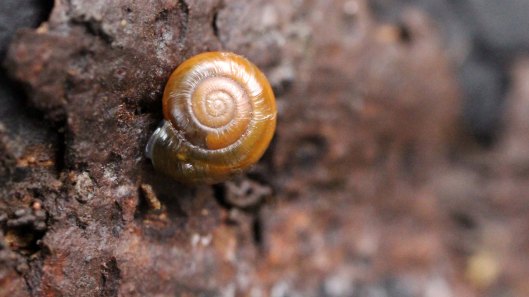
Smooth glass snail (Aegopinella nitidula)
Also known as the Clear glass snail or Waxy glass snail, this little land mollusc can be found munching away on plant matter all year round in gardens and hedgerows, rough grassland, waste ground and woodlands throughout much of Britain. It only grows to around 10mm so is quite little.

Rounded snail (Discus rotundatus)
At between 5 and 7mm across, the Rounded or Discus snail (I think that second name suits it very well) is also rather small. Its shell is quite flat but tightly coiled, with up to 6 whorls, and its upper surface is densely ribbed. It’s another very common snail (I obviously haven’t been looking very hard as this was my first sighting) and is especially partial to sheltered damp spots under logs, amongst leaf litter, beneath stones and rubble. Apparently it feeds on detritus (I’m never quite sure what that means!) and fungi.
Kentish snail (Monacha cantiana)
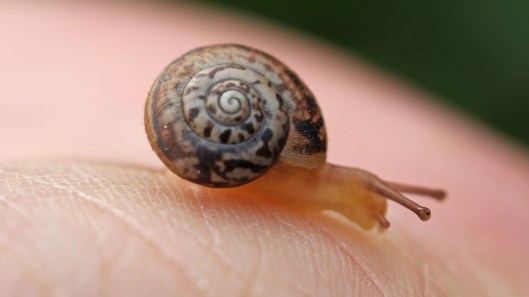
It may be named the Kentish snail but this is actually an introduced species. According to the German website Animal Base, it was ‘introduced to Great Britain with farmers in late Roman times and spread mainly in the mediaeval period, occupying a compact area covering S and E England, and still continues spreading (isolated sites in Wales, W central England and Scotland)’. The slight hairiness of my little friend (see photo above right) is because it’s a juvenile – those hairs will rub off as it grows to its full size of around 16mm.

You must be logged in to post a comment.