Winding back the clock
15 Friday Dec 2017
15 Friday Dec 2017
13 Wednesday Dec 2017
Tags
#WildWords, forests, invented words, trees, walking in nature, wandering through forests, werifesteria
Although you might read in some corners of the internet that werifesteria is a word with its origins in Old English, this word will not be found in any dictionary. It seems it was invented in late 2014 and can now be found most commonly on social media, overlaying images of trees and forests.

Despite this, I like the word and the meaning that has been attached to it: ‘to wander longingly through the forest in search of mystery’. That’s my kind of verb!

11 Monday Dec 2017
Tags
bryophytes, Cosmeston, Cosmeston Lakes Country Park, lichen on trees, lichens, mosses, mosses on trees
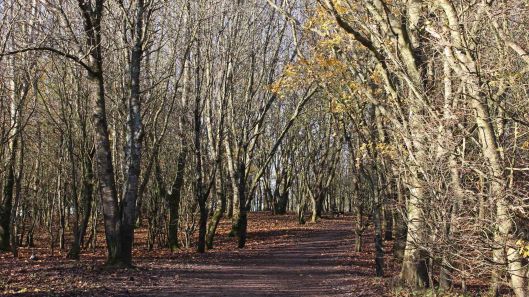
Over the summer months my eye has been distracted by all the little creatures that move – butterflies and moths, dragonflies and beetles, and all manner of other insects – but now that it’s winter and those creatures have mostly disappeared (you’ll notice one crept in to one of my photos!), my eye is again drawn to the more static beauty that surrounds me. Take, for example, this small grove of trees at Cosmeston Lakes Country Park.

I spent perhaps an hour here the other day, looking in wonder at the incredible variety of tiny lichens and bryophytes to be found on the tree trunks. I haven’t tried to identify these but I’m determined to return to them over the coming months to see which I can put names to and find out more about. For now, I just want to share their beauty.
06 Wednesday Dec 2017
Tags
#WildWords, autumn leaves, Psithurism, rustling leaves, sound of rustling leaves, words about Nature
Here’s a word that’s not in the Oxford Dictionary because it’s now considered obsolete but, as Oxford University Press has a habit of somewhat arbitrarily removing words from its dictionaries (since 2007 it was deleted words like ‘buttercup’ and acorn’ from its Junior Dictionary) and replacing them with modern lingo (like ‘cut-and-paste’ and ‘analogue’), I’m doing my bit to revive words before they’re forgotten.

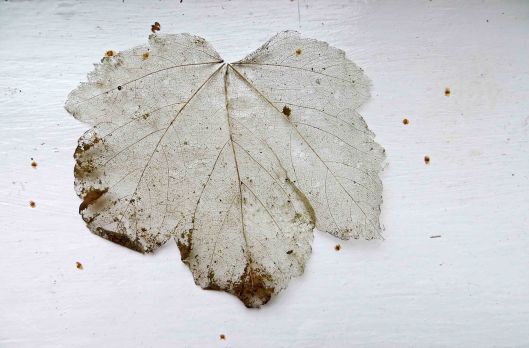
Psithurism, then, is a noun used to describe the sound of rustling leaves. It is, apparently, an adaptation of the Ancient Greek ψιθύρισµα (psithurisma) or ψιθυρισµός (psithurismos), which are derived from ψιθυρίζω (psithurizō, meaning ‘I whisper’) and from ψίθυρος (psithuros, meaning ‘whispering’ or ‘slanderous’). Can you hear them rustling? And, here’s a little test: what’s the word for leaves like these that wither but stay attached to the stem?

04 Monday Dec 2017
Tags
birding, birdwatching, Crossbill, Glamorgan Bird Club, Indian runner, Parc Cwm Darran, Siskin, Welsh valleys
With temperatures hovering around zero and a brisk wind making it feel even colder, our eleven intrepid Glamorgan Bird Club members were well wrapped up for last Wednesday’s birding at Parc Cwm Darran (and Rhaslas Pond, but more on that tomorrow).
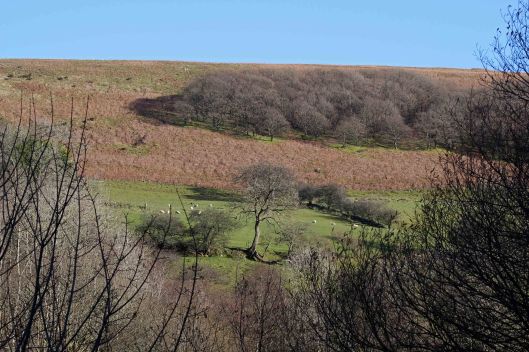

The park sits on the site of the old Ogilvie Colliery, which was active from the early 1900s through to 1975, and various buildings and pieces of mining equipment can still be seen around the park. The scenery was stunning, with glorious old trees dotting the landscape, as well as areas of more modern plantings. One of our party was a local and showed us one particularly beautiful hidden gem, a waterfall cascading over the edge of an old quarry into a pool below.


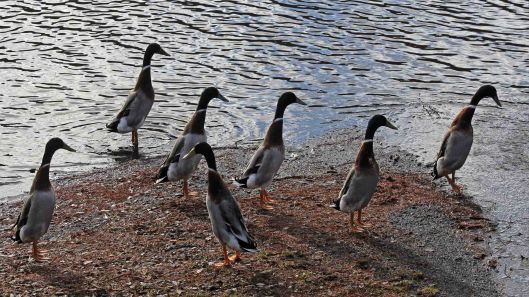
The birds were also stunning. We had good ’scope views of a male Crossbill, who sat very obligingly atop a tree for at least 15 minutes; we enjoyed sightings of several birds of prey, including four Buzzards, one of which came flying low straight towards us out of the quarry; and I saw my first Siskins of the year. The prize for the most entertaining birds, however, must go to the seven Indian runners, who looked to have Mallard in their genes and who were convinced we had food for them, running out of the water towards us and following us as we walked along the lake edge.
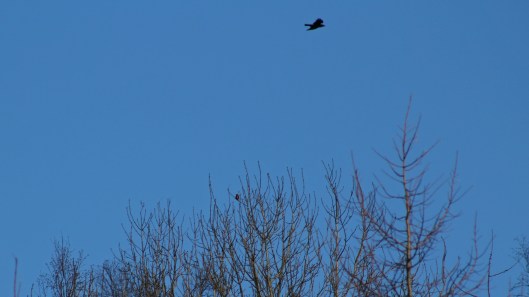
You’ll have to take my word about the dot in the tree being a Crossbill!

The full list of the 44 species seen (these include those seen at Rhaslas Pond) is: Mute Swan, Canada Goose, Wigeon, Mallard, Tufted Duck, Goldeneye, Goosander, Great Crested Grebe, Red Kite, Sparrowhawk, Buzzard, Kestrel, Coot, Lesser Black-backed Gull, Herring Gull, Green Woodpecker, Magpie, Jay, Rook, Carrion Crow, Raven, Blue Tit, Great Tit, Coal Tit, Long-tailed Tit, Goldcrest, Wren, Nuthatch, Treecreeper, Starling, Blackbird, Fieldfare, Song Thrush, Mistle Thrush, Robin, Stonechat, Dunnock, House Sparrow, Pied Wagtail, Chaffinch, Goldfinch, Siskin, Common Crossbill and Bullfinch, though somehow I missed the Green woodpecker and Mistle thrushes.

29 Wednesday Nov 2017
Rampike: Noun, meaning ‘A dead or dying tree, especially the bleached skeleton or bleached trunk of a tree killed by fire, lightning or wind; an upright stump, especially a burnt one’.

The Oxford Dictionary lists the word as being common in Irish English, English Regional, North American Regional, and Northern, though what Northern means is unclear. The rampikes in my photos are English (above) and Welsh (below).

28 Tuesday Nov 2017
22 Wednesday Nov 2017
15 Wednesday Nov 2017
Tags
#WildWords, canopy disengagement, Canopy shyness, Crown shyness, Intercrown spacing, tree behaviour
Who would’ve thought that trees value their personal space? Well, they do … or, at least, some trees, particularly those of the same species, do.
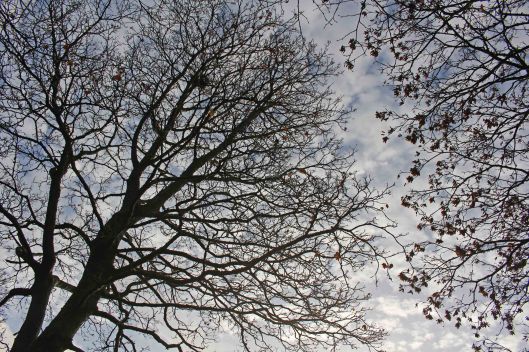
Next time you go walking amongst trees, look up and you may notice gaps in the tree canopy, where trees appear to be avoiding touching each other. This phenomenon is known as crown shyness (sometimes also called canopy shyness, intercrown spacing and canopy disengagement). There have been various hypotheses to explain crown shyness: these include ‘reciprocal pruning’ caused by the trees rubbing together in windy conditions; ‘photoreceptor-mediated shade avoidance response’, a long-winded term for trees adapting to the shade caused by their neighbours; and the idea that trees are actively limiting the spread of insects by not touching each other (though, presumably, insects could simply crawl down one tree, across the ground and up the next!). Whatever the true reason, crown shyness can create some lovely patterns in the canopy and I’ll be looking up more often from now on.

12 Sunday Nov 2017
There is so much to love about autumn: it’s as if Nature is an award-winning play, and all the trees are her actors. She’s coming to the end of another successful season, it’s the last grand finale, the players are dressed in magnificent richly coloured costumes ready to take their final bows before a rapturous audience amidst great critical acclaim … and then the curtain comes down for another year.
You must be logged in to post a comment.