‘No spring nor summer beauty hath such grace
As I have seen in one autumnal face.’
~ John Donne, ‘Elegy IX: The Autumnal’, The Complete Poetry and Selected Prose



12 Monday Sep 2016
‘No spring nor summer beauty hath such grace
As I have seen in one autumnal face.’
~ John Donne, ‘Elegy IX: The Autumnal’, The Complete Poetry and Selected Prose
05 Monday Sep 2016
It must be autumn – even if I chose to ignore the cooler evenings, the nights drawing in and the falling leaves, I can’t ignore the gorgeous cyclamen flowering in my local park!

The Wild cyclamen (Cyclamen hederifolium) is not native to Britain – it hails from the Mediterranean countries, though has, over time, made its way into more northern European countries, including Britain, where garden escapees have gradually become naturalised in many of the southern counties and here in Wales.


The word cyclamen comes originally from the Greek for circle, cyclamīnos, which is a nod to its round-shaped tuber, and the species name, hederifolium, is a combination of the Latin hedera (meaning ivy) and folium (meaning leaf), which refers to the shape and patterns on cyclamen leaves. More interesting though is its common name, sowbread, which apparently came about because pigs like to eat cyclamen, a fact reflected not only in the English common name but in several other languages as well: pain de pourceau in French, pan porcino in Italian, varkensbrood in Dutch, and ‘pigs’ manjū’ in Japanese.


20 Sunday Dec 2015
Posted in fungi, nature, nature photography
I was living in Auckland, New Zealand, when I first spotted one of these mushrooms and I admit to having had a ‘wow’ moment. It was like walking into a fairytale … I half expected fairies and elves to emerge and perform a magical dance amongst the leaf litter. This is, after all, the classic what-every-kid-would-draw-if-you-asked-them mushroom.

The Fly agaric (Amanita muscaria), also known as the Fly amanita and the Scarlet flycap, isn’t native to New Zealand but was unintentionally introduced there due to its rather intimate relationship with pine trees. Since its arrival, it has been quite wanton and, as it has now begun forming relationships with native trees, to the detriment of native fungi, it is considered a pest.

On the left, a young mushroom; on the right, an aging specimen
As the flesh of the Fly agaric contains psychoactive substances it has been used for centuries in religious and shamanistic rituals in Asia and parts of northern Europe. This fungus is, however, classified as poisonous, so forget the hallucinogenic adventure and feast with your eyes only!
16 Wednesday Dec 2015
Posted in autumn, nature, nature photography, wildflowers
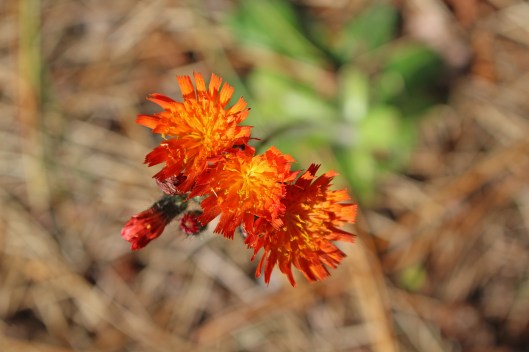
Just two short weeks ago, my local cemetery was dotted with these vibrant little bursts of orange. Now they’ve all disappeared. This pretty little member of the daisy family is officially known as Pilosella aurantiaca but I much prefer its many common names: orange or tawny hawkweed (‘hawk’ because the Romans believed hawks ate the blossoms to enhance their vision and ‘weed’ because it can be very invasive in the right conditions); Grim-the-collier (after the character Grim, who appeared in English devil plays in the 1600s); devil’s paintbrush (another reference to the devil in those old plays or, maybe, because it can be a devil of a plant to get rid of!); and, my favourite, fox-and-cubs (perhaps because the yet-to-open flowers seem to hide beneath those that are open or, more likely, because the furry rosette of leaves sends out runners to produce more furry little plants). Love it or curse it, this little plant is rich in nectar so a favourite of bees.
10 Thursday Dec 2015
Posted in autumn, birds, leaves, nature, nature photography

For me, one of the great pleasures of late autumn / early winter is scuffing up leaves. Feet clad in hiking boots or wellies, I head out to those areas of park or woodland where the deciduous trees are at their most dense, and I look for the deepest drifts of leaves I can find. And I walk and I kick and I scuff those leaves up, producing little showers of orange and red and gold as the crispy leaves rustle and scrunch and flutter back down to the ground.

I feel sorry for those grumpy adults who frown in my direction, their stern looks chastising me for such undignified behaviour. How sad they are to live such a restricted life, to have forgotten the simple – and free! – pleasure of kicking up a few leaves.
As the winter weather slowly morphs the fallen leaves into a dreary brown sludge, I continue to scuff when I can because those leaves now contain the worms and woodlice and grubs the little birds love to eat. And, if I’m lucky, my scuffing efforts will be rewarded by the sweet serenade of a robin, full-bellied and happy from its snacking.

 earthstar
You must be logged in to post a comment.