• ABOUT
  • BIRDING 2018
  • Birding 2019
  • BLOG POSTS
  • Butterflies 2018
  • Resources

earthstar

~ a celebration of nature

earthstar

Tag Archives: birding

Whistling a merry tune?

10 Wednesday May 2017

Posted by sconzani in birds, nature

≈ Leave a comment

Tags

Angkor Centre for Conservation of Biodiversity, Asian birds, birding, birds of Cambodia, birdwatching, Dendrocygna javanica, Lesser whistling duck, Siem Reap, whistling duck

You might be forgiven for thinking that a bird with the name Lesser whistling duck (Dendrocygna javanica) could sing a merry tune but apparently its song is only a two-note wheezy call. Instead, and rather remarkably, its outermost primary wing feather has a rather unusual shape and is said to produce a prominent whistling sound when the bird is flying. As I only saw this duck looking rather drowsy and sitting perfectly still, I can neither confirm nor deny its musicality.
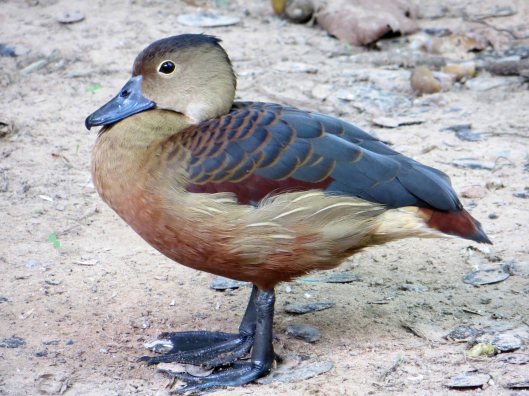
170510 Lesser whistling duck

Lesser whistling ducks can be found throughout the wetlands of Southeast Asia and lowland parts of the Indian subcontinent. I photographed this one in Cambodia, at the Angkor Centre for Conservation of Biodiversity about 60 kilometres outside Siem Reap. (You can read more about the conservation, rescue, rehabilitation and educational work of the ACCB here.)

Like Loading...

The Sanderlings and the Dunlins

01 Monday May 2017

Posted by sconzani in birds, nature, spring

≈ 2 Comments

Tags

birding, birdwatching, British birds, Calidris alba, Calidris alpina, Dunlin, passage migrant, Sanderling

Yesterday I told you about my chilly but super exciting birdwatching morning on Saturday and showcased two of the highlights, the Whimbrel and the Bar-tailed Godwit. Today, we have the Sanderlings and the Dunlins, both so well camouflaged against the stones on the seashore that, if they hadn’t been almost constantly moving about in their search for insects, they would’ve been very hard to spot.

170501 sanderling (2)
170501 sanderling (3)
170501 sanderling (1)

Sanderlings to the left, Turnstones to the right

Like yesterday’s birds, the Sanderling (Calidris alba) is a passage migrant, seen in parts of coastal Britain during the spring as it heads to its breeding grounds in the Arctic and in the autumn as it heads south to tropical beaches around the world, a journey that can be as long as 6000 miles. During the breeding season, the birds’ grey plumage takes on a much redder hue on the head, neck and back, which you can clearly see on one of these birds (particularly in the photo top left).

170501 dunlin (1)

The Dunlin (Calidris alpina) – like the Sanderling, a member of the Sandpiper family – is a very common sight on Britain’s coast throughout the year, though breeding birds head to the upland areas of Wales, Scotland and England to nest between April and July. The Dunlin also becomes a more rufous colour during the breeding season and acquires the dark tummy feathers you can see on these birds. I’m guessing they’ll be heading for the hills shortly to find a mate.

170501 dunlin (2)
170501 dunlin (3)
Like Loading...

The Whimbrel and the Barwit

30 Sunday Apr 2017

Posted by sconzani in birds, nature, spring

≈ 2 Comments

Tags

Bar-tailed Godwit, birding, birdwatching, British birds, British seabirds, Limosa lapponica, Numenius phaeopus, passage migrants, Whimbrel

170430 whimbrel (1)

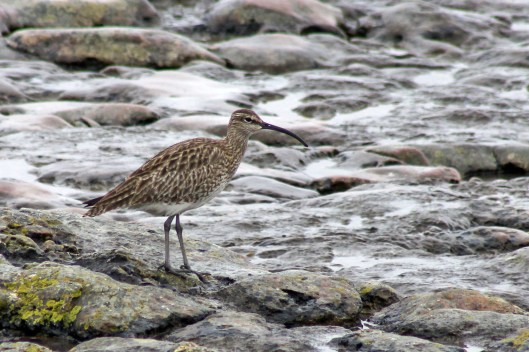
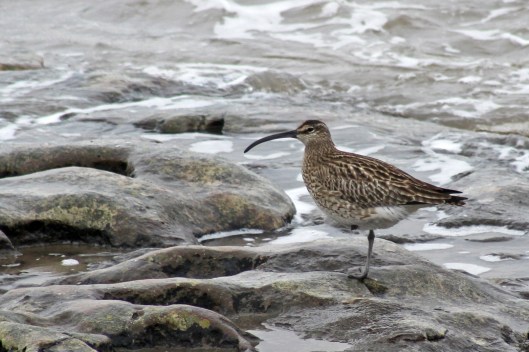
I was in my element yesterday morning, stealthily stalking along the stony coastal path at Sully in a shiver-inducing chilly wind, trying to observe and photograph a wonderful variety of seabirds. And I got lucky, really really lucky, as by the time I decided I needed to get walking to ward off hypothermia, I had seen noisy fly-pasts of Oystercatchers; Dunlins and Turnstones and, an unexpected bonus, two Sanderlings foraging along the tide-deposited seaweed; several rather skittish Whimbrels; and a fleeting glimpse of one also unexpected but rather beautiful Bar-tailed Godwit.

170430 Whimbrel and bar-tailed godwit (1)
170430 Whimbrel and bar-tailed godwit (2)

Both the Whimbrels and the Bar-tailed godwit are passage migrants. The Whimbrel (Numenius phaeopus) (the bird with the curved beak) can be seen around Britain’s coastline during spring as it flies north to Shetland and Orkney to breed and again in autumn when it heads back to South Africa to enjoy a warmer winter. The Bar-tailed Godwit (affectionately abbreviated amongst birders to Barwit) (Limosa lapponica) passes through Britain on its way to its breeding grounds in the Scandinavian and Siberian Arctic, though does sometimes over-winter in Britain.

p.s. See tomorrow’s post for the Sanderlings and the Dunlins.

170430 whimbrel (2)

Like Loading...

Happy as a (Sky)lark

20 Thursday Apr 2017

Posted by sconzani in birds, nature

≈ 2 Comments

Tags

Alauda arvensis, bird conservation, bird idiom, birding, birdwatching, British birds, happy as a lark, Red list, Skylark, The Blorenge

It’s easy to see where the ‘happy as a lark’ expression comes from when you hear a Skylark singing – they sound like they’re positively bursting with happiness. And, though they sing throughout the year, spring is the prime season for their singing, as the males perform their vertical flight displays, hovering and belting out their songs from high in the sky before plummeting back down to earth. How could a female Skylark not be impressed with such melodic rhapsodies!

170420 Skylark (1)

When it’s on the ground, the Skylark (Alauda arvensis) can be difficult to spot, as its streaky brown colours blend so well with its preferred habitat, of grassland and moorland, as you can see in these photos, taken on top of The Blorenge, a 561-metre mountain in the Brecon Beacons National Park.

170420 Skylark (2)
170420 Skylark (3)
170420 Skylark (4)

Sadly, the once numerous Skylark has declined greatly in numbers in recent years and it’s now on the British Red List of Birds of Conservation Concern. Its decline has been attributed to agricultural intensification and to changing farming practices – many farmers have switched from spring to autumn for the sowing of their cereal crops, which has a knock-on effect on farmland birds. Hopefully, something can be done to rescue these beautiful songsters; otherwise the Skylark will be happy no longer.

Like Loading...

A Green-legged long-shank comes to call

17 Monday Apr 2017

Posted by sconzani in birds, nature

≈ 2 Comments

Tags

birding, birdwatching, Cardiff Bay, Green-legged horseman, Green-legged long-shank, Greenshank, Tringa nebularia

I get alerts for sightings of uncommon birds through various Twitter accounts and my birding group on Facebook and, when I heard a Greenshank had been spotted in Cardiff Bay, I crossed my fingers it would stay around overnight and was up early the next morning to see. I was lucky and, considering they have a reputation for being flighty, this bird was uncommonly still and very obliging. When it did start a little nervous jiggle, I quickly moved on.

170417 Greenshank (1)

The Greenshank (Tringa nebularia) has gained a delightful collection of common names including barker, stiltie (in Scotland, meaning wader with long legs), greater plover, green-legged horseman, green-legged long-shank, and green-shanked godwit. As you might guess from all those mentions of ‘green shanks’, it has a greenish tinge to its long slim legs. It’s an elegant bird, I think, not large, though it is the largest amongst its close relatives the redshanks and larger sandpipers.

170417 Greenshank (2)

In south Wales, the Greenshank is mostly a passage bird, seen around coastal wetlands and estuaries and near inland waters like ponds and marshes. They spend their winters in western Europe, the Mediterranean and Africa, through the Middle East and Arabian Peninsula to Southeast Asia, and as far south as Australia, and in Britain they spend their summers in the north and west of Scotland, where they breed on upland moorlands, usually near trees, a large rock or fencepost (possibly as a visual aid to nest location).

Like Loading...

Genetic mutation leads to immigration

13 Thursday Apr 2017

Posted by sconzani in birds, nature

≈ 2 Comments

Tags

birding, birdwatching, Collared dove, genetic mutation, Mutation affected sense of direction, Streptopelia decaocto

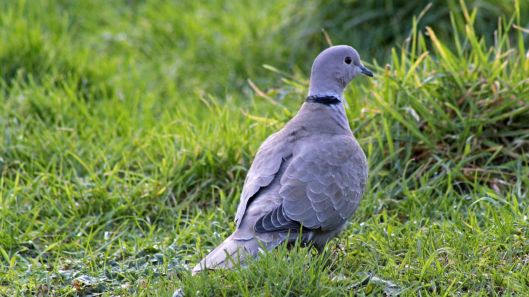
I came across the delightful bird in the series of three images below during a recent walk around Cardiff Bay. Sitting quietly in a tree by the footpath, it was indulging in a good preening, running its beak repeatedly down through its fluffed-up chest feathers. It’s a Collared dove (Streptopelia decaocto), a bird you’re often more likely to hear than to see, its continuous cooing floating down from the leafy trees where it’s sitting.

170413 Collared dove (2)
170413 Collared dove (1)
170413 Collared dove (3)

Amazingly, these birds only immigrated to Britain in the 1950s – they’re native to the Middle East but gradually spread across Europe before crossing the Channel, and they’re now very common garden visitors in villages and towns across the country. In Fauna Britannica, Richard Mabey notes that this incredible spread, more than any other European bird in the past 50 years, has been attributed to ‘a genetic mutation that affected the birds’ sense of direction and encouraged them to move north and west’, though the British Trust for Ornithology believes natural selection has probably now reduced this tendency. If it hadn’t, the birds would all be flying off over the Atlantic, a trip they probably wouldn’t survive.

170413 Collared dove (4)

Like Loading...

The chase is on!

11 Tuesday Apr 2017

Posted by sconzani in birds, nature

≈ 2 Comments

Tags

birding, birdwatching, Cygnus olor, Mute swan, swan, swan chasing swan, swan protecting female

170411 Swan chases swan (1)

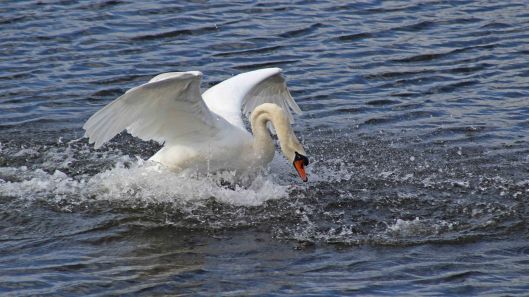
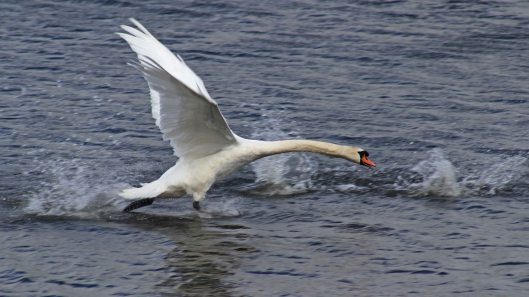
Mute swans (Cygnus olor) sure do get stroppy at this time of year. I guess it’s all about establishing and protecting their relationships with their female companions but sometimes they do get a bit carried away. This angry bird must’ve chased the interloper almost 500 metres before it was satisfied the other bird was far enough away from its lady friend and returned to her.

170411 Swan chases swan (2)170411 Swan chases swan (3)170411 Swan chases swan (4)170411 Swan chases swan (5)170411 Swan chases swan (6)

Like Loading...

Craig-y-Cilau National Nature Reserve

10 Monday Apr 2017

Posted by sconzani in geology, nature, parks, walks

≈ Leave a comment

Tags

birding, birdwatching, Brecon Beacons, Craig-y-Cilau, Glamorgan Bird Club, limestone cliffs, national nature reserve, old tramway

170410 Craig Y Cilau NNR (4)

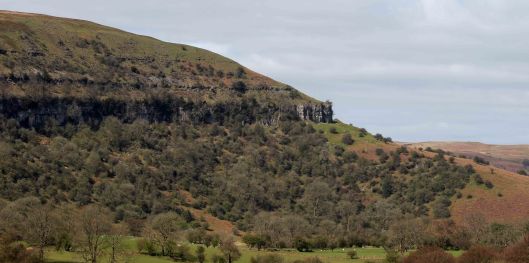
Last Wednesday I joined 19 of my fellow Glamorgan Bird Club members on a trip to the Craig-y-Cilau National Nature Reserve. Though our species list for the day totalled around 30, most birds were too distant for photographs but the location, high in the hills on the edge of the Brecon Beacons National Park, is stunning!

170410 Craig Y Cilau NNR (7)
170410 Craig Y Cilau NNR (3)
170410 Craig Y Cilau NNR (8)

The limestone cliffs here were once quarried and our path – at times rather narrow and with a steep drop to one side – followed the route of the old tramway, the signs of which could still be seen in the stones. The cliffs are riddled with caves, with a mapped system of over 400 miles of passageways, though you’d be foolhardy to enter without an experienced guide.

170410 Craig Y Cilau NNR (6)

Though the birds were somewhat elusive, we were surrounded by flourishing and sometimes rare flora, with wildflowers aplenty and some interesting fungi.

170410 Craig Y Cilau NNR (1)
170410 Craig Y Cilau NNR (5)

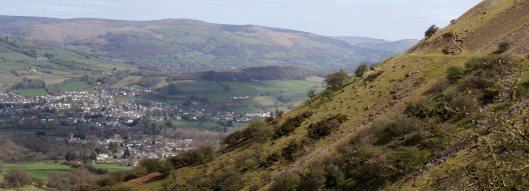
And the panoramic views, towards the towns of Crickhowell and Llangattock and over the surrounding countryside, were simply sensational. We didn’t get a chance to explore the whitebeam-filled woodlands or the unique raised bog so I’m already planning a return trip.

170410 Craig Y Cilau NNR (2)

Like Loading...

The birds are back in town!

08 Saturday Apr 2017

Posted by sconzani in birds, nature

≈ 3 Comments

Tags

birding, birdwatching, Cardiff Bay, migrating birds, Riparia riparia, Sand martin, signs of summer

Not just any old birds – I’m referring to the Sand martins (Riparia riparia), one of the first migrating birds to arrive in the springtime. When you start to see them swooping and diving in the hunt for insects and hear their characteristic chattering sounds, you know summer really is just around the corner.

170408 Sand Martin (1)

The Sand martins have been arriving at various places along the south Wales coast for the past couple of weeks, after a marathon flight from their overwintering spots in the Sahel, south of the Sahara in Africa. For such small birds, it really is a huge effort so it’s no surprise they stop over in Cardiff Bay to refuel and rest up. Though many birds fly on to destinations throughout Britain, some will stay on in Wales to breed and raise their broods of four or five chicks before heading south to Africa again around August-September. It’s usually quite difficult to get photos of these aerial acrobats but this morning I got lucky when this little one sat and sang me a pretty song.

170408 Sand Martin (2)

Like Loading...

Another day, another new gull!

06 Thursday Apr 2017

Posted by sconzani in birds, nature

≈ Leave a comment

Tags

birding, birdwatching, Blakc-headed gull, Cardiff Bay, gulls, Ichthyaetus melanocephalus, Mediterranean gull

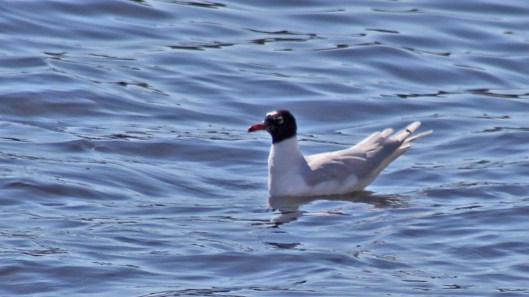
I’m rather ignorant about gulls but, when I saw this particular gull in a flock of about 20 others in Cardiff Bay a few days ago, I realised it looked different though I wasn’t able to identify the bird until I got home and had a good look at my photos. Even then I wasn’t entirely certain so posted some photos on the South Wales Birding group page on Facebook to get some expert opinions. And it turns out my deduction was right – this is a Mediterranean gull (Ichthyaetus melanocephalus).

170406 Mediterranean gull (1)

How did I recognise it from the usual Black-headed gulls (BHGs)? Well, in this bird the black feathers cover the whole head, rather than just the front half, and they are very black, not dark brown like the BHGs – the word melanocephalus means black-headed. Also, as one of my Facebook friends pointed out, you should always keep a look out for gulls that have white primaries, the long outermost feathers towards the top of a bird’s wing. Here are some flight photos that show how pale this bird’s wings were (and apologies for the poor images – it’s not easy to capture a flying bird and these are also heavily cropped).

170406 Mediterranean gull (2)
170406 Mediterranean gull (3)
170406 Mediterranean gull (5)
170406 Mediterranean gull (4)
Like Loading...
← Older posts
Newer posts →

About me

sconzani

sconzani

I'm a writer and photographer; researcher and blogger; birder and nature lover; countryside rambler and city strider; volunteer and biodiversity recorder.

View Full Profile →

Follow earthstar on WordPress.com

Enter your email address to follow this blog and receive notifications of new posts by email.

Recent blog posts

  • A Portland Bill Kestrel April 2, 2026
  • A proliferation of Peacocks April 1, 2026
  • Little owl March 31, 2026
  • Distant seabirds March 30, 2026
  • Thrift March 29, 2026

From the archives

COPYRIGHT

Unless otherwise acknowledged, the text and photographs on this blog are my own and are subject to international copyright. Nothing may be downloaded or copied without my permission.

Fellow Earth Stars!

  • Unknown's avatar
  • Unknown's avatar
  • Unknown's avatar
  • Unknown's avatar
  • Unknown's avatar
  • Unknown's avatar
  • Unknown's avatar
  • Unknown's avatar
  • Unknown's avatar
  • Unknown's avatar
  • Unknown's avatar
  • Unknown's avatar
  • Unknown's avatar
  • Unknown's avatar
  • Unknown's avatar
  • Unknown's avatar
  • Unknown's avatar
  • Unknown's avatar
  • Unknown's avatar
  • Unknown's avatar
  • Unknown's avatar
  • Unknown's avatar
  • Unknown's avatar
  • Unknown's avatar
  • Unknown's avatar
  • Unknown's avatar
  • Unknown's avatar
  • Unknown's avatar
  • Unknown's avatar
  • Unknown's avatar
  • Unknown's avatar
  • Unknown's avatar
  • Unknown's avatar
  • Unknown's avatar
  • Unknown's avatar
  • Unknown's avatar
  • Unknown's avatar
  • Unknown's avatar
  • Unknown's avatar
  • Unknown's avatar
  • Unknown's avatar
  • Unknown's avatar
  • Unknown's avatar
  • Unknown's avatar
  • Unknown's avatar
  • Unknown's avatar
  • Unknown's avatar
  • Unknown's avatar
  • Unknown's avatar
  • Unknown's avatar

Blog at WordPress.com.

Privacy & Cookies: This site uses cookies. By continuing to use this website, you agree to their use.
To find out more, including how to control cookies, see here: Cookie Policy
  • Subscribe Subscribed
    • earthstar
    • Join 642 other subscribers
    • Already have a WordPress.com account? Log in now.
    • earthstar
    • Subscribe Subscribed
    • Sign up
    • Log in
    • Report this content
    • View site in Reader
    • Manage subscriptions
    • Collapse this bar
 

Loading Comments...
 

You must be logged in to post a comment.

    %d