• ABOUT
  • BIRDING 2018
  • Birding 2019
  • BLOG POSTS
  • Butterflies 2018
  • Resources

earthstar

~ a celebration of nature

earthstar

Tag Archives: birding

New Zealand’s parson bird

18 Wednesday May 2016

Posted by sconzani in birds, nature, nature photography

≈ 4 Comments

Tags

birding, birdwatching, New Zealand birds, parson bird, Prosthemadera novaeseelandiae, tui

For world wildlife Wednesday this week, I thought I’d go back to my roots and show you one of my favourite New Zealand birds.

160518 tui (1)

Called the parson bird by the early European immigrants to New Zealand, presumably because the white tufts of feathers at the front of its neck resemble a priest’s clerical collar, the Tui (Prosthemadera novaeseelandiae) is anything but pious. In fact, it has a habit of imbibing so much nectar from blossoming trees that it becomes quite intoxicated and sings uproariously. Its song is one of its most endearing qualities, highly variable, pleasingly melodic but also including a comprehensive vocabulary of clicks, creaks, cackles and groans.

160518 tui (2)
160518 tui (3)

Beautifully plumaged in shades ranging from iridescent greens and blues through dark browns to an inky black, the Tui has quite a distinctive flight pattern, with louder flapping than most other birds due to its relatively short wide wings. Chances are, then, that if you visit New Zealand, you’ll hear the tui before you see it.

160518 tui (4)
160518 tui (5)
Like Loading...

Pigeons: ‘rats with wings’?

14 Saturday May 2016

Posted by sconzani in birds, nature

≈ 4 Comments

Tags

birding, birdwatching, British birds, domestic pigeon, feral pigeon, pigeon, rats with wings

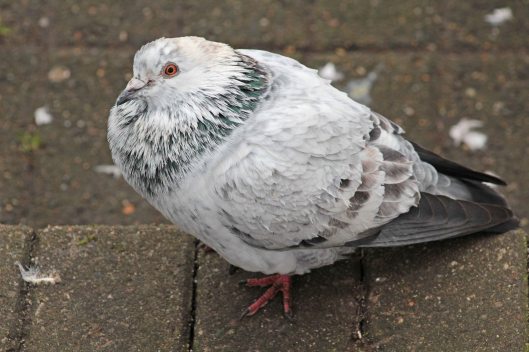
Humans have a love-hate relationship with the Feral pigeon (Columba livia domestica). On the one hand, we love to feed them – until recently, crowds would flock to London’s Trafalgar Square to be photographed feeding the birds (an activity now banned), and what child didn’t learn to love birds through feeding pigeons (or ducks). On the other hand, we hate the mess they make and spend millions defacing our buildings with anti-pigeon spikes and wires to stop pigeons roosting on their handy ledges.

160514 pigeons (3)

Yet, the pigeon has long been a friend of humankind. It was probably our first tame bird, having been domesticated as early as c. 4000 BC; it has seen war service and been awarded medals as a carrier of messages; it has been admired for its homing abilities; and it was once an important source of food.

160514 pigeons (2)

While many feral pigeons have the grey colouring of their Rock dove ancestors, others display a multitude of colour combinations, ranging from almost completely white through red and brown to almost completely black. The reds are my favourites, just because they’re so different, but I think all pigeons are pretty and I would never call them ‘rats with wings’, like Woody Allen did in his 1980 film Stardust Memories.

160514 pigeons (1)

Like Loading...

Cute coots!

08 Sunday May 2016

Posted by sconzani in birds, nature

≈ 4 Comments

Tags

birding, birdwatching, British birds, Coot, Eurasian coot, Fulica atra, nesting birds

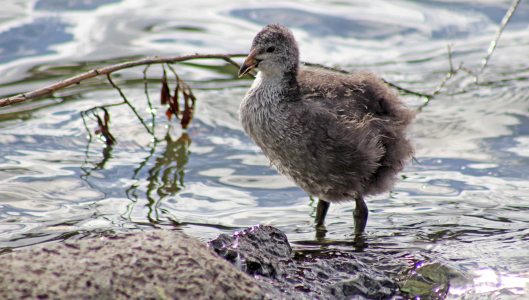
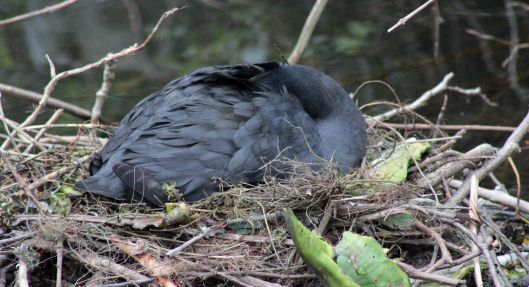
Around the British Isles, near rivers and lakes, ponds and meres, reservoirs, flashes and gravel pits, the Eurasian coot (scientific name Fulica atra, and commonly just called coot) can currently be found nesting. In shallow water, sometimes using the support of an underwater obstacle (two pairs in Cardiff are using the lights that illuminate the council building!), they build nests of sticks and grasses, and bits of human detritus like plastic, paper and other assorted rubbish.

160509 cute coots (1)160509 cute coots (3)

Mrs Coot lays between 5 and 10 eggs then incubates these for around three weeks, while hubby brings her food and continues to beautify the nesting platform. Though exceptionally cute, the chicks are bizarre-looking wee things, little bundles of black fluff with reddish-orange heads and a ruff of yellow feathers around their necks. The vibrant colour fades during their two-month fledgling period and juveniles look more greyish-brown, with a lighter throat and face.

160509 cute coots (5)
160509 cute coots (4)

Though both parents feed the chicks, they rarely all survive. This can be due to predation by Lesser black-backed gulls, mink and pike, though sometimes, if there is a lack of food, coot parents will occasionally kill their own chicks, sacrificing one for the good of the others.

160509 cute coots (6)
160509 cute coots (7)

160509 cute coots (7)

Like Loading...

When is a magpie not a magpie?

07 Saturday May 2016

Posted by sconzani in birds, nature

≈ 10 Comments

Tags

Australian magpie, birding, birdwatching, British birds, European magpie, Gymnorhina tibicen, Magpie, New Zealand birds, New Zealand magpie, Pica pica

What I grew up in New Zealand thinking of as a magpie is nothing like the magpies I see here in Wales, which is not really surprising as they are totally different species and the New Zealand bird is actually Australian. Confused?

European magpie (1)
European magpie (2)

The bird that lives in Britain is the European magpie (Pica pica) (pictured above) and is a member of the corvid family, a relative of crows, rooks and jackdaws. The bird that lives in New Zealand is Gymnorhina tibicen, one of the nine species of Australian magpie (there were thought to be two Australian species in New Zealand but this is now in doubt).

New Zealand 1 magpie male
New Zealand 2 magpie male

The Australian birds are called magpies because of their physical resemblance to the European birds – it was quite common for British settlers to name birds, animals and plants after similar ones ‘at home’. Australian birds from Tasmania and Victoria were introduced into several areas of New Zealand in the 1860s and 1870s by local Acclimatisation Societies to control pasture pests like grass grubs, and their supposed importance to New Zealand agriculture was the reason they were afforded legal protection till 1951.

New Zealand 3 magpie female
New Zealand 4 magpie juvenile

The magpies in New Zealand can be very aggressive birds, occasionally attacking both animals and humans that stray too close to their nests during the breeding season, though their nests are usually built high up in tall trees so their attacks are, in fact, unwarranted.

Like Loading...

Gossamery goslings

03 Tuesday May 2016

Posted by sconzani in birds, nature, nature photography

≈ 6 Comments

Tags

birding, birdwatching, British birds, gosling, Greylag goose, Roath Park Lake

I’ve always thought Ryan Gosling was rather cute but, sorry Ryan, you pale in comparison to these little guys and gals.

160503 goslings (2)

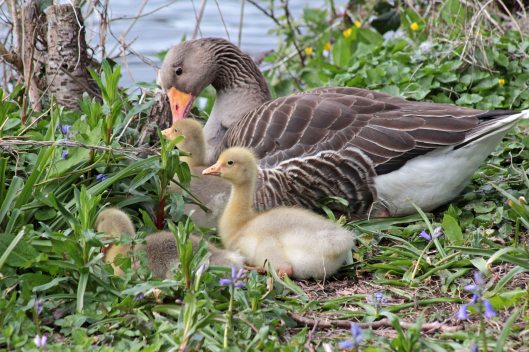
The Greylag geese (Anser anser) at Cardiff’s Roath Park Lake have produced at least three nests of goslings so far this spring, and they are the most delightful little creatures: awkward on their feet, quick to learn, well trained to stay close to mum and dad, playful little jokesters, fast growing, bundles of fluff.

160503 goslings (1)
160503 goslings (4)
160503 goslings (3)

160503 goslings (5)

Greylags usually lay between five and eight eggs, often in a large floating nest hidden amongst reeds, though at Roath Park they seem to nest under the vegetation on the small islands, where they’re protected from predatory Lesser black-backed gulls. Unlike many waterbirds, Mr and Mrs Greylag stay together to feed and guard their offspring, and the family will remain together until the adult birds are ready to mate again.

160503 goslings (6)160503 goslings (7)

160503 goslings (8)

Like Loading...

Magpies: sorrow or joy?

28 Thursday Apr 2016

Posted by sconzani in birds, nature

≈ 9 Comments

Tags

birding, birdwatching, British birds, Magpie, Pica pica

One for sorrow,
Two for joy,
Three for a girl,
Four for a boy,
Five for silver,
Six for gold,
Seven for a secret,
Never to be told.
Eight for a wish,
Nine for a kiss,
Ten for a bird,
You must not miss. 

So the modern version of the rhyme goes. The original version, first recorded in 1780, was a little more sinister – One for sorrow, Two for mirth, Three for a funeral, Four for birth, Five for heaven, Six for hell, Seven for the devil, his own self – reflecting the common perception of magpies as birds of ill omen.

160428 magpie (1)

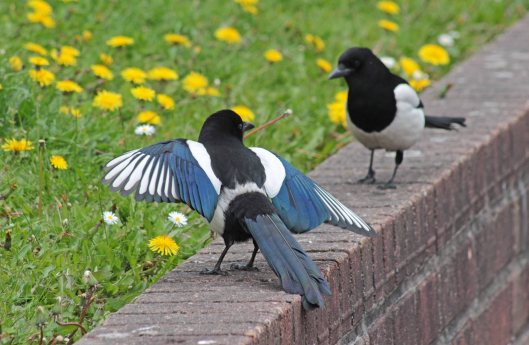
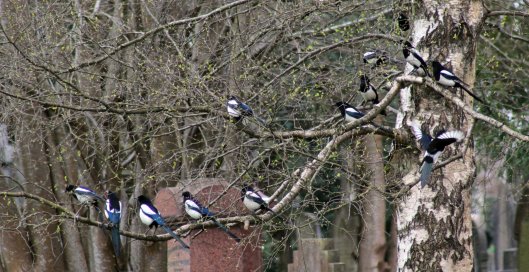
The magpie, with the easiest-to-remember scientific name of Pica pica, is a member of the corvidae family which also includes jays and crows, ravens and jackdaws. One look at that strong beak shows the similarity. But these birds also have other things in common: they are intelligent, able to solve problems and have excellent memory. They have a strong sense of curiosity, are sociable and are brilliant mimics. Many people think of magpies as black and white but, of course, they’re not. As soon as the sunshine strikes their back, wing and tail feathers, you can see what a gorgeous bluish sheen they feathers have.

 160428 magpie (3)

My question is: what does it mean when you see 12 magpies together?

160428 magpie (2)

Like Loading...

A birder’s bliss

25 Monday Apr 2016

Posted by sconzani in birds, nature, parks

≈ 6 Comments

Tags

birding, birdwatching, Blackcap, Blue tit, British birds, chaffinch, Cosmeston Lakes Country Park, Great tit, jackdaw, robin, Woodpigeon

We’ve seen some of the landscape at Cosmeston Lakes Country Park; we’ve checked out the prime lakefront real estate; and we’ve been tit-elated by some of its small birds. Now, here’s what was on Nature’s menu last Wednesday.

160425 blackcap

The absolute highlight of the day was seeing my first Blackcap, and not just one, but five in total, at different times, in different locations, including a female (she wears a brown cap). I was well pleased with that!

160425 tits

After a quiet birding day last time I visited, I was delighted to see more of my favourites this time: a robin was feeding its fledgling; the great and blue tits were demanding food; chaffinches and wood pigeons were getting tucked in to seed left by others; two buzzards were gliding overhead, looking for lunch; a jackdaw was collecting nest-making materials.

160425 wood pigeon
160425 robins
160425 jackdaw
160425 chaffinch

As well as these and many other birds, there was a wonderful assortment of butterflies and bees feasting on the lesser celandine and wild violets flowering along the path edges. There were occasional clumps of bluebells and wafts of wild garlic flowers, and it was a gloriously warm spring day. A man I met during my wandering told me I looked happy, and so I was, doing what I love most – being with nature.

Like Loading...

Cosmeston Lakes Country Park

24 Sunday Apr 2016

Posted by sconzani in nature, parks

≈ 3 Comments

Tags

birding, Cosmeston Lakes Country Park, countryside, walks, wildflowers

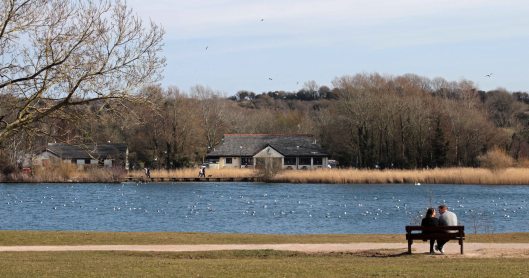
I’ve mentioned Cosmeston Lakes Country Park a couple of times previously in this blog so I thought I would show you what a wonderful place it is for a visit. With two lakes and over 100 hectares of woodland and meadows, it’s a place you can get lost in – or, at least, find somewhere to escape the madding crowd.
160424 cosmeston (5)

Where the lakes now provide homes to a myriad of waterbirds there used to be limestone quarries, providing the raw material for the since demolished British Portland Cement works. And the northern part of the park, which was once the site of two rubbish tips – the air vents can still be seen dotted around the grasslands, is now the perfect environment for wildflowers, birds and insects. It is a splendid example of a landscape reclaimed from the ravages of mankind to provide a home for wildlife, and so successful has that transformation been that some areas are now designated Sites of Special Scientific Interest.

160424 cosmeston (2)

The park is not far from Penarth, a seaside town on the outskirts of Cardiff. It is easily accessible by car or public bus, though I prefer to catch the train to Penarth then walk along the now-disused railway track that has been converted to a tree-lined trail heading west. For me, that provides the perfect start to a wonderful long wander in the park.

160424 cosmeston (1)
160424 cosmeston (4)
160424 cosmeston (3)
160424 cosmeston (6)
Like Loading...

In nesting news …

23 Saturday Apr 2016

Posted by sconzani in birds, nature, nature photography, spring

≈ 6 Comments

Tags

birding, birdwatching, British birds, chicks, Coot, Great Crested Grebe, Mute swan, nesting, nesting birds

I checked out the nesting neighbourhood again a couple of days ago so here’s the latest family news.

160423 grebe

At the original three-nest site: the Mute swans appear to have abandoned their nest, which was empty – maybe they just weren’t ready for parenthood. The Great crested grebe that had chicks but lost them was still sitting on her second nest, and she was sitting tight again so I still don’t know what she’s sitting on.

160423 coot A (1)
160423 coot A (2)

The Coots that had three chicks in my last update now have just one chick remaining. The family has left the nest, though are still in the same general area. Both parents are actively feeding the little guy but, sadly, I’m not overly optimistic about its chances as there were a lot of gulls, flying overhead and perched on nearby lamp posts, just looking for the right scavenging opportunity.

160423 coot B

Nearby, at the other Great crested grebe nest, the grebe has been usurped by a Coot. Her partner was about and feeding her but she didn’t stand up so I have no egg update for her.

160423 coots C (1)
160423 coots C (2)
160423 coots C (3)
160423 coots C (4)

I recently learnt of another Coot nest, also nearby, and seeing that was the highlight of the afternoon. Six chicks, all well developed and seemingly ravenous, were frantically being fed by both parents. Very cleverly, the parents were keeping them sitting under a lip of concrete at the water’s edge, so they were quite well protected. Let’s hope they continue to thrive.

Like Loading...

Black-crowned night heron

13 Wednesday Apr 2016

Posted by sconzani in birds, nature

≈ 5 Comments

Tags

Angkor Centre for Conservation of Biodiversity, birding, birds, birdwatching, Black-crowned night heron, heron, Kuala Lumpur Bird Park, Lincoln Park, Nycticorax nycticorax

For this week’s World Wildlife Wednesday we have a bird that can be found almost everywhere in the world (though it’s neither partial to the cold nor to Australasia), and my images go some way to showing that.

160413 Black crowned night heron cambo ACCB

My first photo of the Black-crowned night heron (Nycticorax nycticorax) was taken at the Angkor Centre for Conservation of Biodiversity (ACCB) not far from Siem Reap in Cambodia. Like so many species of wildlife in poverty-stricken Cambodia, this heron is considered by many locals to be a food item, and hunting has dramatically reduced its numbers. The ACCB operates a captive breeding programme that aims to rebuild the local population.

160413 black crowned night heron chicago

My second set of photos was taken in Chicago and shows immature night herons roosting in the trees in Lincoln Park, just north of the city centre. Due mainly to habitat loss, these herons are endangered in Illinois, so the Chicago Parks, Lincoln Park Zoo and Department of Natural Resources are working together to encourage and support the 400-odd birds that breed in Lincoln Park each year.

160413 black crowned night heron  kl

The location of my third photo is the Kuala Lumpur Bird Park in Malaysia. According to the Malaysian Birds website, the Black-crowned night heron is faring rather better in Malaysia, where the bird is widespread and the populations in local heronries frequently number in the hundreds.

Like Loading...
← Older posts
Newer posts →

About me

sconzani

sconzani

I'm a writer and photographer; researcher and blogger; birder and nature lover; countryside rambler and city strider; volunteer and biodiversity recorder.

View Full Profile →

Follow earthstar on WordPress.com

Enter your email address to follow this blog and receive notifications of new posts by email.

Recent blog posts

  • Bearded tit!!! April 3, 2026
  • A Portland Bill Kestrel April 2, 2026
  • A proliferation of Peacocks April 1, 2026
  • Little owl March 31, 2026
  • Distant seabirds March 30, 2026

From the archives

COPYRIGHT

Unless otherwise acknowledged, the text and photographs on this blog are my own and are subject to international copyright. Nothing may be downloaded or copied without my permission.

Fellow Earth Stars!

  • Unknown's avatar
  • Unknown's avatar
  • Unknown's avatar
  • Unknown's avatar
  • Unknown's avatar
  • Unknown's avatar
  • Unknown's avatar
  • Unknown's avatar
  • Unknown's avatar
  • Unknown's avatar
  • Unknown's avatar
  • Unknown's avatar
  • Unknown's avatar
  • Unknown's avatar
  • Unknown's avatar
  • Unknown's avatar
  • Unknown's avatar
  • Unknown's avatar
  • Unknown's avatar
  • Unknown's avatar
  • Unknown's avatar
  • Unknown's avatar
  • Unknown's avatar
  • Unknown's avatar
  • Unknown's avatar
  • Unknown's avatar
  • Unknown's avatar
  • Unknown's avatar
  • Unknown's avatar
  • Unknown's avatar
  • Unknown's avatar
  • Unknown's avatar
  • Unknown's avatar
  • Unknown's avatar
  • Unknown's avatar
  • Unknown's avatar
  • Unknown's avatar
  • Unknown's avatar
  • Unknown's avatar
  • Unknown's avatar
  • Unknown's avatar
  • Unknown's avatar
  • Unknown's avatar
  • Unknown's avatar
  • Unknown's avatar
  • Unknown's avatar
  • Unknown's avatar
  • Unknown's avatar
  • Unknown's avatar
  • Unknown's avatar

Blog at WordPress.com.

Privacy & Cookies: This site uses cookies. By continuing to use this website, you agree to their use.
To find out more, including how to control cookies, see here: Cookie Policy
  • Subscribe Subscribed
    • earthstar
    • Join 642 other subscribers
    • Already have a WordPress.com account? Log in now.
    • earthstar
    • Subscribe Subscribed
    • Sign up
    • Log in
    • Report this content
    • View site in Reader
    • Manage subscriptions
    • Collapse this bar
 

Loading Comments...
 

You must be logged in to post a comment.

    %d