• ABOUT
  • BIRDING 2018
  • Birding 2019
  • BLOG POSTS
  • Butterflies 2018
  • Resources

earthstar

~ a celebration of nature

earthstar

Tag Archives: birding

Wild words: jizz

01 Wednesday Nov 2017

Posted by sconzani in birds, nature

≈ Leave a comment

Tags

#WildWords, birding, birding lingo, birding words, birdwatching, jizz, words in nature

There’s a whole new lingo to learn when you move more seriously into birdwatching. There’s dipping (missing out on seeing a particular bird), confiding (used to describe a bird that allows good views), twitching (chasing rare sightings, a pursuit that can get obsessive), LBJs (Little brown jobs, describing small brown birds that can be indistinguishable one from the other; interestingly, also applied to fungi), as well as the shortened names for the birds themselves (Blackwit for Black-tailed godwit; Mipit for Meadow pipit but Rockit not Ripit for Rock pipit).
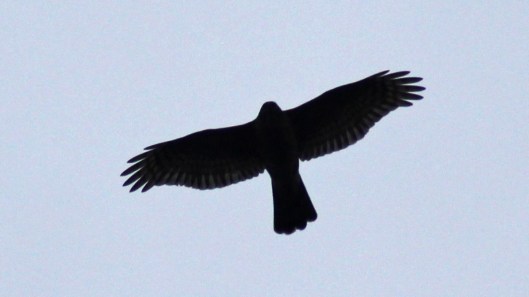
171101 sparrowhawk

The word I like best, though it provides the biggest challenge – indeed, this will be a rest-of-my-lifetime challenge, is jizz, ‘the characteristic impression given by a particular species of animal or plant’. Let me give you an example: I see a bird flying overhead and, though the bird is distant and its exact features difficult to see, I can recognise which bird it is from its silhouette and the way it is flying. I had a moment of great jubilation just this week when I was able to identify a Sparrowhawk flying over a local field, from its outline and its distinctive flap-flap-glide flying pattern.

Like Loading...

October on the Ely embankment

31 Tuesday Oct 2017

Posted by sconzani in birds, coastal fauna, nature, walks

≈ Leave a comment

Tags

birding, birdwatching, British birds, Cardiff Bay, Ely embankment, Great Crested Grebe, Linnet, little grebe, Pied wagtail, Redshank, River Ely, Rock pipit, Turnstone, Wheatear

At least once a week I take a turn along the embankment where the River Ely flows out into Cardiff Bay as it makes a nice circular walk from my home on the cliff-top above in Penarth. (It’s good exercise too, as what goes down there must walk back up!) I always record what I see – usually birds – so thought I would share my sightings in an end-of-monthly post.

171031a Ely embankment map
171031b turnstone & coot

A variety of birds make their home in this stretch of water, which they share with a yachting marina and associated water traffic coming and going. There are almost always Turnstones in varying quantities (from one to nine), Mallards, Mute swans, one or two Great Crested Grebes (including their progeny this year), a proliferation of Coots, the occasional Cormorant fishing, usually a couple of Grey wagtails and a couple of Pieds. Gulls fly overhead and there are plenty of hirundines, in the season.
171031c Wheatear
171031d Pied wagtail
171031e Rock pipit

2 October: A Wheatear, an unusual visitor, almost certainly on a migration stopover, was dotting about on the embankment stones; a Pied wagtail was doing its morning stretches, and a Rock pipit was browsing for titbits.
171031f Little grebe

171031g Great crested grebe (1)
171031g Great crested grebe (2)
171031g Great crested grebe (3)

16 October: This was the day before ex-hurricane Ophelia made her presence felt, the day of the jaundiced yellow sky and the rusty red sun, which you can see reflected in my photo of the four Little grebes that were sheltering from the incoming weather. A juvenile Grey wagtail was dotting along the embankment, calling incessantly for its parent; and a Great crested grebe was enjoying a very successful fishing session, coming up with fish in two successive dives.

171031h Linnet

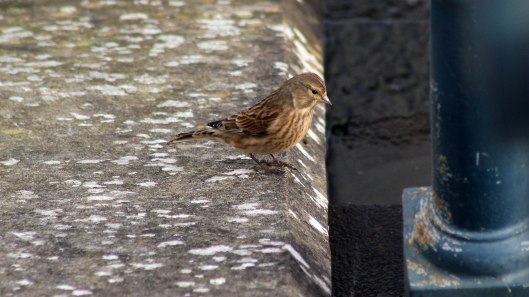
22 October: The day after Storm Brian I walked the embankment to see if any unusual birds had been blown in. The usual suspects were present, except that, most unusually, there wasn’t a single Turnstone. A solitary Linnet flitted back and forth from pavement to stones, and three rather exhausted-looking Redshanks dozed warily along the water line. One of these was colour-ringed and might possibly be the bird I saw back in March but I couldn’t see its rings well enough to be sure.

171031i Redshank

Like Loading...

The return of the tufties

29 Sunday Oct 2017

Posted by sconzani in birds, nature

≈ Leave a comment

Tags

Aythya fuligula, birding, birdwatching, British birds, British ducks, ducks, Tufted duck

171029 Tufted ducks (a)

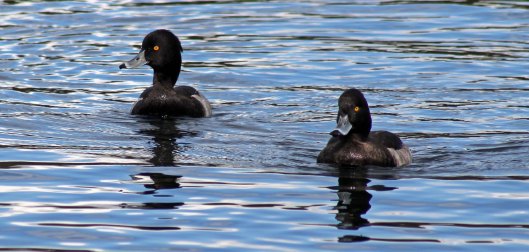
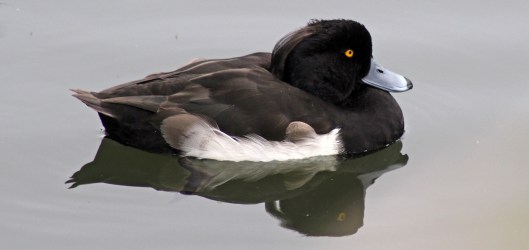
They always make me smile so it’s a joy to see Tufted ducks (Aythya fuligula) back on my local lakes here in south Wales. These ducks tend not to live in Wales year-round: instead, they spend most of the year in England and Scotland, only heading south-west when the days get shorter and the temperatures cooler. Numbers throughout Britain also increase during the winter months as birds from Iceland and northern Europe head to our slightly milder isles.

171029 Tufted ducks (b)
171029 Tufted ducks (c)
171029 Tufted ducks (d)
171029 Tufted ducks (e)
171029 Tufted ducks (f)
171029 Tufted ducks (g)

171029 Tufted ducks (h)

Like Loading...

Arne and the Sika

26 Thursday Oct 2017

Posted by sconzani in animals, mammal, nature

≈ Leave a comment

Tags

Avocet, birding, birdwatching, Cervus nippon, Corfe Castle, Glamorgan Bird Club, RSPB Arne, Sika deer, Sika fawn, Sika hind

171028 Arne (1)

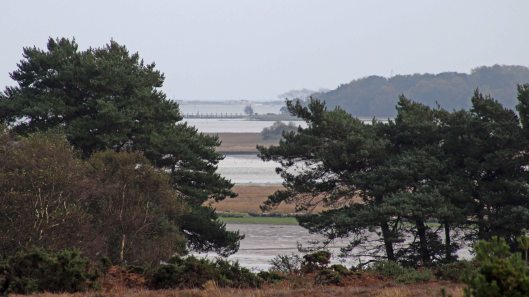
On the way back from Portland our group of Glamorgan Bird Clubbers detoured to RSPB Arne to follow up on the reported sighting of a Stilt sandpiper.

171028 Arne (2)
171028 Arne birders (7)
171028 Arne Avocets

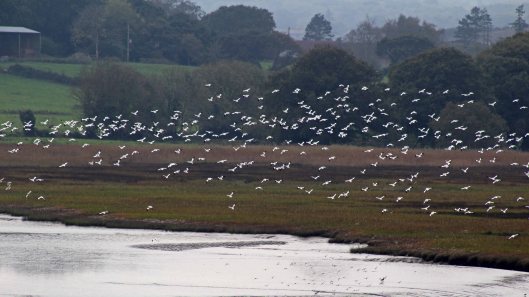
It was down there somewhere, amidst the large numbers of waders – it was a real treat to see so many Avocets together – but I can’t definitively say I saw it.

171028 Corfe Castle from Arne

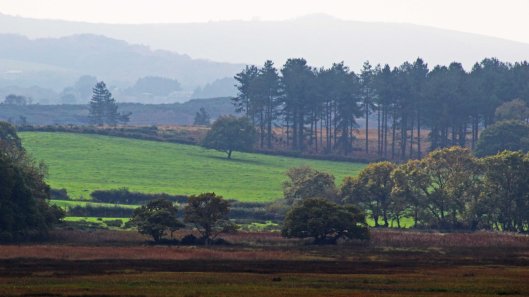
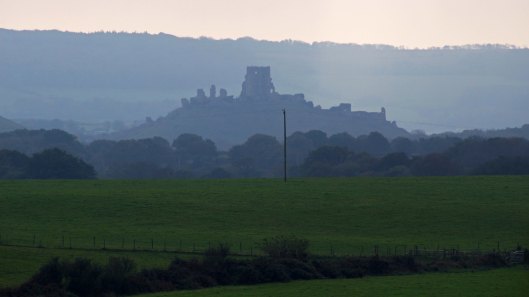
However, we did have fabulous views of the surrounding countryside and the distant Corfe Castle – another place added to my list of ‘must visits’ – and, to my delight, we also had wonderful views of a Sika deer mother and fawn, the first time I’ve seen these deer.

171028 Arne Sika deer (1)

The Sika (Cervus nippon) is about the size of a Fallow deer – this hind would’ve been between 50 and 90cm at the shoulder, her fawn, obviously, smaller – but the Sika’s coat is generally darker. They do have whitish spots in the summer but these can be very faint, almost invisible in the winter months. Fawns are usually born in May – June so this little one must’ve been 4 to 5 months old.

171028 Arne Sika deer (2)
171028 Arne Sika deer (3)
171028 Arne Sika deer (4)

The countryside at Arne is perfect for Sika as they prefer coniferous woodlands and acidic heathland, where they nibble away at grasses and heather. Although these Sika are not a native British species – three different Asian species have been kept on estates and parklands, escapees from the Japanese species (hence C. nippon) can be found through much of Britain where the habitat is right, particularly in parts of Scotland.

Like Loading...

Birding at Portland

23 Monday Oct 2017

Posted by sconzani in birds, nature

≈ 2 Comments

Tags

birding, birdwatching, Cormorant, Dorset coastline, Gannet, Glamorgan Bird Club, Kestrel, Little owl, Portland, Portland Bird Observatory, Portland stone

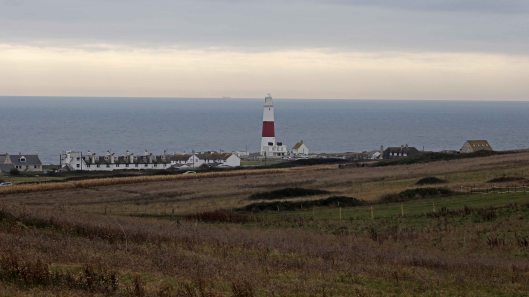
One more birding blog from my wonderful weekend at the Portland Bird Observatory and then no more about Portland … till next year.

171023 Portland Bird Observatory (3)171023 Portland lighthouse

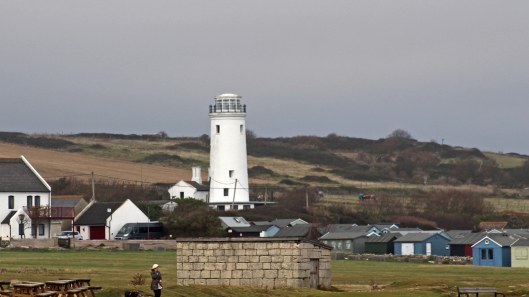
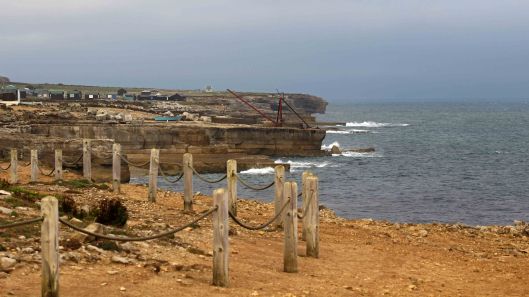
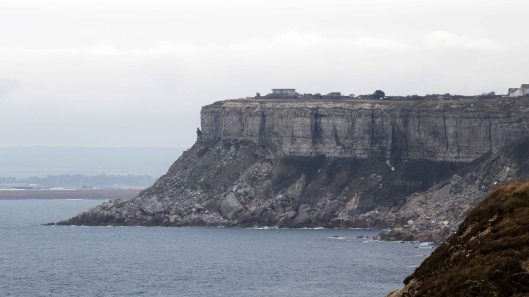
In case you don’t know, Portland is sort of an island – it is actually connected to the mainland – but it looks for all the world like a small island jutting out into the English Channel. It’s where the famous Portland stone (used to build such landmarks as St Paul’s Cathedral in London) comes from, and so the coastline is dramatically rocky and the land is riddled with quarries, many of which are now disused.

171023 Portland coastline (1)171023 Portland coastline (2)

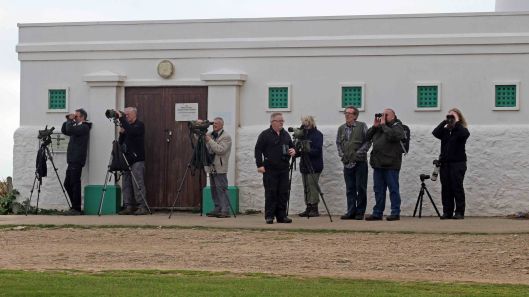
On the Saturday of our long weekend we went for a wonderful walk, along the cliff-top coastal paths and inland through fields, and later in to one of the old quarries. Those with ’scopes spotted some nice seabirds passing by, and gannets, shags, cormorants and various gulls could easily be seen with the naked eye and bins.

171023 Seawatching birders

171023 Cormorants
171023 Gannet

Kestrels were abundant – one sat obligingly on top of a post (though shooting in to a bright sky didn’t make for good photos) and I managed to get a reasonable fly-by shot.

171023 Kestrel (2)
171023 Kestrel (1)

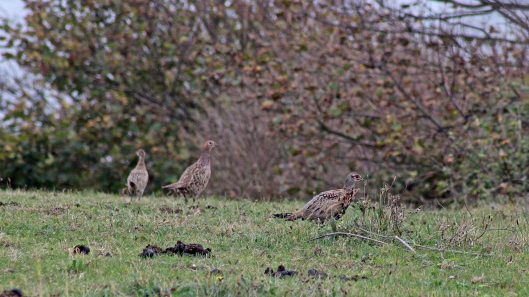
As well as seeing Stonechats, Meadow pipits, a Whinchat, Wheatears and large flocks of Goldfinches and Linnets, we also disturbed a family of Pheasants (mum, dad and two kids) in one of the fields.

171023 Pheasants

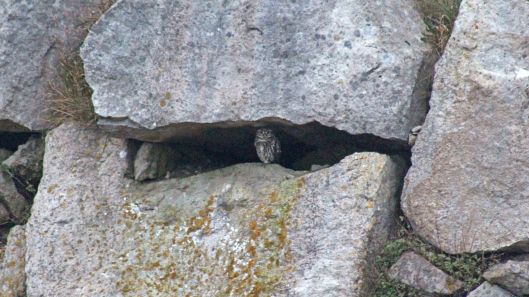
And the resident Little owl popped out of its hidey hole in a local quarry for a short time early on Sunday morning, though, again, the light was not the best for photography.

171023 Little owl

All up the group total for the weekend was 117 species seen or heard. At 82, my personal total was a bit lower but it’s the quality, not the quantity that counts – of those 82, 15 were lifers, birds I’d never seen before – and that’s a pretty impressive total for just three days’ birding!

Like Loading...

Birding at Chesil Beach

21 Saturday Oct 2017

Posted by sconzani in birds, coastal fauna, nature

≈ Leave a comment

Tags

birding, birdwatching, Brent geese, British birds, Chesil Beach, Dorset Wildlife Trust Centre, Little egret, Mediterranean gulls, Oystercatchers, Sandwich terns, The Fleet

171021 Chesil Beach (2)

After exploring RSPB Lodmoor, our birding road trip moved on to Chesil Beach, and what an amazing place it is!

171021 Chesil Beach (1)

To quote a brochure I picked up: ‘Chesil Beach is a natural wonder – a bank of 180 billion pebbles stretching for 18 miles along Dorset’s coast, linking Portland to the mainland. Trapped behind the beach is the Fleet, one of the largest saline lagoons in the country and a haven for bird and marine life’.

171021 Med gulls Sandwich terns171021 Brent geese Med gulls

Here we staked ourselves out behind the Dorset Wildlife Trust Centre, trying, somewhat ineffectually, to shelter from the bracing winds. The wind chill was worth it though, as we had good views of a gaggle of Brent geese and a large flock of Mediterranean gulls.

171021 Sandwich terns

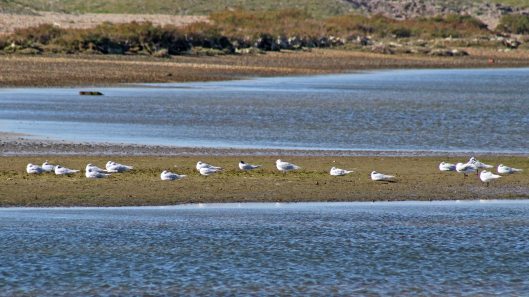
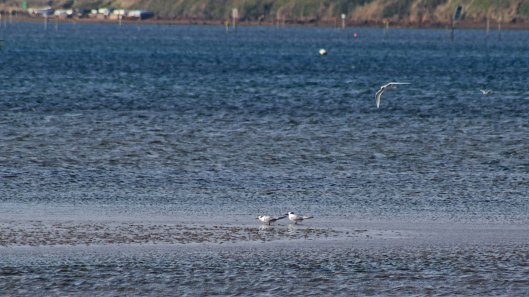
Amongst the gulls were two Sandwich terns, and the beach was also hosting the ubiquitous Oystercatchers and more common gulls, a Bar-tailed godwit and a solitary Dunlin.

171021 Oystercatchers Gull

A Wheatear dotted about on the grass below the pebble bank and, when we briefly stopped here again on our way home on Sunday, a Little egret entertained with its fishing antics, paddling about very successfully in the waterways. Next time I need to climb that bank!

171021 Little egret

Like Loading...

Birding at RSPB Lodmoor

19 Thursday Oct 2017

Posted by sconzani in birds, nature

≈ Leave a comment

Tags

birding, birdwatching, British birds, Canada goose, Great white egret, Kingfisher, Lesser yellowlegs, Mediterranean gull, RSPB Lodmoor, Teal, Tringa flavipes

171019 RSPB Lodmoor

On the way to Portland Bird Observatory last Friday we called in at the RSPB’s Lodmoor Reserve, just outside of Weymouth, to see if we could catch a glimpse of one of their rare visitors, a Lesser yellowlegs (Tringa flavipes), a bird that’s usually more at home in the Americas. Our views weren’t super clear – my photos were taken through tall grasses and bramble – but it was great to see one of these occasional visitors to Europe.

171019 Lesser yellow-legs (1)
171019 Lesser yellow-legs (2)

As well as the Lesser yellowlegs (and the Gadwall I blogged about earlier in the week), there was an abundance of other birdlife.

171019 Various birds

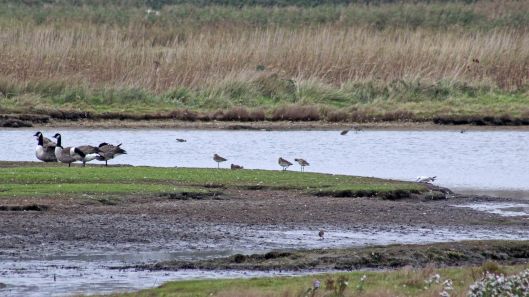
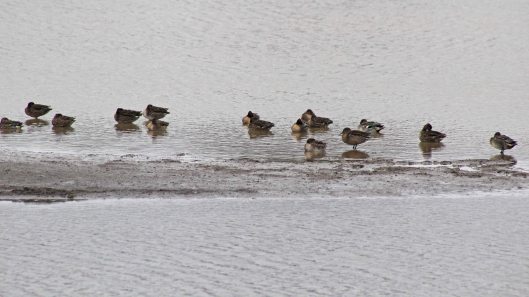
Large numbers of Canada geese flew in while we walked the trails, and there were numerous Teal and Tufted ducks.

171019 Canada geese

171019 Teal

A few Mediterranean as well as the more common gull species …

171019 Assorted gulls (1)
171019 Assorted gulls (2)
171019 Assorted gulls (3)

Ruff, Snipe, Little and Great white egrets puddled about in the lagoons; a very confiding Kingfisher posed for photos; two Marsh harriers glided over the distant reed beds; and a Spoonbill was a nice, though distant sighting. I recorded over 30 species of birds at Lodmoor and that was without walking right around the reserve.

171019 Great white egret
171019 Kingfisher
Like Loading...

Gadding about

17 Tuesday Oct 2017

Posted by sconzani in birds, nature

≈ 1 Comment

Tags

Anas strepera, birding, birdwatching, British birds, dabbling duck, duck, Gadwall, Glamorgan Bird Club, Lodmoor, RSPB Lodmoor

Here’s another beauty from last weekend’s wonderful birding trip with the Glamorgan Bird Club. Though this bird is not the rarity of yesterday’s Rustic bunting, it’s not terribly common either, and is ‘Amber listed’, meaning its population has declined in recent years and its situation is being monitored.

171017 Gadwall (1)

This is a male Gadwall (Anas strepera), a very handsome dabbling duck, a little smaller than a Mallard. Sitting on one of the ponds at the RSPB’s Lodmoor Reserve near Weymouth in Dorset, he was looking a little sleepy. Perhaps that’s why he wasn’t bothered about us looking at him, as he actually approached quite near – a bonus for me trying to get reasonable photos. We didn’t hear a peep out of him but, apparently, it’s their chattering call that originally gave the Gadwalls their imitative name.

171017 Gadwall (2)
171017 Gadwall (3)
171017 Gadwall (4)
171017 Gadwall (5)
Like Loading...

A bird in the hand

16 Monday Oct 2017

Posted by sconzani in birds, nature

≈ 6 Comments

Tags

birding, birdwatching, British birds, Emberiza rustica, Glamorgan Bird Club, Portland Bird Observatory, Portland Obs, rare bird, Rustic bunting

I’ve just had a fantastic long weekend’s birding with the Glamorgan Bird Club at the Portland Bird Observatory in Dorset. Not only did we stay in an old lighthouse but we saw an incredible number of amazing birds. I haven’t typed up my list yet but I do know I had fifteen (yes, 15!!!) lifers (for non-birders, I saw fifteen species I had never seen before).

171016 Rustic bunting (3)

This little beauty was one of them: it’s a Rustic bunting (Emberiza rustica), a bird that breeds in northern Europe and in Asia and normally migrates to Japan and parts of China and south-east Asia to over-winter. This little one may have been blown the wrong way by strong winds or perhaps, by mistake, it joined up with a group of other small birds heading for Britain.

171016 Rustic bunting (1)

It was both an amazing experience and a real privilege to see such a rarity up close. (You can read more about this bird and see more pictures on the Portland Obs blog here.)

171016 Rustic bunting (2)

Like Loading...

Autumn migration: Stonechats

15 Sunday Oct 2017

Posted by sconzani in autumn, birds, nature

≈ Leave a comment

Tags

autumn, autumn migration, birding, birdwatching, Cardiff Bay Wetland Reserve, Cosmeston Lakes Country Park, Grangemoor Park, migrant birds, Saxicola torquata, Stonechat

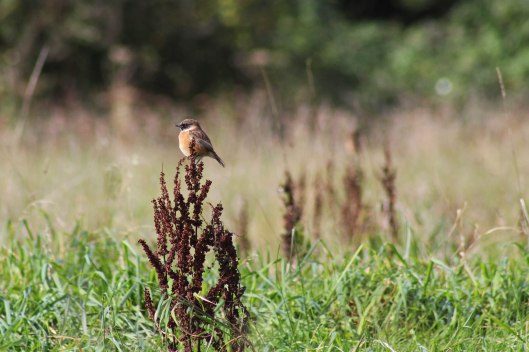
Meet the Stonechat (Saxicola torquata), the bird whose song sounds like two pebbles being rapped together, hence its common name.

171015 Stonechat (4)

These little birds, about the size of your average Robin, usually live a little north of where I live in south Wales, preferring the plantations of conifers that grow in the Welsh valleys and the heathland of the Brecon Beacons. But, come the cooler temperatures of autumn they begin to move south to over-winter in slightly warmer climes.

171015 Stonechat (3)

I saw my first local bird at the Cardiff Bay Wetland Reserve on 17 September, a pair at Cosmeston Lakes Country Park on 6 October, and then a solitary female at Grangemoor Park last Sunday, 8 October.

171015 Stonechat (1)

Stonechats are not always easy to spot, as they duck down amongst tall grass and wildflowers in their search for insects and seeds, and their colours act as good camouflage. But, luckily, they also have a habit of perching on the tops of those grasses and wildflowers and on low shrubs so they can keep an eye out for threats – and humans with cameras! – so I have managed to get a few distant photos.

171015 Stonechat (2)

Like Loading...
← Older posts
Newer posts →

About me

sconzani

sconzani

I'm a writer and photographer; researcher and blogger; birder and nature lover; countryside rambler and city strider; volunteer and biodiversity recorder.

View Full Profile →

Follow earthstar on WordPress.com

Enter your email address to follow this blog and receive notifications of new posts by email.

Recent blog posts

  • A Portland Bill Kestrel April 2, 2026
  • A proliferation of Peacocks April 1, 2026
  • Little owl March 31, 2026
  • Distant seabirds March 30, 2026
  • Thrift March 29, 2026

From the archives

COPYRIGHT

Unless otherwise acknowledged, the text and photographs on this blog are my own and are subject to international copyright. Nothing may be downloaded or copied without my permission.

Fellow Earth Stars!

  • Unknown's avatar
  • Unknown's avatar
  • Unknown's avatar
  • Unknown's avatar
  • Unknown's avatar
  • Unknown's avatar
  • Unknown's avatar
  • Unknown's avatar
  • Unknown's avatar
  • Unknown's avatar
  • Unknown's avatar
  • Unknown's avatar
  • Unknown's avatar
  • Unknown's avatar
  • Unknown's avatar
  • Unknown's avatar
  • Unknown's avatar
  • Unknown's avatar
  • Unknown's avatar
  • Unknown's avatar
  • Unknown's avatar
  • Unknown's avatar
  • Unknown's avatar
  • Unknown's avatar
  • Unknown's avatar
  • Unknown's avatar
  • Unknown's avatar
  • Unknown's avatar
  • Unknown's avatar
  • Unknown's avatar
  • Unknown's avatar
  • Unknown's avatar
  • Unknown's avatar
  • Unknown's avatar
  • Unknown's avatar
  • Unknown's avatar
  • Unknown's avatar
  • Unknown's avatar
  • Unknown's avatar
  • Unknown's avatar
  • Unknown's avatar
  • Unknown's avatar
  • Unknown's avatar
  • Unknown's avatar
  • Unknown's avatar
  • Unknown's avatar
  • Unknown's avatar
  • Unknown's avatar
  • Unknown's avatar
  • Unknown's avatar

Blog at WordPress.com.

Privacy & Cookies: This site uses cookies. By continuing to use this website, you agree to their use.
To find out more, including how to control cookies, see here: Cookie Policy
  • Subscribe Subscribed
    • earthstar
    • Join 642 other subscribers
    • Already have a WordPress.com account? Log in now.
    • earthstar
    • Subscribe Subscribed
    • Sign up
    • Log in
    • Report this content
    • View site in Reader
    • Manage subscriptions
    • Collapse this bar
 

Loading Comments...
 

You must be logged in to post a comment.

    %d