• ABOUT
  • BIRDING 2018
  • Birding 2019
  • BLOG POSTS
  • Butterflies 2018
  • Resources

earthstar

~ a celebration of nature

earthstar

Tag Archives: bracket fungi

Oak mazegill

21 Friday Nov 2025

Posted by sconzani in autumn, fungi

≈ 2 Comments

Tags

bracket fungi, British fungi, Daedalea quercina, fungi on Oak, mazegill fungi, mazegills, Oak mazegill

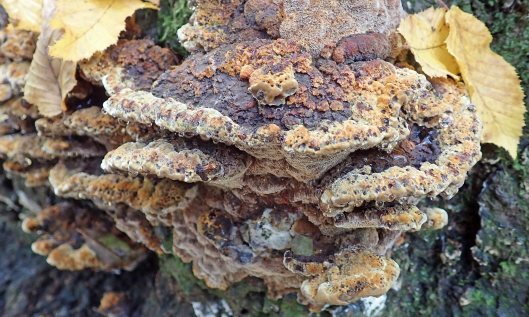
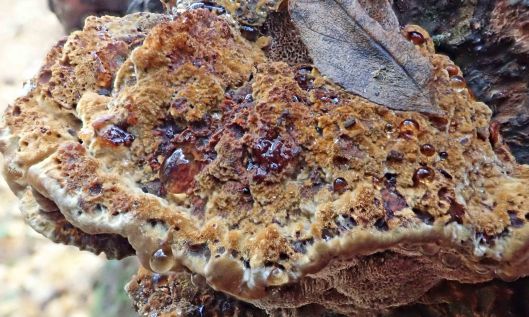
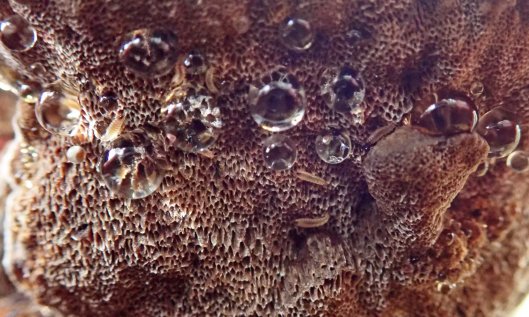
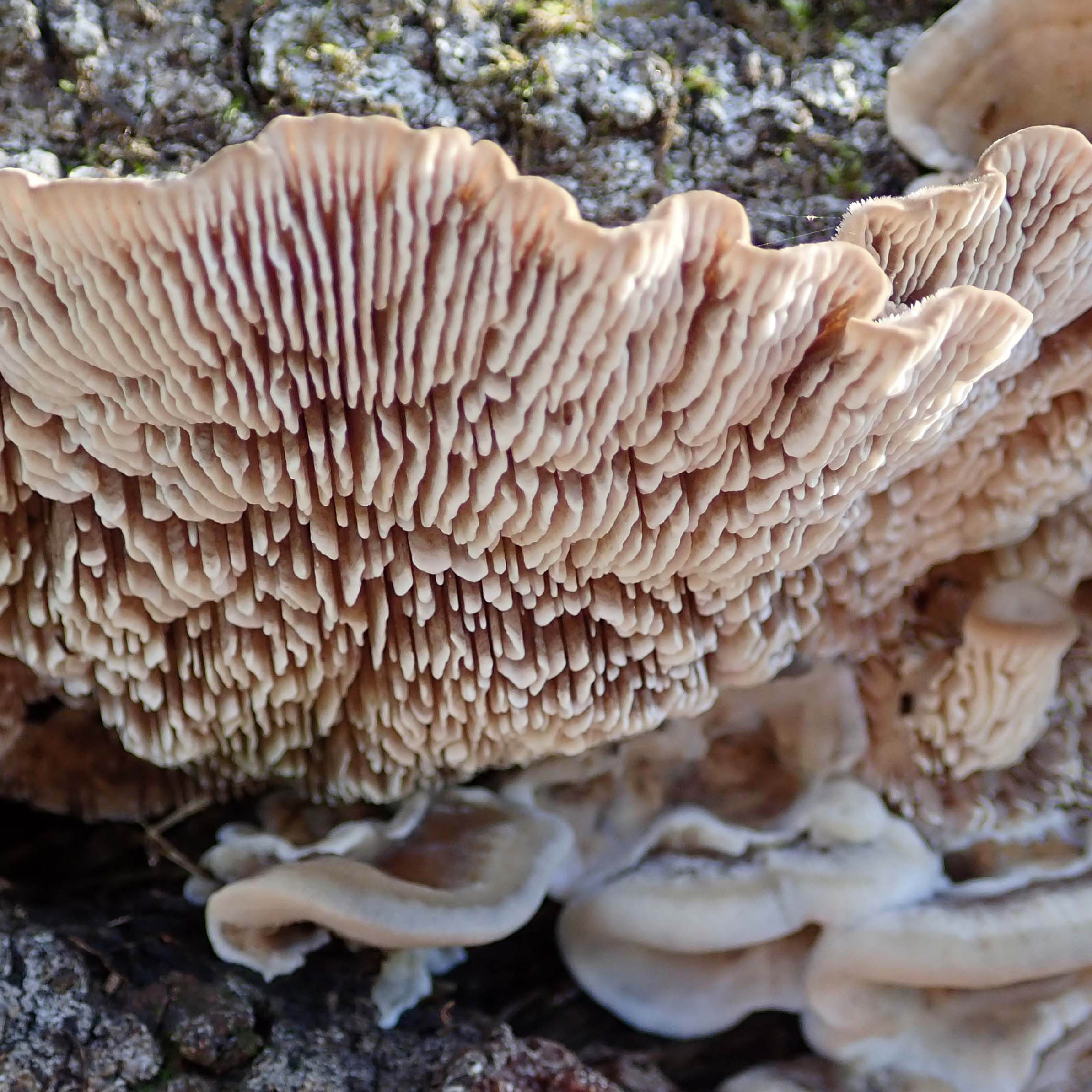
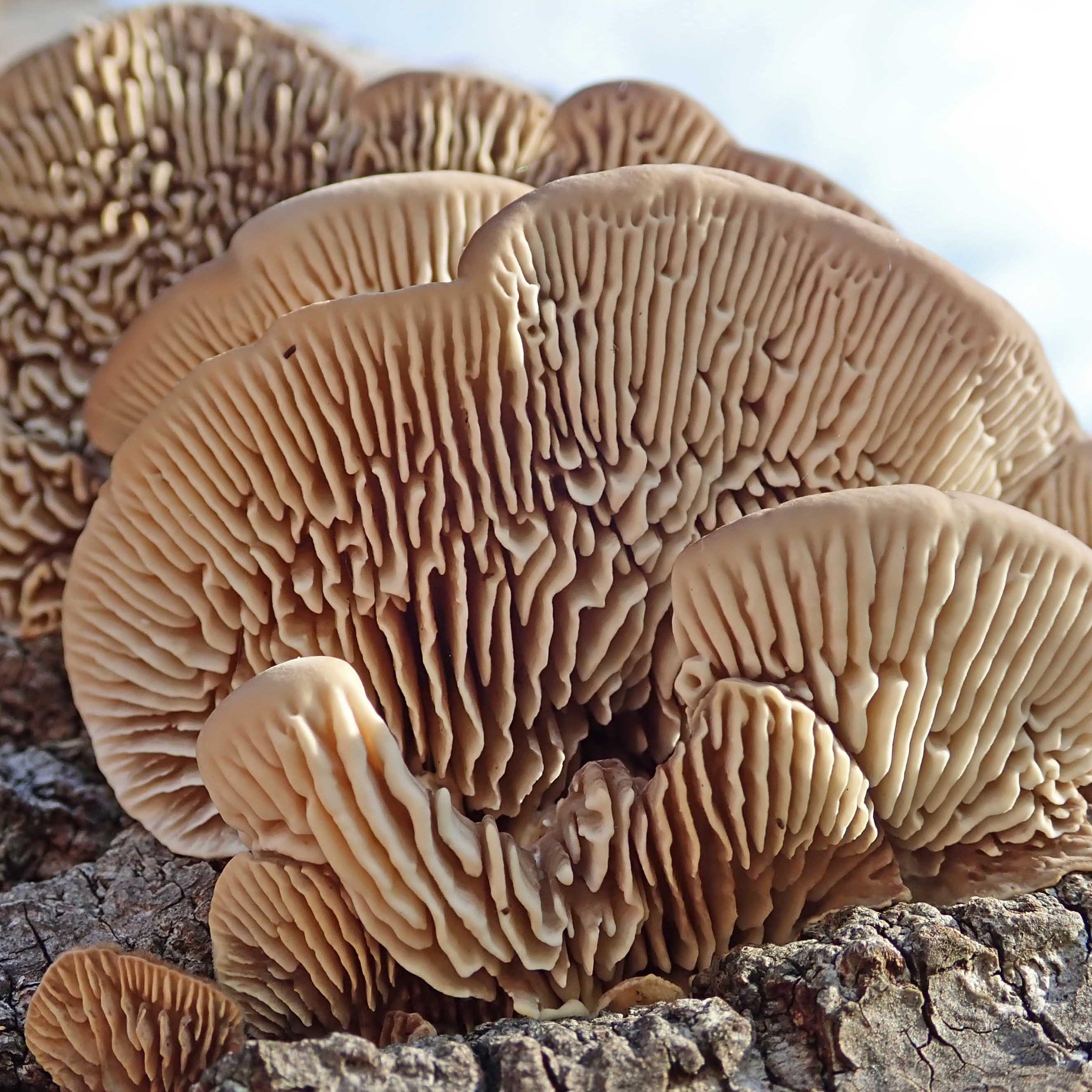
I’m sure I must have seen these stunning bracket fungi, Oak mazegill (Daedalea quercina), before this week but I have no images of them on my laptop. Growing on a huge old fallen Oak – they always grow on Oak (i.e. Quercus species), hence the quercina epithet, consuming dead fallen and still standing trees and large branches, these brackets grow annually, eventually reaching a thickness of 10cm and a diameter of 20cm. And, as you can see from my photos, the fertile surface (i.e. the underside of the bracket, from which the spores are released) has maze-like channels, which explains the mazegill name.
Pat O’Reilly, in his book Fascinated by Fungi, explains that its generic name (Daedalea) refers to Daedalus, the legendary figure who supposedly designed the maze on ancient Crete, in which Pasiphaë, wife of King Minos, hid her offspring the Minotaur, half man and half bull.
O’Reilly’s book also includes a couple of other fascinating facts about Oak mazegill:

This fungus was valued by beekeepers who used the smoke from smouldering fruitbodies to anaesthetise bees. Once the bees had been calmed by the dense smoke, the beekeeper could open a hive and work on it without triggering painful panic reactions by the occupants.

The deep, hard-wearing channels make these tough and durable brackets very handy as combs for grooming horses – one of their traditional uses.
Like Loading...

Lumpy brackets

17 Friday Nov 2023

Posted by sconzani in fungi

≈ Leave a comment

Tags

bracket fungi, British fungi, Lumpy bracket, Trametes gibbosa, white bracket fungus

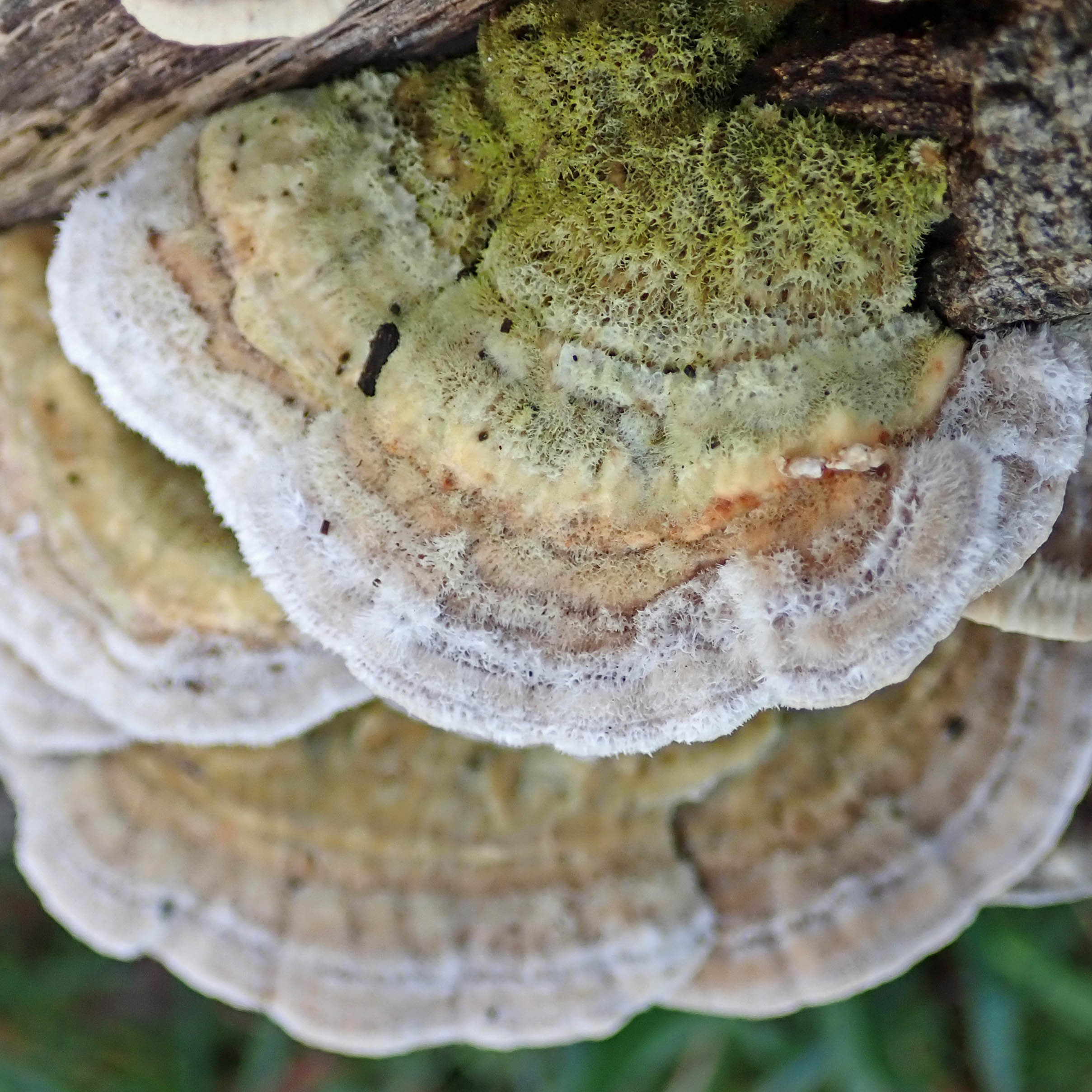
How to identify Lumpy brackets (Trametes gibbosa) (courtesy of the First Nature website):
– found on most kinds of hardwood trees but most commonly on Beech (these were on Beech)
– the pale upper surface is often discoloured by green algae, particularly away from the edges
– the pores are slot-like, rather than round or oval as found on other whitish Trametes
I found this impressive array of Lumpy brackets on a huge fallen Beech in Cardiff’s Heath Park.

Like Loading...

Dryad’s saddles

26 Friday May 2023

Posted by sconzani in fungi

≈ Leave a comment

Tags

bracket fungi, British fungi, Dryad's saddle, fungus, Polyporus squamosus

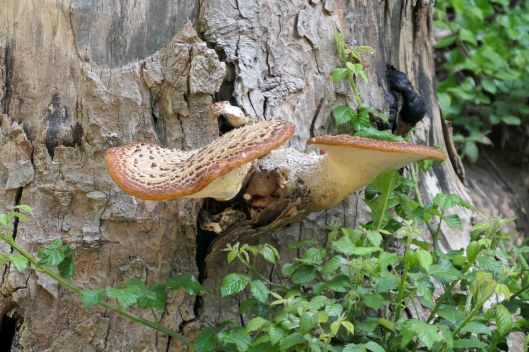
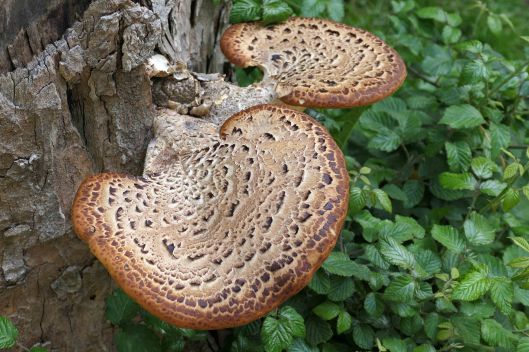
What a cracking pair these were, both at least 30 cms across, fresh, boldly marked, rigid, an imposing sight!

230527 dryads saddle (1)

These are Dryad’s saddles (Polyporus squamosus), named for their saddle-like shape that one might, with a liberal sprinkling of imagination, visualise being used by the tree nymphs for their travels through their forest domain.

230527 dryads saddle (2)

Like Loading...

Brackets

24 Friday Feb 2023

Posted by sconzani in fungi

≈ Leave a comment

Tags

bracket fungi, Trametes versicolor, Turkey tail

Wet weather does have some compensations, especially when it comes to fungi. This marvellous display of fungal brackets had been looking rather dry and shrivelled but a good blast of recent rain has rehydrated and refreshed the whole stump full. They’re Turkey tails, I think, Trametes versicolor.

230224 brackets

Like Loading...

Golden globules

21 Monday Nov 2022

Posted by sconzani in fungi

≈ Leave a comment

Tags

Alder bracket, bracket fungi, British fungi, Inonotus radiatus

I’ve blogged about Alder brackets before (Oozing brackets, November 2021; Fungi Friday: Alder bracket, December 2016; and 353/366 Old Alder brackets, December 2020), so today I’m just going to share a photo of my most recent find of the golden globules of Alder bracket goodness.

221121 alder bracket

Like Loading...

Humongous fungus

05 Friday Aug 2022

Posted by sconzani in fungi

≈ Leave a comment

Tags

bracket fungi, British fungi, Dryad's saddle, fungus, Polyporus squamosus, summer fungus

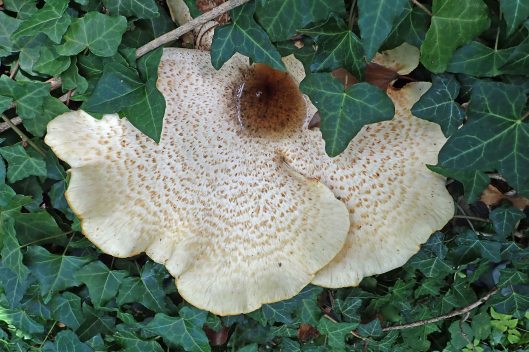
During Monday’s local meander I was hugely surprised to spot this humongous fungus, though I shouldn’t have been. Dryad’s saddle (Polyporus squamosus) is actually one of the first bracket fungi to appear each year, often sprouting its saddle-shaped ledges during the summer months when you’d least expect fungi to appear. This one was in a shady woodland, in an area less affected by the scorching sun that’s parched much of the land around here, so it was certainly a much more fungi-friendly location.

220805 dryads saddle

Like Loading...

A cascade of brackets

04 Friday Mar 2022

Posted by sconzani in fungi

≈ Leave a comment

Tags

bracket fungi, British fungi, Trametes versicolor, Turkeytail

One positive from all the recent rain has been the rehydration of resident fungi. The last time I visited this dead tree its brackets were looking dry and shrivelled. Now, it’s like a flood of fungi, six feet of rippling rapids, a veritable cascade of colourful brackets.

220304 brackets

Like Loading...

Oozing brackets

26 Friday Nov 2021

Posted by sconzani in fungi, insects

≈ Leave a comment

Tags

Alder bracket, bracket fungi, British fungi, Fungus gnat larvae, Inonotus radiatus

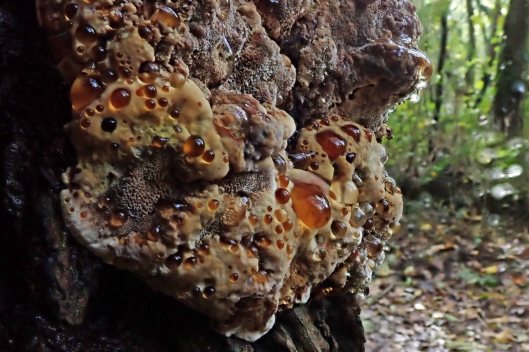
It was the weak sunlight filtering through the almost-leafless overhead branches that drew my eyes to these fungi, their droplets of oozing liquid glinting as the light fell on them.

211126 alder brackets (1)

These are Alder brackets, Inonotus radiatus, a common species which, as you might expect from the name, is most often found on dead and dying Alder trees, though it does also grow on other species of hardwood trees.

211126 alder brackets (2)

According to the First Nature website, ‘Inonotus, the genus name of the Alder Bracket fungus, comes from ino– a prefix meaning fibrous, and ot which means an ear; the ending –us merely turns it into the form of a Latinised noun. The specific name radiatus comes from the Latin radi– meaning a ray, spoke or plate, and it is probably a reference to the radial wrinkles that are often evident on the upper surfaces of mature Alder Brackets.’

211126 alder brackets (3)

As you can see from my last photograph, these particular brackets were also home to several tiny larvae, perhaps of fungus gnats, though I can’t be sure of that.

211126 alder brackets (4)

Like Loading...

Chicken-of-the-woods

10 Friday Sep 2021

Posted by sconzani in fungi

≈ Leave a comment

Tags

bracket fungi, British fungi, Chicken-of-the-woods, Laetiporus sulphurous

This glorious cascade of brackets was a delightful surprise during a recent woodland meander.

210910 chicken-of-the-woods (1)
210910 chicken-of-the-woods (2)

This is the wonderfully named Chicken-of-the-woods (Laetiporus sulphurous), which apparently tastes like chicken, hence the name. However, as Pat O’Reilly writes in Fascinated by Fungi: ‘Young caps taste rather like chicken; old ones taste more like the wood!’ and ‘Never eat Chicken of the Woods gathered from Yews’ because, of course, almost every part of the Yew is poisonous.

210910 chicken-of-the-woods (3)

I’ve only seen these bright yellow-and-orange brackets growing on Oak, though they can also be found on Beech and Sweet chestnut as well as Yew. They are large, growing up to 40cm across, with a velvety upper surface and pores below.

Like Loading...

Phellinus pomaceus

12 Friday Mar 2021

Posted by sconzani in fungi, trees

≈ Leave a comment

Tags

blackthorn, bracket fungi, British fungi, fungi on Blackthorn, Phellinus pomaceus, Prunus spinosa

Though I haven’t been able to verify its identification, I’m fairly sure today’s fungus is Phellinus pomaceus.

210312 Phellinus pomaceus (1)

It’s a hard, woody bracket fungus that grows on Prunus tree species – in this case, it’s growing on Blackthorn (Prunus spinosa).

210312 Phellinus pomaceus (2)
210312 Phellinus pomaceus (3)

The NBN (National Biodiversity Network Trust) Atlas entry for this species (which also includes a map showing where in Britain the fungus has been recorded) says ‘It is not aggressively pathogenic but can cause considerable decay in trees suffering from other stress factors’, so you wouldn’t want to find it in a commercial fruit orchard. In my case, the fungi were only showing on two adjacent trees in a large copse of Blackthorn, and the trees looked quite elderly, so I don’t think it’s causing a problem.

210312 Phellinus pomaceus (4)
210312 Phellinus pomaceus (5)
Like Loading...
← Older posts

About me

sconzani

sconzani

I'm a writer and photographer; researcher and blogger; birder and nature lover; countryside rambler and city strider; volunteer and biodiversity recorder.

View Full Profile →

Follow earthstar on WordPress.com

Enter your email address to follow this blog and receive notifications of new posts by email.

Recent blog posts

  • M is for mite December 18, 2025
  • L is for lepidopteran lifers December 17, 2025
  • K is for Keeled skimmers December 16, 2025
  • J is for Jersey tiger December 15, 2025
  • I is for Ichneumon December 14, 2025

From the archives

COPYRIGHT

Unless otherwise acknowledged, the text and photographs on this blog are my own and are subject to international copyright. Nothing may be downloaded or copied without my permission.

Fellow Earth Stars!

  • Unknown's avatar
  • Unknown's avatar
  • Unknown's avatar
  • Unknown's avatar
  • Unknown's avatar
  • Unknown's avatar
  • Unknown's avatar
  • Unknown's avatar
  • Unknown's avatar
  • Unknown's avatar
  • Unknown's avatar
  • Unknown's avatar
  • Unknown's avatar
  • Unknown's avatar
  • Unknown's avatar
  • Unknown's avatar
  • Unknown's avatar
  • Unknown's avatar
  • Unknown's avatar
  • Unknown's avatar
  • Unknown's avatar
  • Unknown's avatar
  • Unknown's avatar
  • Unknown's avatar
  • Unknown's avatar
  • Unknown's avatar
  • Unknown's avatar
  • Unknown's avatar
  • Unknown's avatar
  • Unknown's avatar
  • Unknown's avatar
  • Unknown's avatar
  • Unknown's avatar
  • Unknown's avatar
  • Unknown's avatar
  • Unknown's avatar
  • Unknown's avatar
  • Unknown's avatar
  • Unknown's avatar
  • Unknown's avatar
  • Unknown's avatar
  • Unknown's avatar
  • Unknown's avatar
  • Unknown's avatar
  • Unknown's avatar
  • Unknown's avatar
  • Unknown's avatar
  • Unknown's avatar
  • Unknown's avatar
  • Unknown's avatar

Blog at WordPress.com.

Privacy & Cookies: This site uses cookies. By continuing to use this website, you agree to their use.
To find out more, including how to control cookies, see here: Cookie Policy
  • Subscribe Subscribed
    • earthstar
    • Join 667 other subscribers
    • Already have a WordPress.com account? Log in now.
    • earthstar
    • Subscribe Subscribed
    • Sign up
    • Log in
    • Report this content
    • View site in Reader
    • Manage subscriptions
    • Collapse this bar
 

Loading Comments...
 

You must be logged in to post a comment.

    %d