• ABOUT
  • BIRDING 2018
  • Birding 2019
  • BLOG POSTS
  • Butterflies 2018
  • Resources

earthstar

~ a celebration of nature

earthstar

Tag Archives: British birds

Murmuration

26 Wednesday Feb 2025

Posted by sconzani in nature

≈ 2 Comments

Tags

birding, birdwatching, Black-tailed godwit, British birds, Dunlin, Knot, large flock of flying birds, murmuration

When you hear or read the word murmuration, you probably think of Starlings and the incredible sight of thousands of those birds flying though the evening sky in perfect unison. But it isn’t only Starlings that execute such amazing aerial displays; many other species of bird perform similar feats of synchronised flying and, on Monday, I was privileged to see just such a spectacle.
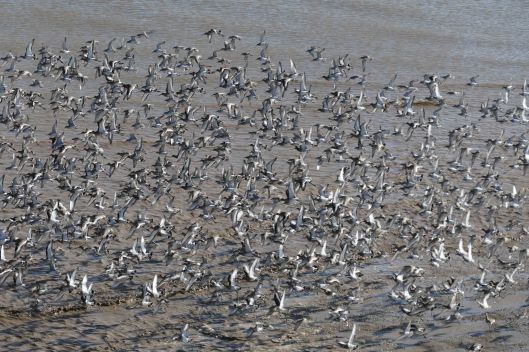
As soon as I arrived at the Cardiff Bay Barrage, I saw a large flock of birds flying around the area outside the Barrage, on the edge of the Bristol Channel. Luckily for me, the birds settled on one of the mudflats and began feeding. In my almost ten years of living in the area, I had never seen so many waders doing this; they usually feed on mudflats north of Cardiff.
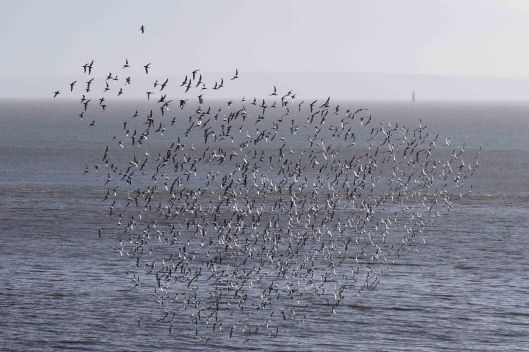
The flock must have been several hundred strong and consisted of three species of wader, Black-tailed godwit, Knot and Dunlin. For 45 minutes, I watched and listened to and photographed these stunning birds, sharing my delight and wonder with a man who was out walking his dog and who’d never seen anything like this sight in his many years of living locally.
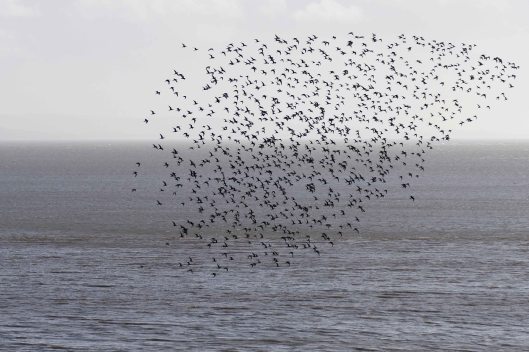
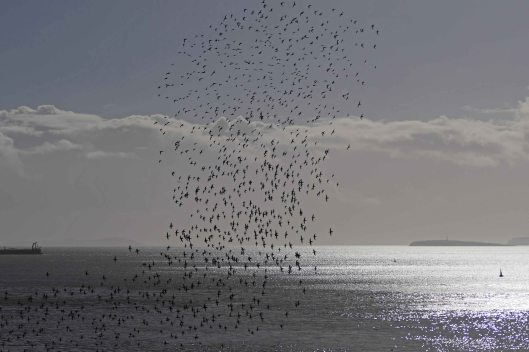
Then, for some unknown reason, the Barrage operations staff opened more of the sluice gates that allow water in Cardiff Bay to flow out in to the Bristol Channel, creating a small wave that swiftly encroached on the area of mud where the flock was feeding, and eventually covering it completely. As the wave reached them, the birds took to the air, creating an ever expanding cloud of flying birds. As one, they flew around the outer Barrage area, looking for another place to land but there was nowhere. For perhaps ten minutes, they swirled high into the air, then back down towards the water, wheeling left and right in perfect harmony, before abandoning their search for more mudflats and heading northwards along the coast. It was a sublime aerial symphony that I will never forget.
Like Loading...

Hoovering Shelduck

25 Tuesday Feb 2025

Posted by sconzani in birds, winter

≈ Leave a comment

Tags

birding, birdwatching, British birds, feeding Shelducks, Shelduck, Shelducks feeding

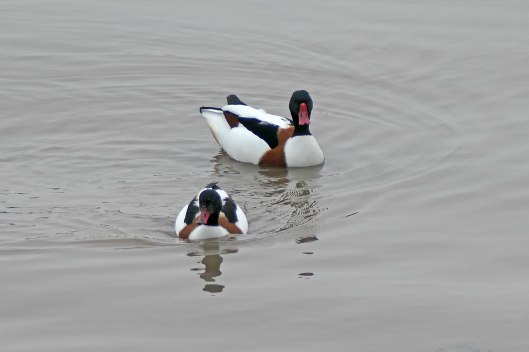
According to a research report* published on the British Trust for Ornithology’s website, the Shelduck (Tadorna tadorna) was ‘one of the most common waterbird species at Cardiff Bay prior to barrage-closure’. When the report was written, in 2003, Shelduck were still using the Bay as a roosting site between tides, albeit in small numbers. Twenty-two years later, the Bay has become so overwhelmed by human water traffic (jetboats, speedboats, water taxis, yachts, kayakers, paddleboarders) that it is rare to see Shelduck within the Bay itself.

Fortunately, there are still reasonably untouched areas of mudflat along the coast between Cardiff and Newport, and Bridgwater Bay, a National Nature Reserve renowned for its population of Shelducks, is a relatively short flight across the Bristol Channel from Cardiff Bay. So, the birds can often be seen, at a distance, feeding on the tidal mudflats outside the Barrage at low tide. And, occasionally, as happened one day last week, a pair will arrive early and wait for the lowering tide along the beach below Penarth Heads or, in this case, in the Barrage basin. This is the only time I get to see these beautiful birds up close so I sat on a rock and watched and, as the mud was exposed, took this short video of them hoovering and filtering the mud for tiny invertebrates.

* S. J. Holloway, N. A. Clark & N. H. K. Burton, ‘The Numbers and Status of Waterbirds using Cardiff Bay from 1999/2000 to 2002/2003‘, BTO Research Report No.319, The National Centre for Ornithology, Norfolk, July 2003.

Like Loading...

A Dipper dipping

22 Saturday Feb 2025

Posted by sconzani in birds

≈ Leave a comment

Tags

birding, birdwatching, British birds, Dipper

I heard this Dipper singing before I saw it. With my binoculars, I scanned the stones and small boulders along the opposite edge of the River Taff, near Radyr in south Wales, until I spotted the bird, then stood mesmerised as it sang its sweet melody, presumably hoping to attract a female Dipper.

Serenade over, the bird proceeded to do as its name implies, dipping beneath the fast-flowing waters of the river. This is how Dippers feed, moving along underwater in the search for small invertebrates, though, in this case, I’m not sure whether the Dipper was feeding or washing itself or simply enjoying a good splash. It was a delight to watch so I tried to capture some of the action for you all to enjoy.

Like Loading...

Male Bullfinches

20 Thursday Feb 2025

Posted by sconzani in birds, winter

≈ 2 Comments

Tags

birding, birdwatching, British birds, bullfinch, Forest Farm Nature Reserve, male Bullfinch

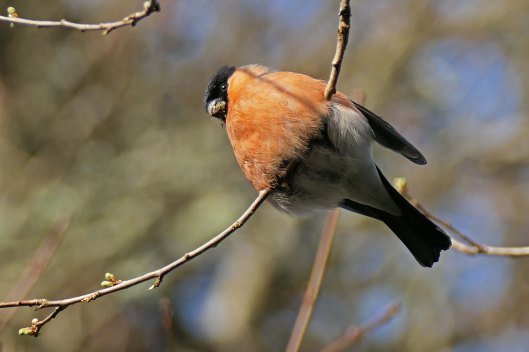
For me the male Bullfinch, with his glorious apricot breast feathers, is the most exotic-looking of Britain’s birds. He looks like he belongs in a tropical rain forest, not in the sub-zero temperatures of a British winter. These two particularly handsome chaps were busily nibbling the new buds from the trees at Forest Farm Nature Reserve earlier this week, which is why these birds are never much liked by orchardists.

There were female Bullfinches about as well, though, for some reason, they tended to be skulking in the furthest reaches of the branches, out of this photographer’s lens range. Perhaps it’s just that male birds in general like to advertise their presence more as we approach spring and the breeding season.

Like Loading...

Rook pair-bonding behaviour

18 Tuesday Feb 2025

Posted by sconzani in birds

≈ Leave a comment

Tags

bird pair-bonding, birding, birdwatching, British birds, Rook, Rook behaviour, Rook pair-bonding behaviour

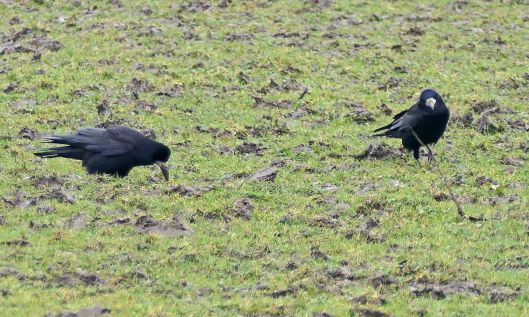
I’d read, on the British Trust for Ornithology website, that ‘Rook pairs spend a lot of time close together, feeding one another, displaying and vocalising together and preening’, but had never seen that behaviour until last Sunday when I stood watching eight Rooks grazing a horse field.

As you will see in my short video clip, one bird ‘bows’ to the other, while splaying out its tail feathers, then its mate feeds it. What a privilege it was to witness this pair-bonding behaviour.

Like Loading...

Scurrying Turnstones

15 Saturday Feb 2025

Posted by sconzani in birds

≈ Leave a comment

Tags

birding, birdwatching, British birds, Turnstone, Turnstones scurrying on beach

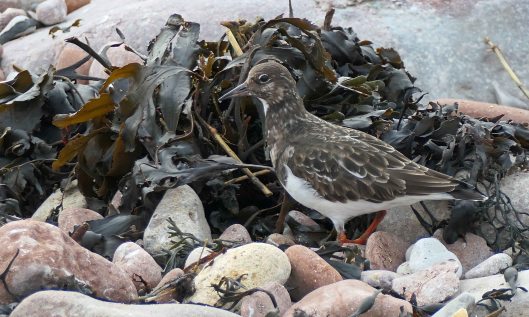
As is often the case, I heard them before I saw them, a huddle of perhaps 20 Turnstones, busily scurrying back and forth, flicking their way through the most recent piles of seaweed deposited by the outgoing tide and hooking their beaks beneath the smaller stones to find the delicacies hidden beneath.

Though my video only catches the distant sound of the waves, I could hear two other, different types of sound: as well as the clinking of the stones, the birds were also chattering to themselves and each other. I wondered what they were saying: ‘Look what I’ve found’; ‘This one’s juicy’; ‘That’s mine’; ‘It’s a good feast today’; ‘I saw that first’?

As walkers passed by with their dogs, completely oblivious to the delightful gathering just a few feet below their path, I paused to watch and enjoy these glorious little shore birds going about their daily business.

Like Loading...

The sprat catcher

12 Wednesday Feb 2025

Posted by sconzani in birds

≈ Leave a comment

Tags

birding, birdwatching, British birds, Lisvane Reservoir, little grebe, Little grebe with fish

Little grebes are one of the cutest of Britain’s small birds. They are also efficient fishers, as this little one proved to me several times with its successful sprat catching during my recent visit to Cardiff’s northern reservoirs, Lisvane and Llanishen.

Like Loading...

One-eyed

10 Monday Feb 2025

Posted by sconzani in birds

≈ Leave a comment

Tags

birding, birdwatching, British birds, Magpie, one-eyed Magpie

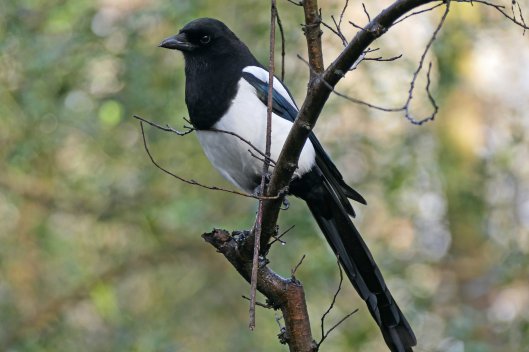
Magpies are beautiful birds and I am often guilty of overlooking them so, when this bird posed nicely on a nearby branch, I admired it and took some photos.

It was only when the bird turned its head that I realised it had somehow lost an eye, Fortunately, that didn’t seem to be affecting its ability to fly or feed and, as a second Magpie was hovering in the trees very nearby, I presume it had also been successful at finding a mate.

Like Loading...

My latest bogey bird

08 Saturday Feb 2025

Posted by sconzani in birds, winter

≈ Leave a comment

Tags

birding, birdwatching, British birds, British gulls, Cardiff Bay birding, Larus michahellis, Yellow-legged gull

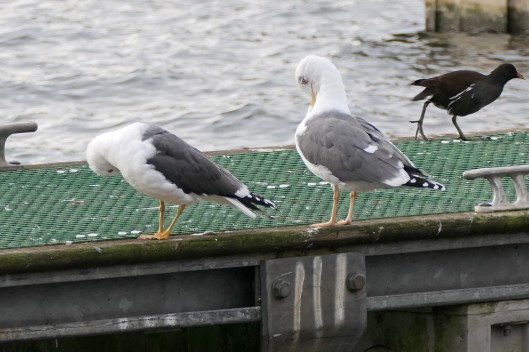
The Water rail used to be my bogey bird but, once my sightings of that beautiful skulker increased, the bogey bird title passed to the Yellow-legged gull (Larus michahellis). I’ve continued to look for one, several times thought I’ve found one, only to work out for myself or be told by birders more skilled than me that I’ve been wrong.

That same thing happened with this bird: when I posted photos online, no one stepped up to proffer an opinion and the one birder who was prompted by someone else to give his judgment decided it wasn’t a Yellow-legged gull.

So, you can imagine how very delighted I was when I received a message from our county bird recorder that he was happy to accept it as a Yellow-leg. As he wrote, the bird shows: ‘uppers mid grey (darker than Herring [gull], paler than LBBG [Lesser black-backed gull]), large size, and [in this case, quite pale] yellow legs all consistent.’ And those features are precisely why these birds can be tricky to identify – unless you have all three gull species standing side by side, the colour ‘mid-grey’ can be difficult to determine, as can the gull’s size. I was fortunate than my Yellow-legged gull was standing next to a Lesser black-backed gull as that made the comparison a little easier. Now to find another!

Like Loading...

A Jay day

05 Wednesday Feb 2025

Posted by sconzani in birds, winter

≈ 4 Comments

Tags

birding, birdwatching, British birds, Garrulus glandarius, Jay

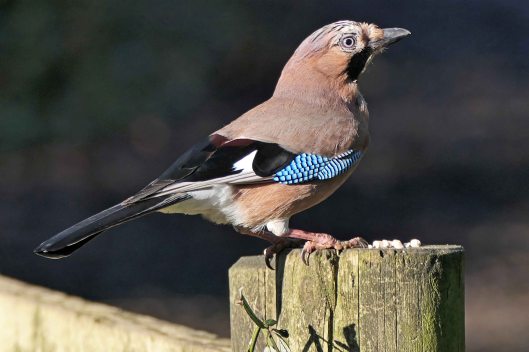
I was going to write about a different bird today but during this morning’s walk in central Cardiff I was approached by a young man who, on seeing me staring at a bush, camera in hand, very politely asked if I might know the name of the bird he’d just seen.

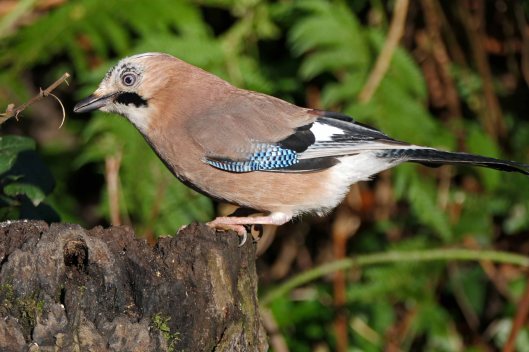
‘It was a bronzey pink with fluorescent blue in its wings. It looked amazing!’ The mention of bronze confused me but, when, together, we retraced his steps and spotted the bird, it was, as I’m sure you’ve already guessed, a Jay.

He had never seen one before, which surprised me, but we had a lovely conversation and I know he will be looking for more Jays during his daily walks from the student halls to the university buildings and back. And that makes me very happy!

Jays have proved very frequent, more confiding and visible during our recent cold weather, a treat I’ve thoroughly enjoyed and taken advantage of with my camera, so the photos here were taken over several days.

Like Loading...
← Older posts
Newer posts →

About me

sconzani

sconzani

I'm a writer and photographer; researcher and blogger; birder and nature lover; countryside rambler and city strider; volunteer and biodiversity recorder.

View Full Profile →

Follow earthstar on WordPress.com

Enter your email address to follow this blog and receive notifications of new posts by email.

Recent blog posts

  • Nesting material April 28, 2026
  • Lifer: Box bug April 27, 2026
  • Peak Wild garlic April 26, 2026
  • First damsels of 2026 April 25, 2026
  • NFY: Green-veined white April 24, 2026

From the archives

COPYRIGHT

Unless otherwise acknowledged, the text and photographs on this blog are my own and are subject to international copyright. Nothing may be downloaded or copied without my permission.

Fellow Earth Stars!

  • Unknown's avatar
  • Unknown's avatar
  • Unknown's avatar
  • Unknown's avatar
  • Unknown's avatar
  • Unknown's avatar
  • Unknown's avatar
  • Unknown's avatar
  • Unknown's avatar
  • Unknown's avatar
  • Unknown's avatar
  • Unknown's avatar
  • Unknown's avatar
  • Unknown's avatar
  • Unknown's avatar
  • Unknown's avatar
  • Unknown's avatar
  • Unknown's avatar
  • Unknown's avatar
  • Unknown's avatar
  • Unknown's avatar
  • Unknown's avatar
  • Unknown's avatar
  • Unknown's avatar
  • Unknown's avatar
  • Unknown's avatar
  • Unknown's avatar
  • Unknown's avatar
  • Unknown's avatar
  • Unknown's avatar
  • Unknown's avatar
  • Unknown's avatar
  • Unknown's avatar
  • Unknown's avatar
  • Unknown's avatar
  • Unknown's avatar
  • Unknown's avatar
  • Unknown's avatar
  • Unknown's avatar
  • Unknown's avatar
  • Unknown's avatar
  • Unknown's avatar
  • Unknown's avatar
  • Unknown's avatar
  • Unknown's avatar
  • Unknown's avatar
  • Unknown's avatar
  • Unknown's avatar
  • Unknown's avatar
  • Unknown's avatar

Blog at WordPress.com.

Privacy & Cookies: This site uses cookies. By continuing to use this website, you agree to their use.
To find out more, including how to control cookies, see here: Cookie Policy
  • Subscribe Subscribed
    • earthstar
    • Join 642 other subscribers
    • Already have a WordPress.com account? Log in now.
    • earthstar
    • Subscribe Subscribed
    • Sign up
    • Log in
    • Report this content
    • View site in Reader
    • Manage subscriptions
    • Collapse this bar

Loading Comments...

You must be logged in to post a comment.

    %d