• ABOUT
  • BIRDING 2018
  • Birding 2019
  • BLOG POSTS
  • Butterflies 2018
  • Resources

earthstar

~ a celebration of nature

earthstar

Tag Archives: British birds

Black-necked grebe

22 Saturday Dec 2018

Posted by sconzani in birds, nature

≈ 4 Comments

Tags

birding, birdwatching, Black-necked grebe, British birds, British grebes, Cardiff Bay, Cardiff Bay birds, grebe, Podiceps nigricollis

There are five species of grebe you can reasonably expect to see in Britain: the Great crested and the Little grebes are relatively common here in south Wales, while the Slavonian, the Red-necked and the Black-necked are rarer visitors. Yet, I’ve been lucky enough to see all five this year and all within 30 miles of home – in fact, except for the Slavonian at Kenfig National Nature Reserve, the other four were within walking distance of home, and one of these lovely rarities is currently visiting Cardiff Bay.

181222 CardiffBay (1)

This handsome little water bird is a Black-necked grebe (Podiceps nigricollis). Its generic name Podiceps is a combination of two Latin words, podicis, meaning vent or anus, and pes, meaning foot. This has nothing to do with the bird’s bottom – cute though that certainly is – but is, rather, a reference to the fact that its legs are attached to its body at the extreme back end. The epithet nigricollis is Latin for black-necked (niger means black and collis means neck).

181222 CardiffBay (2)

This is a bird that switches from freshwater to saline habitats throughout the year, favouring freshwater lakes throughout Europe in which to breed, then moving to saline waterways to undergo its moult, before migrating to winter in the coastal estuaries of the south-western Palearctic and eastern parts of Africa. According to the RSPB website, an average of 130 birds opt to spend their winter in Britain.

181222 CardiffBay (3)

This is the second Black-necked grebe to spend some time in Cardiff Bay in 2018: another – or perhaps the same – bird was here for a couple of weeks in September. Although I did see that grebe, I didn’t get very good views of it, whereas this latest visitor has been treating birders to relatively close views from the Cardiff Bay Barrage in recent days, usually in the company of Tufted ducks and Coots.

181222 CardiffBay (4)

It’s a small bird – only about 12 inches long and, from the way it appears to bob about on top of the water, it must be as light as a feather. In its searches for the aquatic insects, small fish and crustaceans that make up its diet, it dives frequently, staying underway for several minutes at a time and sometimes reappearing a considerable distance from where it originally disappeared.

181222 CardiffBay (5)

Some of the local birding community, me included, are hoping this little grebe will stay around until at least the dawn of 2019, as it would certainly be a treat to have this on our bird lists on the first day of the new year.
Like Loading...

Second time lucky

19 Wednesday Dec 2018

Posted by sconzani in birds, nature, winter

≈ 2 Comments

Tags

1st-winter drake Scaup, Aythya marila, birding, birdwatching, British birds, Cosmeston, Cosmeston Lakes Country Park, Greater scaup, juvenile Scaup, Scaup

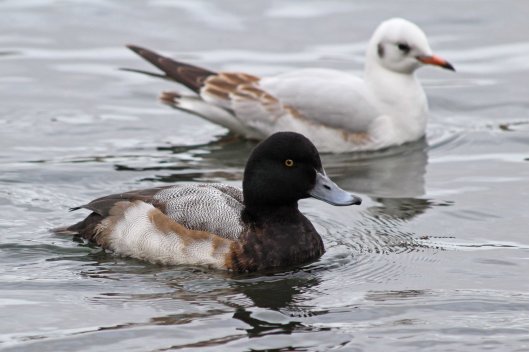
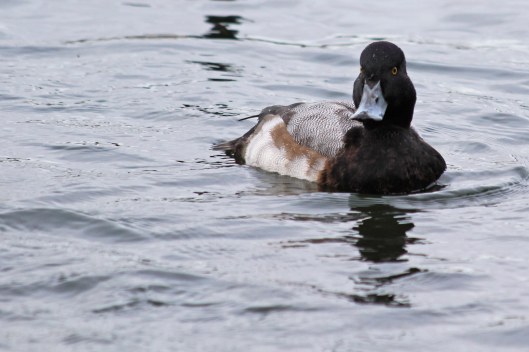
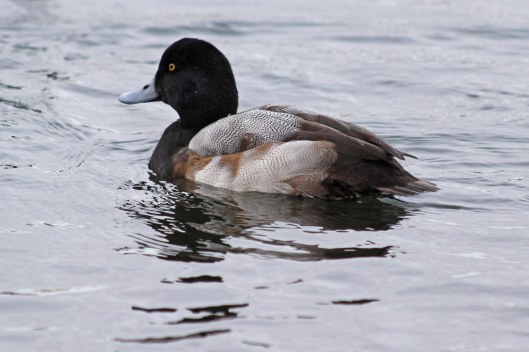
On Sunday I went to Cosmeston Lakes Country Park to look for the Scaup that has, since 13 December, been enjoying the delights of the lakes and the company of the huge number of Tufted ducks currently resident there. I had a wonderful mooch about but couldn’t find the Scaup (though I did spot a Hawfinch, a rare visitor, and was very pleased with that).

181219 scaup (1)

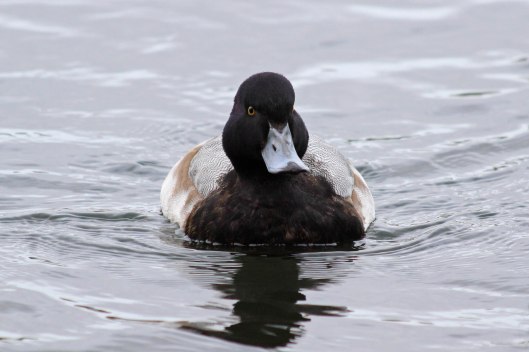
So, I went back again on Monday, partly to look again for that Hawfinch but also for the Scaup. And I was lucky with both birds, with another very fleeting, distant view of the finch but superb close views of the Scaup, which came to feed on the seed I always carry with me in the winter.
181219 scaup (3)181219 scaup (5)

This is a drake Scaup – actually a Greater scaup (Aythya marila), which is usually just known as Scaup, as the Lesser scaup is so rarely seen, and a first-winter bird, as it doesn’t yet have its adult plumage – the brown colouring you can see on this bird will disappear as it develops into an adult.

181219 scaup (6)181219 scaup (7)

In south Wales, the Scaup is an uncommon winter visitor and passage migrant, which, according to the latest Glamorgan Bird Report, enjoyed a ‘welcome increase of records and numbers’ in the 2017 first winter period (i.e. between January and mid April). Let’s hope the increasing number of sightings of this handsome little duck continues.

181219 scaup (8)181219 scaup (9)

Like Loading...

The gammy-legged Rock pipit

15 Saturday Dec 2018

Posted by sconzani in birds, nature, seaside, winter

≈ 5 Comments

Tags

birding, birdwatching, British birds, Ely embankment, Rock pipit, Rock pipit with misshapen claw

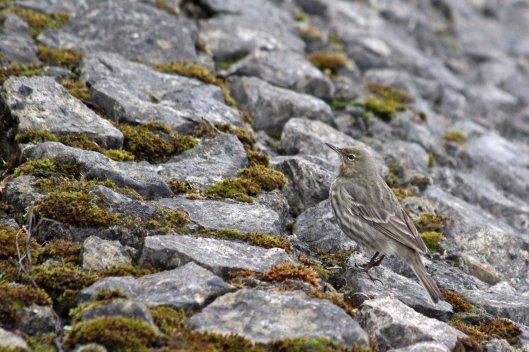
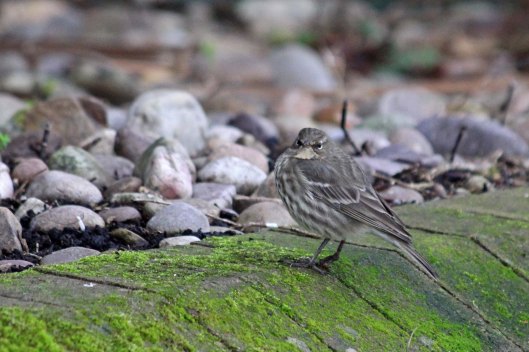
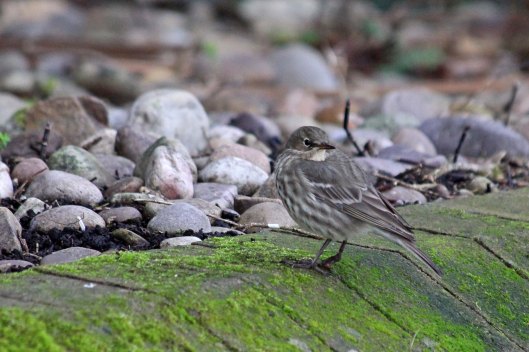
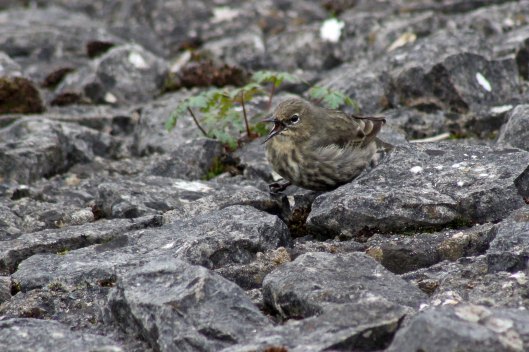
Last Monday, during my stroll along the Ely embankment path, I enjoyed a close encounter with this Rock pipit. It had ventured across the pavement at the top of the stony embankment and was poking about in a pebble-filled ground-floor garden in front of one of the tall apartment blocks that border the path. I guess, to a Rock pipit, one group of stones is as good as another to explore for insects.

181215 rock pipit (3)

The Rock pipit saw me approaching and quickly hopped back across to the safety of the embankment, where it would be easier to fly away. So, I moved to stand next to a lamp post, kept completely still and waited.

181215 rock pipit (2)181215 rock pipit (1)

As I’d hoped, the pipit decided I presented no immediate threat and, though it continued to keep a wary eye on me, it soon hopped back across to the garden again. So I was able to spend a delightful 10 minutes getting some photos and watching it foraging. It always amazes me how much food small birds like this seem able to find – tiny titbits to be sure but, presumably, enough to keep them alive.

181215 rock pipit (4)181215 rock pipit (5)

It was only when I got home and checked my photos that I noticed the bird’s gammy right leg, with its twisted misshapen claw. This had not seemed to be causing the bird any difficulty while I was watching it. And then something stirred in my memory – I was certain I’d seen this bird before. And, sure enough, when I checked through my Rock pipit album, I had photos of this same bird in this general area taken on 27 January and 11 March 2017, and 11 and 31 January, and 14 March 2018. I’m not sure how long Rock pipits usually live but this little bird has obviously been coping remarkably well with its disability.

181215 rock pipit (6)

Same bird, 11 March 2017

Like Loading...

My little Welsh Robin

13 Thursday Dec 2018

Posted by sconzani in birds, nature

≈ 8 Comments

Tags

birding, birdwatching, British birds, British robin, redbreast, robin, Robin Redbreast

181213 robin (1)

‘Art thou the bird whom Man loves best,
The pious bird with the scarlet breast,
Our little English Robin …’
~  from William Wordsworth, ‘The Redbreast Chasing the Butterfly’, 1806

181213 robin (2)
181213 robin (3)

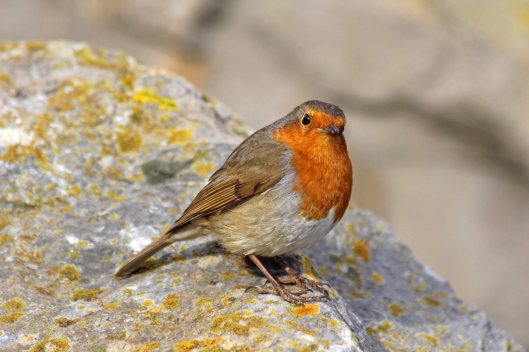
Blogger’s note: This particular little cutie, with whom I shared some quality moments – me chatting and it peeping – at Penarth Heads beach on Monday, is actually a Welsh (not English) Robin. And its breast is really more orange than red but I’ve just this week found out why it was formerly known as Redbreast and described as having a red or scarlet rather than orange breast – it’s because orange as a colour (which originated from the fruit of the same name) was unknown in Britain prior to the mid 16th century.

181213 robin (4)
181213 robin (5)
181213 robin (6)
181213 robin (7)
Like Loading...

The marina sparrows

08 Saturday Dec 2018

Posted by sconzani in birds, nature, plants

≈ 4 Comments

Tags

birding, birdwatching, British birds, house sparrow, pampas grass, Penarth marina, sparrow, toetoe

At one end of my regular walk along the embankment of the Ely River where it flows in to Cardiff Bay, near the entrance to Penarth Marina, is a huge stand of what I presume is a type of pampas grass. I always look at it, partly because it reminds me of my New Zealand home (where we would call this by the Maori name Toetoe) and partly because it is often covered in House sparrows.

181208 marina sparrows (1)

The birds seem to adore this grass. The sturdy stems provide convenient perches on which to sit and cheep their continuous sparrow conversations, and they pluck away at the fluffy plumes, presumably extracting edible seeds to munch on. And, when threatened by the local ginger-and-white cat, which is frequently to be seen staring hungrily in their direction, the sparrows can easily flit into the dense vegetation of the grass clump to escape the cat’s clutches.

181208 marina sparrows (2)
181208 marina sparrows (3a)
181208 marina sparrows (4)
181208 marina sparrows (5)
181208 marina sparrows (6)
181208 marina sparrows (7)
181208 marina sparrows (8)
181208 marina sparrows (9)
Like Loading...

Synchronised grebes

04 Tuesday Dec 2018

Posted by sconzani in birds, nature

≈ 1 Comment

Tags

birding, birdwatching, British birds, Great Crested Grebe, synchronised swimming

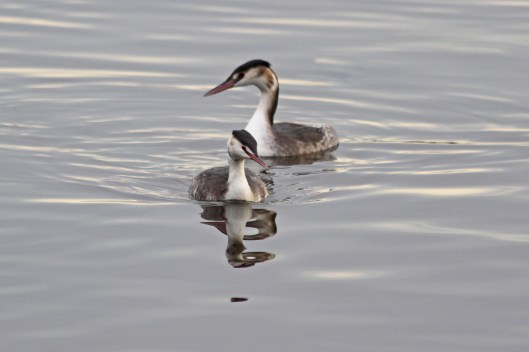
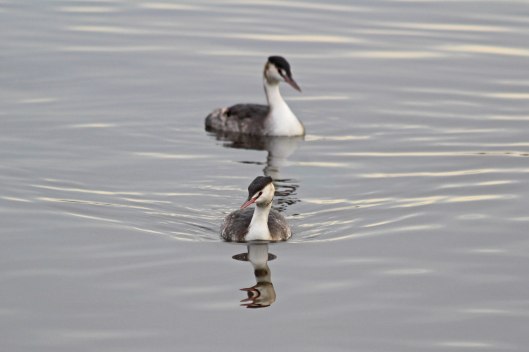
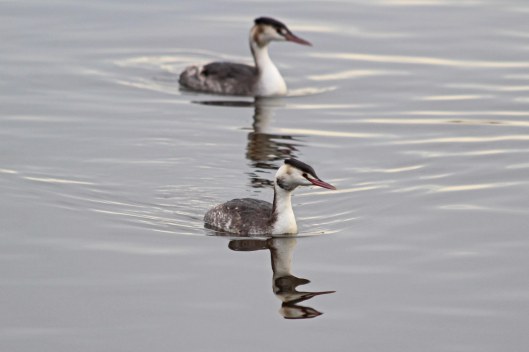
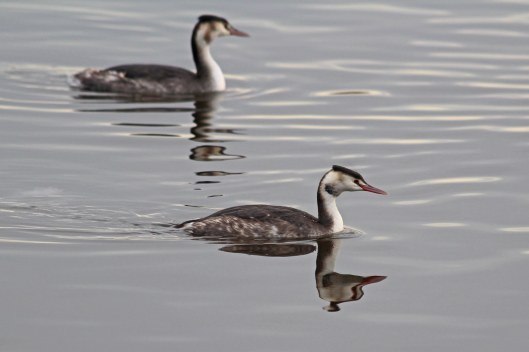
These two Great crested grebes put on a delightful display of synchronised swimming for me at Cardiff Bay Wetlands today, gliding first one way, then the other. I scored them a perfect 10. I almost applauded … but that would’ve scared them off. Gold to the grebes!

181204 great crested grebes (1)181204 great crested grebes (2)181204 great crested grebes (3)181204 great crested grebes (4)

Like Loading...

Twitching in the rain

03 Monday Dec 2018

Posted by sconzani in birds, nature

≈ 2 Comments

Tags

birding, birdwatching, British birds, diving birds, Great northern diver, twitching

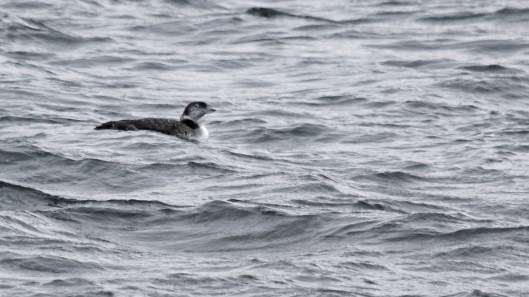
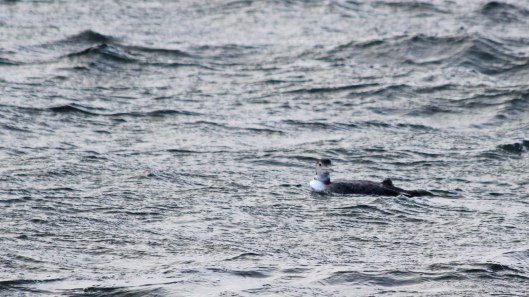
It’s Saturday morning, the Met Office’s forecast of no rain was a lie so I’m doing house chores. At 11:30 I re-check the weather – supposedly clearing, but that’s not what the pitter-patter on my window panes is telling me – and I have a quick look at the birding hashtag used by local birders on Twitter to see if anything’s happening. It is! At 11:41, local birder Mat had posted that another local Ian had spotted a Great northern diver at Barry Docks.

Action stations. My backpack is packed, rain jacket, hat, scarf and gloves are on, and I’m out the door in record time. I stride the 20-minute walk to Cogan Station in record time and wait impatiently for the next train, due in 7 minutes. Why am I in such a rush to twitch this bird? Because, although there was a Great northern diver – the same bird? – at Barry Docks for several weeks earlier this year, I didn’t manage to spot it on the two occasions I went looking. So, I’m determined not to dip this time.

The slowest train ride ever, another rapid stride from the station to the edge of the dock and, as soon as I get there, my heart sinks – as well as the drizzly rain, it’s windy and the water in the dock is incredibly choppy, making it difficult to see anything. I put my backpack on a bench, get out my bins and turn to start scanning the water. And there is the bird, no more than 20 metres in front of me!

181203 great northern diver (1)

181203 great northern diver (2)

I can hardly believe my luck and get my camera out as quickly as I can to record the moment. I fire off half a dozen shots, then the bird dives. Knowing it could go quite a distance underwater, I put my backpack on, move to the edge of the dock and wait, scanning constantly from left to right as if I’m watching a tennis match.

181203 great northern diver (3)

It’s up again, not too far away and I move closer, grabbing more photos. For some reason, it’s got its eye on the sky so I look to see what it might be looking at – only gulls wheeling on the wind – but when I look back, the diver has disappeared again.

181203 great northern diver (6)

I move over to where a lone fisherman is packing up his gear and he asks me if I’ve come  specially to see this bird. He says he’s been watching it for about 15 minutes, working its way along the dock and then returning. As the fisherman heads off, I look again for the bird and realise I’ve lost it. I walk further west along the dock edge, stopping to scan the water every couple of minutes, but the rain is heavier now and it’s become very dull and gloomy. I thank my lucky stars that I’ve managed to see the bird at all and decide to head back to the station. And when I turn, there’s the diver again – it has doubled back and is quite close in, so I grab a few more photos.

181203 great northern diver (5)

The diver looks sleepy now, is closing its eyes as it rocks up and down on the waves, and is drifting further and further away from me. I call it a day and head home, smiling all the way.

181203 great northern diver (7)

Like Loading...

A’dipping and a’bobbing

01 Saturday Dec 2018

Posted by sconzani in birds, nature

≈ 4 Comments

Tags

birding, birdwatching, bobbing in birds, British birds, Cinclidae, Cinclus cinclus, Dipper

You might think it’s just the little Robin that goes bob-bob-bobbing along but no!

After two days of weather warnings, gale-force winds and heavy rain showers, I was itching for a walk, partly because I tend to go a little stir crazy if I can’t get out every day but also because I’ve been learning this year how much weather affects the movements of birds. On Thursday, though more rain was forecast, I decided I’d head down to Penarth Marina for a walk along the Ely embankment path to see if anything unusual was sheltering from the tumultuous weather in its relatively calm waters.

181202 redshank (1)
181202 redshank (2)
181202 redshank (3)

The three Redshanks were a nice surprise, the most I’ve seen there this autumn, but the highlight came right at the end. As I approached the last bend in the path, I spotted a dark bird at the water’s edge. I hadn’t brought my bins with me so used my camera to take a photo and zoom in. A Dipper! What a treat!

181292 dipper (1)

The Dipper (Cinclus cinclus) is a rotund little bird, more often seen prospecting for food in stony streams and low-flowing rivers. It’s the only British passerine (birds that perch) that feeds underwater and the only British member of the five species of Cinclidae found around the world. Their name cinclus comes from the Ancient Greek word kinklos, meaning a small tail-wagging bird that lives near water.

181292 dipper (2)

In deeper water, the Dipper swims down to the river bed, ‘flying underwater’ – an action probably more akin to rowing with wings, and its sturdy claws can grip even the smoothest of stones. This lovely bird, though, was working the shallow water where the stony embankment of the River Ely meets the brackish water of Cardiff Bay, poking about and flipping stones in its quest for aquatic insects.

181292 dipper (4)
181292 dipper (5)

It paused when it noticed me watching it from the top of the bank above so I stayed completely still, hoping it would then ignore me and return to its grazing. It blinked at me several times, exposing its pale upper eyelid, an action I have since read is either a courtship or threat display – I don’t think it fancied me!

181292 dipper (6)

Luckily, after a couple of minutes, it obviously decided I posed no immediate threat, bobbed a couple of times and carried on. Bobbing is an odd motion that several different birds make – it has been interpreted as a means of visual communication but that seems unlikely in this case as the bird was on its own. I also read on the Birdnote website:

One possibility is that the dipper’s repetitive bobbing, against a background of turbulent water, helps conceal the bird’s image from predators. A second theory asserts that dipping helps the bird spot prey beneath the surface of the water.

181292 dipper (3)

Perhaps we’ll never know the real reason for its bobbing but it was certainly a joy to watch this particular bird a’dipping and a’bobbing on my local patch.

Like Loading...

My bogey bird

24 Saturday Nov 2018

Posted by sconzani in birds, nature

≈ Leave a comment

Tags

birding, birdwatching, British birds, Cardiff Bay wetlands, Rallus aquaticus, Water rail

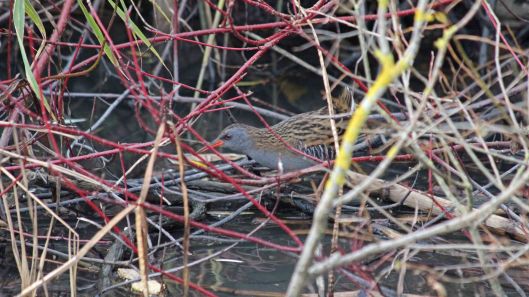
On Thursday, at long last, I saw and got photos of my bogey bird – not great photos, because it didn’t stop still for a single moment and was mostly obscured as it poked and prodded its way along the shrubby water’s edge at Cardiff Bay Wetlands Reserve – but I’m still absolutely delighted to have seen the bird.

181124 water rail (3)

Though I’ve heard these birds in various locations, I’ve only ever seen a Water rail (Rallus aquaticus) once previously, at Forest Farm Nature Reserve, back in February 2016. At the time, I didn’t realise how lucky I was to have good views of it as it did a circuit of the pond in front of one of the hides. Now I know better.

181124 water rail (4)

My failure to see a Water rail during the intervening 2 years 9 months was not simply down to bad luck or bad field craft. These are notoriously secretive birds, seemingly relishing concealment and a quiet life in the very thickest of wetland vegetation, though quiet they are not.

181124 water rail (5)

Various adjectives have been used to describe their call: squealing, grunting, snorting, piglet-like. (You can listen for yourself here.) Though it was constantly chattering away to itself, this particular Water rail made none of those more raucous sounds: its one-sided conversation was more of a sharp-voiced running commentary on the chilliness of the weather, the lack of insects, the number of pesky mallards.

181124 water rail (7)

This Water rail was smaller than I remembered, about half the size of the more numerous and extrovert Moorhen, and, to my eye, it was much more handsome. Its head, chest and underbelly have the rich blues of the Moorhen but its brown-and-black back is mallard-like, and it has a lovely blue-and-white stripey area on each flank. The cheeky white bobbing under-tail  is the same as its bigger cousin though.

181124 water rail (1)
181124 water rail (2)
Like Loading...

A goose roost

21 Wednesday Nov 2018

Posted by sconzani in birds, nature

≈ 4 Comments

Tags

birding, birdwatching, British birds, Canada goose, goose roost, honking geese

181121 canada geese (1)

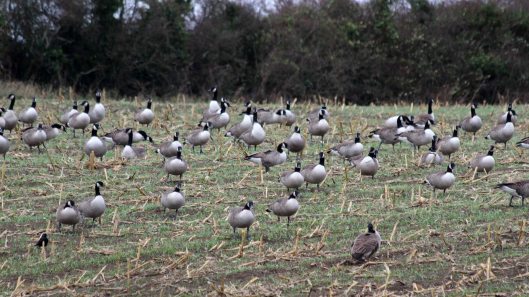
Have I gone from the sublime (yesterday’s Hen harrier) to the ridiculous (today’s Canada geese)? Maybe. But to me all birds are interesting so geese today it is!

181121 canada geese (2)

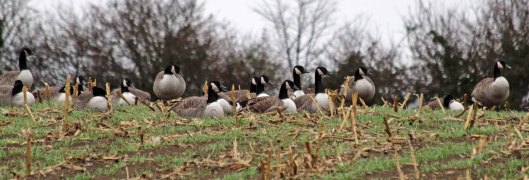
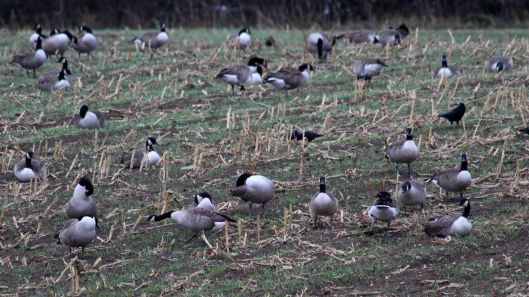
With their constant honking conversation, I could hear these birds before I saw them, sitting, standing, arguing with their neighbours, walking about, feeding on excess seeds from the farmer’s recent planting.

181121 canada geese (3)

A local birder recently reported 280 Canada geese on the lakes at Cosmeston, which is just a short distance as the goose flies from where these birds were resting at Lavernock, and by my reckoning there were over 200 in this field yesterday.

181121 canada geese (4)

I have walked this way on two consecutive mornings this week and have seen the geese both times but, even as I watched them, I doubted that the farmer would let them stay much longer.

181121 canada geese (5)

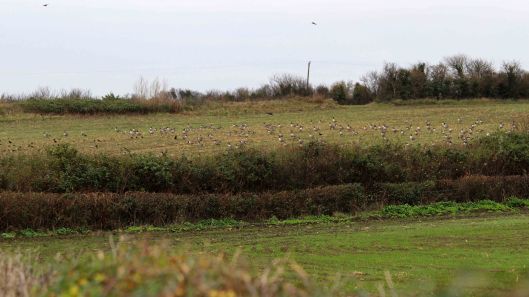
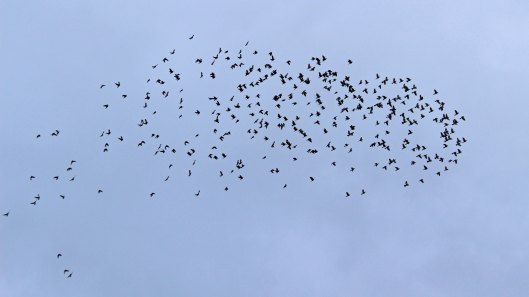
As I was leaving the area yesterday, I heard shooting, saw geese flying off in small groups and also saw large flocks of Woodpigeons and Jackdaws take to the air, so I assume the farmer is now actively chasing all potential seed-eaters off his fields.

181121 canada geese (6)

181121 canada geese (7)

Just a few Woodpigeons!

Like Loading...
← Older posts
Newer posts →

About me

sconzani

sconzani

I'm a writer and photographer; researcher and blogger; birder and nature lover; countryside rambler and city strider; volunteer and biodiversity recorder.

View Full Profile →

Follow earthstar on WordPress.com

Enter your email address to follow this blog and receive notifications of new posts by email.

Recent blog posts

  • Cetti’s warblers March 27, 2026
  • Goose barnacles March 26, 2026
  • Black-tailed godwits fighting March 25, 2026
  • Singing from every tree top March 24, 2026
  • Turtle bug March 23, 2026

From the archives

COPYRIGHT

Unless otherwise acknowledged, the text and photographs on this blog are my own and are subject to international copyright. Nothing may be downloaded or copied without my permission.

Fellow Earth Stars!

  • Unknown's avatar
  • Unknown's avatar
  • Unknown's avatar
  • Unknown's avatar
  • Unknown's avatar
  • Unknown's avatar
  • Unknown's avatar
  • Unknown's avatar
  • Unknown's avatar
  • Unknown's avatar
  • Unknown's avatar
  • Unknown's avatar
  • Unknown's avatar
  • Unknown's avatar
  • Unknown's avatar
  • Unknown's avatar
  • Unknown's avatar
  • Unknown's avatar
  • Unknown's avatar
  • Unknown's avatar
  • Unknown's avatar
  • Unknown's avatar
  • Unknown's avatar
  • Unknown's avatar
  • Unknown's avatar
  • Unknown's avatar
  • Unknown's avatar
  • Unknown's avatar
  • Unknown's avatar
  • Unknown's avatar
  • Unknown's avatar
  • Unknown's avatar
  • Unknown's avatar
  • Unknown's avatar
  • Unknown's avatar
  • Unknown's avatar
  • Unknown's avatar
  • Unknown's avatar
  • Unknown's avatar
  • Unknown's avatar
  • Unknown's avatar
  • Unknown's avatar
  • Unknown's avatar
  • Unknown's avatar
  • Unknown's avatar
  • Unknown's avatar
  • Unknown's avatar
  • Unknown's avatar
  • Unknown's avatar
  • Unknown's avatar

Blog at WordPress.com.

Privacy & Cookies: This site uses cookies. By continuing to use this website, you agree to their use.
To find out more, including how to control cookies, see here: Cookie Policy
  • Subscribe Subscribed
    • earthstar
    • Join 642 other subscribers
    • Already have a WordPress.com account? Log in now.
    • earthstar
    • Subscribe Subscribed
    • Sign up
    • Log in
    • Report this content
    • View site in Reader
    • Manage subscriptions
    • Collapse this bar
 

Loading Comments...
 

You must be logged in to post a comment.

    %d