• ABOUT
  • BIRDING 2018
  • Birding 2019
  • BLOG POSTS
  • Butterflies 2018
  • Resources

earthstar

~ a celebration of nature

earthstar

Tag Archives: British fungi

297/366 Candlesnuff

23 Friday Oct 2020

Posted by sconzani in autumn, fungi, nature

≈ Leave a comment

Tags

British fungi, Candlesnuff, Candlesnuff fungus, Xylaria hypoxylon

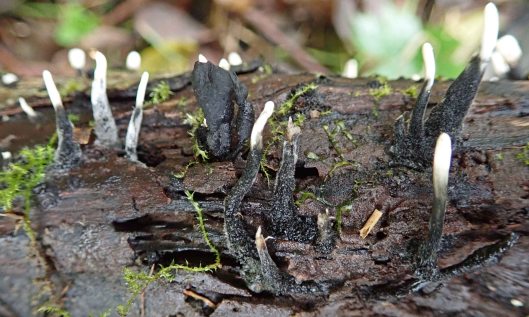
With our weather much wetter and temperatures not too cold, October should be a good month for spotting fungi but I haven’t been finding much during my daily meanders. So, it was good to spot a piece of wood with the early stages of Candlesnuff (Xylaira hypoxylon) fungi growing out of it.

201023 candlesnuff (1)

I’ve blogged about this lovely fungus before so to find out more about it, click on The right snuff, December 2016.

201023 candlesnuff (2)

Like Loading...

288/366 Little Japanese umbrella

14 Wednesday Oct 2020

Posted by sconzani in autumn, fungi

≈ Leave a comment

Tags

autumn fungi, British fungi, inkcap, Parasola plicatilis, Pleated inkcap

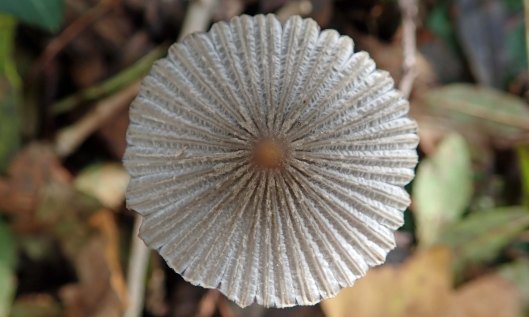
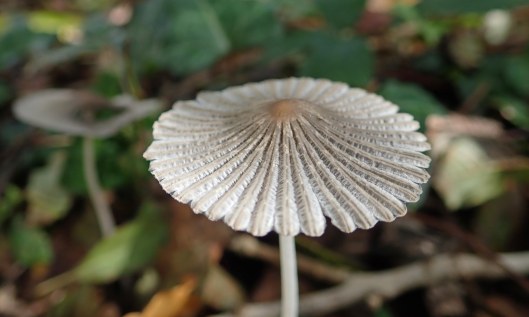
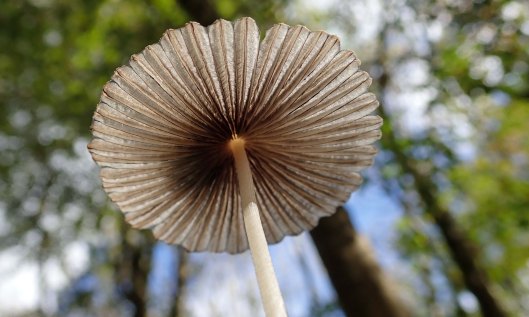
I didn’t know until I read the entry for the Pleated inkcap (Parasola plicatilis) on the First Nature website that this fungus is also known as the Little Japanese umbrella but it’s easy to see how its delicate pleated structure would suggest the comparison. These little beauties are a one-day wonder and you have to be up early to appreciate them at their best. Here, we have photos looking directly down at the cap, a side shot, and then looking up from ground level at the underside of the cap. A perfect tiny parasol!

201014 pleated inkcap (1)201014 pleated inkcap (2)201014 pleated inkcap (3)

Like Loading...

195/366 An inkcap in the grass

13 Monday Jul 2020

Posted by sconzani in fungi, nature

≈ Leave a comment

Tags

British fungi, fungi in grass, inkcap, mushroom

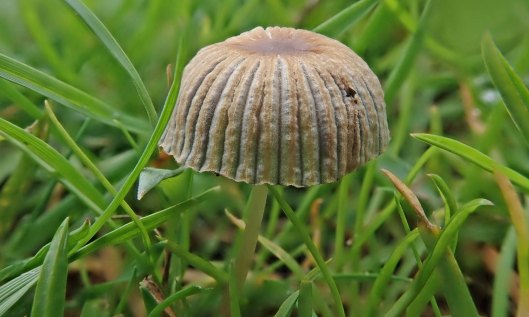
One thing about the rain, it brings out the fungi.

200713 inkcap (2)

This might be a Goldenhaired inkcap (Parasola auricoma), which can often be found growing on bark chips in gardens, or it could be a Pleated inkcap (Parasola plicatilis), which mostly grow in short grass, or it might also be a Bald inkcap (Parasola Leiocephala), which likes short grass and woodland edges. Though my specimen looks like it’s surrounded by grass, there were twigs, small branches and pieces of bark in amongst the grass, and woodland trees nearby, so the habitat doesn’t aid with identification.

200713 inkcap (1)

As I don’t own a microscope and don’t want to get in to the often complicated process of identifying fungi, I simply enjoyed seeing this little surprise that had popped up along my path.

Like Loading...

77/366 Eyelash fungi

17 Tuesday Mar 2020

Posted by sconzani in fungi, nature

≈ 2 Comments

Tags

British fungi, Cosmeston Lakes Country Park, Eyelash fungi, Scutellinia fungi, Scutellinia olivascens

As you can see from my photos, the aptly named Eyelash fungi have hair-like bristles around their outer edges.

200317 eyelash fungi (1)

These particular Eyelashes can currently be found in large numbers in the west paddock at Cosmeston Lakes Country Park, where I presume they are enjoying the soggy muddy conditions, though they are growing on banks and slightly raised areas rather than in the completely sodden soil of the flatter parts.

200317 eyelash fungi (3)
200317 eyelash fungi (2)

When compared to the Eyelash fungi I blogged about back in May 2016 (see ‘Fluttering their eyelashes’ here), these latest examples have much shorter lashes. They are probably one of the Scutellinia species – possibly Scutellinia olivascens – but there are many very similar species of Eyelash fungi and you need to examine them under a microscope to be able to identify them correctly.

200317 eyelash fungi (4)

Like Loading...

56/366 Spots and splashes

25 Tuesday Feb 2020

Posted by sconzani in fungi, lichen, nature

≈ 2 Comments

Tags

British fungi, British lichens, Common jellyspot, Cosmeston Lakes Country Park, Illosporiopsis christiansenii, lichenicolous fungus

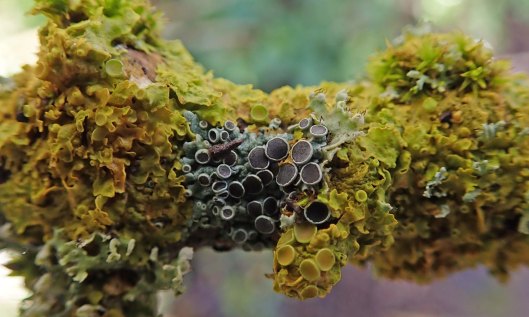
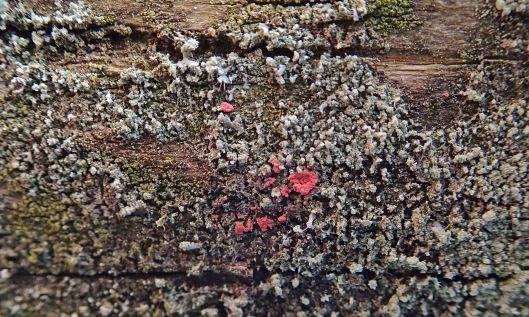
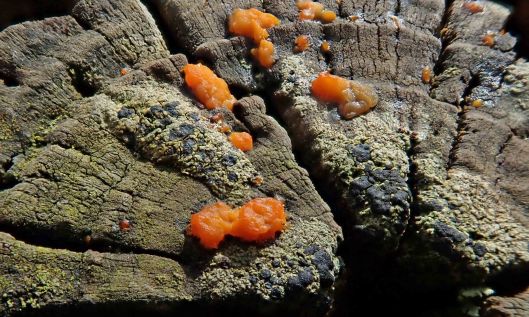
Amidst all the greys and browns and dull greens of the wintertime natural world, there are still wonderful wee spots and splashes of colour to be found. These are some I found during today’s stomp around Cosmeston, a rather rapid stomp trying, unsuccessfully, to avoid the rain showers.

200225 lichen and fungi (1)

200225 lichen and fungi (2)
200225 lichen and fungi (3)

I’m not good at identifying lichens but I do love their fresh, bright yellow-greens, especially on the twigs and small branches that have recently blown down from the tree tops.

200225 lichen and fungi (4)200225 lichen and fungi (5)

The tiny bursts of lollipop pink are Illosporiopsis christiansenii, a lichenicolous fungus (that’s a fungus which is parasitic on lichens, usually on Physcia tenella and sometimes on Xanthoria parietina).

200225 lichen and fungi (6)
200225 lichen and fungi (7)

And the pretty pops of orange, found on several fence posts, are Common Jellyspot fungus, Dacrymyces stillatus.

200225 lichen and fungi (8)

Like Loading...

17/366 Starry soils

17 Friday Jan 2020

Posted by sconzani in fungi, nature

≈ 2 Comments

Tags

British fungi, collared earthstar, earthstar, fungus, Geastrum triplex

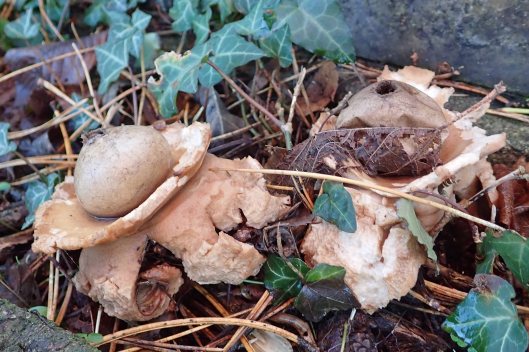
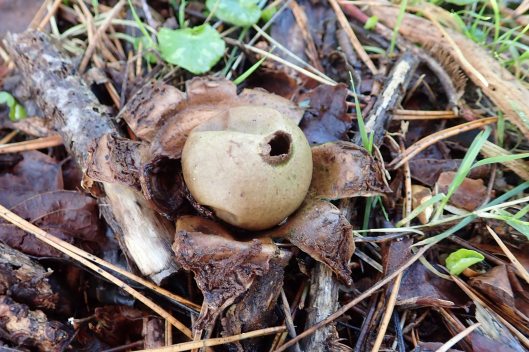
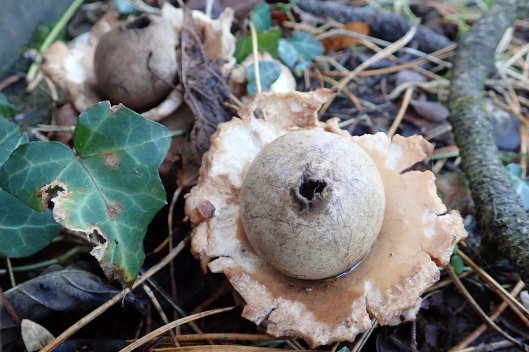
I know we usually speak of starry skies rather than starry soils but, three years ago, when I still lived in Cardiff, I found this one small patch of dirt, ’neath towering conifers in a local cemetery, where the stars could be found emerging from the soil.

200117 earthstar (1)

These Collared earthstars are the reason for the name of this blog: they show how amazing things can be found in everyday places if we only look; they show how incredible Nature is; they inspired me to write this blog, to try to get people to open their eyes to the beauty our world has to offer, even ten minutes’ walk from home.

200117 earthstar (2)

This cemetery is no longer managed with wildlife in mind – it is overly neatened and tidied – so I was particularly delighted, during a recent walk, to find these earthstars had escaped the over enthusiast strimming and pruning and scraping and chopping of the council’s operatives. Fingers crossed they continue to thrive.

200117 earthstar (3)

Like Loading...

10/366 In my cups

10 Friday Jan 2020

Posted by sconzani in fungi, nature, winter

≈ 3 Comments

Tags

#FungiFriday, British fungi, Elfcups, Scarlet elfcup

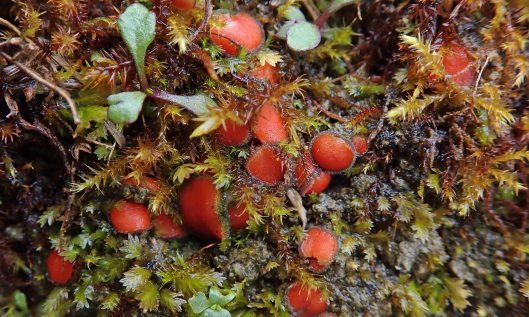
It seems appropriate that I should be ‘in my cups’ on a Friday night, the traditional night at the end of the working week for downing an alcoholic beverage or three. But, in my case, I neither work nor drink, and my ‘cups’ are fungi, Scarlet elfcups to be precise. As these are one of my favourite species of fungi I’ve blogged about them several times before and explained, in a blog back in 2017, how I know these are Scarlet, not the less common Ruby elfcups. They are always a joy to find, and they recur at this particular site every year.

200110 scarlet elfcups (1)
200110 scarlet elfcups (2)
200110 scarlet elfcups (3)
200110 scarlet elfcups (4)

(Though, as you’ll see in that previous blog, I was excited to learn how to identify fungi using microscopy, I didn’t continue with it. SEWBReC moved to an out-of-town location so it would now be a two-bus ninety-minute journey to their office, and I didn’t want the expense of buying my own microscope.)

Like Loading...

361/365 Soggy shanks

27 Friday Dec 2019

Posted by sconzani in fungi, nature

≈ 2 Comments

Tags

British fungi, Flammulina velutipes, fungus, Velvet shanks, winter fungi

It was so misty and soggy out today that I could hear more than I could see, particularly as my specs were alternately splattered with raindrops or steamed up.

191227 velvet shanks (1)

Yet, these gorgeous fungi were impossible to miss, a burst of golden orange amongst the drab browns and greys and greens.

191227 velvet shanks (2)

These are very slippery, soggy examples of Velvet shanks (Flammulina velutipes).

191227 velvet shanks (3)

Like Loading...

353/365 Oak curtain crust

19 Thursday Dec 2019

Posted by sconzani in fungi, nature, winter

≈ 1 Comment

Tags

British fungi, crust fungi, Grangemoor Park, Hymenochaete rubiginosa, Oak curtain crust

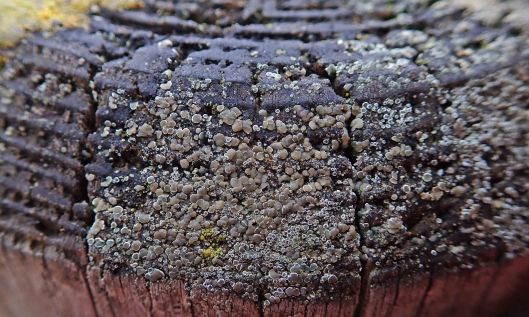
‘Nearly always associated with dead oak trees, this easily-overlooked crust fungus varies considerably in its appearance, sometimes mainly resupinate beneath fallen logs but usually in bracket form when on dead stumps,’ writes Pat O’Reilly on his First Nature website. The specimens of Oak curtain crust fungi I found yesterday, in Cardiff’s Grangemoor Park, were definitely growing on oak but, in this case, they were on thick, solid oak logs that have been used to construct benches and signposts.

191219 Oak Curtain Crust (2)

I always enjoy reading the etymology entries on O’Reilly’s website. Oak curtain crust’s binomial name is Hymenochaete rubiginosa, which is explained as follows:

Hymenochaete, the genus name, comes from hymen – a prefix referring to the fertile membrane (the crust surface), and -chaete perhaps from the Greek noun chaite meaning long hair and perhaps referring to the fine hairs (settae) on the upper surfaces of fungi in this generic group.
The specific epithet rubiginosa means rusty and refers to the reddish-brown colour of the hymenial (fertile) surface of this crust fungus.

191219 Oak Curtain Crust (1)

Like Loading...

340/365 Plums and custard

06 Friday Dec 2019

Posted by sconzani in fungi, nature, trees, winter

≈ Leave a comment

Tags

British fungi, fungi on conifers, Plums and custard, Tricholomopsis rutilans, winter fungi

In this case, Plums and custard does not refer to a tasty Friday night dessert, sadly, but rather to a deliciously named fungus with the scientific name Tricholomopsis rutilans, which certainly does not roll off the tongue.

191206 plums and custard (1)

The Plums and custard name (and the alternate, Strawberry fungus) don’t refer to taste or edibility, however – at its most vibrant, this fungus displays rich shades of a plum-like colour on its cap and its gills are a lovely custard yellow.

191206 plums and custard (2)
191206 plums and custard (3)
191206 plums and custard (4)
191206 plums and custard (5)

These wood-rotting fungi are usually found growing on decaying conifers, and you can read more about them, their habitats, and their identification features on the First Nature website.

191206 plums and custard (6)

Like Loading...
← Older posts
Newer posts →

About me

sconzani

sconzani

I'm a writer and photographer; researcher and blogger; birder and nature lover; countryside rambler and city strider; volunteer and biodiversity recorder.

View Full Profile →

Follow earthstar on WordPress.com

Enter your email address to follow this blog and receive notifications of new posts by email.

Recent blog posts

  • Q is for Quercus December 22, 2025
  • P is for Phalarope December 21, 2025
  • O is for Odonata December 20, 2025
  • N is for nest December 19, 2025
  • M is for mite December 18, 2025

From the archives

COPYRIGHT

Unless otherwise acknowledged, the text and photographs on this blog are my own and are subject to international copyright. Nothing may be downloaded or copied without my permission.

Fellow Earth Stars!

  • Unknown's avatar
  • Unknown's avatar
  • Unknown's avatar
  • Unknown's avatar
  • Unknown's avatar
  • Unknown's avatar
  • Unknown's avatar
  • Unknown's avatar
  • Unknown's avatar
  • Unknown's avatar
  • Unknown's avatar
  • Unknown's avatar
  • Unknown's avatar
  • Unknown's avatar
  • Unknown's avatar
  • Unknown's avatar
  • Unknown's avatar
  • Unknown's avatar
  • Unknown's avatar
  • Unknown's avatar
  • Unknown's avatar
  • Unknown's avatar
  • Unknown's avatar
  • Unknown's avatar
  • Unknown's avatar
  • Unknown's avatar
  • Unknown's avatar
  • Unknown's avatar
  • Unknown's avatar
  • Unknown's avatar
  • Unknown's avatar
  • Unknown's avatar
  • Unknown's avatar
  • Unknown's avatar
  • Unknown's avatar
  • Unknown's avatar
  • Unknown's avatar
  • Unknown's avatar
  • Unknown's avatar
  • Unknown's avatar
  • Unknown's avatar
  • Unknown's avatar
  • Unknown's avatar
  • Unknown's avatar
  • Unknown's avatar
  • Unknown's avatar
  • Unknown's avatar
  • Unknown's avatar
  • Unknown's avatar
  • Unknown's avatar

Blog at WordPress.com.

Privacy & Cookies: This site uses cookies. By continuing to use this website, you agree to their use.
To find out more, including how to control cookies, see here: Cookie Policy
  • Subscribe Subscribed
    • earthstar
    • Join 667 other subscribers
    • Already have a WordPress.com account? Log in now.
    • earthstar
    • Subscribe Subscribed
    • Sign up
    • Log in
    • Report this content
    • View site in Reader
    • Manage subscriptions
    • Collapse this bar
 

Loading Comments...
 

You must be logged in to post a comment.

    %d