• ABOUT
  • BIRDING 2018
  • Birding 2019
  • BLOG POSTS
  • Butterflies 2018
  • Resources

earthstar

~ a celebration of nature

earthstar

Tag Archives: British fungi

26/365 Velvet shanks

26 Saturday Jan 2019

Posted by sconzani in 365DaysWildin2019, fungi, nature, winter

≈ 1 Comment

Tags

#365DaysWild, British fungi, British mushrooms, Flammulina velutipes, Velvet shanks

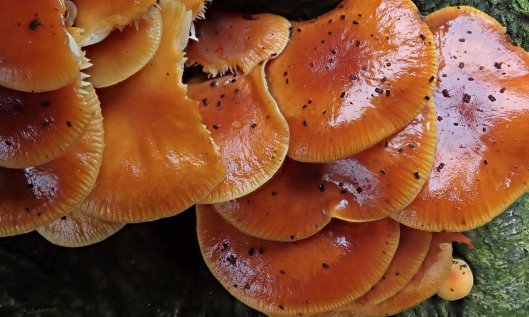
These honey-coloured mushrooms, Velvet shanks (Flammulina velutipes), can most often be found growing in the cold days of winter in groups on hardwood trees, which is where I found these beauties this morning, sprouting out of what remained of a large roadside tree that had been chopped off at a height of about four feet. Fungi expert Pat O’Reilly explains the origin of the scientific name on his First Nature website: ‘… Flammulina is a reference to the orange caps, which shine like “little flames” in the winter sunshine … [and] velutipes means “with velvet legs’’, and that’s exactly what the stems of these winter fungi look and feel like.’

OLYMPUS DIGITAL CAMERA

Like Loading...

Fungi Friday: Turkey tails

21 Friday Dec 2018

Posted by sconzani in fungi, nature

≈ 2 Comments

Tags

#FungiFriday, British fungi, fungi, fungus, Trametes versicolor, Turkey tail, Turkeytail

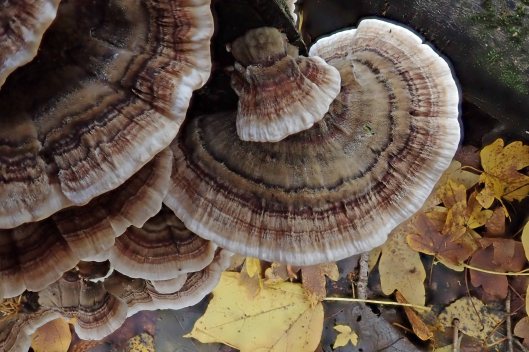
I’ve been collecting these images of Turkey tail fungi (Trametes versicolor) for the past couple of months, thinking they would be appropriate for the last Fungi Friday before Christmas seeing as how a lot of people eat turkey for their Christmas dinner.
So, merry feasting … but not on these!

181221 turkey tails (1)

181221 turkey tails (2)
181221 turkey tails (3)
181221 turkey tails (4)
181221 turkey tails (5)
181221 turkey tails (6)
181221 turkey tails (7)
Like Loading...

Fungi Friday: variety

14 Friday Dec 2018

Posted by sconzani in fungi, nature

≈ Leave a comment

Tags

#FungiFriday, black-and-white fungi, British fungi, diversity of fungi, fungal diversity, fungus, Heath Park, shapes of fungi, textures of fungi

I took myself off for a fungi foray around the woodland at Cardiff’s Heath Park today as it’s usually a good place to find a wide variety of fungi. And, rather than post colour photos of my finds, I thought I’d convert them all to black and white as that shows, I think, the fungal world’s amazing diversity of shapes and textures.

181214 fungi diversity (3)
181214 fungi diversity (4)
181214 fungi diversity (5)
181214 fungi diversity (6)
181214 fungi diversity (7)
181214 fungi diversity (8)
181214 fungi diversity (9)
181214 fungi diversity (10)
181214 fungi diversity (1)
181214 fungi diversity (2)
Like Loading...

Friday night discos

30 Friday Nov 2018

Posted by sconzani in autumn, fungi, nature

≈ 2 Comments

Tags

Bisporella citrina, British fungi, cup fungi, disco fungi, fungi on rotting wood, Lachnum virgineum, Lemon disco, Snowy disco

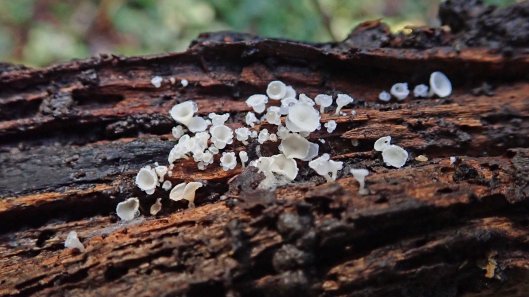
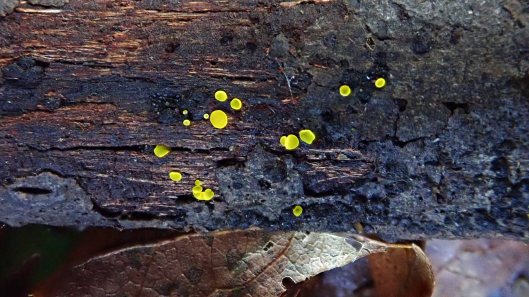
Discos seem appropriate for a Friday night or, rather, they would have in the 1960s and ’70s. But my discos don’t involve a multi-colour dance floor or a flashing-ball light or John Travolta-style dancing – my discos are fungi. Getting down and dirty in Cogan Wood earlier this week, selectively picking up small logs of rotting wood for inspection, I found two of these little beauties.

181130 snowy discoSnowy disco (Lachnum virgineum)

181130 lemon discoLemon disco (Bisporella citrina)
Disclaimer: Fungi are notoriously difficult to identify and one thing I’ve learnt from dipping my toes into the mycological world is that one should always confirm one’s identification, especially of minute fungi like these, by microscopic examination. I have not done that so my IDs are not confirmed, just quite likely.

Like Loading...

Crepidotus calolepis

23 Friday Nov 2018

Posted by sconzani in autumn, fungi, nature

≈ Leave a comment

Tags

#FungiFriday, British fungi, Crepidotus calolepis, Oysterling, oysterling fungi

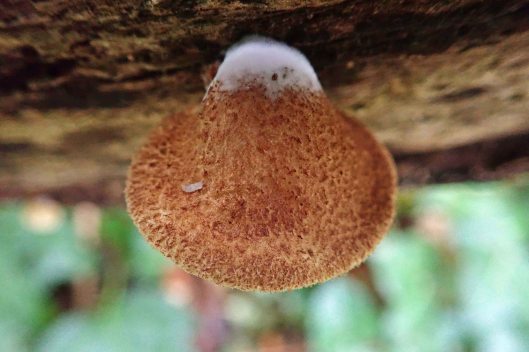
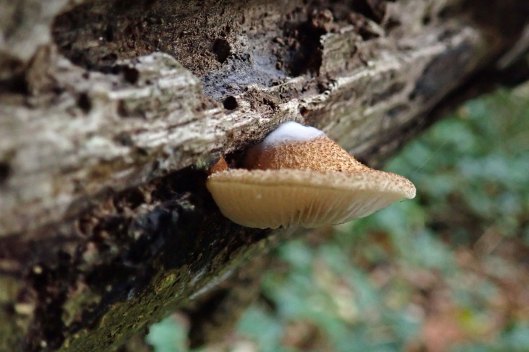
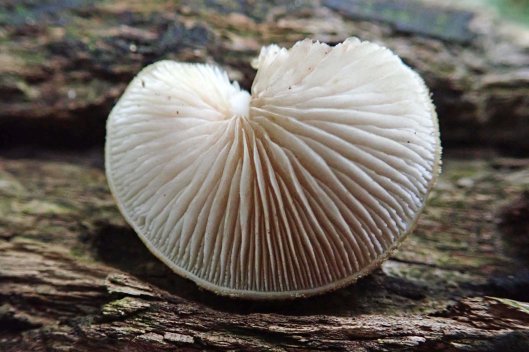
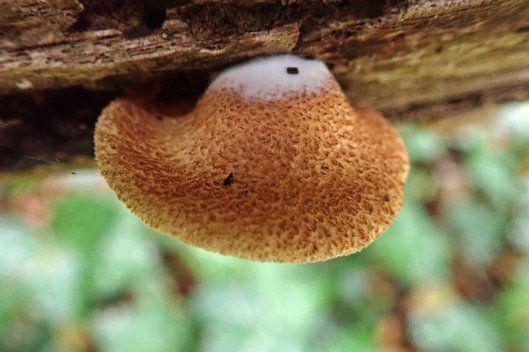
Happy #FungiFriday! I actually found these little oysterling fungi a few weeks ago but forgot to share them at the time.

181123 Crepidotus calolepis (1)

Crepidotus calolepis is a bit of a mouthful but these little beauties don’t have a common name. Here’s what fungi expert Pat O’Reilly says about its scientific name:

The generic name Crepidotus comes from crepid- meaning a base such as a shoe or a slipper (although some sources state that it means ‘cracked’), and otus, meaning an ear – hence it suggests a ‘slipper-like ear’. In the past mushrooms in this genus were sometimes referred to as slipper mushrooms. The specific epithet calolepis may come from the roots calo- meaning beautiful and lepis, meaning with scales.

181123 Crepidotus calolepis (2)

181123 Crepidotus calolepis (3)
181123 Crepidotus calolepis (4)

181123 Crepidotus calolepis (6)

O’Reilly is doubtful about the presence of Crepidotus calolepis in Britain, suggesting that the British records are, in fact, scaly forms of Crepidotus mollis, the Peeling oysterling, but my find was confirmed from photos by two other British experts so C. calolepis it is!

181123 Crepidotus calolepis (5)

Like Loading...

A new Earthstar

16 Friday Nov 2018

Posted by sconzani in fungi, nature

≈ 2 Comments

Tags

#FungiFriday, British fungi, collared earthstar, earthstar, earthstar fungus, Geastrum triplex

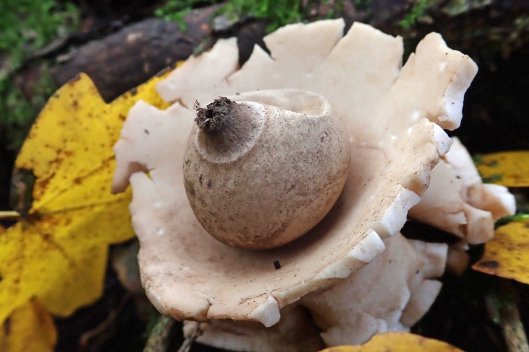
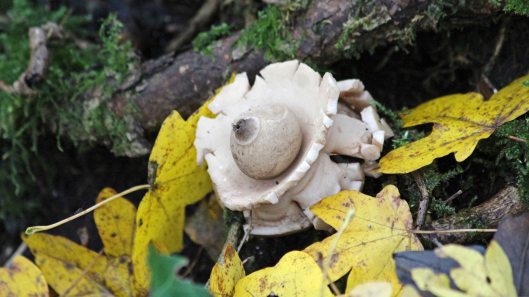
You can’t have a blog called Earthstar without occasionally having a post about an Earthstar, so here it is.

181116 earthstar (3)

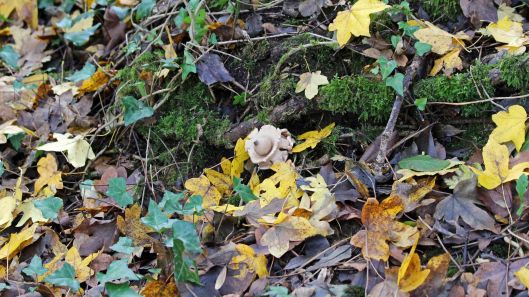
Though I searched for these amazing little fungi at a known location in Cathays Cemetery a couple of weeks ago, I couldn’t find any. So, I was delighted when a birding acquaintance showed me this solitary Earthstar at a completely new location earlier this week.

181116 earthstar (2)

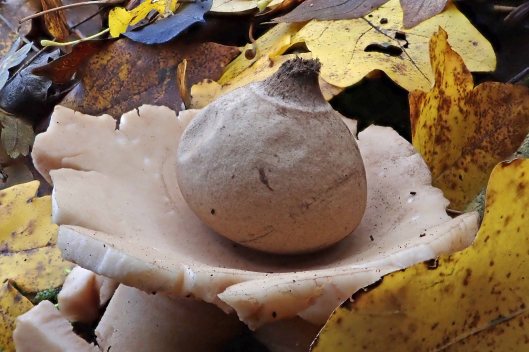
This is Geastrum triplex, a Collared earthstar. I’ve previously only found them under conifers but the experts say they are most often found, like this one, under hardwood trees.

181116 earthstar (1)

I gave its sac a poke to show my friend how the spores are released – let’s hope that also helped to spread the spores so we see more of these little stunners in future.

181116 earthstar (4)

Like Loading...

Earpick fungus

09 Friday Nov 2018

Posted by sconzani in fungi, nature

≈ 2 Comments

Tags

Auriscalpium vulgare, British fungi, Cathays Cemetery, Earpick fungus, fungi on conifer cones, fungi on pine cones, rare fungi

During a wander around Cardiff’s Cathays Cemetery last Friday, I found my first Earpick fungi (Auriscalpium vulgare).

Now, you might think Earpick is a very odd name for a fungus – you certainly wouldn’t want to use them to clean your ears out! – but it’s actually quite logical. Auriscalpium is a combination of the Latin words auris, meaning ear, and scalpare, the verb ‘to scratch’. The stem of the fungus certainly does look quite scratchy, as does the underside of the cap, with its mass of tiny cone-shaped rods. And it’s those rods that are the connection to the word ‘ear’ in the fungi’s name – have you ever seen a magnified photo of the sensory hair cells of the human inner ear?

Vulgare just means common, though this fungus is certainly not that – when I checked the biological database for Wales, I found only 10 previous recorded sightings.

These fungi were growing at the base of a conifer but I didn’t realise until I started reading up about them when I got home that the fungi nearly always grow on the rotting cones of pines and other conifers. I didn’t notice any cones but they must have been there, under the moss and grass. Fascinating!

Like Loading...

Butter cap anyone?

28 Sunday Oct 2018

Posted by sconzani in autumn, fungi, nature

≈ Leave a comment

Tags

autumn fungi, British fungi, Butter cap, Butter cap mushroom, fungus, Rhodocollybia butyracea

Here’s a fungus I can actually identify! This is the Butter cap, a name that’s so much easier to say than its scientific name Rhodocollybia butyracea.

181028 Butter cap fungus (2)

Thanks to the most excellent First Nature website, I can tell you that Rhodocollybia is from rhodo, meaning ‘pink’ (a reference to the pinkish tinge of the mushroom’s gills), and collybia means ‘small coin’, while the epithet butyracea means ‘buttery’ (but not in taste – it’s a reference to the greasiness of the cap).

181028 Butter cap fungus (1)

Like Loading...

Just peachy

06 Saturday Oct 2018

Posted by sconzani in autumn, fungi, nature

≈ 1 Comment

Tags

British fungi, Elm tree, fungi on Elm, fungus, Rhodotus palmatus, Wrinkled peach

I was over the moon when I spotted this first little burst of peachiness growing on an old, ivy-smothered log a week ago.

181006 Wrinkled peach (1)

Why? Because this is one of the few fungi I can positively identify by sight, and it’s quite the rarity in most parts of Britain these days because it grows on Elm, a tree that is itself increasingly rare in Britain nowadays. According to the Forest Research website, 60 million Elm trees have been killed by Dutch Elm disease since it was first discovered in Britain in the 1920s, the majority of those dying since the 1970s.

181006 wrinkled peach (2)181006 wrinkled peach (3)

This fungus is the wonderfully named Wrinkled peach (Rhodotus palmatus). Rhodotus comes from the Ancient Greek Rhodon, meaning rose, and palmatus is Latin and means ‘shaped like a hand’, presumably a reference to the surface texture of the fungus’s cap resembling the lines on the palm of a hand.

181006 Wrinkled peach (4)

Incredibly, I found nine of these fungi on two different logs, and then, on a subsequent visit, found another one growing on a log a few metres away. Presumably the logs are the remains of an Elm that was cut down when Dutch Elm disease was at its height.

181006 wrinkled peach (7)

As you can see from my photos, the fungi range from the very young and fresh to the aging and wrinkled and decaying. Wrinkled peach, when seen at all, is usually found between July and November, so I have a few more weeks yet to enjoy these little beauties.

181006 Wrinkled peach (5)
181006 Wrinkled peach (6)

181006 Wrinkled peach (8)181006 Wrinkled peach (9)

Like Loading...

It’s a brittlestem

25 Tuesday Sep 2018

Posted by sconzani in fungi, nature

≈ 2 Comments

Tags

British fungi, brittlestem fungi, Conical brittlestem, fungus, Parasola conopilus, Psathyrella conopilus

After misidentifying my fungi last week, I’m going to take a huge chance and say that I’m fairly confident these are Conical brittlestems (Parasola conopilus, formerly known as Psathyrella conopilus). I completely understand if you don’t believe me!

180925 Conical brittlestem (2)

180925 Conical brittlestem (3)
180925 Conical brittlestem (1)
Like Loading...
← Older posts
Newer posts →

About me

sconzani

sconzani

I'm a writer and photographer; researcher and blogger; birder and nature lover; countryside rambler and city strider; volunteer and biodiversity recorder.

View Full Profile →

Follow earthstar on WordPress.com

Enter your email address to follow this blog and receive notifications of new posts by email.

Recent blog posts

  • R is for Red-throated diver December 23, 2025
  • Q is for Quercus December 22, 2025
  • P is for Phalarope December 21, 2025
  • O is for Odonata December 20, 2025
  • N is for nest December 19, 2025

From the archives

COPYRIGHT

Unless otherwise acknowledged, the text and photographs on this blog are my own and are subject to international copyright. Nothing may be downloaded or copied without my permission.

Fellow Earth Stars!

  • Unknown's avatar
  • Unknown's avatar
  • Unknown's avatar
  • Unknown's avatar
  • Unknown's avatar
  • Unknown's avatar
  • Unknown's avatar
  • Unknown's avatar
  • Unknown's avatar
  • Unknown's avatar
  • Unknown's avatar
  • Unknown's avatar
  • Unknown's avatar
  • Unknown's avatar
  • Unknown's avatar
  • Unknown's avatar
  • Unknown's avatar
  • Unknown's avatar
  • Unknown's avatar
  • Unknown's avatar
  • Unknown's avatar
  • Unknown's avatar
  • Unknown's avatar
  • Unknown's avatar
  • Unknown's avatar
  • Unknown's avatar
  • Unknown's avatar
  • Unknown's avatar
  • Unknown's avatar
  • Unknown's avatar
  • Unknown's avatar
  • Unknown's avatar
  • Unknown's avatar
  • Unknown's avatar
  • Unknown's avatar
  • Unknown's avatar
  • Unknown's avatar
  • Unknown's avatar
  • Unknown's avatar
  • Unknown's avatar
  • Unknown's avatar
  • Unknown's avatar
  • Unknown's avatar
  • Unknown's avatar
  • Unknown's avatar
  • Unknown's avatar
  • Unknown's avatar
  • Unknown's avatar
  • Unknown's avatar
  • Unknown's avatar

Blog at WordPress.com.

Privacy & Cookies: This site uses cookies. By continuing to use this website, you agree to their use.
To find out more, including how to control cookies, see here: Cookie Policy
  • Subscribe Subscribed
    • earthstar
    • Join 667 other subscribers
    • Already have a WordPress.com account? Log in now.
    • earthstar
    • Subscribe Subscribed
    • Sign up
    • Log in
    • Report this content
    • View site in Reader
    • Manage subscriptions
    • Collapse this bar
 

Loading Comments...
 

You must be logged in to post a comment.

    %d