• ABOUT
  • BIRDING 2018
  • Birding 2019
  • BLOG POSTS
  • Butterflies 2018
  • Resources

earthstar

~ a celebration of nature

earthstar

Tag Archives: British leafhoppers

Leafhopper: Acericerus heydenii

30 Wednesday Oct 2024

Posted by sconzani in insects

≈ Leave a comment

Tags

Acericerus heydenii, British cicadellidae, British leafhoppers, Cicadellidae, leafhopper, leafhopper on Sycamore

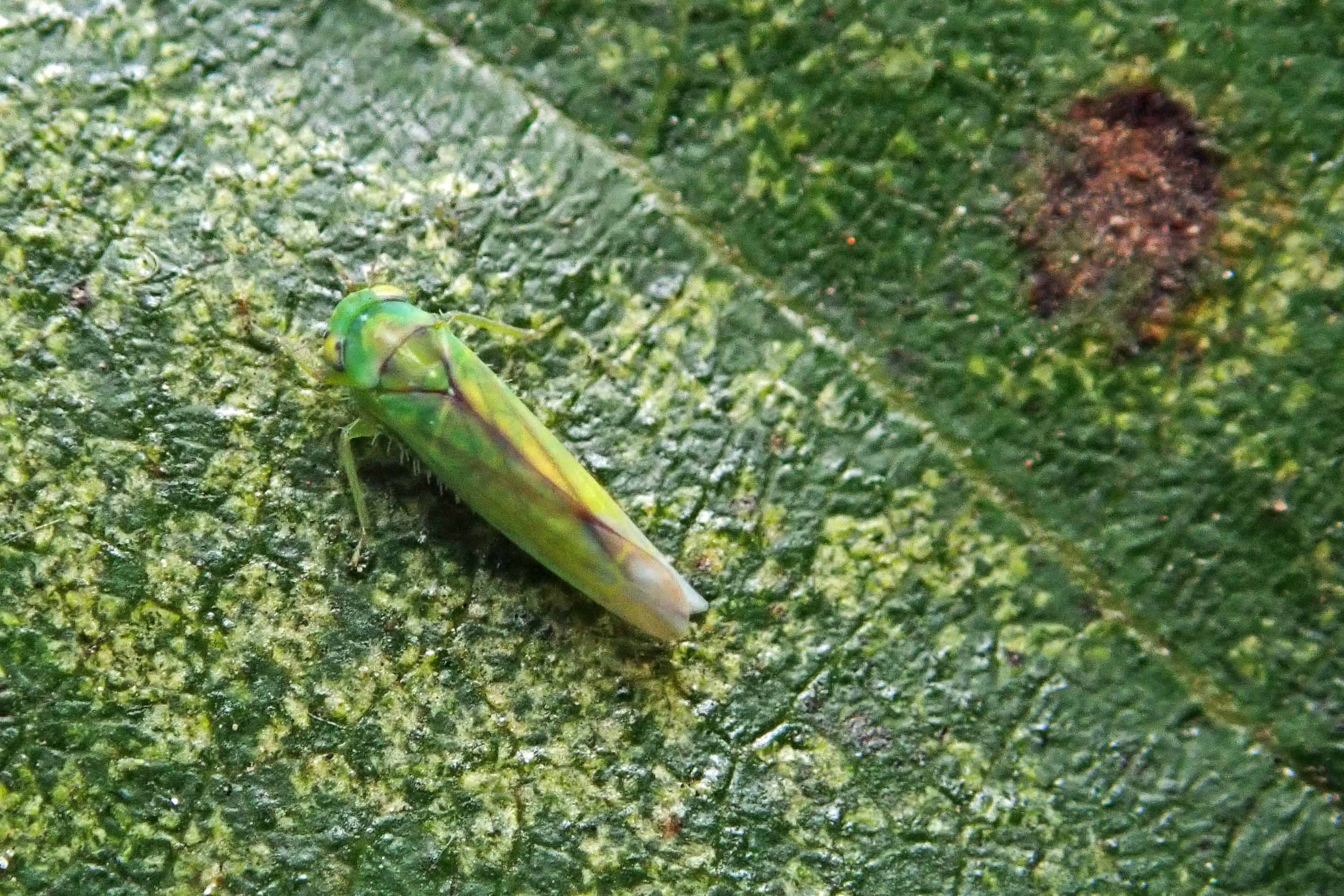
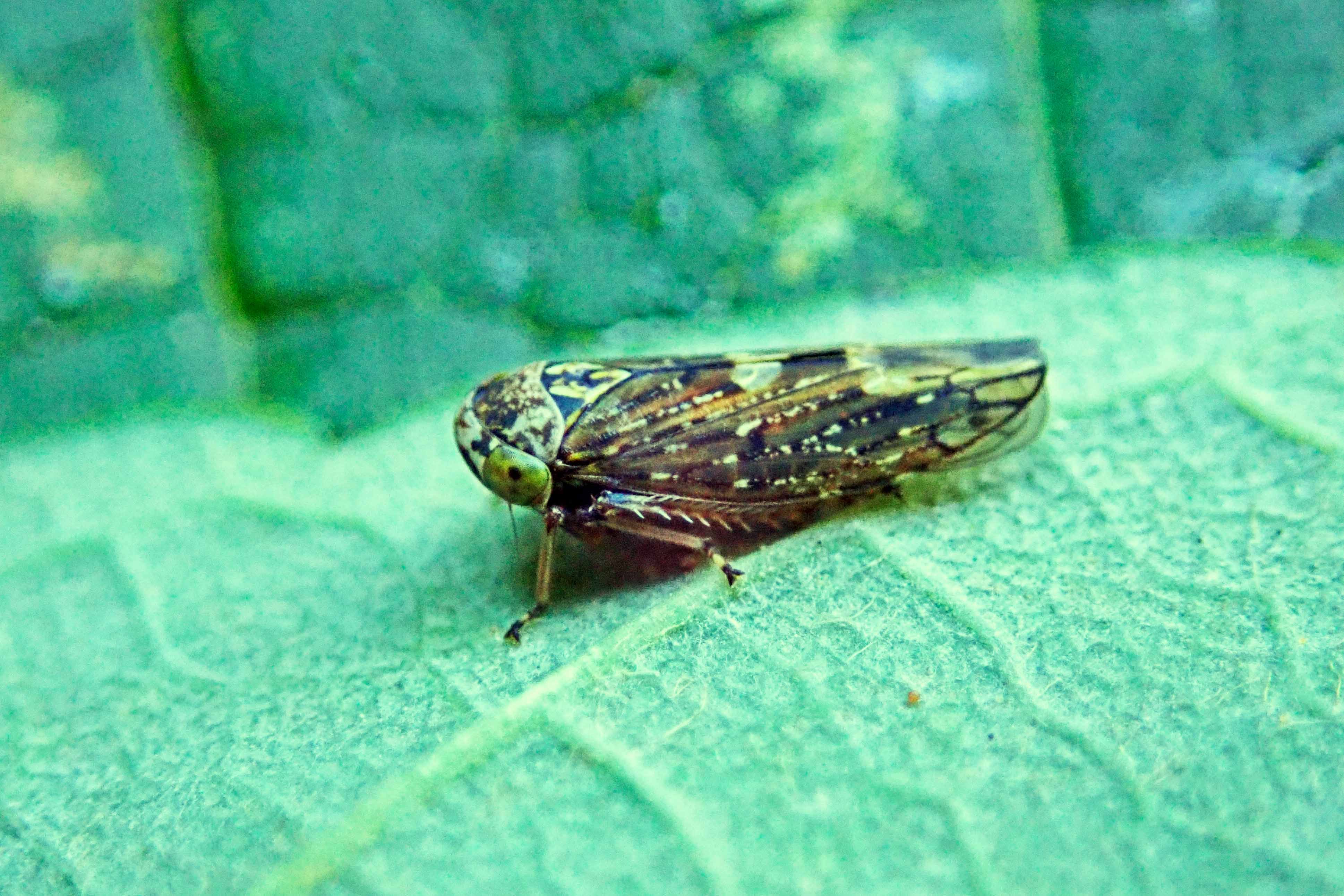
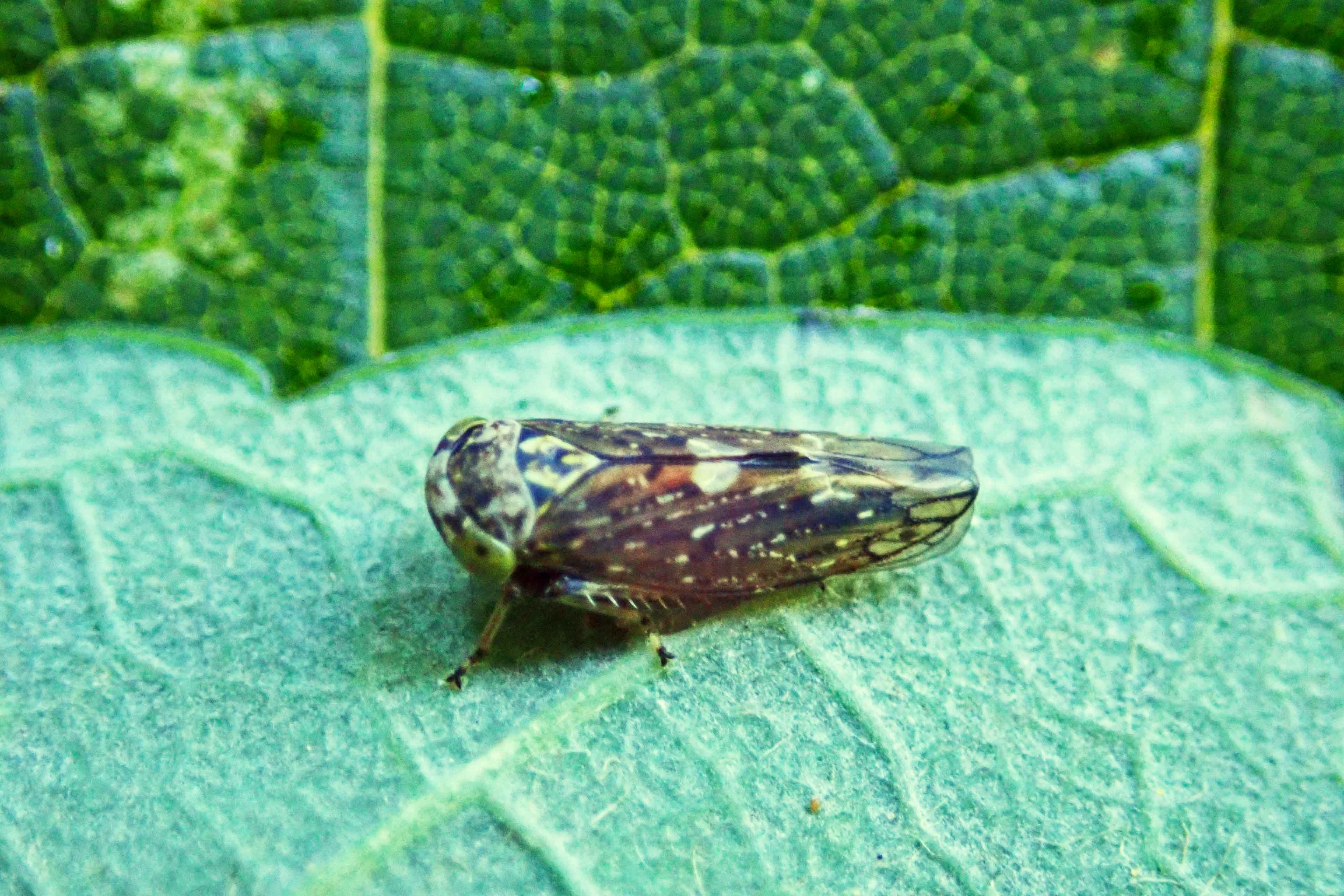
Today’s little leafhopper appeared when I was turning over leaves of Sycamore trees at Cardiff’s Cathays Cemetery. I initially thought it was Acericerus vittifrons but my record was redetermined to Acericerus heydenii by the national leafhopper recorder when he checked it.
241030 Acericerus heydenii (1)

Acericerus heydenii (previously known as Idiocerus heydenii) is a relatively recent arrival to Britain – it was first spotted in the south of England in 2010, probably having hitched a ride on a ferry across the Channel, or on a train through the Eurotunnel, from somewhere in Europe. Judging by the records on the Welsh national biodiversity database, it took about nine years to make its way across to Wales, where 15 specimens have now been recorded.
241030 Acericerus heydenii (2)

Please excuse the quality of my photos today. The camera I use for all my close-ups, an Olympus TG-5, does not deal well with low light (apparently, a known fault, which I did not know about when I bought it). This fault causes a purple cast in the centre of images, which I’ve tried not very successfully to correct. If you’re interested, you can see excellent images of today’s leafhopper on the True Hoppers of the Western Palearctic website.

Like Loading...

Leafhopper: Rhytidodus decimusquartus

24 Thursday Oct 2024

Posted by sconzani in insects

≈ Leave a comment

Tags

British cicadellidae, British leafhoppers, Cicadellidae, Idiocerus decimusquartus, leafhopper, leafhoppers on Poplar, Rhytidodus decimusquartus

Though we missed the worst of it here in south-east Wales, last Sunday was a miserable day, the rain and gusty winds of Storm Ashley blasting across the British Isles. Luckily for me, the gloom was much cheered by an email verifying my recent record of this leafhopper, Rhytidodus decimusquartus.

241024 Rhytidodus decimusquartus (1)

It’s always good to have records of new species identified but, in this case, I was particularly chuffed as this was a rare sighting. The Aderyn biodiversity database shows no previous Welsh records, though, when I checked the NBN Atlas to see how many other British records there were, I found one record from 1985 in north Wales (I’m not sure why that’s not showing in Aderyn), and just 30 other British records.

241024 Rhytidodus decimusquartus (2)

I’m sure you’ll agree that Rhytidodus decimusquartus (previously known as Idiocerus decimusquartus) is a handsome little beastie, just 6-7mm long. The British Bugs website warns that leafhoppers in this group can be very tricky to identify but ‘This species has one unique feature that allows definitive identification: the vertex and pronotum have fine transverse ridges’, and these ridges were clearly visible in my photographs. I’ve now found at least four species of leafhopper on the Lombardy poplars where this little one was lurking so I’ll be heading back very soon to see what other wonders I might discover amongst their leaves (if the leaves are still on the trees after all that wind).

Like Loading...

Leafhopper: Kybos species

26 Thursday Sep 2024

Posted by sconzani in insects

≈ Leave a comment

Tags

British cicadellidae, British leafhoppers, Cicadellidae, Kybos, Kybos species, leafhoppers

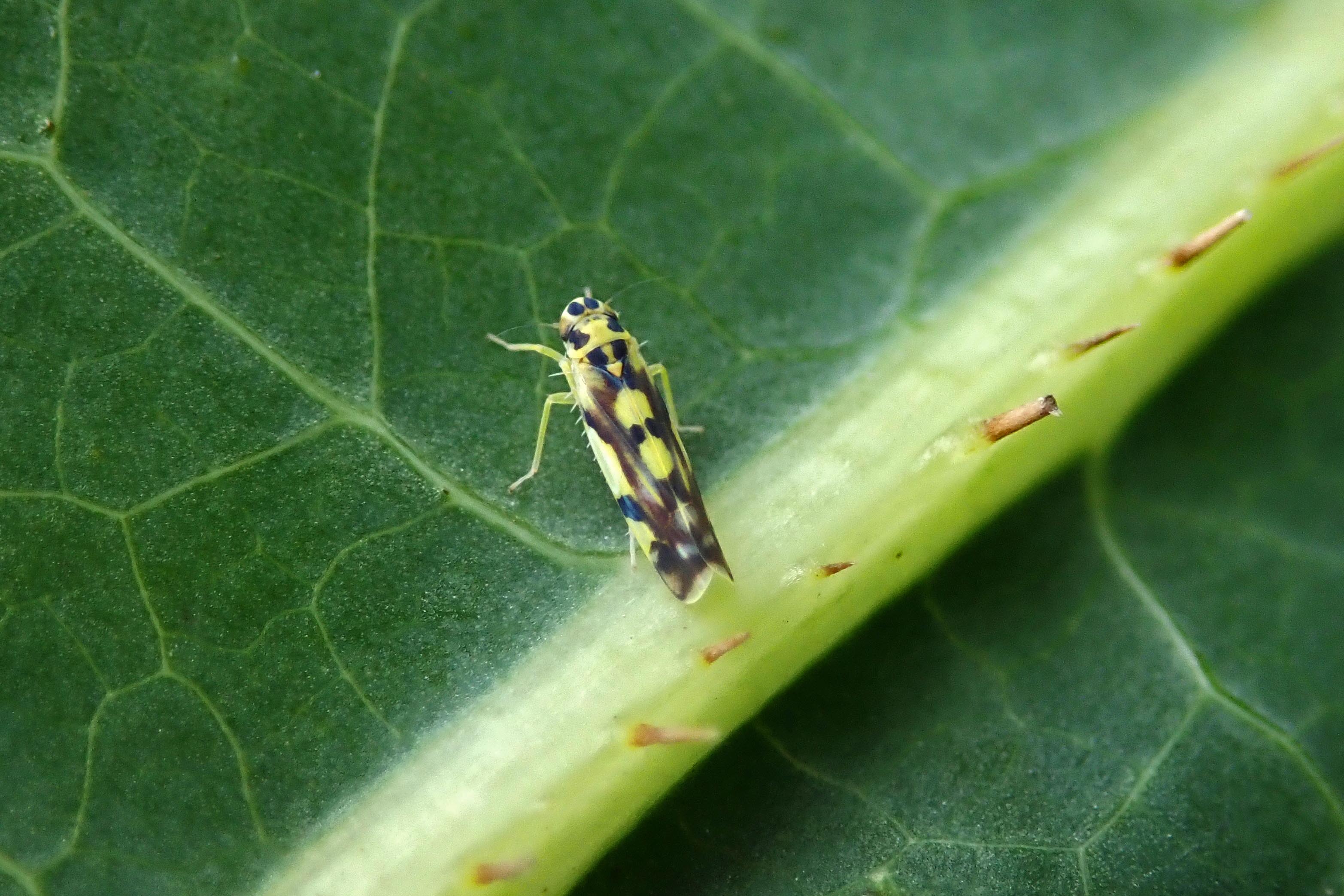
The checklist of Auchenorrhyncha on the British Bugs website includes eight species from the Kybos genus of Cicadellidae, all of which appear to be indistinguishable from each other unless through dissection. As the website specifies ‘The host-plant is a useful guide to identification, but is not sufficient in itself.’

240926 kybos sp (1)

Still, I think my indeterminable leafhoppers are very attractive and worth this brief post. The Kybos in my first image was found on Sycamore in Cardiff’s Cathays Cemetery on 15 August, the second on Alder in nearby Heath Park on 23 July.

240926 kybos sp (2)

Like Loading...

Leafhopper: Eupteryx aurata

19 Thursday Sep 2024

Posted by sconzani in insects

≈ Leave a comment

Tags

British cicadellidae, British leafhoppers, Cicadellidae, Eupteryx aurata, leafhoppers, Potato leafhopper

As these tiny leafhoppers (just 3.5-4.5mm in length) are most often found living amongst brambles and nettles, I’m not sure why their common name is Potato leafhopper. I found the two shown below on Prickly lettuce so, presumably, they browse widely on a variety of plant species.

240919 Eupteryx aurata (1)

Their scientific name is Eupteryx aurata and, though all the other Eupteryx species are strongly marked, the dark spot patterns and what the British Bugs website describes as the ‘pale hour-glass on the top of the forewings’ are distinctive. These leafhoppers are common and can be found from May through to November.

240919 Eupteryx aurata (2)

Like Loading...

Leafhopper: Acericerus species

12 Thursday Sep 2024

Posted by sconzani in insects

≈ Leave a comment

Tags

Acericerus nymphs, Acericerus species, British cicadellidae, British leafhoppers, Cicadellidae, leafhoppers

I’ve been leaf-bothering a few times recently at Cardiff’s Cathays Cemetery in an attempt to re-find the species of leafhopper (Zyginella pulchra) that I found ‘new to Wales’ back in 2016 (First recorded sighting in Wales!, September 2016). I’ve had no luck with that so far – I’m planning more visits, but I have found a few other nice leafhoppers at the cemetery and in nearby Heath Park (those leafhoppers will feature in future blogs).

240912 Acericerus sp (1)

Though I thought its markings quite distinctive, today’s handsome leafhopper can only be identified to species, one of the Acericerus species to be precise. According to the Cicadellidae species list on the British Bugs website, there are three possibilities: Acericerus heydenii (British Bugs has no page dedicated to this species but I found it on Naturespot), A. ribauti and A. vittifrons. To be honest, none of these look anything like my photos (mine were identified as Acericerus species by the national records verifier), so I assume the two I found were nymphs and thus were sporting the colouration and patterning of immature specimens. Leafhoppers can be tricky, and I obviously need to search further.

240912 Acericerus sp (2)

Like Loading...

Leafhopper: Populicerus confusus

07 Saturday Sep 2024

Posted by sconzani in insects

≈ Leave a comment

Tags

British cicadellidae, British leafhoppers, Cicadellidae, Idiocerus confusus, leafhopper, leafhopper on willow, Populicerus confusus

I found this little leafhopper a few weeks ago but it sometimes take a while for the verifiers to check records (that’s not a criticism – they are almost all volunteers, and I am hugely grateful for their efforts). And, to be honest, I wasn’t sure this would be accepted as I read on one website that the species could only be identified by examination of its internal genital structure. Fortunately, that didn’t prove necessary in this case.

240907 Populicerus confusus (1)

So, meet Populicerus confusus (also known as Idiocerus confusus), a leafhopper that can be found throughout Britain, living on the various species of willow (Salix species), usually in the damp environments preferred by those trees. The two I spotted quite close together were on a young willow at Cosmeston Lakes Country Park.

240907 Populicerus confusus (2)

Like most members of the Cicadellidae family, Populicerus confusus is small, between 5 and 7mm in length. It is mainly yellow-green, with rusty colouring on the inside of its forewings and, often but not always, a brownish posterior. The adult leafhoppers can be seen from June to October.

Like Loading...

Wild word: moult

10 Wednesday Jul 2024

Posted by sconzani in insects

≈ Leave a comment

Tags

British leafhoppers, Eupterycyba jucunda, insect moulting, leafhopper nymph moulting, moult, wild words

Moult (or molt, if you’re from the USA): noun; (of birds, mammals, arthropods, etc.) to shed (feathers, hair, or cuticle) in order that new growth can take place (Collins Concise Dictionary).

240710 Eupterycyba jucunda (2)

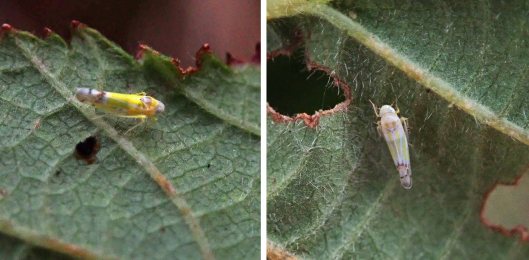
Last week, when checking the leaves of Italian alder, I found tiny creatures on almost every leaf. They were the various stages of the leafhopper Eupterycyba jucunda, from nymph to adult, and, amazingly, I even caught one in the middle of its moult from one stage to the next. The images below show an early stage nymph on the left and an adult on the right.

240710 Eupterycyba jucunda (1)

Like Loading...

Leafhopper: Ribautiana tenerrima

28 Tuesday Nov 2023

Posted by sconzani in insects

≈ Leave a comment

Tags

British leafhoppers, Cicadellidae, leafhopper, leafhopper on Bramble, Ribautiana tenerrima

Over the years I’ve seen many small green-looking leafhoppers on Bramble and, knowing that small green-looking leafhoppers can be very difficult to identify, I’ve tended to ignore them. Last week, when Bramble-leaf-turning, I noticed that these little hoppers had some quite subtle markings on their backs (some with more saturated colour than others) that might help to distinguish them from others of their kin and, as they were keeping relatively still, I was able to get some photos (though grainy due to the dim light).

231128 Ribautiana tenerrima (1)

These have now been confirmed as Ribautiana tenerrima sensu lato, one of the most common species in Britain, that can be seen on Brambles and several other plant species between June and December. As there are other very similar Ribautiana species, for recording purposes, where we can’t distinguish one from the other, we use the catch-all name Ribautiana tenerrima sensu lato, with sensu lato meaning ‘in the broad sense’.

231128 Ribautiana tenerrima (2)

Like Loading...

Leafhopper: Populicerus sp.

28 Monday Aug 2023

Posted by sconzani in insects

≈ Leave a comment

Tags

British cicadellidae, British leafhoppers, leafhopper, leafhopper on Poplar, Poplar, Populicerus sp.

I found a new leafhopper species last week but, despite it having quite distinctive markings, I have not been able to identify it exactly. This is because there are several that look very similar and, even knowing the tree or plant they are on (in this case, Poplar), doesn’t help. One needs to examine their genitals to figure these little leafhoppers out.

230828 Populicerus sp (1)

There are five species of Populicerus showing in the Welsh database (Populicerus confusus, P. populi, P. albicans, P. nitidissimus, and P. laminatus), only four of which have been recorded in Wales (the first four in my list) and, of those, the numbers, except for P. confusus (64) are in single digits. That is likely to be a reflection of the difficulty of identifying the species rather than the populations of these leafhoppers.

230828 Populicerus sp (2)

All five species have similar markings but three have different colouring. However, Populicerus populi and P. laminatus are so similar that they require more intimate examination – the creature I found, the leafhopper shown here, is one of these two.

Like Loading...

Leafhopper: Typhlocyba quercus

31 Monday Jul 2023

Posted by sconzani in insects

≈ Leave a comment

Tags

British leafhoppers, Cicadellidae, leafhopper, leafhopper on Oak, Typhlocyba quercus

How adorable is this little leafhopper? And, even better than being adorable, its markings mean it is instantly recognisable as Typhlocyba quercus, the ‘quercus’ indicating that its preferred tree is the Oak, though it will also live on other trees.

230731 Typhlocyba quercus

Like Loading...
← Older posts
Newer posts →

About me

sconzani

sconzani

I'm a writer and photographer; researcher and blogger; birder and nature lover; countryside rambler and city strider; volunteer and biodiversity recorder.

View Full Profile →

Follow earthstar on WordPress.com

Enter your email address to follow this blog and receive notifications of new posts by email.

Recent blog posts

  • Birch polypore January 30, 2026
  • The Marl Med gull January 29, 2026
  • Recording Grey squirrels January 28, 2026
  • Jimmy Wren January 27, 2026
  • Millipede: Nanogona polydesmoides January 26, 2026

From the archives

COPYRIGHT

Unless otherwise acknowledged, the text and photographs on this blog are my own and are subject to international copyright. Nothing may be downloaded or copied without my permission.

Fellow Earth Stars!

  • Unknown's avatar
  • Unknown's avatar
  • Unknown's avatar
  • Unknown's avatar
  • Unknown's avatar
  • Unknown's avatar
  • Unknown's avatar
  • Unknown's avatar
  • Unknown's avatar
  • Unknown's avatar
  • Unknown's avatar
  • Unknown's avatar
  • Unknown's avatar
  • Unknown's avatar
  • Unknown's avatar
  • Unknown's avatar
  • Unknown's avatar
  • Unknown's avatar
  • Unknown's avatar
  • Unknown's avatar
  • Unknown's avatar
  • Unknown's avatar
  • Unknown's avatar
  • Unknown's avatar
  • Unknown's avatar
  • Unknown's avatar
  • Unknown's avatar
  • Unknown's avatar
  • Unknown's avatar
  • Unknown's avatar
  • Unknown's avatar
  • Unknown's avatar
  • Unknown's avatar
  • Unknown's avatar
  • Unknown's avatar
  • Unknown's avatar
  • Unknown's avatar
  • Unknown's avatar
  • Unknown's avatar
  • Unknown's avatar
  • Unknown's avatar
  • Unknown's avatar
  • Unknown's avatar
  • Unknown's avatar
  • Unknown's avatar
  • Unknown's avatar
  • Unknown's avatar
  • Unknown's avatar
  • Unknown's avatar
  • Unknown's avatar

Blog at WordPress.com.

Privacy & Cookies: This site uses cookies. By continuing to use this website, you agree to their use.
To find out more, including how to control cookies, see here: Cookie Policy
  • Subscribe Subscribed
    • earthstar
    • Join 670 other subscribers
    • Already have a WordPress.com account? Log in now.
    • earthstar
    • Subscribe Subscribed
    • Sign up
    • Log in
    • Report this content
    • View site in Reader
    • Manage subscriptions
    • Collapse this bar
 

Loading Comments...
 

You must be logged in to post a comment.

    %d