• ABOUT
  • BIRDING 2018
  • Birding 2019
  • BLOG POSTS
  • Butterflies 2018
  • Resources

earthstar

~ a celebration of nature

earthstar

Tag Archives: British spiders

Spider: Larinioides sclopetarius

28 Tuesday Oct 2025

Posted by sconzani in spiders

≈ Leave a comment

Tags

Bridge orbweb spider, British spiders, Larinioides sclopetarius

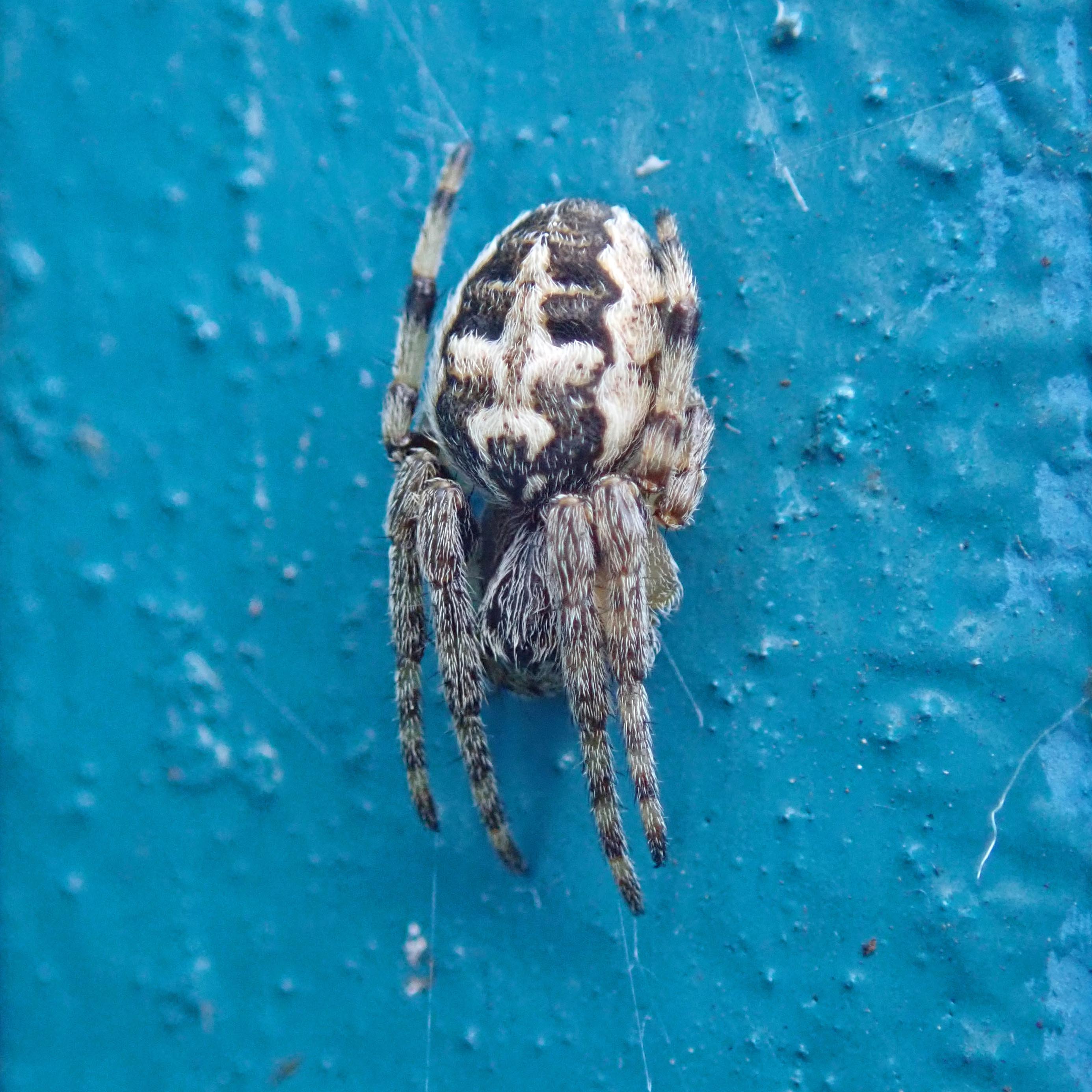
Meet my latest new spider find, Larinioides sclopetarius, also known as the Bridge orbweb spider. So, where did I find it? Why, under a bridge, of course! I must quickly add that I didn’t know what it was when I spotted it.

The railings, that make safe the riverside edge of the footpath that runs under a road bridge over the River Taff, were covered in spiders’ webs so I couldn’t resist having a peek to see what had created them. Most of the makers were hiding, as spiders often do in the daytime, but this one was sitting half in half out of its refuge, so I was able to get a couple of photos to post on social media. I was lucky to get a fairly quick identification from the British Arachnological Society, and the find has been attracting quite a lot of interest from arachnophiles. I’ll have to return to see what else I can find there.

Like Loading...

Spider: Metellina segmentata

20 Saturday Sep 2025

Posted by sconzani in autumn, spiders

≈ Leave a comment

Tags

British spiders, Metellina segmentata, Metellina species, orb web spiders

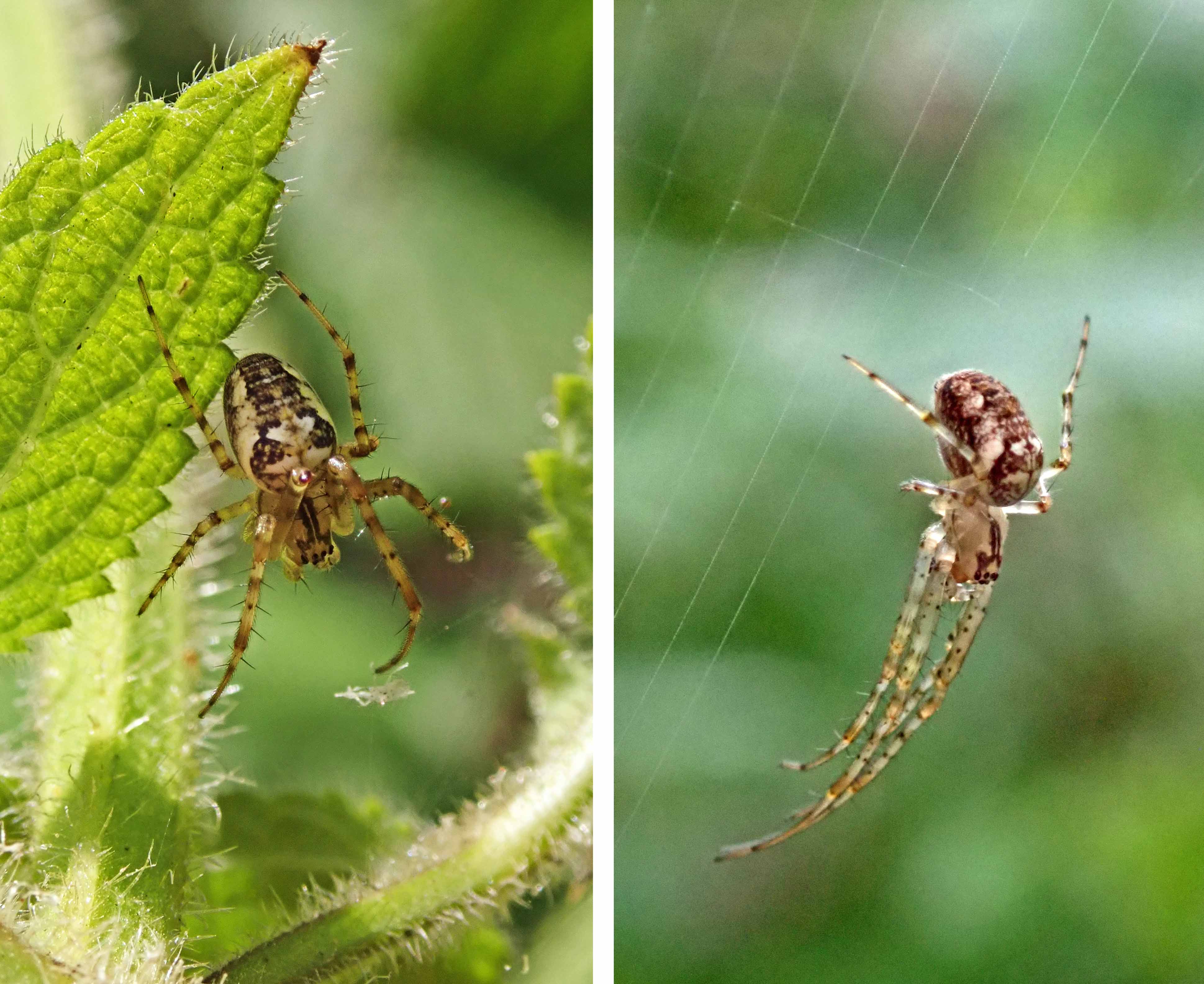
I’m rather chuffed with how many new spiders I’ve managed to find this year; this is the latest of them, two found close together on vegetation along a quiet local footpath just before my mini break in Weymouth, and now verified by our Welsh spider recording expert.

There are three species of Metellina orb web spiders in Britain, all of which are common and quite difficult to tell apart – my guide book includes the dreaded ‘microscopic examination of the genitalia is necessary to confirm identification‘ phrase. The two species most easily confused are Metellina mengei and Metellina segmentata but, fortunately, they can be seen at different times of the year, M. mengei in spring and early summer, M. segmentata in late summer and autumn. As I found these a couple of weeks ago, in early autumn, that has helped to confirm them as Metellina segmentata.

Like Loading...

Spider: Agalenatea redii

09 Tuesday Sep 2025

Posted by sconzani in spiders

≈ Leave a comment

Tags

Agalenatea redii, British spiders, Gorse orbweb spider, spider on Knapweed flower head

I met this handsome little spider, a Gorse orbweb spider (Agalenatea redii) in a local field where once there had been a medieval village (no trace of the village remains above ground, except perhaps if you squint a certain way at small lumps and bumps in the grass).

I was actually checking the dying flower heads of Knapweed for insects, now difficult to find after our prolonged period of drought, and didn’t at first notice the little spider, so well did its colours blend with its surroundings. But then I noticed a series of tiny black eyes watching me from behind a fringe of long pale hairs.

My guide book observes that Agalenatea redii is most often found ‘amongst heath and gorse, and in rough grassland, often in rather damp situations, where it spins its web fairly low down amongst the stems. A retreat is often constructed in an adjacent dead flower head.’ So, perhaps, I had found my watchful little friend sitting comfortably in its retreat, waiting for its next meal to stumble into, and be ensnared in, its web.

Like Loading...

Spider: Agelena labyrinthica

09 Wednesday Jul 2025

Posted by sconzani in spiders

≈ Leave a comment

Tags

Agelena labyrinthica, Agelena labyrinthica with sawfly prey, British spiders, Labyrinth spider, mating Agelena labyrinthica spiders, Rhogogaster sawfly, spider

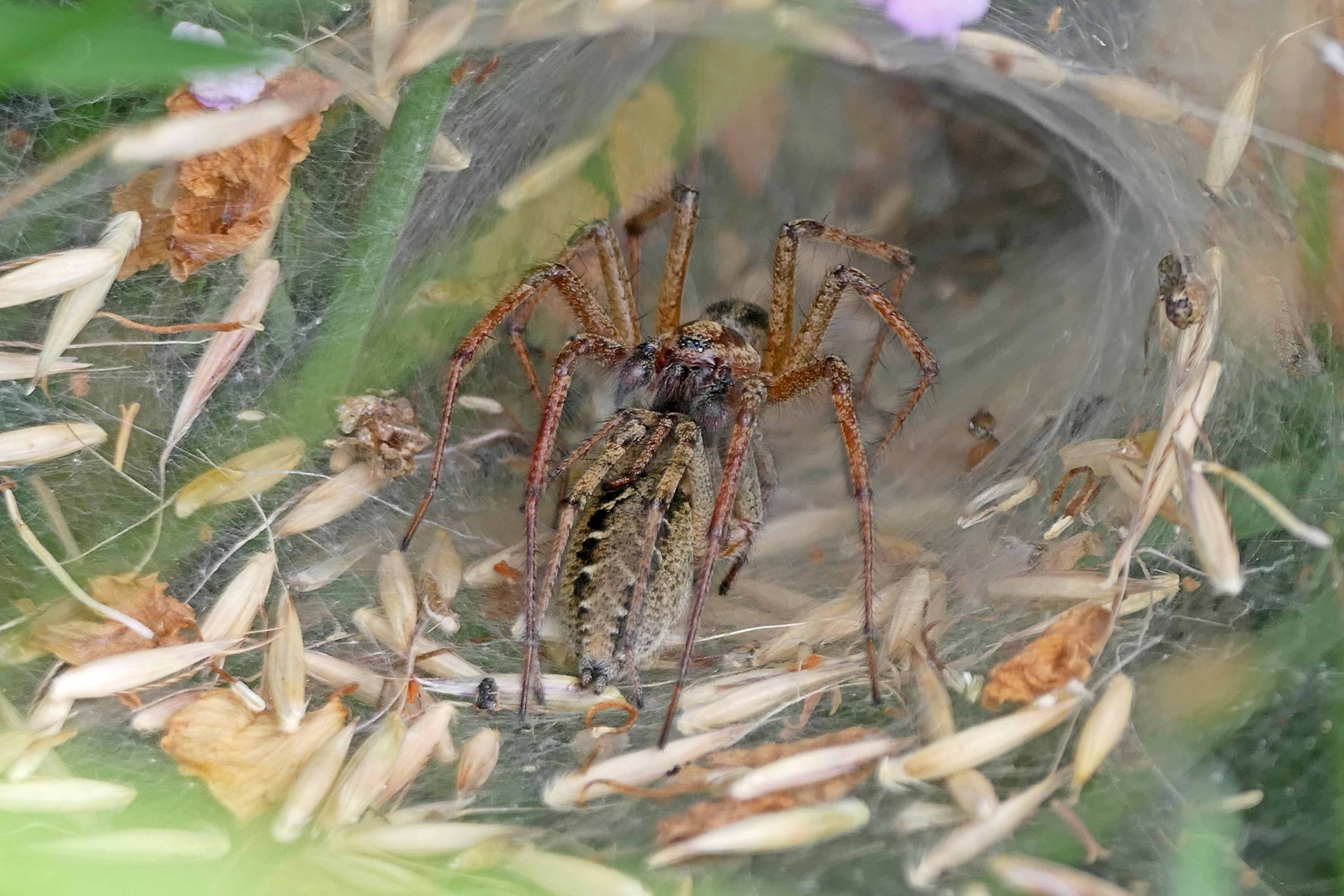
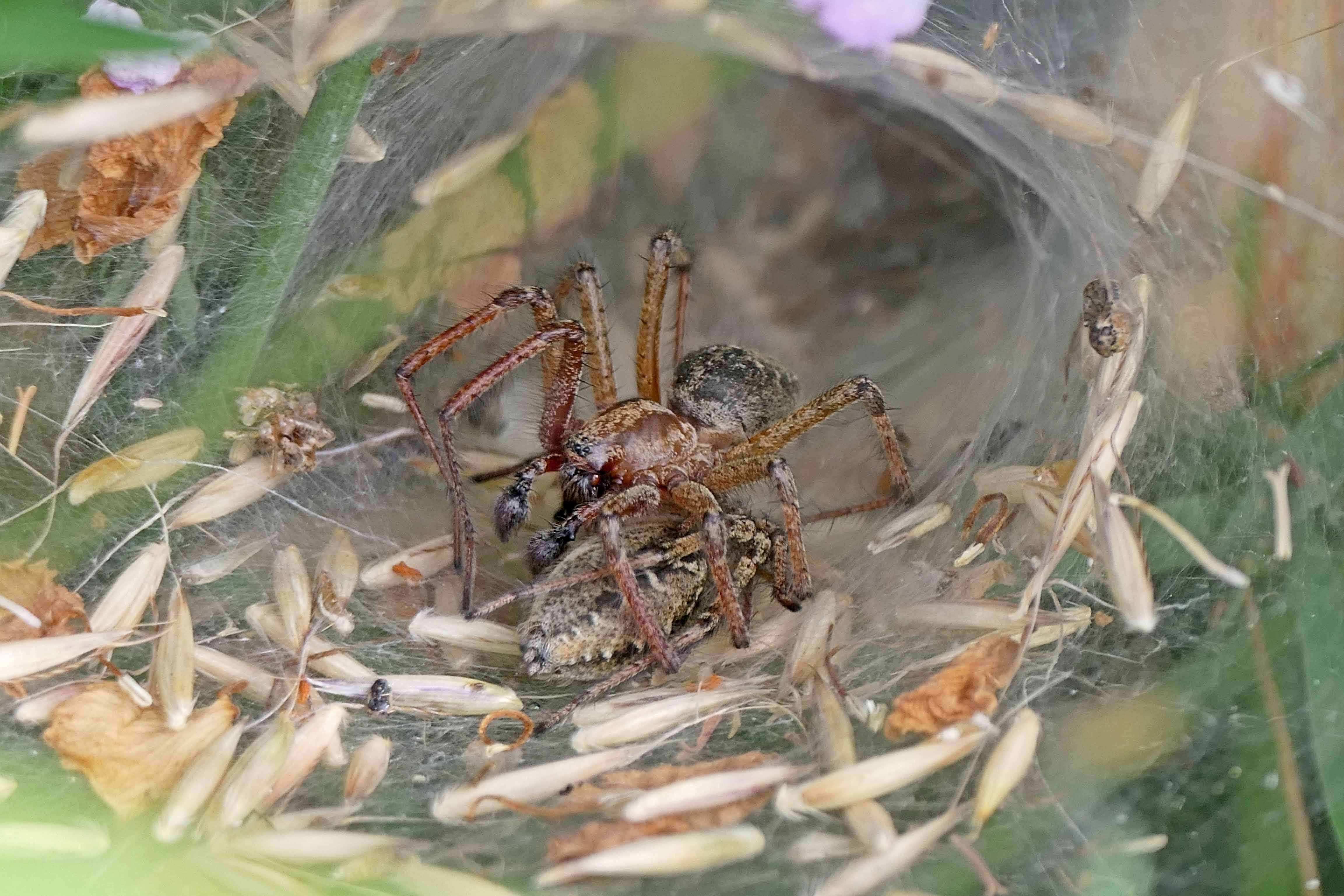
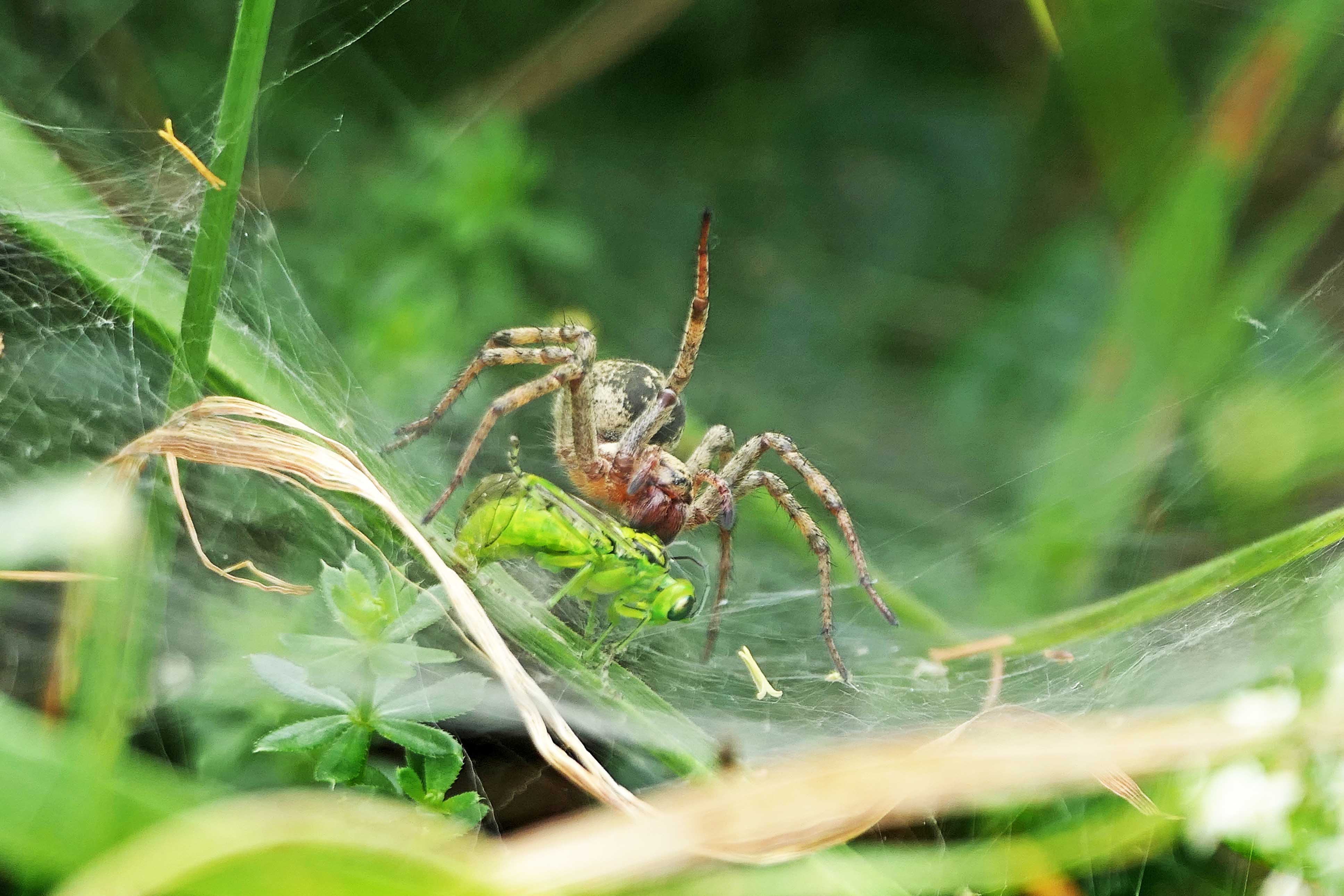
Though the distribution of this spider is quite patchy in south Wales, I’ve seen the extensive sheet-like webs they construct in and over and around vegetation in wild meadows, grasslands and on rough ground several times before, but the webs’ creators, the Labyrinth spiders (Agelena labyrinthica), are usually tucked away in their tunnel-like sanctuary at the back of the web structure. So, I was very pleased to see not one, but three of these handsome beasties on the first day of my little trip to Gloucestershire.

I’m sure the reason I saw all of them is because they were so preoccupied with other activities that they either didn’t even notice me or considered me a presence that could be ignored. The first two I spotted, shown above and below, were locked together, and I wasn’t sure if this was a fight in progress or something else. Turns out these were male and female Labyrinth spiders in the act of mating. I’m advised by those much more expert than me that the male is at the back in the first photo and on top in the second.

And the third handsome Agelena labyrinthica specimen I found had just that moment rushed out of its tunnel to secure a sawfly, one of the vivid green Rhogogaster species, that had inadvertently strayed on to the spider’s web and was about to be dragged back to the lair for consumption. A sad end for the sawfly but a happy co-incidence for me and the hungry spider.

Like Loading...

Spider: Pardosa species

11 Wednesday Jun 2025

Posted by sconzani in spiders

≈ Leave a comment

Tags

British spiders, Lycosidae, Pardosa female with egg sac, Pardosa species, wolf spiders

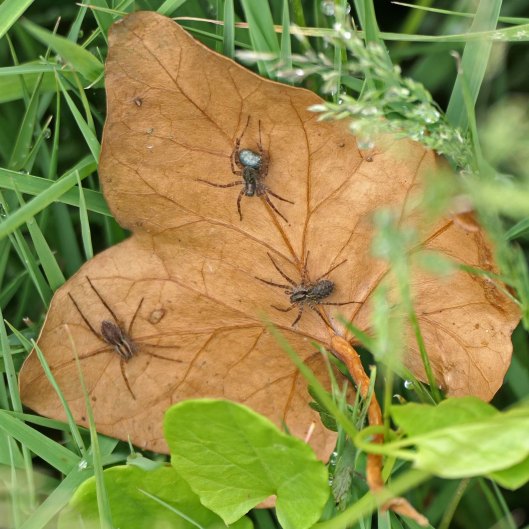
Does it look like a wolf? Then why is this one of the so-called wolf spiders? I presume it’s because the Lycosidae or wolf spiders don’t use webs to catch their prey, relying instead on their running speed and superb eyesight (they have 8 eyes lined up in 2 rows) to catch their food.

There are nine genera of wolf spiders, and the spiders shown here belong to one of 15 British species in the Pardosa genus. I cannot be more precise about the name because this is yet another family where identification is difficult; my guide book states that ‘even with the use of a microscope, identification can be extremely difficult’, so I’m just glad I managed to get the fact that these are Pardosa species verified.

All the Pardosa are brownish in colour, with similar markings on their abdomens in lighter and darker hues. As you can perhaps make out in my photos, even though these are all the same species, the markings are different in each spider. As you may also have gathered from looking at my photos, the females in this family carry their egg sacs around with them, presumably to protect them. Those sacs are usually a blue-green colour, with a paler seam down the centre.

If you want to see more of the spiders in this family, check out Steven Falk’s amazing album of photos on Flikr.

Like Loading...

Spider: Anyphaena accentuata

04 Wednesday Jun 2025

Posted by sconzani in spiders

≈ Leave a comment

Tags

Anyphaena accentuata, British spiders, buzzing spiders

When I read in my guide book that spiders of the genus Anyphaena, which my find definitely looked like (those dark markings on its abdomen are distinctive), required ‘microscopic examination of the genitalia … to distinguish between the species’, I thought to myself ‘Oh, no, not again!’ Fortunately, this time things were actually a little more straight forward than that statement implied, as the other two species are rare and currently confined to known areas in and around London. So, I submitted my record and it’s now been confirmed.

This handsome spider is Anyphaena accentuata, a buzzing spider. They’re called buzzing spiders because, during courtship, the male vibrates its abdomen against a leaf, which results in a high-pitched buzzing sound – a novel way to attract a female, to be sure. These spiders are mostly found in woodland and well-vegetated locations, where they live, hunt and mate amongst the leaves. Anyphaena accentuata is currently found mostly in the southern half of Britain, though it does appear to be expanding its range slowly northwards.

Like Loading...

Spider: Cheiracanthium erraticum

31 Saturday May 2025

Posted by sconzani in spiders

≈ Leave a comment

Tags

British spiders, Cheiracanthium erraticum, heathland spider, spider in low vegetation, spider in web

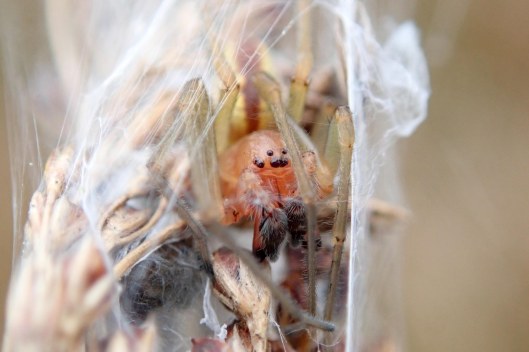
Having first been recorded here in 1861, this spider is a relative newcomer to Britain and, though it is still most frequently seen in southeastern England, it is slowly expanding its range north and west. I found this one at Cosmeston Lakes Country Park, not because I was looking for it, but simply because I noticed something had spun a web to bind two or three reed seedheads together and wondered what it was.

The adult spider was visible inside, and my photos were clear enough to see the distinctive red stripe that runs within a broader band of cream down the centre of its abdomen, which helped confirm this as Cheiracanthium erraticum. It favours grassland, more particularly areas of heathland, where it is typically found in low vegetation.

Like Loading...

Spider: Segestria florentina

21 Wednesday May 2025

Posted by sconzani in spiders

≈ 2 Comments

Tags

British spiders, Segestria florentina, tube web spider, tube-dwelling spider

With this year’s focus on identifying spiders, I’m getting better at being close to them but this large beast did give me pause. Fortunately, it wasn’t in my house or any other enclosed space; I spotted it sitting on an external house wall as I walked along a street. After consulting a local with good spider knowledge, I can confirm this is the tube web spider Segestria florentina, though its chelicerae (fanged mouthparts) are not the shiny green colour described in my guide book. Perhaps that was just due to the light conditions when I photographed it.

Segestria florentina usually lives in a tube-shaped web, tucked in a hole in a wall or amongst rocks, speeding out to grab its prey when it passes the hole. You definitely wouldn’t want to poke your finger in its hole, as it does have a venomous bite, though apparently it’s not dangerous, and the spider’s only found in the south of the UK. If you want to know more, the iNaturalist website has a good article and excellent photos.

Like Loading...

Spiders: Philodromus species

06 Tuesday May 2025

Posted by sconzani in spiders

≈ Leave a comment

Tags

British spiders, Philodromidae, Philodromus spiders, running crab spiders

When I got my new guide book*, I very naively assumed it would help me identify all the spiders I saw. I should have known from tackling all the other types of creatures I’ve been trying to put names to that nothing is ever that easy.

These three spiders are a case in point. They all belong to the Philodromidae, the running crab spiders, of which, in Britain, there are 17 eight-eyed species in four genera.

Though they share a similar crab-like body structure, the three shown here all look quite different to my eye, and I thought I would be able to identify them but no! Highlighted in red in my book are those words I never like to read: ‘Microscopic examination of the genitalia is necessary to confirm identification of all species in these genera.’

* Lawrence Bee, Geoff Oxford and Helen Smith, Britain’s Spiders: a field guide, 2nd ed., Princeton University Press, Princeton, 2020.

Like Loading...

Spider: Larinioides cornutus

07 Monday Apr 2025

Posted by sconzani in spiders

≈ Leave a comment

Tags

British spiders, Larinioides cornutus, spider on Gorse

I was looking for weevils when I spotted these two spiders on the same Gorse bush at the Cardiff Bay Wetlands Reserve recently. (This was a bit freaky: I need both distance and reading glasses but don’t like bifocals so, when I’m out walking, I have to push my distance specs down my nose and get my head close to small things to see with my unspectacled eyes.)

I initially thought these two spiders were Agalematea redii but quickly realised I was wrong about the first one I found. It is, in fact, Larinioides cornutus, a species that prefers living on vegetation in damp places but can also be found on built structures in those areas. It’s common in the south of Britain, becoming less so the further north you travel. The Spider and Harvestman Recording Scheme website has a map and lots of interesting information.

And, though it looks different to my untrained eye, it turns out that the second spider is also Larinioides cornutus. The very helpful British Spiders social media person on Bluesky explained: ‘The second looks like Larinioides cornutus as well. Although the alpha form of Agelenatea redii has quite similar patterning, it has a noticeably smaller and rounder abdomen – one of those things that’s obvious when you meet it!’ I’m hoping I meet it a little more distantly than I did with the two shown here!

Like Loading...
← Older posts

About me

sconzani

sconzani

I'm a writer and photographer; researcher and blogger; birder and nature lover; countryside rambler and city strider; volunteer and biodiversity recorder.

View Full Profile →

Follow earthstar on WordPress.com

Enter your email address to follow this blog and receive notifications of new posts by email.

Recent blog posts

  • M is for mite December 18, 2025
  • L is for lepidopteran lifers December 17, 2025
  • K is for Keeled skimmers December 16, 2025
  • J is for Jersey tiger December 15, 2025
  • I is for Ichneumon December 14, 2025

From the archives

COPYRIGHT

Unless otherwise acknowledged, the text and photographs on this blog are my own and are subject to international copyright. Nothing may be downloaded or copied without my permission.

Fellow Earth Stars!

  • Unknown's avatar
  • Unknown's avatar
  • Unknown's avatar
  • Unknown's avatar
  • Unknown's avatar
  • Unknown's avatar
  • Unknown's avatar
  • Unknown's avatar
  • Unknown's avatar
  • Unknown's avatar
  • Unknown's avatar
  • Unknown's avatar
  • Unknown's avatar
  • Unknown's avatar
  • Unknown's avatar
  • Unknown's avatar
  • Unknown's avatar
  • Unknown's avatar
  • Unknown's avatar
  • Unknown's avatar
  • Unknown's avatar
  • Unknown's avatar
  • Unknown's avatar
  • Unknown's avatar
  • Unknown's avatar
  • Unknown's avatar
  • Unknown's avatar
  • Unknown's avatar
  • Unknown's avatar
  • Unknown's avatar
  • Unknown's avatar
  • Unknown's avatar
  • Unknown's avatar
  • Unknown's avatar
  • Unknown's avatar
  • Unknown's avatar
  • Unknown's avatar
  • Unknown's avatar
  • Unknown's avatar
  • Unknown's avatar
  • Unknown's avatar
  • Unknown's avatar
  • Unknown's avatar
  • Unknown's avatar
  • Unknown's avatar
  • Unknown's avatar
  • Unknown's avatar
  • Unknown's avatar
  • Unknown's avatar
  • Unknown's avatar

Blog at WordPress.com.

Privacy & Cookies: This site uses cookies. By continuing to use this website, you agree to their use.
To find out more, including how to control cookies, see here: Cookie Policy
  • Subscribe Subscribed
    • earthstar
    • Join 667 other subscribers
    • Already have a WordPress.com account? Log in now.
    • earthstar
    • Subscribe Subscribed
    • Sign up
    • Log in
    • Report this content
    • View site in Reader
    • Manage subscriptions
    • Collapse this bar
 

Loading Comments...
 

You must be logged in to post a comment.

    %d