• ABOUT
  • BIRDING 2018
  • Birding 2019
  • BLOG POSTS
  • Butterflies 2018
  • Resources

earthstar

~ a celebration of nature

earthstar

Tag Archives: Cicadellidae

Leafhopper: Kybos species

26 Thursday Sep 2024

Posted by sconzani in insects

≈ Leave a comment

Tags

British cicadellidae, British leafhoppers, Cicadellidae, Kybos, Kybos species, leafhoppers

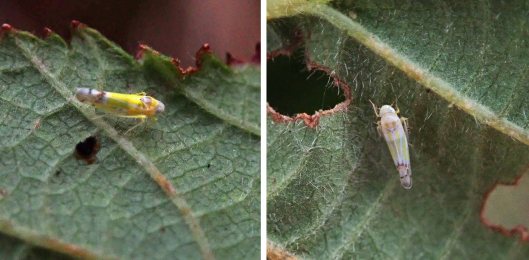
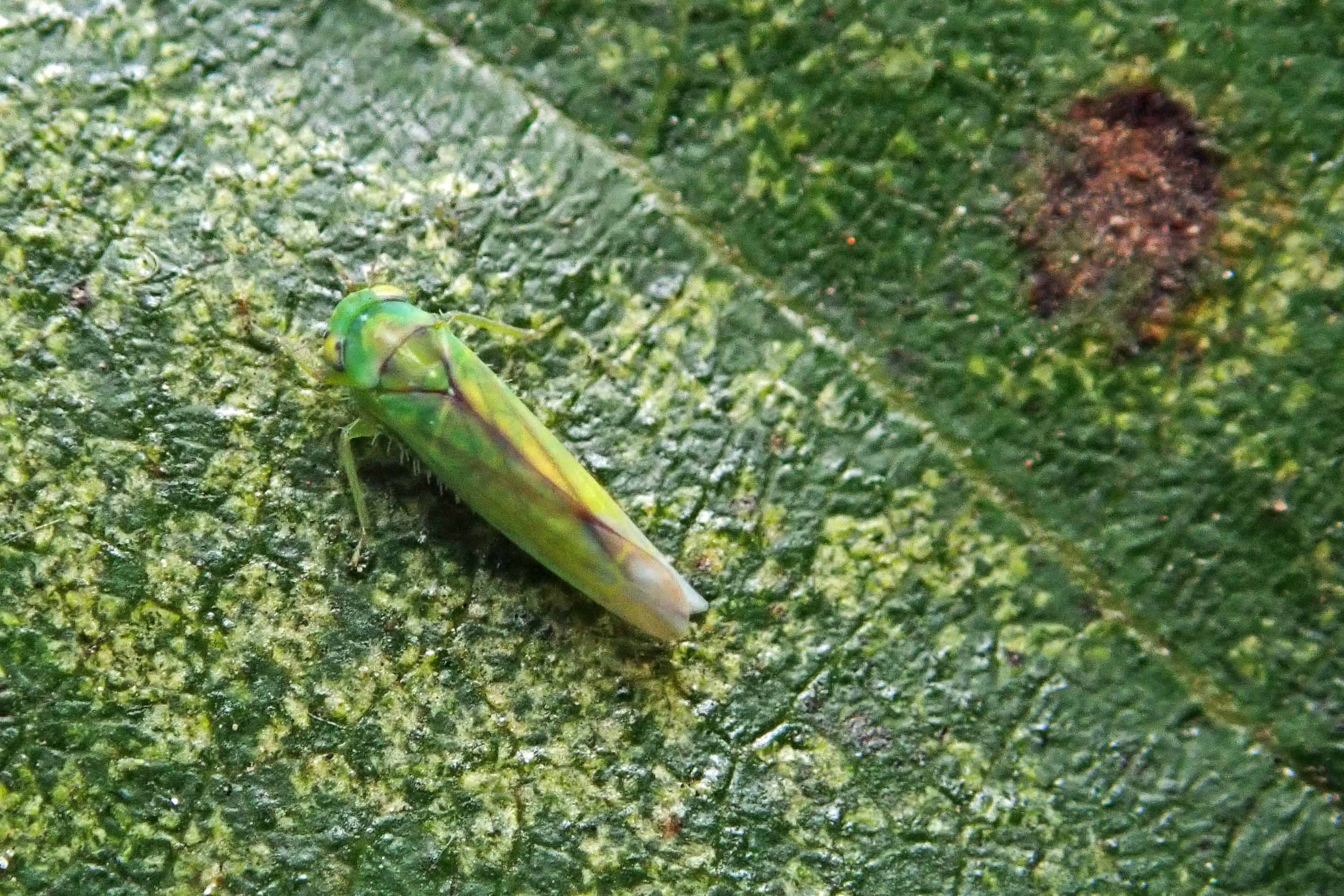
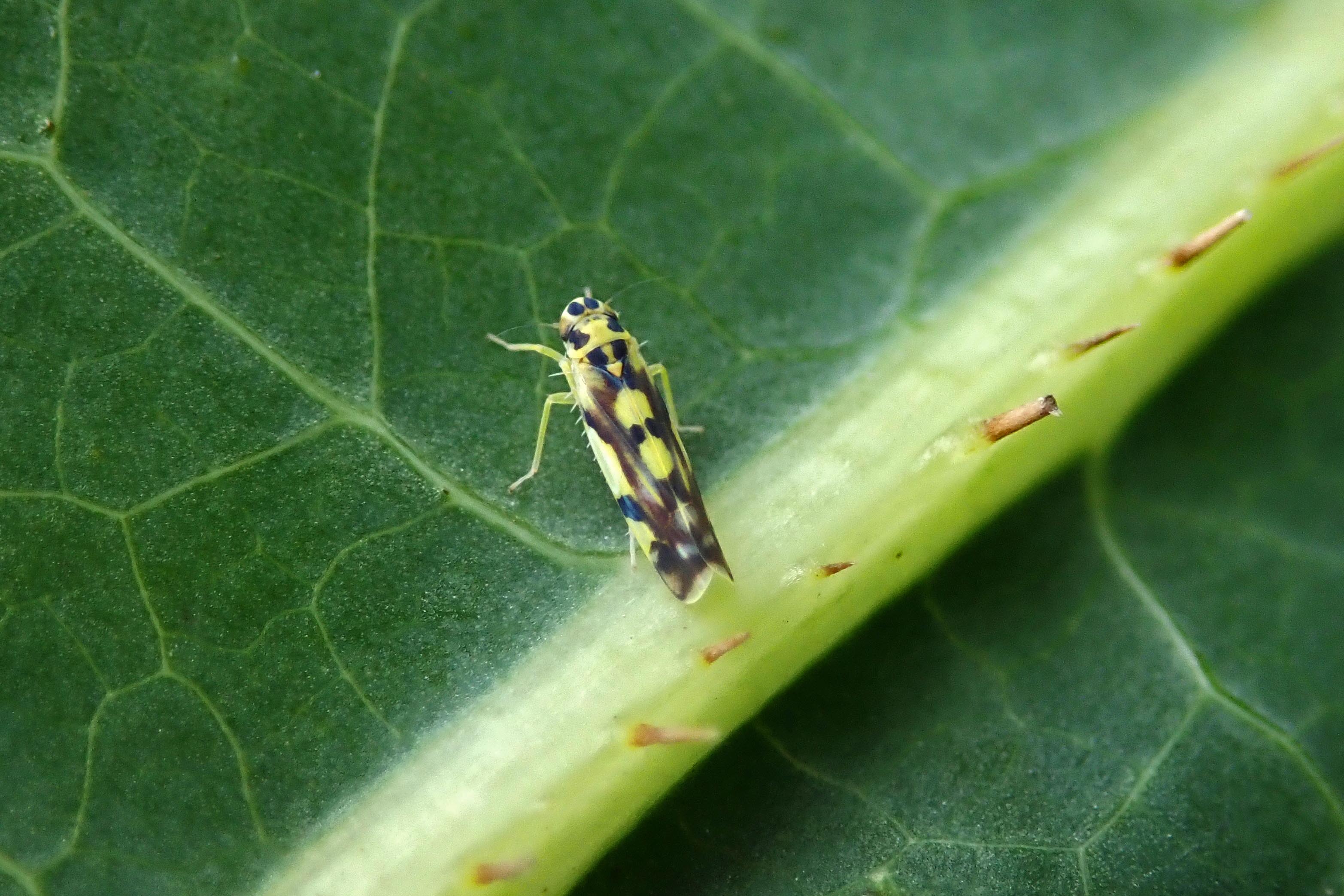
The checklist of Auchenorrhyncha on the British Bugs website includes eight species from the Kybos genus of Cicadellidae, all of which appear to be indistinguishable from each other unless through dissection. As the website specifies ‘The host-plant is a useful guide to identification, but is not sufficient in itself.’
240926 kybos sp (1)

Still, I think my indeterminable leafhoppers are very attractive and worth this brief post. The Kybos in my first image was found on Sycamore in Cardiff’s Cathays Cemetery on 15 August, the second on Alder in nearby Heath Park on 23 July.

240926 kybos sp (2)

Like Loading...

Leafhopper: Eupteryx aurata

19 Thursday Sep 2024

Posted by sconzani in insects

≈ Leave a comment

Tags

British cicadellidae, British leafhoppers, Cicadellidae, Eupteryx aurata, leafhoppers, Potato leafhopper

As these tiny leafhoppers (just 3.5-4.5mm in length) are most often found living amongst brambles and nettles, I’m not sure why their common name is Potato leafhopper. I found the two shown below on Prickly lettuce so, presumably, they browse widely on a variety of plant species.

240919 Eupteryx aurata (1)

Their scientific name is Eupteryx aurata and, though all the other Eupteryx species are strongly marked, the dark spot patterns and what the British Bugs website describes as the ‘pale hour-glass on the top of the forewings’ are distinctive. These leafhoppers are common and can be found from May through to November.

240919 Eupteryx aurata (2)

Like Loading...

Leafhopper: Acericerus species

12 Thursday Sep 2024

Posted by sconzani in insects

≈ Leave a comment

Tags

Acericerus nymphs, Acericerus species, British cicadellidae, British leafhoppers, Cicadellidae, leafhoppers

I’ve been leaf-bothering a few times recently at Cardiff’s Cathays Cemetery in an attempt to re-find the species of leafhopper (Zyginella pulchra) that I found ‘new to Wales’ back in 2016 (First recorded sighting in Wales!, September 2016). I’ve had no luck with that so far – I’m planning more visits, but I have found a few other nice leafhoppers at the cemetery and in nearby Heath Park (those leafhoppers will feature in future blogs).

240912 Acericerus sp (1)

Though I thought its markings quite distinctive, today’s handsome leafhopper can only be identified to species, one of the Acericerus species to be precise. According to the Cicadellidae species list on the British Bugs website, there are three possibilities: Acericerus heydenii (British Bugs has no page dedicated to this species but I found it on Naturespot), A. ribauti and A. vittifrons. To be honest, none of these look anything like my photos (mine were identified as Acericerus species by the national records verifier), so I assume the two I found were nymphs and thus were sporting the colouration and patterning of immature specimens. Leafhoppers can be tricky, and I obviously need to search further.

240912 Acericerus sp (2)

Like Loading...

Leafhopper: Populicerus confusus

07 Saturday Sep 2024

Posted by sconzani in insects

≈ Leave a comment

Tags

British cicadellidae, British leafhoppers, Cicadellidae, Idiocerus confusus, leafhopper, leafhopper on willow, Populicerus confusus

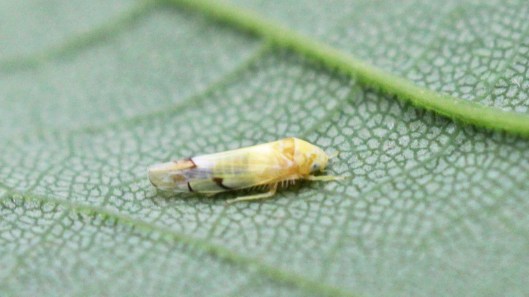
I found this little leafhopper a few weeks ago but it sometimes take a while for the verifiers to check records (that’s not a criticism – they are almost all volunteers, and I am hugely grateful for their efforts). And, to be honest, I wasn’t sure this would be accepted as I read on one website that the species could only be identified by examination of its internal genital structure. Fortunately, that didn’t prove necessary in this case.

240907 Populicerus confusus (1)

So, meet Populicerus confusus (also known as Idiocerus confusus), a leafhopper that can be found throughout Britain, living on the various species of willow (Salix species), usually in the damp environments preferred by those trees. The two I spotted quite close together were on a young willow at Cosmeston Lakes Country Park.

240907 Populicerus confusus (2)

Like most members of the Cicadellidae family, Populicerus confusus is small, between 5 and 7mm in length. It is mainly yellow-green, with rusty colouring on the inside of its forewings and, often but not always, a brownish posterior. The adult leafhoppers can be seen from June to October.

Like Loading...

Leafhopper: Ribautiana tenerrima

28 Tuesday Nov 2023

Posted by sconzani in insects

≈ Leave a comment

Tags

British leafhoppers, Cicadellidae, leafhopper, leafhopper on Bramble, Ribautiana tenerrima

Over the years I’ve seen many small green-looking leafhoppers on Bramble and, knowing that small green-looking leafhoppers can be very difficult to identify, I’ve tended to ignore them. Last week, when Bramble-leaf-turning, I noticed that these little hoppers had some quite subtle markings on their backs (some with more saturated colour than others) that might help to distinguish them from others of their kin and, as they were keeping relatively still, I was able to get some photos (though grainy due to the dim light).

231128 Ribautiana tenerrima (1)

These have now been confirmed as Ribautiana tenerrima sensu lato, one of the most common species in Britain, that can be seen on Brambles and several other plant species between June and December. As there are other very similar Ribautiana species, for recording purposes, where we can’t distinguish one from the other, we use the catch-all name Ribautiana tenerrima sensu lato, with sensu lato meaning ‘in the broad sense’.

231128 Ribautiana tenerrima (2)

Like Loading...

Leafhopper: Typhlocyba quercus

31 Monday Jul 2023

Posted by sconzani in insects

≈ Leave a comment

Tags

British leafhoppers, Cicadellidae, leafhopper, leafhopper on Oak, Typhlocyba quercus

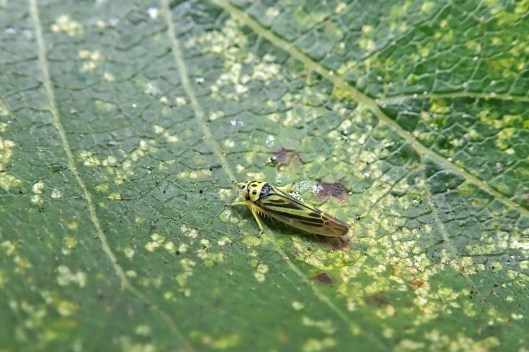
How adorable is this little leafhopper? And, even better than being adorable, its markings mean it is instantly recognisable as Typhlocyba quercus, the ‘quercus’ indicating that its preferred tree is the Oak, though it will also live on other trees.

230731 Typhlocyba quercus

Like Loading...

A new leafhopper

31 Tuesday May 2022

Posted by sconzani in insects, trees

≈ Leave a comment

Tags

British cicadellidae, British leafhoppers, Cicadellidae, leafhopper, Speudotettix subfusculus

Brownish? Check. Pale veins? Check. ‘The vertex has two streaks at the anterior edge which may join in the middle’? (You can’t really see this in my photos – I had to enlarge them to find them. Also, if, like me, you aren’t familiar with the anatomy of a leafhopper, the British Bugs website has an illustrated page of bug bits.) Check. ‘And there is an orange-brown transverse band behind this’? Check. ‘The anterior of the pronotum has variably dark markings’? Check.
Six checks is a winner! This little leafhopper, a new find for me, is Speudotettix subfusculus. Look for it on trees, especially Oak trees.

220531 Speudotettix subfusculus

Like Loading...

L is for leafhoppers

17 Friday Dec 2021

Posted by sconzani in insects

≈ Leave a comment

Tags

British leafhoppers, Cicadellidae, Eupterycyba jucunda, leafhopper, Linnavuoriana sexmaculata

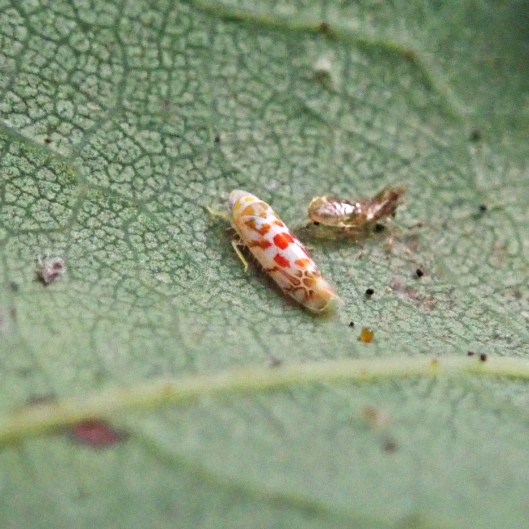
Given my frequent recent posts, you might have been forgiven for thinking that I would choose leafmines for the letter L, but no. Leafhoppers, more formally known as the Cicadellidae, are another family of insects I sometimes dabble in but am determined to look more closely at in 2022 as there are so many species lurking under leaves that I have yet to discover. Back in July, I blogged about the first new species I was able to add to my list for 2021, Eupterycyba jucunda.

211217 Eupterycyba jucunda

And, more recently, on 28 November, I found another, Linnavuoriana sexmaculata. Once again, this was found by turning over leaves, in this case one of the Salix genus – willows, sallows, osiers, as we more commonly call them. Though some species of leafhopper can be tricky to identify, both its host plant and the bug’s markings (sexmaculata means six-spotted) made this one a little easier.

211217 Linnavuoriana sexmaculata

Like Loading...

A new leafhopper

13 Tuesday Jul 2021

Posted by sconzani in insects, trees

≈ Leave a comment

Tags

British leafhoppers, Cicadellidae, Eupterycyba jucunda, Italian Alder, leafhopper, leafhoppers on Alder

I just happened to be examining the leaves of a local Italian alder tree on Saturday (looking for signs of the Crypturaphis grassii aphids I found on this tree last December) when I spotted first one, then another, then several more leafhoppers, all with quite distinctive markings so, of course, I took photos. When I later checked the British Bugs website, I was able to identify them as Eupterycyba jucunda, a new species for me.

210713 Eupterycyba jucunda (1)
210713 Eupterycyba jucunda (2)
210713 Eupterycyba jucunda (3)
210713 Eupterycyba jucunda (4)

The website notes that this species is ‘found predominantly on alder in England and Wales, as far north as Lancashire’, and that the adults can be seen between July and October. Looking at the photos on the website, I think the small black-and-white objects I also saw (photos below) are actually the empty exuvia of Eupterycyba jucunda nymphs. Fascinating!

210713 Eupterycyba jucunda nymph case (1)
210713 Eupterycyba jucunda nymph case (2)
Like Loading...

Two more leafhoppers

16 Sunday Jul 2017

Posted by sconzani in insects, nature

≈ 2 Comments

Tags

British bugs, British insects, British leafhoppers, Cicadellidae, Eurhadina cocinnia, Eurhadina loewii, leafhopper

I’ve been leaf-turning again and one thing you’re almost sure to find if you turn over enough leaves is a leafhopper. These are two recent finds, their identities now confirmed by the national recorder. Both are small – around 4mm long when adults, and both can be seen from around June to September.

170712 Eurhadina cocinnia

Eurhadina cocinnia
These little guys have a preference for oak trees but can also be found on other deciduous tree, and are common throughout Britain.

170712 Eurhadina loewii

Eurhadina loewii
E. loewii prefers Sycamore trees and, occasionally, Field maple, and lives in most English counties and in south Wales, but hasn’t yet crossed the Brecon Beacons.

The two photos below are interesting, I think. The one on the left shows E. loweii in its larval form and the photo on the right shows an empty skin, after the larva has gone through one of several moults between its emergence from an egg until the time it’s ready to pupate.

170712 Eurhadina loewii larva
170712 Eurhadina loewii larval skin
Like Loading...
← Older posts
Newer posts →

About me

sconzani

sconzani

I'm a writer and photographer; researcher and blogger; birder and nature lover; countryside rambler and city strider; volunteer and biodiversity recorder.

View Full Profile →

Follow earthstar on WordPress.com

Enter your email address to follow this blog and receive notifications of new posts by email.

Recent blog posts

  • City Hall Peregrine January 12, 2026
  • Blackthorn in bloom January 11, 2026
  • Weevil: Mecinus pyraster January 10, 2026
  • Red in beak and claw January 9, 2026
  • Who’s watching who? January 8, 2026

From the archives

COPYRIGHT

Unless otherwise acknowledged, the text and photographs on this blog are my own and are subject to international copyright. Nothing may be downloaded or copied without my permission.

Fellow Earth Stars!

  • Unknown's avatar
  • Unknown's avatar
  • Unknown's avatar
  • Unknown's avatar
  • Unknown's avatar
  • Unknown's avatar
  • Unknown's avatar
  • Unknown's avatar
  • Unknown's avatar
  • Unknown's avatar
  • Unknown's avatar
  • Unknown's avatar
  • Unknown's avatar
  • Unknown's avatar
  • Unknown's avatar
  • Unknown's avatar
  • Unknown's avatar
  • Unknown's avatar
  • Unknown's avatar
  • Unknown's avatar
  • Unknown's avatar
  • Unknown's avatar
  • Unknown's avatar
  • Unknown's avatar
  • Unknown's avatar
  • Unknown's avatar
  • Unknown's avatar
  • Unknown's avatar
  • Unknown's avatar
  • Unknown's avatar
  • Unknown's avatar
  • Unknown's avatar
  • Unknown's avatar
  • Unknown's avatar
  • Unknown's avatar
  • Unknown's avatar
  • Unknown's avatar
  • Unknown's avatar
  • Unknown's avatar
  • Unknown's avatar
  • Unknown's avatar
  • Unknown's avatar
  • Unknown's avatar
  • Unknown's avatar
  • Unknown's avatar
  • Unknown's avatar
  • Unknown's avatar
  • Unknown's avatar
  • Unknown's avatar
  • Unknown's avatar

Blog at WordPress.com.

Privacy & Cookies: This site uses cookies. By continuing to use this website, you agree to their use.
To find out more, including how to control cookies, see here: Cookie Policy
  • Subscribe Subscribed
    • earthstar
    • Join 669 other subscribers
    • Already have a WordPress.com account? Log in now.
    • earthstar
    • Subscribe Subscribed
    • Sign up
    • Log in
    • Report this content
    • View site in Reader
    • Manage subscriptions
    • Collapse this bar
 

Loading Comments...
 

You must be logged in to post a comment.

    %d