• ABOUT
  • BIRDING 2018
  • Birding 2019
  • BLOG POSTS
  • Butterflies 2018
  • Resources

earthstar

~ a celebration of nature

earthstar

Tag Archives: Common spangle gall

268/366 Gone galling

24 Thursday Sep 2020

Posted by sconzani in insects, trees

≈ Leave a comment

Tags

Common spangle gall, gall wasps, galls on oak trees, Knopper gall, Marble galls, oak galls, Oyster gall, Silk button galls, Smooth spangle galls

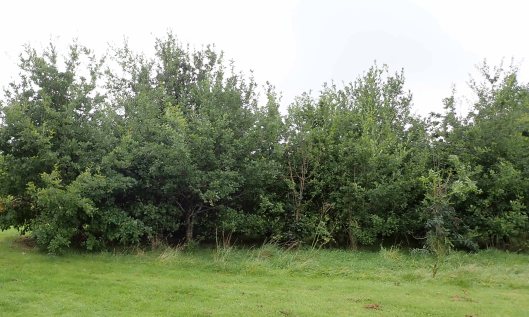
I wanted a relatively short walk between rain showers so headed to a small local green belt where Oak saplings were planted a few years ago, and my wander turned into a challenge to see how many different types of gall I could find in just this one small copse of young Oaks. The answer? Six!
200924 oak galls (1)

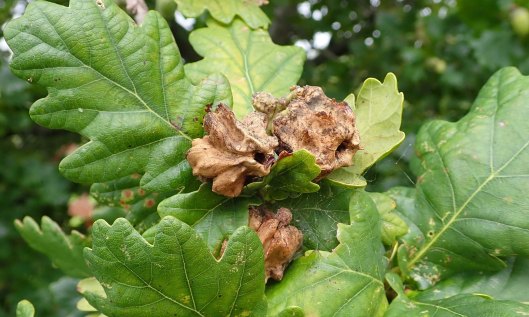
First up, Knopper galls, caused by the wasp Andriscus quercuscalicis. For more on that gall, see my August 2017 post Oak galls: knoppers and artichokes.
200924 oak galls (2) knopper

Next, Marbles, which I covered in Oak galls: marbles and apples, August 2017.
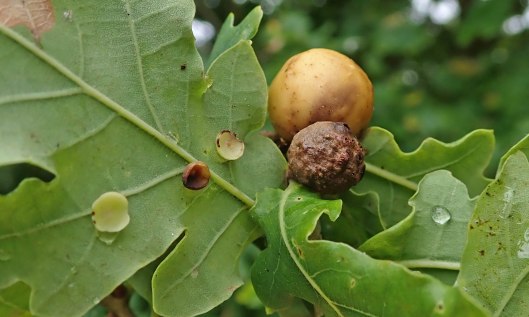
200924 oak galls (3) marble

Then, I found some Common spangles (below left), caused by the wasp Neuroterus quercusbaccarum. More on that mouthful in Oak galls: currants and spangles, August 2017.

200924 oak galls (4a) common spangle
200924 oak galls (4b) smooth spangle

You may have noticed my photo of Marble galls also had something else on the leaves. These were Smooth spangles (above right), a product of the wasp Neuroterus albipes.

200924 oak galls (5a) oyster
200924 oak galls (5b) oyster

I covered both Smooth spangles and this next gall, the Oyster, in the same blog: Oak galls: spangles and oysters, September 2017. The photo on the left above shows Oysters just beginning to form on the spine of the leaf; the one on the right shows two more developed examples, both on the same tree.
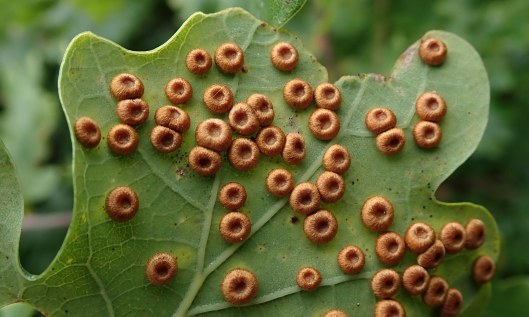
200924 oak galls (6) silk button

And, last but most certainly not least, as there were thousands of these on all the Oak trees I looked at, Silk button galls, caused by the wasp Neuroterus numismalis. I wrote about those in Oak galls: ram’s-horns and silk buttons, September 2017.

Not a bad haul for an hour turning over leaves and peering amongst branches. I didn’t find examples of all the Oak galls I’ve found before but I was very happy with this sampling.

Like Loading...

Oak galls: Currants and spangles

22 Tuesday Aug 2017

Posted by sconzani in insects, leaves, nature, trees

≈ 7 Comments

Tags

Common spangle gall, Currant gall, galls on oak, Neuroterus quercusbaccarum, Oak gall, Oak gall wasp, oak tree, Spangle gall

This is part one of the story of Oak galls – there will be a sequel (possibly two) because the poor old oak tree, one of the most iconic of British trees, the one almost everyone can identify, is also one of the trees most attacked by galls (though, in this case, the galls do little, if any, damage to the actual tree). This first Oak attack story is a bit like the chicken and the egg – which came first? – as Neuroterus quercusbaccarum, a wasp so tiny that only expert spotters ever actually see it, has the ability to reproduce both sexually and asexually, producing two types of gall on oak trees: the sexual generation is produced inside the Currant galls and the asexual generation develops inside the Common spangle galls.

170822 Neuroterus quercusbaccarum Oak Currant gall (1)
170822 Neuroterus quercusbaccarum Oak Currant gall (2)
170822 Neuroterus quercusbaccarum Oak Currant gall (3)

Let’s start with the Currants. As their name suggests, they look a little like currants or berries, maturing in colour from yellow and green to red and purple. In spring, you can find these attached to an Oak’s catkins or to the undersides of leaves.

170822 Neuroterus quercusbaccarum Oak Currant gall

Inside, tiny larvae develop, emerging as adult wasps in June. These wasps are either male or female, they mate soon after emerging, then lay their eggs within the epidermis on the undersides of oak leaves.

170822 Neuroterus quercusbaccarum Spangle gall (1)
170822 Neuroterus quercusbaccarum Spangle gall (2)
170822 Neuroterus quercusbaccarum Spangle gall (3)

Now to the Spangles. When the eggs of the Currant gall generation hatch and their larvae begin to develop within the oak leaves, they create Spangle galls on the undersides of those leaves. The galls look a little like inverted saucers, with a slight hump in the middle. They are hairy and often quite a bright pinkish red to begin with, maturing eventually to a dull brown. Once mature, in late summer, the spangles detach and fall to the ground to be covered by the leaves of the oak, when they fall in autumn. The larvae overwinter in their cosy spangles, hatching in the spring when, without the need to mate, they lay their eggs on the oak’s leaves and catkins, thus producing the alternate generation of Currant galls. And so the cycle continues …

170822 Neuroterus quercusbaccarum Spangle gall (4)

Like Loading...

About me

sconzani

sconzani

I'm a writer and photographer; researcher and blogger; birder and nature lover; countryside rambler and city strider; volunteer and biodiversity recorder.

View Full Profile →

Follow earthstar on WordPress.com

Enter your email address to follow this blog and receive notifications of new posts by email.

Recent blog posts

  • M is for mite December 18, 2025
  • L is for lepidopteran lifers December 17, 2025
  • K is for Keeled skimmers December 16, 2025
  • J is for Jersey tiger December 15, 2025
  • I is for Ichneumon December 14, 2025

From the archives

COPYRIGHT

Unless otherwise acknowledged, the text and photographs on this blog are my own and are subject to international copyright. Nothing may be downloaded or copied without my permission.

Fellow Earth Stars!

  • Unknown's avatar
  • Unknown's avatar
  • Unknown's avatar
  • Unknown's avatar
  • Unknown's avatar
  • Unknown's avatar
  • Unknown's avatar
  • Unknown's avatar
  • Unknown's avatar
  • Unknown's avatar
  • Unknown's avatar
  • Unknown's avatar
  • Unknown's avatar
  • Unknown's avatar
  • Unknown's avatar
  • Unknown's avatar
  • Unknown's avatar
  • Unknown's avatar
  • Unknown's avatar
  • Unknown's avatar
  • Unknown's avatar
  • Unknown's avatar
  • Unknown's avatar
  • Unknown's avatar
  • Unknown's avatar
  • Unknown's avatar
  • Unknown's avatar
  • Unknown's avatar
  • Unknown's avatar
  • Unknown's avatar
  • Unknown's avatar
  • Unknown's avatar
  • Unknown's avatar
  • Unknown's avatar
  • Unknown's avatar
  • Unknown's avatar
  • Unknown's avatar
  • Unknown's avatar
  • Unknown's avatar
  • Unknown's avatar
  • Unknown's avatar
  • Unknown's avatar
  • Unknown's avatar
  • Unknown's avatar
  • Unknown's avatar
  • Unknown's avatar
  • Unknown's avatar
  • Unknown's avatar
  • Unknown's avatar
  • Unknown's avatar

Blog at WordPress.com.

Privacy & Cookies: This site uses cookies. By continuing to use this website, you agree to their use.
To find out more, including how to control cookies, see here: Cookie Policy
  • Subscribe Subscribed
    • earthstar
    • Join 667 other subscribers
    • Already have a WordPress.com account? Log in now.
    • earthstar
    • Subscribe Subscribed
    • Sign up
    • Log in
    • Report this content
    • View site in Reader
    • Manage subscriptions
    • Collapse this bar
 

Loading Comments...
 

You must be logged in to post a comment.

    %d