• ABOUT
  • BIRDING 2018
  • Birding 2019
  • BLOG POSTS
  • Butterflies 2018
  • Resources

earthstar

~ a celebration of nature

earthstar

Tag Archives: cup fungi

Orange peel fungus

14 Friday Nov 2025

Posted by sconzani in autumn, fungi

≈ 2 Comments

Tags

Aleuria aurantia, autumn colour, British fungi, cup fungi, Orange peel, Orange peel fungus

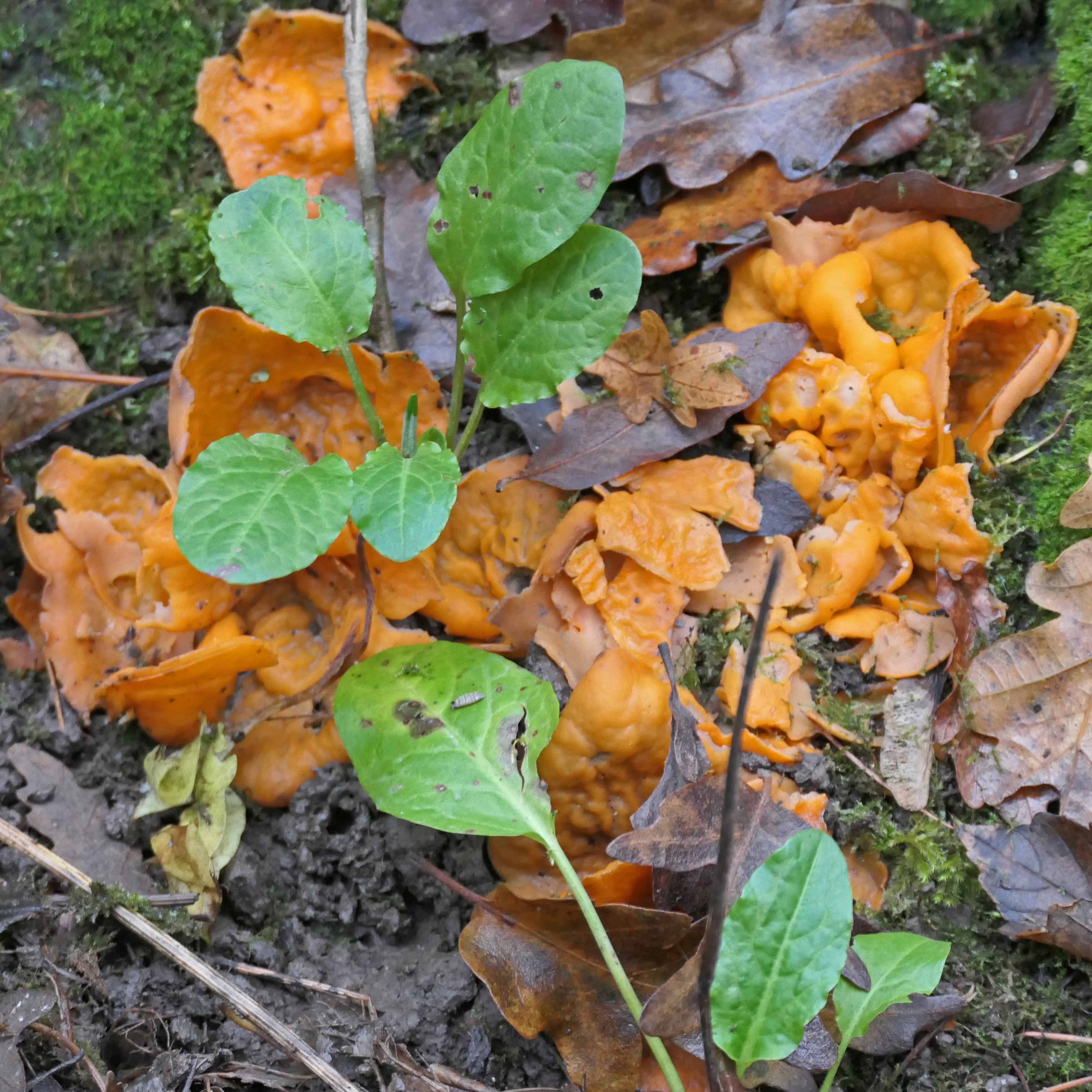
Orange peel (Aleuria aurantia) is a fungus I’ve not seen very often, despite it being officially classified as common. So, when, on a very grey, often drizzly day, I spotted a scattering of something bright orange on the ground in front of me, I initially thought some litter bug had thrown away the remains of their fruit. But no, this was the real thing, and there was more of it than I’d ever seen before.
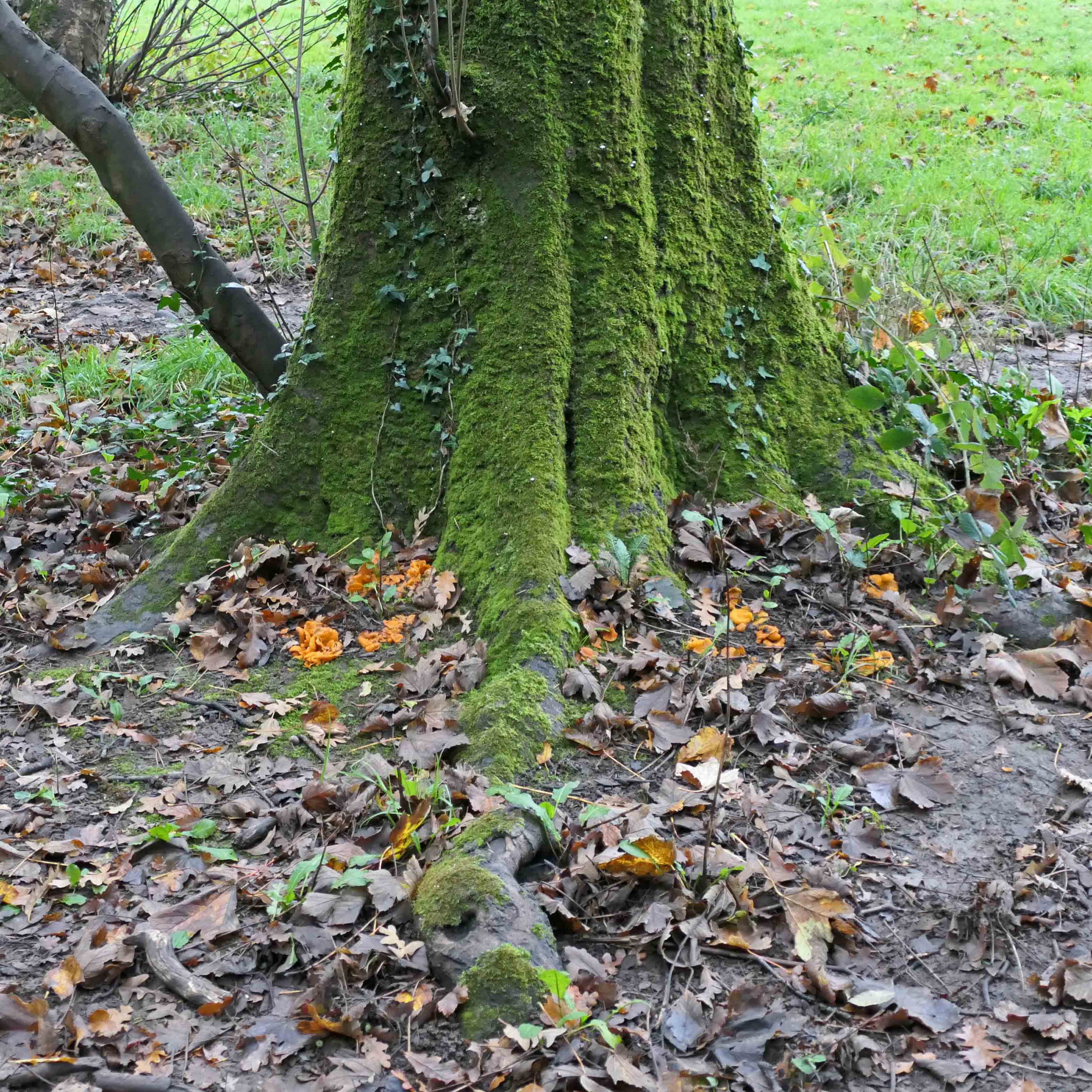
My guide book says this fungus grows alongside paths and disturbed forest tracks, which is exactly where I found it, alongside a meandering path at the edge of the woodland in one of Cardiff’s parks.
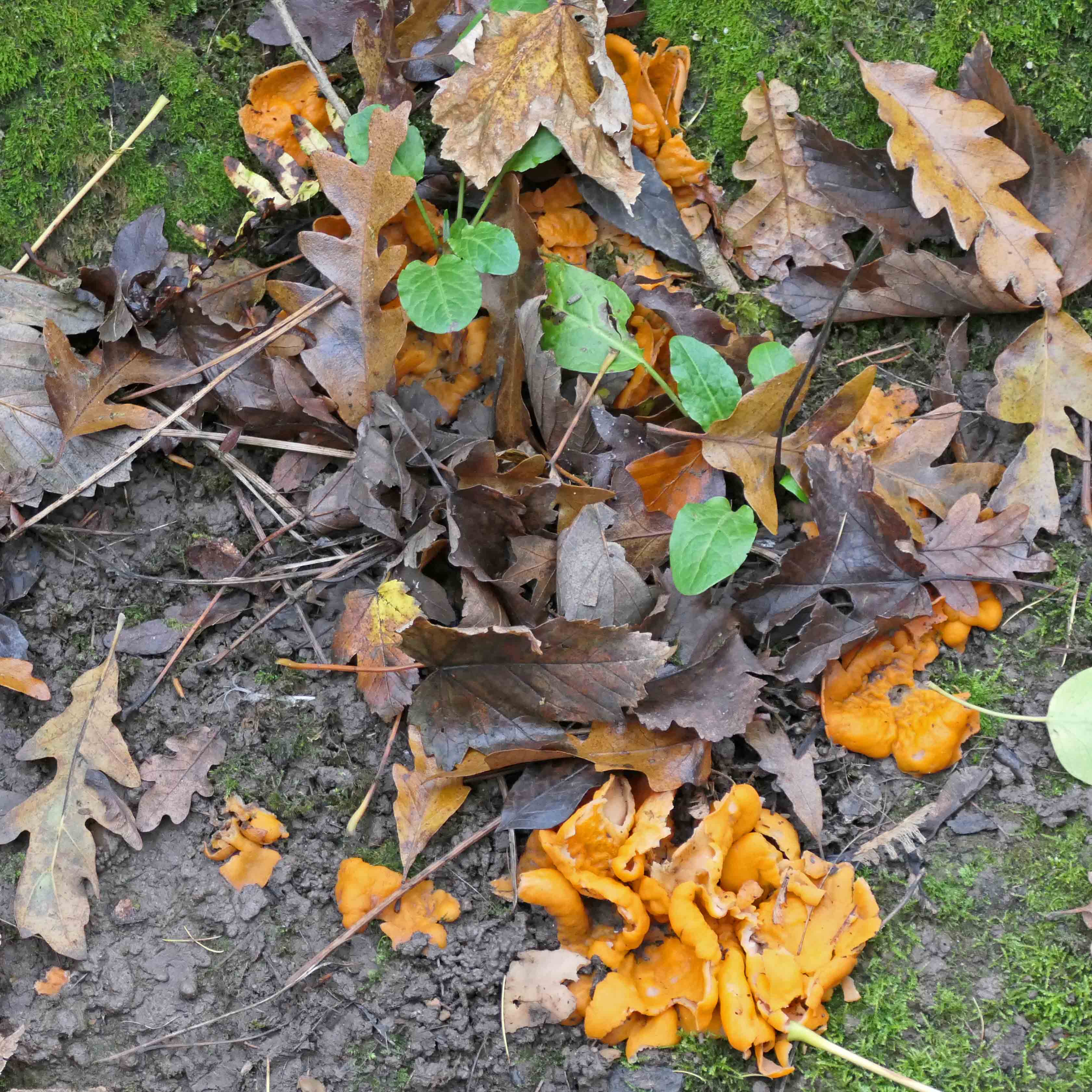
Though it doesn’t look much like it in these photos, Orange peel is a cup fungus. The exterior of the cup is a paler shade of orange-beige and covered with fine down, whereas the interior is, as you can see, a vibrant orange.
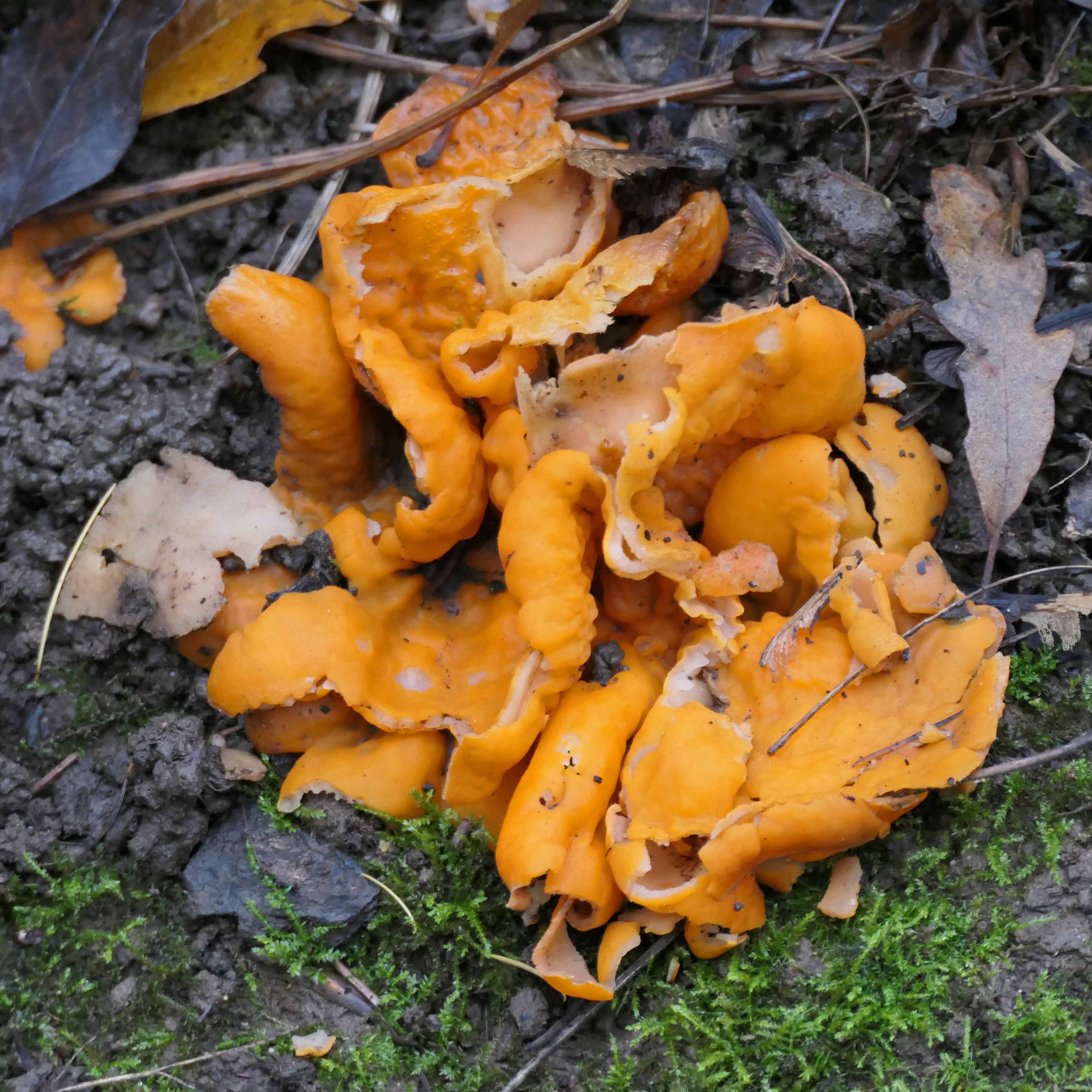
The Orange peel I found had become wavy and twisted with age, and had been munched around the edges, probably by snails and slugs, but it was still a stunning sight.
Like Loading...

Common grey disco, probably

24 Friday Jan 2025

Posted by sconzani in fungi, winter

≈ Leave a comment

Tags

British fungi, Common grey disco, cup fungi, disco fungi, fungi on rotting logs, Mollisia cinerea

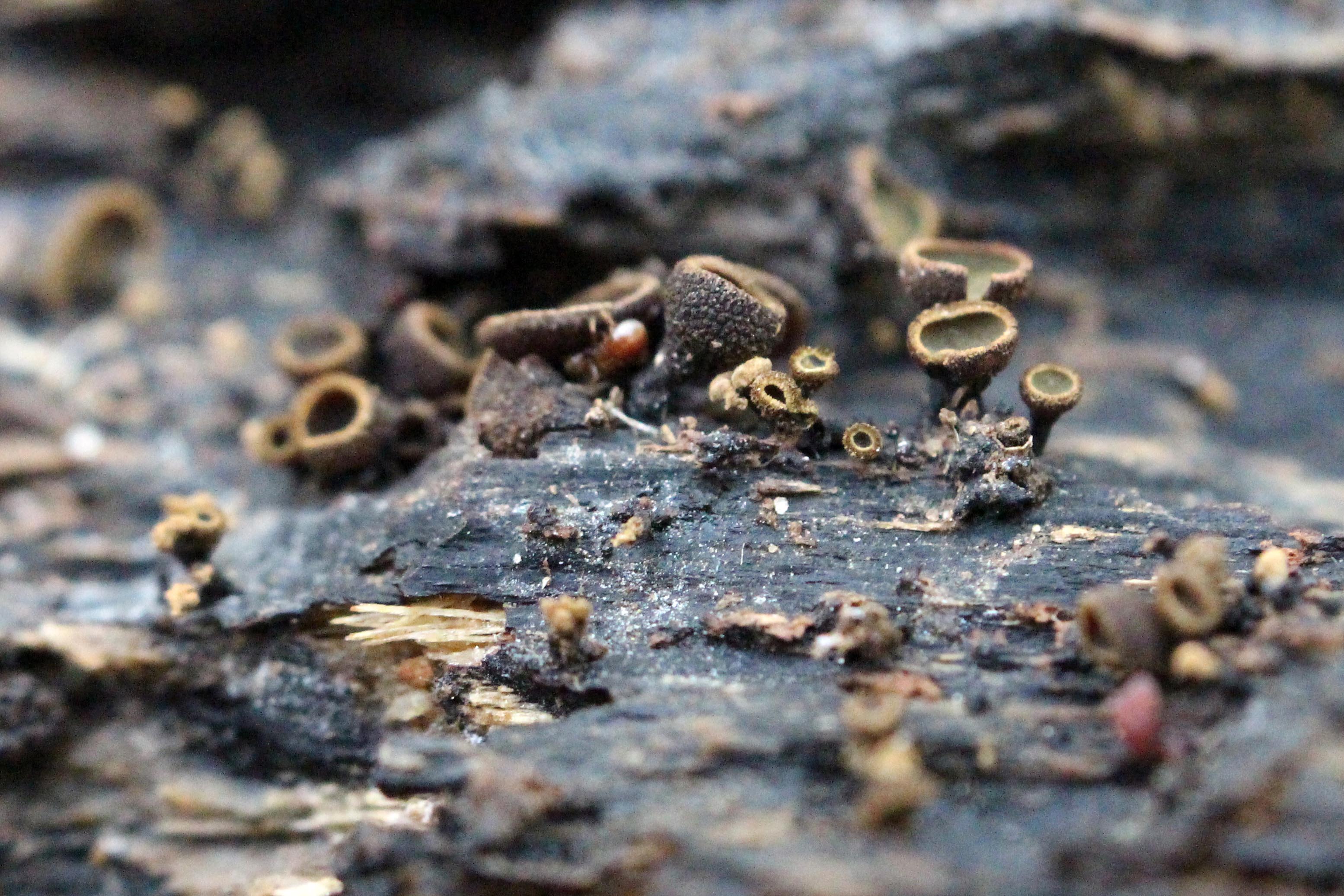
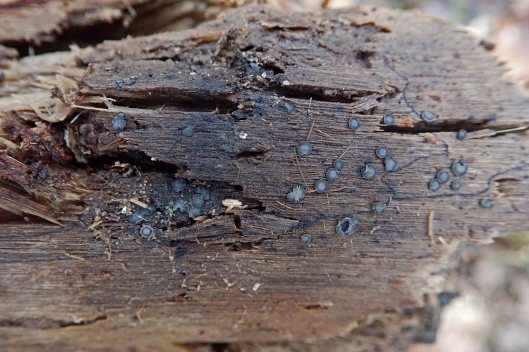
I am very aware that cup fungi like these really need to be confirmed by microscopic examination of their spores but, sticking my neck out and assuming the most common species is most likely the one I’ve found, I’m going to say this is Common grey disco (Mollisia cinerea).

As they are tiny and grey and the white margin to their cups is often not particularly obvious, it is easy to overlook these little beauties. I wasn’t looking for fungi; I simply got lucky while poking about amongst some rotting logs in a local park.

Like Loading...

Cheery yellow

03 Friday Nov 2023

Posted by sconzani in autumn, fungi

≈ 2 Comments

Tags

Bisporella citrina, British fungi, cup fungi, Lemon disco, yellow fungi

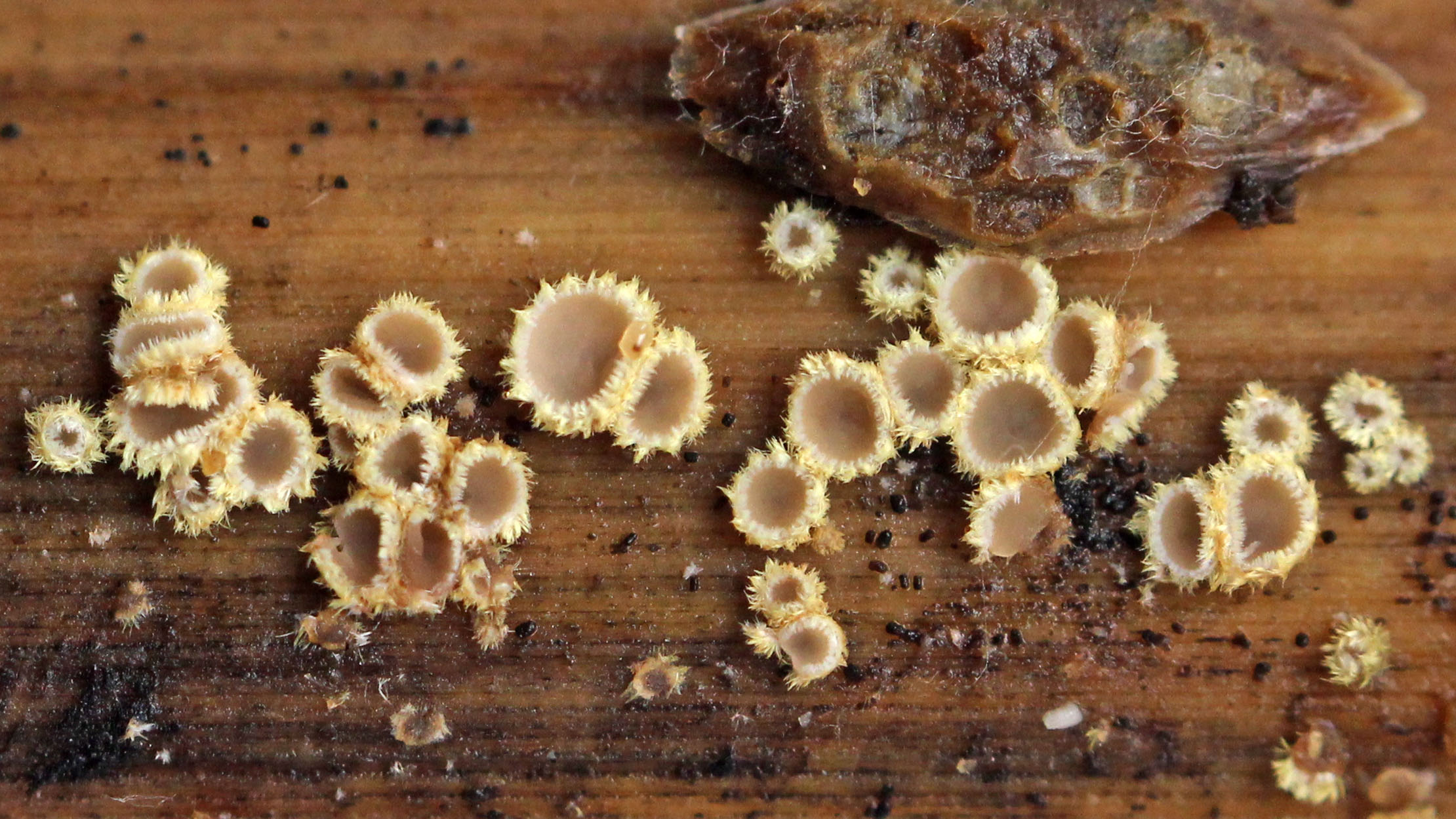
After the last few grey, wet, windy days of Storm Ciarán, I thought we needed a little sunshine, even if it’s coming from the ground below rather than the sky above. It’s not exactly warming but it certainly made me feel more cheery after days of gloom. These are likely to be Lemon disco fungi (Bisporella citrina), though they really need examination under a microscope to be sure.

231103 lemon disco

Like Loading...

Cups aplenty

12 Friday May 2023

Posted by sconzani in fungi, nature

≈ Leave a comment

Tags

British fungi, Cellar cup, cup fungi, Peziza cerea, Peziza species

I was surprised but delighted to find this large colony of fungi on a pile of woodchips earlier this week. I think these are Cellar cups (Peziza cerea), as they fit perfectly with the description in my guide book:

Pale cup associated with limestone and often found growing out of mortar joints in buildings. Solitary or in small groups on woody debris, sandbags, limestone rubble, lime mortar and, sometimes, in damp cellars. Fruit bodies to 5cm across irregular cup-shaped, with the margin inrolled at first; inner surface pale ochre or yellowish brown with a smooth texture; outer surface concolorous and finely granular.

However, there are over 50 species of similar cups in Britain, many of which grow in similar locations, so microscopic examination is needed to be sure of identification.

Like Loading...

Friday night discos

30 Friday Nov 2018

Posted by sconzani in autumn, fungi, nature

≈ 2 Comments

Tags

Bisporella citrina, British fungi, cup fungi, disco fungi, fungi on rotting wood, Lachnum virgineum, Lemon disco, Snowy disco

Discos seem appropriate for a Friday night or, rather, they would have in the 1960s and ’70s. But my discos don’t involve a multi-colour dance floor or a flashing-ball light or John Travolta-style dancing – my discos are fungi. Getting down and dirty in Cogan Wood earlier this week, selectively picking up small logs of rotting wood for inspection, I found two of these little beauties.

181130 snowy discoSnowy disco (Lachnum virgineum)

181130 lemon discoLemon disco (Bisporella citrina)

Disclaimer: Fungi are notoriously difficult to identify and one thing I’ve learnt from dipping my toes into the mycological world is that one should always confirm one’s identification, especially of minute fungi like these, by microscopic examination. I have not done that so my IDs are not confirmed, just quite likely.

Like Loading...

Belonidium mollissimum

31 Friday Mar 2017

Posted by sconzani in fungi, nature

≈ 9 Comments

Tags

ascomycete, Belonidium mollissimum, cup fungi, fungi on umbellifers, fungus

I’ve been finding a lot of fungi recently on the bottoms of the dead stalks of last year’s umbellifers. They’re all exceedingly small and difficult to identify (which I find rather frustrating) but also rather gorgeous (which is why I have so far kept looking for them). This is one I was able to identify with help from my fungi friends and associates and a little microscope work. Its current name is Belonidium mollissimum (but it’s had a long list of other names – fungi keep being re-classified and renamed as researchers examine them and their DNA more carefully!) and the largest of its cups is just 1mm wide. This is a series of photos taken over the past two weeks to show how this tiny fungus has changed in that time.

170331 Belonidium mollissimum 17March

17 March, when first discovered

170331 Belonidium mollissimum 19March

19 March

170331 Belonidium mollissimum 25March

25 March

170331 Belonidium mollissimum 31March

31 March

Like Loading...

Fungi Friday: Diplocarpa bloxamii

18 Friday Nov 2016

Posted by sconzani in fungi, nature

≈ 2 Comments

Tags

ascomycete, cup fungi, Diplocarpa bloxamii, Kew Mycology, SEWBReC

Considering I am exceedingly short-sighted, I am amazed at how many exceedingly tiny fungi I have been finding lately. More on those soon but today I want to share a rare one I found in one of my local Cardiff parks last week. In fact, my find is only the second record for Wales and was the first record in Wales in 42 years and 3 days. As Kew mycologist Brian Douglas wrote, ‘it’s not bad coming second to Derek Reid, ex-head of Kew Mycology’. Needless to say, I’m delighted, though I suspect this fungus is under-recorded rather than as rare as those statistics make it sound!

161118-diplocarpa-bloxamii-1

Diplocarpa bloxamii (no common name) is an ascomycete, a cup fungus, with an olive-black disc-shaped cup growing on a short stem. The external surface of the cup is pustulate (think coarse pimples, without the actual pus) and it has light brown hairs sprouting both from the pustules and around the edge of the cup, which is much lighter, almost beige, in colour. The cups are tiny – no more than 5mm across – I actually had my glasses off and my face about 15cms from the decaying piece of log, looking at something else, when I spotted them.

161118-diplocarpa-bloxamii-2
161118-diplocarpa-bloxamii-3
161118-diplocarpa-bloxamii-4

Of course, I had no idea what they were but took some macro photos to post that evening on Facebook. Luckily, Brian Douglas spotted my post, alerted me to what they might be, sent me some literature, and had me heading back to the woods the next day for a sample. Talk about looking for a needle in a haystack! Fortunately, I’ve been training myself to remember where I spot things so that I can later record my findings, so I found them again quite quickly.

161118-diplocarpa-bloxamii-5
161118-diplocarpa-bloxamii-6

I am very grateful to Brian for his help in determining the identity of my little fungi and to Amy Hicks, of SEWBReC, who very kindly undertook the microscope work needed to confirm their ID and provided me with the stunning photographs (above) that resulted from her work.

diplocarpa-bloxamii-heath-st179799-7

Like Loading...

Green elfcups

10 Thursday Nov 2016

Posted by sconzani in fungi, nature

≈ 16 Comments

Tags

Chlorociboria aeruginascens, Chlorociboria aeruginosa, cup fungi, cup fungus, Elfcups, Green elfcup, Nant Fawr Woodlands, Turquoise elfcup

I’d seen these gorgeous little cup fungi a few times before but last Saturday was the first time I’d found them myself, in nearby Nant Fawr Woodlands, and it’s fair to say I was over the moon! They’re tiny – I deliberately took a photo of my hand holding the fallen branch they were growing on to show their size – but their colour is so unusual that it catches the eye, so they’re not that difficult to spot, though they’re also not very common.

green-elfcup-4

Now, I don’t know about you but I would describe their colour as turquoise, or near as dammit, but there are two very similar species of these cups and these are more likely to be Green elfcups (Chlorociboria aeruginascens) rather than Turqoise elfcups (Chlorociboria aeruginosa), as the latter are smaller and quite rare. Microscope work is needed to distinguish the two and even that is reported to be difficult.

green-elfcup-1

One fascinating thing about these beautiful fungi is the green staining they cause in wood, and, not surprisingly, that wood is highly prized by woodturners. In fact, in Victorian times, green-stained oak was one of the woods used to make Tunbridge ware, the name given to a type of inlaid decorative woodwork that haled originally from the towns of Tonbridge and Tunbridge Wells in Kent. The antique pieces are still highly sort after by collectors and just a little out of my price range but they certainly are lovely.

green-elfcup-2
green-elfcup-3

Like Loading...

About me

sconzani

sconzani

I'm a writer and photographer; researcher and blogger; birder and nature lover; countryside rambler and city strider; volunteer and biodiversity recorder.

View Full Profile →

Follow earthstar on WordPress.com

Enter your email address to follow this blog and receive notifications of new posts by email.

Recent blog posts

  • M is for mite December 18, 2025
  • L is for lepidopteran lifers December 17, 2025
  • K is for Keeled skimmers December 16, 2025
  • J is for Jersey tiger December 15, 2025
  • I is for Ichneumon December 14, 2025

From the archives

COPYRIGHT

Unless otherwise acknowledged, the text and photographs on this blog are my own and are subject to international copyright. Nothing may be downloaded or copied without my permission.

Fellow Earth Stars!

  • Unknown's avatar
  • Unknown's avatar
  • Unknown's avatar
  • Unknown's avatar
  • Unknown's avatar
  • Unknown's avatar
  • Unknown's avatar
  • Unknown's avatar
  • Unknown's avatar
  • Unknown's avatar
  • Unknown's avatar
  • Unknown's avatar
  • Unknown's avatar
  • Unknown's avatar
  • Unknown's avatar
  • Unknown's avatar
  • Unknown's avatar
  • Unknown's avatar
  • Unknown's avatar
  • Unknown's avatar
  • Unknown's avatar
  • Unknown's avatar
  • Unknown's avatar
  • Unknown's avatar
  • Unknown's avatar
  • Unknown's avatar
  • Unknown's avatar
  • Unknown's avatar
  • Unknown's avatar
  • Unknown's avatar
  • Unknown's avatar
  • Unknown's avatar
  • Unknown's avatar
  • Unknown's avatar
  • Unknown's avatar
  • Unknown's avatar
  • Unknown's avatar
  • Unknown's avatar
  • Unknown's avatar
  • Unknown's avatar
  • Unknown's avatar
  • Unknown's avatar
  • Unknown's avatar
  • Unknown's avatar
  • Unknown's avatar
  • Unknown's avatar
  • Unknown's avatar
  • Unknown's avatar
  • Unknown's avatar
  • Unknown's avatar

Blog at WordPress.com.

Privacy & Cookies: This site uses cookies. By continuing to use this website, you agree to their use.
To find out more, including how to control cookies, see here: Cookie Policy
  • Subscribe Subscribed
    • earthstar
    • Join 667 other subscribers
    • Already have a WordPress.com account? Log in now.
    • earthstar
    • Subscribe Subscribed
    • Sign up
    • Log in
    • Report this content
    • View site in Reader
    • Manage subscriptions
    • Collapse this bar
 

Loading Comments...
 

You must be logged in to post a comment.

    %d