• ABOUT
  • BIRDING 2018
  • Birding 2019
  • BLOG POSTS
  • Butterflies 2018
  • Resources

earthstar

~ a celebration of nature

earthstar

Tag Archives: damselfly

National Dragonfly Week: Blue-tailed Damselfly

28 Thursday Jul 2016

Posted by sconzani in insects, nature

≈ 2 Comments

Tags

Blue-tailed damselfly, damselflies, damselfly, exuvia, Ischnura elegans, National Dragonfly Week 2016

Let’s continue National Dragonfly Week today with a delightful damselfly, the little Blue-tailed (Ischnura elegans), another very common damselfly that can be seen flying throughout Britain from May through to September. Though there is also a Scarce blue-tailed damselfly, it is, well, scarce, so chances are if you see a dark-coloured damsel with that distinctive all-blue segment towards the end of its body, it will be the Blue-tailed damselfly. The females are a little more tricky, as their abdomens and tail spots can be different colours – pink, violet, pale green, pale brown – depending on their type and state of maturity.

160728 blue-tailed (1)

160728 blue-tailed (2)

I don’t have any female photos so thought I would show you, instead, earlier stages in a damselfly’s lifecycle. The eggs the females lay in their local pond, lake, or slow-moving stream or river hatch into nymphs that live in that water, preying on other larvae and small insects. After as little as six months or as long as two years, and having gone through a series of skin moults as their bodies grow in size, the nymphs leave the water and climb a plant stem, branch or tree trunk, where they undergo the ultimate change, emerging from their final skin to fly as an adult.

160728 damsel exuvia
160728 damsel new

As you can see above, they are often very pale when they emerge as it takes them a while to colour up. You can often find the discarded skin cases (known as exuvia) near watery places – I found a tree alongside my local lake that was covered in them.

Like Loading...

National Dragonfly Week: Large Red damsel

24 Sunday Jul 2016

Posted by sconzani in insects, nature

≈ 5 Comments

Tags

damselflies, damselfly, Large Red damselfly, National Dragonfly Week 2016, Pyrrhosoma nymphula

For day two of National Dragonfly Week we have another damselfly, the Large Red (Pyrrhosoma nymphula). Of the 20 species of damselfly found in Britain, there are only two that are red and the other, the Small Red, is rare and confined to specific heathland areas, so the chances are that if you see a mainly red damselfly (the females have varying amounts of red and black on their abdomens), it is the Large Red. If only all damselfly identification were so easy!

160724 Large red (1)

The Large Red is one of the first damselflies to appear each spring, flying from early to mid April through to September, and can be found throughout Britain wherever there’s fresh water – ponds, canals, lakes, boggy areas and slow-moving rivers (not fast) – with some vegetation around for it to perch on.

160724 Large red (2)

Mr Large Red can be quite aggressive, buzzing other males foolish enough to invade his territory. When they mate, the male clamps on to the female just behind her head, as you can see in my photo above, and she would normally then bend her body around to attach to his reproductive organs, thus forming the ‘mating wheel’. Maybe this female just wasn’t that into him!

160724 Large red (3)
160724 Large red (4)
Like Loading...

National Dragonfly Week: Beautiful Demoiselle

23 Saturday Jul 2016

Posted by sconzani in insects, nature

≈ 6 Comments

Tags

Beautiful Demoiselle, British Dragonfly Society, Calopteryx Virgo, damselfly, dragonflies, dragonfly, National Dragonfly Week 2016

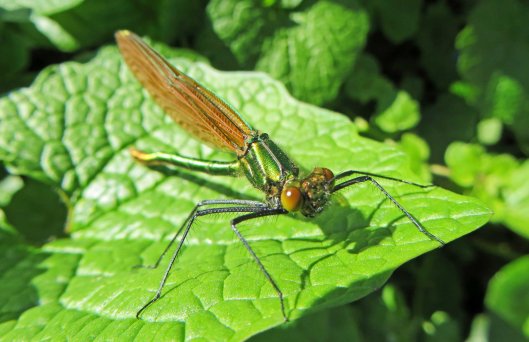
Back at the end of April I wrote about my first dragonfly sighting of the year – only it turned out to be a damselfly, not a dragonfly, and I blogged about my first lesson in telling the two families apart. That gorgeous creature was a female of the very aptly named Beautiful Demoiselle (Calopteryx Virgo) species. Since then I’ve been lucky enough to see many more Beautiful Demoiselles, including the equally handsome metallic blue-green male of the species. I’ve also seen many other types of damselflies and some, though not as many, dragonflies (the 4-spotted chaser featured in one blog, and the Broad-bodied chaser in another).

160723 damsel Beautiful Demoiselle female

You may not know it but today is the first day of National Dragonfly Week 2016, which this year runs from Saturday 23rd to Sunday 31st July. It’s the brainchild of the British Dragonfly Society, which exists to record dragonfly numbers and to educate people about dragonflies and their habitats in order to aid with their conservation. The society and other wildlife groups will be holding events throughout the week to raise awareness of damsel and dragonflies – you can see more on the BDS website – and I will be highlighting a different species each day this week as my own way of celebrating these heavenly creatures.

160723 damsel Beautiful Demoiselle male

Like Loading...

Damsels or dragons?

30 Saturday Apr 2016

Posted by sconzani in insects, nature

≈ 4 Comments

Tags

Aeshna grandis, Beautiful Demoiselle, Brown Hawker, Calopteryx Virgo, damselfly, dragonfly

One of the best things about writing this blog is that I’m constantly learning new things. When this gorgeous creature flitted across my path in Bute Park on Wednesday, I thought ‘Ooooo, my first dragonfly of the year!’ Wrong! This is a damselfly, a female of the very aptly named species Beautiful Demoiselle (Calopteryx Virgo).

damselfly Beautiful Demoiselle female (2)

So, I asked myself, ‘how do I tell the difference between a dragonfly and a damselfly?’ It seems there are four basic differences that even I should be able to spot:
1) Body shape: dragonflies are bulkier, shorter and thicker, whereas damselflies are slender and delicate.
2) Eyes: a dragonfly’s eyes are much larger, wrapping around from the side to the front of the head, often touching. The eyes of the damselfly are also big, but tend to be more to the side of the head, with a definite gap between.

Damselfly Beautiful Demoiselle female

3) Wing shape: the hind wings of the dragonfly are larger than the fore wings and broaden at the base, but the damselfly’s wings are both the same size and shape, and narrow markedly where they connect to the body.
4) Wing position: when resting, the dragonfly always spreads its wings, whereas the damselfly rests with its wings together above its body.

dragonfly brown hawker female

Above is a photo of a female Brown Hawker dragonfly (Aeshna grandis), taken last year, so you can see the differences. And, hopefully, my rather early Beautiful Demoiselle will just be the first of many of these heavenly creatures.

Like Loading...
Newer posts →

About me

sconzani

sconzani

I'm a writer and photographer; researcher and blogger; birder and nature lover; countryside rambler and city strider; volunteer and biodiversity recorder.

View Full Profile →

Follow earthstar on WordPress.com

Enter your email address to follow this blog and receive notifications of new posts by email.

Recent blog posts

  • Q is for Quercus December 22, 2025
  • P is for Phalarope December 21, 2025
  • O is for Odonata December 20, 2025
  • N is for nest December 19, 2025
  • M is for mite December 18, 2025

From the archives

COPYRIGHT

Unless otherwise acknowledged, the text and photographs on this blog are my own and are subject to international copyright. Nothing may be downloaded or copied without my permission.

Fellow Earth Stars!

  • Unknown's avatar
  • Unknown's avatar
  • Unknown's avatar
  • Unknown's avatar
  • Unknown's avatar
  • Unknown's avatar
  • Unknown's avatar
  • Unknown's avatar
  • Unknown's avatar
  • Unknown's avatar
  • Unknown's avatar
  • Unknown's avatar
  • Unknown's avatar
  • Unknown's avatar
  • Unknown's avatar
  • Unknown's avatar
  • Unknown's avatar
  • Unknown's avatar
  • Unknown's avatar
  • Unknown's avatar
  • Unknown's avatar
  • Unknown's avatar
  • Unknown's avatar
  • Unknown's avatar
  • Unknown's avatar
  • Unknown's avatar
  • Unknown's avatar
  • Unknown's avatar
  • Unknown's avatar
  • Unknown's avatar
  • Unknown's avatar
  • Unknown's avatar
  • Unknown's avatar
  • Unknown's avatar
  • Unknown's avatar
  • Unknown's avatar
  • Unknown's avatar
  • Unknown's avatar
  • Unknown's avatar
  • Unknown's avatar
  • Unknown's avatar
  • Unknown's avatar
  • Unknown's avatar
  • Unknown's avatar
  • Unknown's avatar
  • Unknown's avatar
  • Unknown's avatar
  • Unknown's avatar
  • Unknown's avatar
  • Unknown's avatar

Blog at WordPress.com.

Privacy & Cookies: This site uses cookies. By continuing to use this website, you agree to their use.
To find out more, including how to control cookies, see here: Cookie Policy
  • Subscribe Subscribed
    • earthstar
    • Join 667 other subscribers
    • Already have a WordPress.com account? Log in now.
    • earthstar
    • Subscribe Subscribed
    • Sign up
    • Log in
    • Report this content
    • View site in Reader
    • Manage subscriptions
    • Collapse this bar
 

Loading Comments...
 

You must be logged in to post a comment.

    %d