• ABOUT
  • BIRDING 2018
  • Birding 2019
  • BLOG POSTS
  • Butterflies 2018
  • Resources

earthstar

~ a celebration of nature

earthstar

Tag Archives: Dr Mary Gillham

‘Dedicated Naturalist’: The Stormcock

14 Tuesday Jun 2016

Posted by sconzani in 'Dedicated Naturalist' Project, birds, nature

≈ 6 Comments

Tags

birding, birdwatching, British birds, Dr Mary Gillham, Mistle thrush

A snippet from my volunteer work on the ‘Dedicated Naturalist’ Project, helping to decipher and digitise, record and publicise the life’s work of naturalist extraordinaire, Dr Mary Gillham.

Written in her fifth form year at Ealing Grammar School for Girls, Mary’s poignant poem about a mistle thrush was subsequently published in the school’s annual yearbook.

The Stormcock
The thunder roared from the clouds on high;
The lightning flashed across the darkened sky;
The woods were lone and drear and drenched with rain,
And not a soul passed by along the lane.

The raindrops glistened on the leaves like gems,
The flowers drooped low upon their slender stems,
And all the birds save one had gone to rest
While this one lingered on beside his nest.

It was a missel-thrush that perched aloft,
With speckled breast, bright eyes, and plumage soft;
His song rose through the branches clear and sweet,
Above the noise of wind and rain and sleet.

160602 mistle thrush (3)

The hen bird on the nest beside her mate
Had heard him singing frequently of late,
But still she listened with attentive air
While he sang gaily on without a care.

His song defied the tumult of the storm:
The eggs within the nest were safe and warm,
And that was what he cared for most of all,
And so his praise came forth in joyous call.

Despite the elements that tried to quell
The joyous sounds that from his being swell,
The bird sang on through wind and sleet and rain
Until the storm at last began to wane.

160602 mistle thrush (1)
160602 mistle thrush (2)

You can follow our progress with this project on Facebook and on Twitter. A website will follow soon.
Like Loading...

‘Dedicated Naturalist’: The Rabbit

15 Sunday May 2016

Posted by sconzani in 'Dedicated Naturalist' Project, animals, nature

≈ Leave a comment

Tags

Dr Mary Gillham, Forest Farm Nature Reserve, rabbit

A snippet from my volunteer work on the ‘Dedicated Naturalist’ Project, helping to decipher and digitise, record and publicise the life’s work of naturalist extraordinaire, Dr Mary Gillham.

160515 rabbit (1)

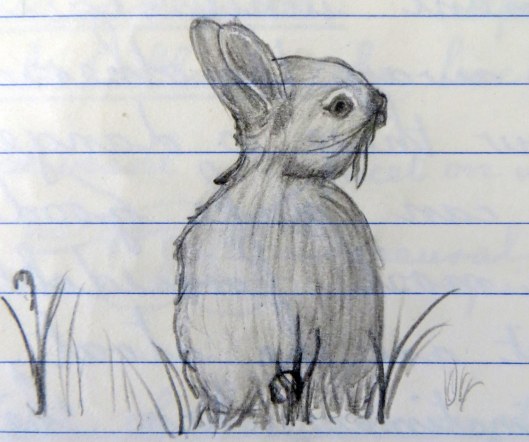
From Mary’s 1935 Form IIa Biology exercise book:

The rabbit is covered with a soft greyish coloured fur. The teats or milk glands of the mother sometimes range over the whole of the ventral side of the body. Rabbits have flat feet with fur on the underneath. Their claws cannot be drawn in as can those of a cat, and so if it wasn’t for the fact that they usually run on grass they would make a noise when running. As it is easy prey for other animals it has large ears so that it can hear the slightest sound. The rabbit has a prominent white tail, so that when one runs away the others may see it and know there is danger at hand, then they can make good their escape. The three most formidable enemies of the rabbit are the stoat, weasel and fox. Sometimes when the rabbit sees any of these it is so overcome with fright that it seems paralysed and cannot move while its attacker comes up and kills it. The rabbit has three eyelids instead of the usual two, it also has sensitive whiskers like those of a cat growing from the sides of its face. The ventral side is a much lighter grey that the dorsal side. Rabbits are very common in England and in almost any field you go into you can see either the rabbits or their burrows.

160515 rabbit (2)
160515 rabbit (3)
160515 rabbit (4)
160515 rabbit (5)

My rabbits were photographed this week at Forest Farm Nature Reserve, where they are certainly very common!

160515 rabbit (6)

You can follow our progress with this project on Facebook and on Twitter. A website will follow soon.

Like Loading...

‘Dedicated Naturalist’: Scientific names

05 Thursday May 2016

Posted by sconzani in 'Dedicated Naturalist' Project, nature

≈ 9 Comments

Tags

binomial nomenclature, biological recording, biological records, Dr Mary Gillham, scientific names, SEWBReC, volunteering

A snippet from my volunteer work on the ‘Dedicated Naturalist’ Project, helping to decipher and digitise, record and publicise the life’s work of naturalist extraordinaire, Dr Mary Gillham.

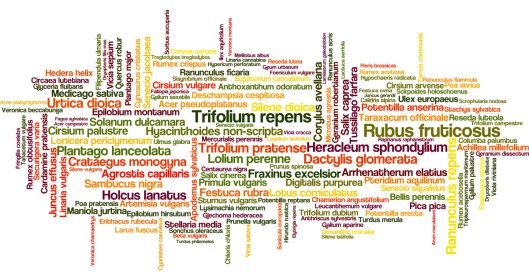
160505 Scientific names

When project officer Al Reeve sent round his monthly volunteer newsletter, he attached this image of the many and varied scientific names we volunteers have been typing up from Dr Mary Gillham’s records. It makes a pretty picture but these things are the stuff of volunteer nightmares! Seriously, what was Linnaeus thinking when he invented binomial nomenclature?

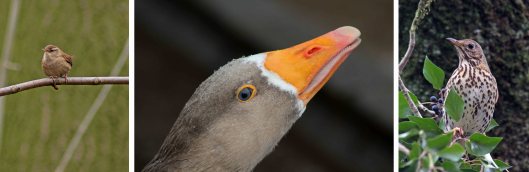
Take, for example, the Eurasian wren, a delicate and tiny bird but its scientific name, Troglodytes troglodytes, makes it sounds like a huge stomping dinosaur. Admittedly, the double-barrel names are easier to remember. There’s Pica pica the Eurasian magpie, Buteo buteo the Common buzzard and Anser anser the Greylag goose.

160505 wren greylag thrush

Troglodytes troglodytes, Anser anser and Turdus philomelos

I feel sorry for the rather unfortunately named Turdus family of true thrushes. There are more than 50 family members, with names like Turdus pilaris the Fieldfare, Turdus merula the Blackbird, and Turdus philomelos the melodic Song Thrush.

Then there are the plants with girls’ names, or should that be girls with plant names? Whenever I type Prunella (as in Prunella vulgaris, the herb Selfheal) I always think of Prunella Scales, the actress who played John Cleese’s exceedingly patient wife in Fawlty Towers, and, though it’s not spelt the same, Silene dioica, the pretty wildflower Red campion, reminds me of singer Celine Dion. And there are plenty more: Veronica, Iris, Lotus, Viola …

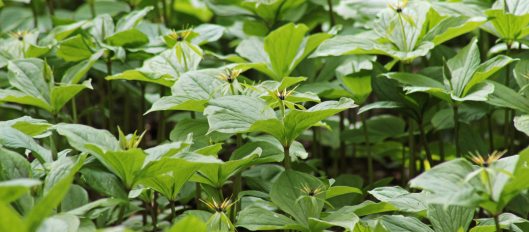
160505 Herb Paris

Then there are the misnomers. You might quite reasonably expect names beginning with Trifolium (tri = three, folio = leaf) to have three leaves, except that plants are often not true to their names: witness Trifolium repens, which can, if you’re lucky, be a four leaf clover! Or there’s Paris quadrifolia, the supposedly four-leaf Herb Paris (shown above), which can have from 5 to 8 leaves.

It’s enough to drive a volunteer to drink, so I’ll end with my favourite cocktail, Sambucus nigra. Cheers!

You can follow our progress with this project on Facebook and on Twitter. A website will follow soon.

Like Loading...

‘Dedicated Naturalist’: The Primrose

29 Friday Apr 2016

Posted by sconzani in 'Dedicated Naturalist' Project, flowers, nature

≈ 2 Comments

Tags

Dr Mary Gillham, primrose, wildflowers

A snippet from my volunteer work on the ‘Dedicated Naturalist’ Project, helping to decipher and digitise, record and publicise the life’s work of naturalist extraordinaire, Dr Mary Gillham.

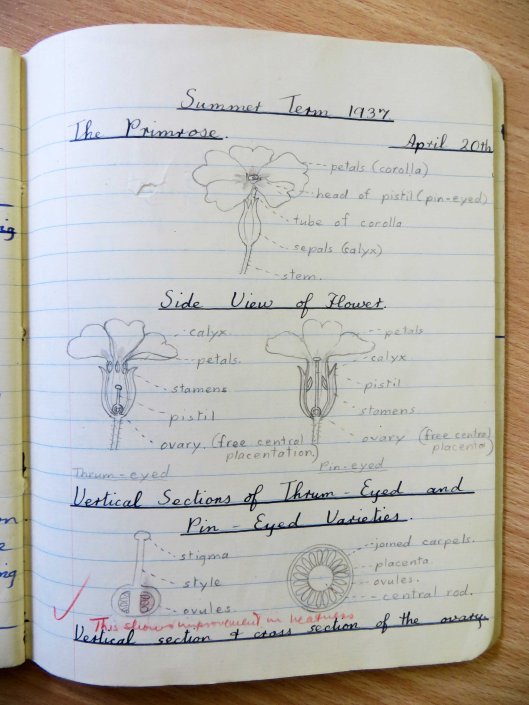
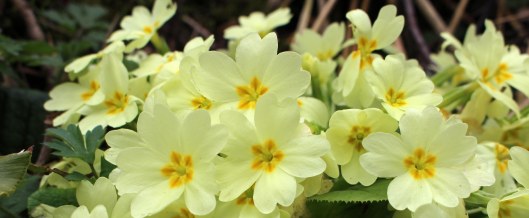
It’s almost 79 years to the day since fifteen-year-old Mary Gillham drew these very precise illustrations of the anatomy of a primrose. (Note the teacher’s comment: ‘This shows improvement in neatness’!)

160429 primrose (1)

She was in her final, fifth form year at Ealing Grammar School for Girls, and, as you can see from her work, she already had well-developed powers of observation and a fine drawing style. Though she was raised in the London suburb of Ealing, Mary’s love of the natural world began early,

looking at birds and flowers in the local parks and on family Saturdays in the country. I brought bits and pieces for the wild flower shelf in my Junior School and began collecting and pressing specimens of the commoner species. One such collection, classified not very scientifically under flower colour, was sent by the school to a museum in Russia, as an example of an eleven-year-old’s work. 

From small beginnings come great naturalists! 

You can follow our progress with this project on Facebook and on Twitter. A website will follow soon.

160429 primrose (2)

Like Loading...

‘Dedicated Naturalist’: Brown rats

14 Thursday Apr 2016

Posted by sconzani in 'Dedicated Naturalist' Project, animals, nature

≈ 4 Comments

Tags

brown rat, Cardiff, Dr Mary Gillham, Rattus norvegicus, volunteering

A snippet from my volunteer work on the ‘Dedicated Naturalist’ Project, helping to decipher and digitise, record and publicise the life’s work of naturalist extraordinaire, Dr Mary Gillham. 

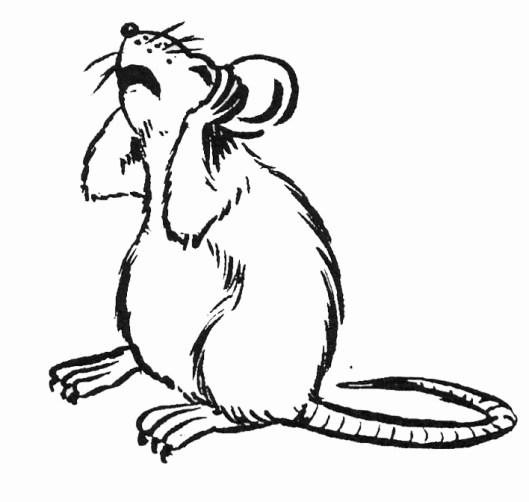
Love them or hate them, you have to admire Mary’s poetic description of the brown rats (Rattus norvegicus) she saw during a walk along the banks of the River Taff, between the Queen and Wood Street bridges in Cardiff city centre, on 27 October 1979.

Sleek brown rats obviously well fed can be viewed from a little riverside grandstand where the human scent above the expected level instigates only momentary peering of beady eyes and twitching of whiskers. Rats have acquired their inauspicious aura only by being carriers of human diseases and frequenters of human sewers. Whose fault? Ours or theirs? Viewed dispassionately here their weavings between the straight sturdy canes of Japanese knotweed resembles that of a jaguar in a primeval forest, their more intricate passage through tall cocksfoot like lions in elephant grass. There are pickings in plenty, both local and river-borne.

I have retraced Mary’s path along this river bank many times in 2016 and not seen any rats. Good thing or bad thing?

160414 brown rat

Mary Gillham was also a talented artist – this is one of her drawings

Like Loading...
Newer posts →

About me

sconzani

sconzani

I'm a writer and photographer; researcher and blogger; birder and nature lover; countryside rambler and city strider; volunteer and biodiversity recorder.

View Full Profile →

Follow earthstar on WordPress.com

Enter your email address to follow this blog and receive notifications of new posts by email.

Recent blog posts

  • Blackthorn in bloom January 11, 2026
  • Weevil: Mecinus pyraster January 10, 2026
  • Red in beak and claw January 9, 2026
  • Who’s watching who? January 8, 2026
  • Springtail: Orchesella cincta January 7, 2026

From the archives

COPYRIGHT

Unless otherwise acknowledged, the text and photographs on this blog are my own and are subject to international copyright. Nothing may be downloaded or copied without my permission.

Fellow Earth Stars!

  • Unknown's avatar
  • Unknown's avatar
  • Unknown's avatar
  • Unknown's avatar
  • Unknown's avatar
  • Unknown's avatar
  • Unknown's avatar
  • Unknown's avatar
  • Unknown's avatar
  • Unknown's avatar
  • Unknown's avatar
  • Unknown's avatar
  • Unknown's avatar
  • Unknown's avatar
  • Unknown's avatar
  • Unknown's avatar
  • Unknown's avatar
  • Unknown's avatar
  • Unknown's avatar
  • Unknown's avatar
  • Unknown's avatar
  • Unknown's avatar
  • Unknown's avatar
  • Unknown's avatar
  • Unknown's avatar
  • Unknown's avatar
  • Unknown's avatar
  • Unknown's avatar
  • Unknown's avatar
  • Unknown's avatar
  • Unknown's avatar
  • Unknown's avatar
  • Unknown's avatar
  • Unknown's avatar
  • Unknown's avatar
  • Unknown's avatar
  • Unknown's avatar
  • Unknown's avatar
  • Unknown's avatar
  • Unknown's avatar
  • Unknown's avatar
  • Unknown's avatar
  • Unknown's avatar
  • Unknown's avatar
  • Unknown's avatar
  • Unknown's avatar
  • Unknown's avatar
  • Unknown's avatar
  • Unknown's avatar
  • Unknown's avatar

Blog at WordPress.com.

Privacy & Cookies: This site uses cookies. By continuing to use this website, you agree to their use.
To find out more, including how to control cookies, see here: Cookie Policy
  • Subscribe Subscribed
    • earthstar
    • Join 669 other subscribers
    • Already have a WordPress.com account? Log in now.
    • earthstar
    • Subscribe Subscribed
    • Sign up
    • Log in
    • Report this content
    • View site in Reader
    • Manage subscriptions
    • Collapse this bar
 

Loading Comments...
 

You must be logged in to post a comment.

    %d