• ABOUT
  • BIRDING 2018
  • Birding 2019
  • BLOG POSTS
  • Butterflies 2018
  • Resources

earthstar

~ a celebration of nature

earthstar

Tag Archives: dragonfly

National Dragonfly Week: The Common Darter

25 Monday Jul 2016

Posted by sconzani in insects, nature

≈ 3 Comments

Tags

Common Darter, dragonflies, dragonfly, National Dragonfly Week 2016, Sympetrum striolatum

Did you know that the dragonfly is one of the fastest flying insects in the world? The Smithsonian says that, with a speed of 56 kms (35 miles) per hour, it is actually the fastest but other sources say the Horsefly is faster – no wonder I can never escape being bitten by those nasty but beautiful flies! Dragonflies also have amazing manoeuvrability, hovering like helicopters, dive-bombing their prey, and even flying backwards.
160725 (1) Common darter male

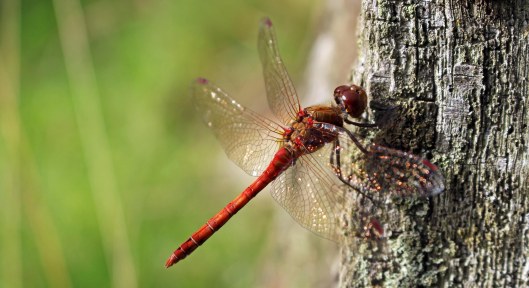
For day three of our celebration of dragon and damselflies, let me introduce you to one of these incredibly speedy dive-bombing hoverers, the Common Darter (Sympetrum striolatum). As their name suggests they are exceedingly common in England and Wales, though they shy away with the colder climes further north, and, yes, they do dart, particularly when pursuing insects to eat. They can appear quite similar to Ruddy Darters, but those dragonflies have a ‘waisted’ abdomen and black legs whereas the Commons have yellow-striped legs.

160725 (2) Common darter imm male

My photos are only of males – they are lighter in colour when immature – and show them in very typical positions, perched on logs, fences, twigs, wires and farm gates while they keep an eye out for passing insects. Though they need the water of ponds, canals, lakes, even ditches to lay their eggs in, they can often be seen away from water. They are not territorial so they do, apparently, assemble in quite large numbers, with ‘groups of several hundred in a single field’ having been recorded and ‘lines of insects … seen along the top of field gates’. Oh to see such a sight!

160725 (3) Common darter male
160725 (4) Common darter imm male
Like Loading...

National Dragonfly Week: Beautiful Demoiselle

23 Saturday Jul 2016

Posted by sconzani in insects, nature

≈ 6 Comments

Tags

Beautiful Demoiselle, British Dragonfly Society, Calopteryx Virgo, damselfly, dragonflies, dragonfly, National Dragonfly Week 2016

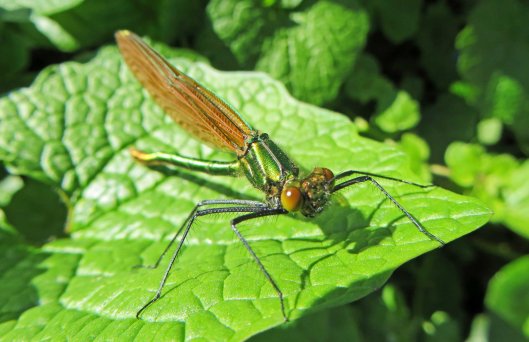
Back at the end of April I wrote about my first dragonfly sighting of the year – only it turned out to be a damselfly, not a dragonfly, and I blogged about my first lesson in telling the two families apart. That gorgeous creature was a female of the very aptly named Beautiful Demoiselle (Calopteryx Virgo) species. Since then I’ve been lucky enough to see many more Beautiful Demoiselles, including the equally handsome metallic blue-green male of the species. I’ve also seen many other types of damselflies and some, though not as many, dragonflies (the 4-spotted chaser featured in one blog, and the Broad-bodied chaser in another).

160723 damsel Beautiful Demoiselle female

You may not know it but today is the first day of National Dragonfly Week 2016, which this year runs from Saturday 23rd to Sunday 31st July. It’s the brainchild of the British Dragonfly Society, which exists to record dragonfly numbers and to educate people about dragonflies and their habitats in order to aid with their conservation. The society and other wildlife groups will be holding events throughout the week to raise awareness of damsel and dragonflies – you can see more on the BDS website – and I will be highlighting a different species each day this week as my own way of celebrating these heavenly creatures.

160723 damsel Beautiful Demoiselle male

Like Loading...

The B-B C, but not as you know it

26 Sunday Jun 2016

Posted by sconzani in insects, nature

≈ 6 Comments

Tags

Broad-bodied Chaser, dragonflies, dragonfly, dragonfly ovipositing, Libellula depressa, National Insect Week

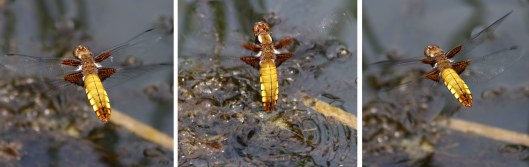
For this last day of National Insect Week 2016 we have one of my favourite types of insect, the dragonfly. Meet the Broad-bodied Chasers (or Libellula depressa to the scientifically minded). If we’re being politically correct, we won’t call them fat – they just happen to be a bit wider in the body than most other dragonflies. Both male and female start off a golden brown colour, but Mr B-B C soon develops a rather dapper layer of blue powdery granules (pruinescence) which matches perfectly with the yellow dots they both have along the sides of their abdomens.

160626 Broad-bodied chaser male

I’ve seen two pairs of Broad-bodied Chasers so far this year, both around small ponds which the males regularly patrol to ensure no intrusions into their territories. I’ve also been privileged to see them mating, a rather brief in-flight encounter, and then to see the female ovipositing – dipping her lower abdomen quickly into the water while in flight, to deposit her eggs into vegetation below the water level (as shown in the photos below). If you’re in southern England or Wales, these beauties will be around till September so go check out the show.

160626 Broad-bodied chaser female ovipositing

Like Loading...

A Four-spotted Chaser or two!

31 Tuesday May 2016

Posted by sconzani in nature, nature photography

≈ 8 Comments

Tags

dragonfly, Four-spotted Chaser, Four-spotted skimmer, Kenfig National Nature Reserve, Libellula quadrimaculata

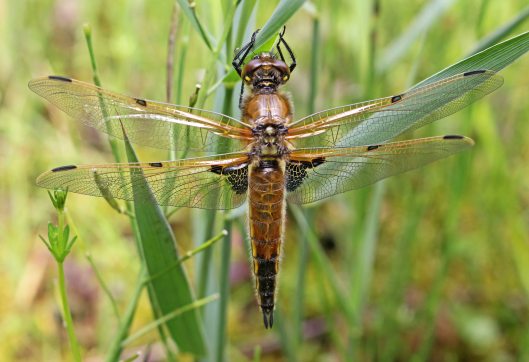
Last Saturday, at Kenfig National Nature Reserve, on a fungi foray with my friends from the Glamorgan Fungi Club, I saw my first dragonflies for the year, not one but two separate sightings of the Four-spotted Chaser (Libellula quadrimaculata), and what magnificent creatures they were!

160531 Four-spotted Chaser dragonfly (1)

Even if you don’t love dragonflies for the sheer beauty of their aeronautical design, which has remained unchanged for nigh on 300 million years (!), you’ve got to love them for the fact that the adults snack on mosquitoes, gnats and midges. Four-spotted chasers can usually be found from April to September around areas of standing water, typically ponds and small lakes, particularly those with lush vegetation. The males aggressively defend their territories, often favouring a prominent reed or stick near the water’s edge from which to launch their sorties against intruders and their foraging flights. Interesting fact: this dragonfly is the state insect of Alaska, where it’s known as the Four-spotted skimmer.

160531 Four-spotted Chaser dragonfly (2)

Like Loading...

Damsels or dragons?

30 Saturday Apr 2016

Posted by sconzani in insects, nature

≈ 4 Comments

Tags

Aeshna grandis, Beautiful Demoiselle, Brown Hawker, Calopteryx Virgo, damselfly, dragonfly

One of the best things about writing this blog is that I’m constantly learning new things. When this gorgeous creature flitted across my path in Bute Park on Wednesday, I thought ‘Ooooo, my first dragonfly of the year!’ Wrong! This is a damselfly, a female of the very aptly named species Beautiful Demoiselle (Calopteryx Virgo).

damselfly Beautiful Demoiselle female (2)

So, I asked myself, ‘how do I tell the difference between a dragonfly and a damselfly?’ It seems there are four basic differences that even I should be able to spot:
1) Body shape: dragonflies are bulkier, shorter and thicker, whereas damselflies are slender and delicate.
2) Eyes: a dragonfly’s eyes are much larger, wrapping around from the side to the front of the head, often touching. The eyes of the damselfly are also big, but tend to be more to the side of the head, with a definite gap between.

Damselfly Beautiful Demoiselle female

3) Wing shape: the hind wings of the dragonfly are larger than the fore wings and broaden at the base, but the damselfly’s wings are both the same size and shape, and narrow markedly where they connect to the body.
4) Wing position: when resting, the dragonfly always spreads its wings, whereas the damselfly rests with its wings together above its body.

dragonfly brown hawker female

Above is a photo of a female Brown Hawker dragonfly (Aeshna grandis), taken last year, so you can see the differences. And, hopefully, my rather early Beautiful Demoiselle will just be the first of many of these heavenly creatures.

Like Loading...
Newer posts →

About me

sconzani

sconzani

I'm a writer and photographer; researcher and blogger; birder and nature lover; countryside rambler and city strider; volunteer and biodiversity recorder.

View Full Profile →

Follow earthstar on WordPress.com

Enter your email address to follow this blog and receive notifications of new posts by email.

Recent blog posts

  • Cormorants, young and old March 12, 2026
  • Bay bunnies March 11, 2026
  • Beating the gloom March 10, 2026
  • No booming Bittern but … March 9, 2026
  • Danish scurvygrass March 8, 2026

From the archives

COPYRIGHT

Unless otherwise acknowledged, the text and photographs on this blog are my own and are subject to international copyright. Nothing may be downloaded or copied without my permission.

Fellow Earth Stars!

  • Unknown's avatar
  • Unknown's avatar
  • Unknown's avatar
  • Unknown's avatar
  • Unknown's avatar
  • Unknown's avatar
  • Unknown's avatar
  • Unknown's avatar
  • Unknown's avatar
  • Unknown's avatar
  • Unknown's avatar
  • Unknown's avatar
  • Unknown's avatar
  • Unknown's avatar
  • Unknown's avatar
  • Unknown's avatar
  • Unknown's avatar
  • Unknown's avatar
  • Unknown's avatar
  • Unknown's avatar
  • Unknown's avatar
  • Unknown's avatar
  • Unknown's avatar
  • Unknown's avatar
  • Unknown's avatar
  • Unknown's avatar
  • Unknown's avatar
  • Unknown's avatar
  • Unknown's avatar
  • Unknown's avatar
  • Unknown's avatar
  • Unknown's avatar
  • Unknown's avatar
  • Unknown's avatar
  • Unknown's avatar
  • Unknown's avatar
  • Unknown's avatar
  • Unknown's avatar
  • Unknown's avatar
  • Unknown's avatar
  • Unknown's avatar
  • Unknown's avatar
  • Unknown's avatar
  • Unknown's avatar
  • Unknown's avatar
  • Unknown's avatar
  • Unknown's avatar
  • Unknown's avatar
  • Unknown's avatar
  • Unknown's avatar

Blog at WordPress.com.

Privacy & Cookies: This site uses cookies. By continuing to use this website, you agree to their use.
To find out more, including how to control cookies, see here: Cookie Policy
  • Subscribe Subscribed
    • earthstar
    • Join 668 other subscribers
    • Already have a WordPress.com account? Log in now.
    • earthstar
    • Subscribe Subscribed
    • Sign up
    • Log in
    • Report this content
    • View site in Reader
    • Manage subscriptions
    • Collapse this bar
 

Loading Comments...
 

You must be logged in to post a comment.

    %d