• ABOUT
  • BIRDING 2018
  • Birding 2019
  • BLOG POSTS
  • Butterflies 2018
  • Resources

earthstar

~ a celebration of nature

earthstar

Tag Archives: Farne Islands

Kittiwakes

20 Friday Jul 2018

Posted by sconzani in birds, nature

≈ 2 Comments

Tags

birding, birds in Dunbar Harbour, birds on Farne Islands, birdwatching, British birds, Farne Islands, Kittiwake

I realised today, when looking through my folder of photos for prepping blogs, that I have a couple of birds from my trip to Northumberland back in May that I haven’t yet blogged about. So, let’s put that right.

180710 kittiwakes (1)
180710 kittiwakes (3)

180712 kittiwakes (2)

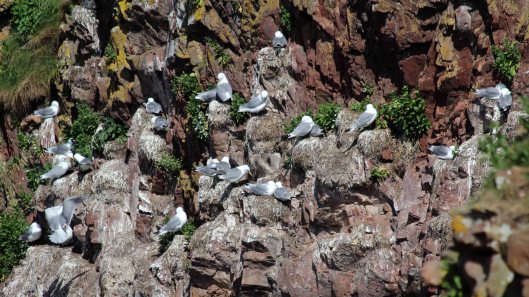
I actually saw – and heard – my first Kittiwakes in Scotland, in Dunbar, where the birds nest on cliffs right on the edge of the town’s harbour. It’s a precarious site but that doesn’t bother these noisy birds, who seem constantly to remind you of their name with their onomatopoeic call.
180712 kittiwakes (4)

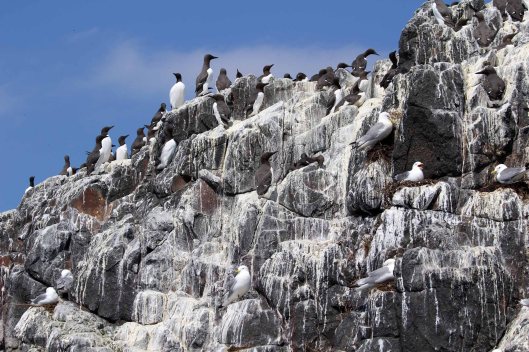
I next saw Kittiwakes when we sailed out to the Farne Islands. Once again, they were perched on impossibly small ledges of rock, sharing these spots on the tall craggy cliffs with Guillemots and Razorbills and Cormorants.

180712 kittiwakes (5)
180712 kittiwakes (6)

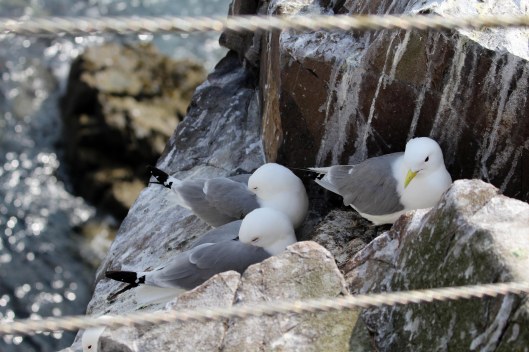
On the Farnes, I managed to get a much closer look at these beautiful gulls. Something about their face makes them look softer and more gentle than their Herring gull cousins – perhaps it’s their smaller, less savage-looking beak.
180712 kittiwakes (7)

Kittiwakes only come to the Farnes during the summer months to breed. Once their young are fledged, they’ll all head back to the Atlantic to spend the winter, dipping down into the deep waters for fish and shrimps to eat, then soaring high above the ocean waves.
Like Loading...

The elegant Eider

30 Wednesday May 2018

Posted by sconzani in birds, nature

≈ 1 Comment

Tags

birding, birdwatching, British birds, Eider, Eider duck, Farne Islands, nesting Eiders

I am now almost ashamed to admit that, as a child, I had an eiderdown on my bed, to keep me warm during the frosty Waikato nights. If you don’t recognise the name, an eiderdown is a quilt stuffed full with the breast down of the female Eider duck. It was certainly very warm and cosy but these days I couldn’t even contemplate owning such a thing, especially after enjoying my first Eider encounters recently in Northumberland.

180604 Eider (4)

I saw my first while enjoying a fish-and-chip-supper-by-sunset by the harbour in Seahouses, where Eiders were just metres away. That’s also where I first heard their fantastic call – so that’s where comedian Frankie Howerd got his inspiration! (Here’s a link to a youtube video – not mine – if you don’t know what I mean.)

180604 Eider (5)
180604 Eider (6)

180604 Eider (2)

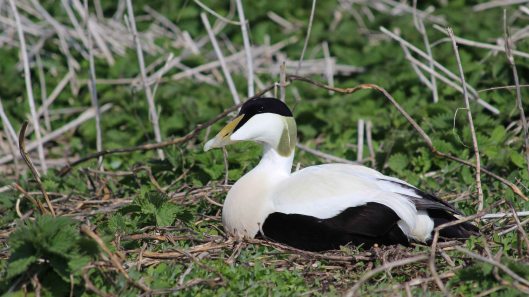
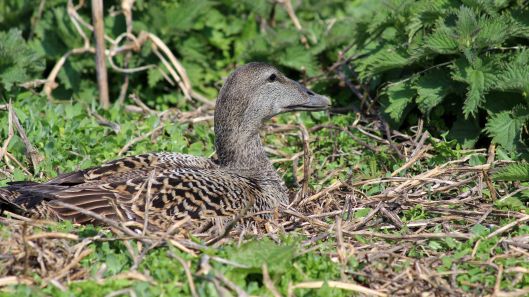
We also encountered Eiders during our trip to the Farne Islands, some so perfectly camouflaged / hidden amongst the vegetation that the local rangers had marked their nesting sites with sticks.

180604 Eider (3)

As usual in the bird world, the male birds are the most colourful, and look very handsome in their black, white (with a pink blush) and light green, but, personally, I prefer the delicate hues and intricate patterning of the females. They are both very elegant birds.
180604 Eider (1)

Like Loading...

Razorbills

24 Thursday May 2018

Posted by sconzani in birds, nature

≈ Leave a comment

Tags

Alca torda, birding, birdwatching, British birds, Farne Islands, Razorbill, seabirds

180524 Razorbills (1)

Though it’s darker in colour, the Razorbill (Alca torda) looks, at first glance, a lot like the Guillemot but then you notice that beak, the sharpness of which is how the bird got its name. It’s a fish eater, which is why its population has been steadily declining – there just aren’t the numbers of sprats, herrings and sandeels in the ocean any more to feed these beautiful creatures.

180524 Razorbills (2)

Like the Guillemot, the Razorbill only comes ashore to breed, which is how I got to see them close up, on my recent trip to the Farne Islands.

180524 Razorbills (3)

Razorbills partner for life – I wonder how long these two have been together?

180524 Razorbills (4)180524 Razorbills (5)

Like Loading...

Gorgeous Guillemots

21 Monday May 2018

Posted by sconzani in birds, nature

≈ 2 Comments

Tags

birding, birdwatching, Bridled form of Guillemot, British birds, dimorphism in Guillemot, Farne Islands, Guillemot

180521 Guillemot (10)

What gorgeous birds the Guillemots are! A delicious combination of crisp white and rich chocolate brown, a smile that beams contentment, a look of gentleness despite that fierce-looking beak….

180521 Guillemot (1)180521 Guillemot (4)

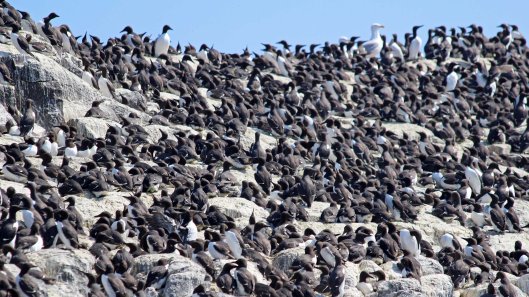
Guillemots spend most of their lives at sea, only moving on to land to breed, so May was the perfect time to see them on the Farne Islands, where they breed in their thousands each year. The densely packed breeding colonies are called loomeries.

180521 Guillemot (2)

180521 Guillemot (8)
180521 Guillemot (9)

Reciprocal grooming is part of their bonding process and was delightful to watch.

180521 Guillemot (3)

Some Guillemots have an additional white marking around their eyes, like the two you can see in this photo. These are officially known as the ‘bridled’ form, though they look like they’re wearing glasses to me. The bridling is, apparently, caused by a genetic mutation, and there seems to be a correlation with temperature – the bridled form is more common in cooler areas.

180521 Guillemot (5)

I’m not sure what was happening in the top of this photo: bouncing for joy? Jumping off the cliff? Coming in to land?

180521 Guillemot (7)
180521 Guillemot (6)

Sleepy in the sunshine. Just beautiful!

Like Loading...

Shags are surprising

19 Saturday May 2018

Posted by sconzani in birds, nature

≈ 6 Comments

Tags

birding, birdwatching, British birds, Farne Islands, Phalacrocorax aristotelis, Shag, Shag behaviour, Shag nesting

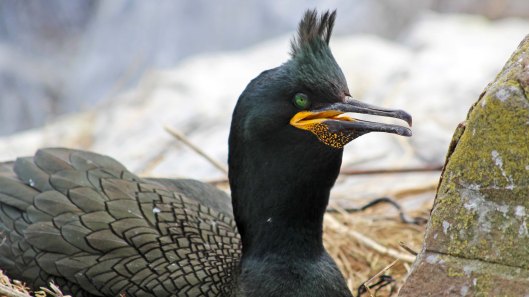
I always thought the Shag was all black, but I was wrong: its adult plumage is an intricate combination of vibrant metallic greens, browns and black, and it has beautiful patterning on its wings. As you can see, the Shag also has soulful green eyes, and, during the breeding season, the adult birds have a very punky crest on the tops of their heads, a combination which, obviously, makes them irresistible …. to other Shags.

180519 shag (1)
180519 shag (2)
180519 shag (3)
180519 shag (4)

Shags have a superb Latin name too, Phalacrocorax aristotelis, which is derived from Ancient Greek. Phalacrocorax is a combination of φαλακρός (phalakros) meaning bald and κόραξ (korax) meaning raven, and the epithet commemorates Aristotle. Did that Greek philosopher look like a bald raven, I wonder?

180519 shag (5)180519 shag (9)

Shags build their stick nests on rocks, sometimes on top of very high cliffs, and, on the Farne Islands, separated only by a rope barrier and monitored by a local ranger, we were able to get very very close to a couple of Shags that had chosen to nest right next to the path.

180519 shag (6)

One of the Shags was making odd motions with its head and puffing out its neck as if breathing heavily (I should’ve taken a video!). The ranger said this was to warn people off getting too close, and I’ve since found a paper that explains some aspects of the displays Shags make:

At the lowest intensity of stationary aggressiveness, the bird on the nest or nest-site points its bill at the object of aggression with gular pouch slightly distended, and at the same time makes slight lateral head-shakes without taking its eyes off the intruder.

180519 shag (8)

It was being close enough to observe such behaviour, as well as get a better look at the physical characteristics of the birds that made our visit to the Farnes so special for me.

180519 shag (7)

Like Loading...

I love Puffins!

15 Tuesday May 2018

Posted by sconzani in birds, nature

≈ 6 Comments

Tags

birding, birdwatching, British birds, Farne Islands, Puffin, Puffins guarding burrows, Puffins in the water, Puffins on cliff tops, Puffins on Farne Islands

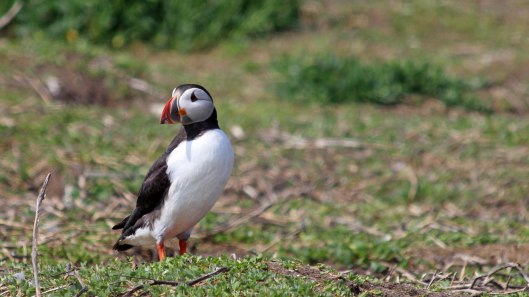
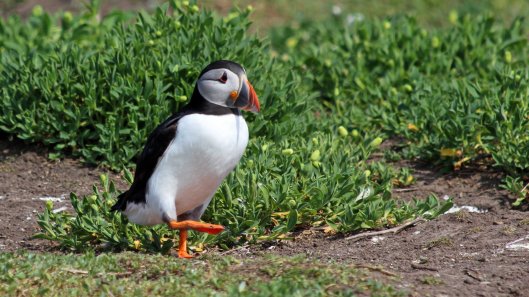
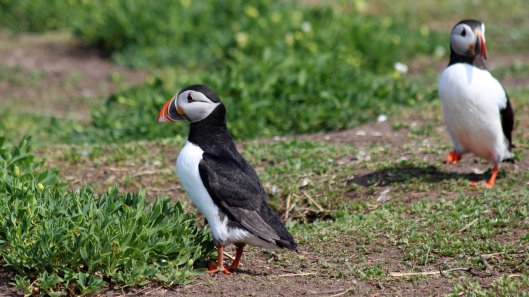
It’s taken me almost 62 years to see my first Puffins (yes, I am that old!) but they were worth the wait. What magnificent little characters they are!
First I saw them in the water, from the boat en route to the Farne Islands …

180515 puffins in the water (2)
180515 puffins in the water (1)

Next I saw them on the cliff tops, craning my neck and lens to look up from the boat …

180515 puffins on the cliff tops (1)180515 puffins on the cliff tops (2)

Then we were on the island, for a very brief 60 minutes that went by so very quickly, and I saw them marching around defending their burrows, trying ever so hard to look stern and menacing …

180515 puffins protecting their burrows (1)180515 puffins protecting their burrows (2)180515 puffins protecting their burrows (3)180515 puffins protecting their burrows (4)180515 puffins protecting their burrows (5)

I also saw them – well, one of them – trying very hard to impress the Puffin of his dreams, but she was having none of it …

180515 puffin trying to impress (1)180515 puffin trying to impress (2)180515 puffin trying to impress (3)

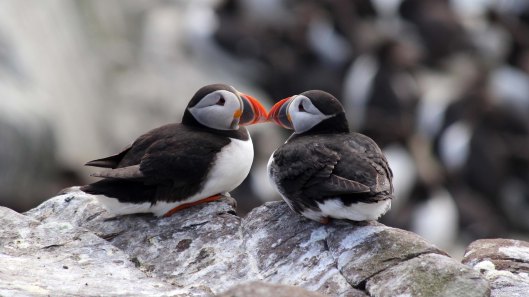
And, finally, I saw a couple in love. So very sweet!

180515 puffins in love

Like Loading...

About me

sconzani

sconzani

I'm a writer and photographer; researcher and blogger; birder and nature lover; countryside rambler and city strider; volunteer and biodiversity recorder.

View Full Profile →

Follow earthstar on WordPress.com

Enter your email address to follow this blog and receive notifications of new posts by email.

Recent blog posts

  • Blackthorn in bloom January 11, 2026
  • Weevil: Mecinus pyraster January 10, 2026
  • Red in beak and claw January 9, 2026
  • Who’s watching who? January 8, 2026
  • Springtail: Orchesella cincta January 7, 2026

From the archives

COPYRIGHT

Unless otherwise acknowledged, the text and photographs on this blog are my own and are subject to international copyright. Nothing may be downloaded or copied without my permission.

Fellow Earth Stars!

  • Unknown's avatar
  • Unknown's avatar
  • Unknown's avatar
  • Unknown's avatar
  • Unknown's avatar
  • Unknown's avatar
  • Unknown's avatar
  • Unknown's avatar
  • Unknown's avatar
  • Unknown's avatar
  • Unknown's avatar
  • Unknown's avatar
  • Unknown's avatar
  • Unknown's avatar
  • Unknown's avatar
  • Unknown's avatar
  • Unknown's avatar
  • Unknown's avatar
  • Unknown's avatar
  • Unknown's avatar
  • Unknown's avatar
  • Unknown's avatar
  • Unknown's avatar
  • Unknown's avatar
  • Unknown's avatar
  • Unknown's avatar
  • Unknown's avatar
  • Unknown's avatar
  • Unknown's avatar
  • Unknown's avatar
  • Unknown's avatar
  • Unknown's avatar
  • Unknown's avatar
  • Unknown's avatar
  • Unknown's avatar
  • Unknown's avatar
  • Unknown's avatar
  • Unknown's avatar
  • Unknown's avatar
  • Unknown's avatar
  • Unknown's avatar
  • Unknown's avatar
  • Unknown's avatar
  • Unknown's avatar
  • Unknown's avatar
  • Unknown's avatar
  • Unknown's avatar
  • Unknown's avatar
  • Unknown's avatar
  • Unknown's avatar

Blog at WordPress.com.

Privacy & Cookies: This site uses cookies. By continuing to use this website, you agree to their use.
To find out more, including how to control cookies, see here: Cookie Policy
  • Subscribe Subscribed
    • earthstar
    • Join 669 other subscribers
    • Already have a WordPress.com account? Log in now.
    • earthstar
    • Subscribe Subscribed
    • Sign up
    • Log in
    • Report this content
    • View site in Reader
    • Manage subscriptions
    • Collapse this bar
 

Loading Comments...
 

You must be logged in to post a comment.

    %d