Big picture, small picture
17 Saturday Feb 2018
27 Saturday Jan 2018
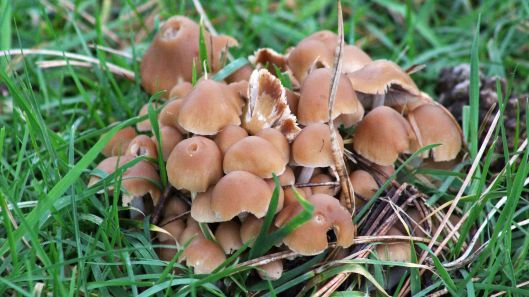
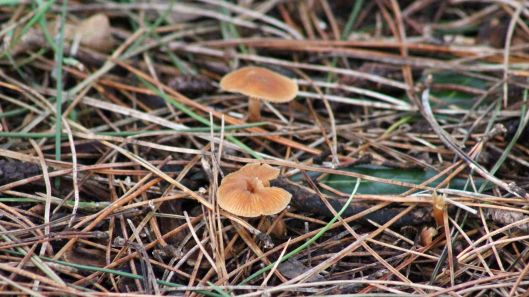
Though I have since learnt that this expression is also used by birders, ‘Little brown job’ is a term I first heard used in relation to fungi, the many and varied, brownish-hued conglomerations of fungi that have few distinguishing characteristics (unless you’re a whizz with a microscope) and so can often be notoriously difficult to identify. Here are some I’ve seen this week.


17 Friday Nov 2017
10 Friday Nov 2017
Look what I found hiding in the grass at Cathays Cemetery during a recent walk around: gorgeous fungal gems!


07 Saturday Oct 2017
Tags
bracket fungus, fungi, fungus, National Fungus Day, Trametes versicolor, Turkey tail, Turkeytail, UK Fungus Day
Sadly, I don’t see a lot of fungi in my local parks and nature reserves, and I’ve found this year that other events have clashed with the fungi forays organised by the Glamorgan Fungus Group so I haven’t been out with them much either. However, I have been taking photos of the fungi I do find and so, in honour of today being National Fungus Day here in Britain, I thought I’d share these photos of Turkeytail (Trametes versicolor).

Turkeytail is one of the most common bracket fungi and you can find it growing on dead logs and fallen trees in almost every forest and woodland but what I love about this fungus is its incredible variation. With colours ranging from beige, yellow and orange through to green, brown and even blue, each bracket is a work of art.
11 Monday Sep 2017
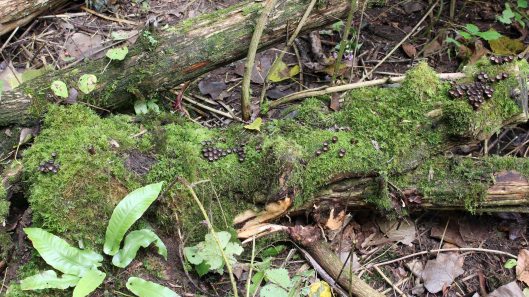
How lucky am I? In the short space of just two weeks, I’ve been privileged to see two different types of Bird’s-nest fungi (the post about the Common Bird’s-nests is here), both with eggs in their nests. This second lot are Fluted Bird’s-nest fungi (Cyathus striatus; Cyathus from the Greek kyath, meaning cup-shaped, and striatus to indicate the striated or ribbed sides).

Fungi expert Pat O’Reilly (on his First Nature website) likens the reproduction of these fungi to a game of Tiddlywinks: I wrote about their ‘eggs’ in my previous post but Pat’s description is much the better read, of course.
Although these fungi are probably common, both their preferred habitat (of rotting logs in shady woodlands) and their excellent camouflage make them difficult to spot so they are rarely seen. As you can probably imagine, I was very excited when told their location by a friend and then to see them for myself. Many photographs were taken!
08 Tuesday Aug 2017
I braved the rain showers and intermittent rumbles of thunder for a wander around Cefn Onn Park, in north Cardiff, last weekend. I hadn’t been there for quite a while and, after the recent rains, I had an inkling there might be some fungi around. I was right! There were actually rather a lot of crusty, brackety, slimy, smutty and generally mushroomy things to be found. (No, I’m not going to ID them – I just enjoyed seeing some fungi again.)
22 Monday Feb 2016
Posted in lichen, nature, nature photography
One way to get kids interested in lichen is to ask them to find the secret writing on woodland trees. The ‘writing’ is made by a lichen, Graphis scripta, which forms long narrow wiggledy black fruiting bodies (apothecia) on its pale smooth crust.

Not surprisingly, this lichen’s common names include script lichen, secret writing lichen, pencil-mark lichen, or hieroglyphics lichen. It is very common on smooth-barked deciduous trees, their twigs and branches, and can be found around the world – does the writing change its language depending on location, I wonder?

Lichens are very sensitive to air quality and, as they are able to accumulate and retain heavy metals, they are often used as a tool to monitor heavy metal pollutants in the atmosphere. Graphis scripta has been utilised in this way by scientists studying air pollution in the Indian city of Bangalore.

28 Thursday Jan 2016
Posted in fungi, nature, nature photography
In my recent post about the fungi King Alfred’s Cakes, I mentioned that one of its other common names is cramp balls. It seems, in times past, folk believed that if you carried around these little fungi you wouldn’t suffer from night cramps. No one seems to know why they believed this!

There is, however, another reason to carry cramp balls – they make good tinder. For this reason, cramp balls are also known as coal fungus and carbon balls, though they won’t light just by holding a match to them. The balls first need to be mature and very dry, and then it’s best to slice them in half and use something like a flint and steel to produce a spark. The cramp ball will smoulder, rather than produce a flame – for that you need something like straw or small twigs to start your fire.

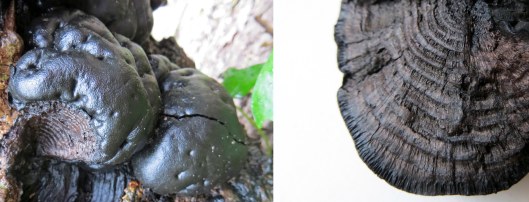
When you cut open the cramp ball, you will see concentric rings of grey and black inside (hence its scientific name Daldinia concentrica). These are similar to the growth rings inside a tree, though here they each represent a season of reproduction. Who would think that a small black lump of fungus could be so interesting?
23 Saturday Jan 2016
Posted in fungi, nature, nature photography
Do you know the story? Alfred became king of the West Saxons on the death of his brother Aethelred in April 871, at a time when the Vikings had conquered most of what is now England. Alfred retained his kingdom of Wessex by negotiating a peace treaty with the Vikings but, in 878, their King Gudrum attacked unexpectedly, forcing Alfred and his loyal supporters to flee into the Somerset levels. There, Alfred was sheltered by the local people while he planned how to regain his kingdom. The story goes that he was asked by the woman he was staying with to keep an eye on the cakes (small loaves of bread) she was baking while she did some chores. Alfred’s mind wandered off to his rather more important worries and he allowed the cakes to burn, much to his hostess’s annoyance.

The immature fungi are a wonderful rich brown colour
Whether or not it’s true, it’s a wonderful story and a very apt common name for Daldinia concentrica, a fungus that, when mature, looks very like a small round burnt cake. You’ll find it growing most often on hardwood trees, in particular beech and ash, throughout Britain and in many other countries. One of its other common names is cramp balls, but that’s a story for another day.

You must be logged in to post a comment.