• ABOUT
  • BIRDING 2018
  • Birding 2019
  • BLOG POSTS
  • Butterflies 2018
  • Resources

earthstar

~ a celebration of nature

earthstar

Tag Archives: fungi

Tales of Turkey tails

19 Tuesday Jan 2016

Posted by sconzani in fungi, nature, nature photography

≈ 2 Comments

Tags

fungi, fungus, Trametes versicolour, Turkey tail

The Turkey tail (Trametes versicolour) is surely the multi-storey condominium of the fungus world. This is one of a huge range of bracket fungi and, as the name suggests, bracket fungi resemble shelves or brackets growing from the sides of tree trunks, branches and logs in forests and woodlands (or condominiums, with large balconies, ranging down the sides of cliffs, if you have an imagination like mine).
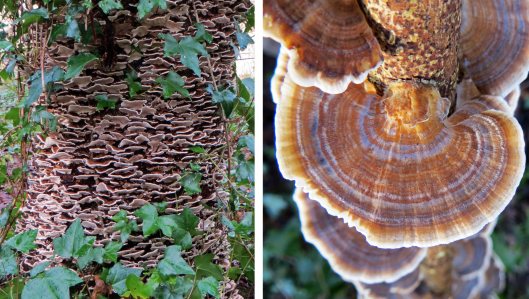
160119 Trametes versicolour Turkey Tail (1)

Turkey tail brackets range in size from 20 to 100mm wide and display concentric zones of colour in shades of beige, yellow, orange, brown and even blue. The common name of Turkey tail originated in North America, as these bands of colour apparently resemble the multi-hued tail of their wild turkey, and this is an extremely variable fungus so no two groupings have the same colour patterns (see slideshow below).

Not only lovely to look at, the Turkey tail is also useful medicinally. Asian people have long extolled the virtues of Turkey tail tea, and science has now proven that this fungus contains polysaccharides, derivatives of which have proven effective both in boosting the body’s immune systems in the fight against cancer and in the actual treatment of certain types of cancer.
This slideshow requires JavaScript.

Like Loading...

Split gill fungi

14 Thursday Jan 2016

Posted by sconzani in fungi, nature, nature photography

≈ Leave a comment

Tags

fungi, fungus, Schizophyllum commune, Split Gill

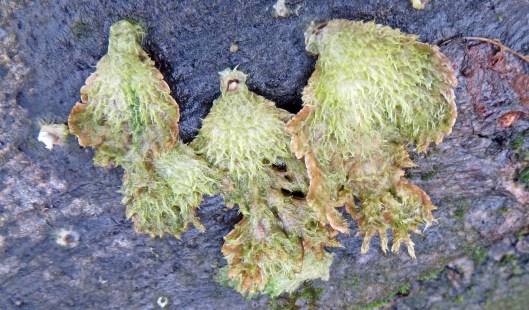
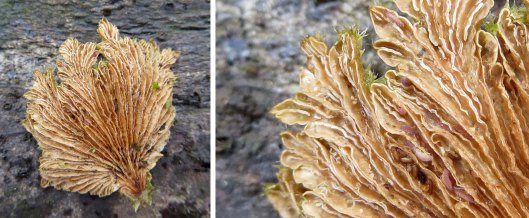
Ten days ago I was out on a fungi foray with friends when we came across this mysterious organism. Was it a lichen? Was it a fern? Was it some other kind of plant? Although we were searching for fungi, we had no idea this was one! Consultations with experts and two return visits later, I can confirm we had found the Split Gill fungus (also known as Schizophyllum commune), one of the most widely distributed mushrooms on earth. It can be found on every continent except Antarctica (no trees).

160114 Schizophyllum commune Split Gill (3)

Although its tough rubbery consistency looks totally unappetising, the Split Gill is a favourite food in many parts of the world, particularly in the tropics where the heat and humidity affect it less than more fleshy mushrooms. In the Congo it is eaten after much boiling and the addition of peanuts; in north-east India it’s a favourite ingredient in pancakes; and in Thailand, where the Split Gill is also valued for its medicinal properties, it’s used to make a hot spicy curry. If you do decide to cook up a feast, please be very careful as the Split Gill can cause disease in humans with immune deficiency issues.

160114 Schizophyllum commune Split Gill (2)

The underside, with a close up showing lots of tiny creatures amongst the gills

160114 Schizophyllum commune Split Gill

Like Loading...

The Jelly ear

07 Thursday Jan 2016

Posted by sconzani in fungi, nature, nature photography

≈ 1 Comment

Tags

fungi, fungus, Jelly ear

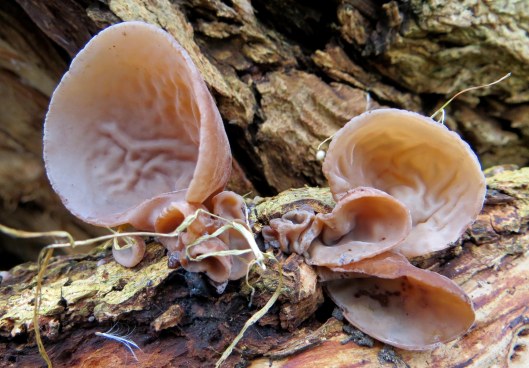
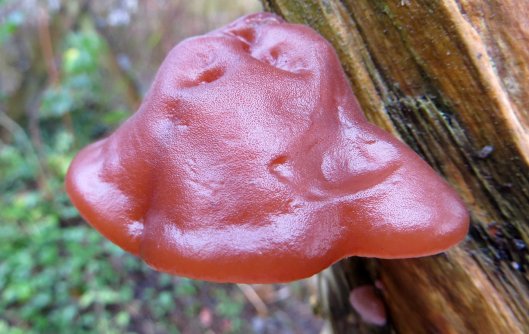
Who needs 3-D printers to produce replacement human body parts when you could use a fungus instead? Not exactly a practical solution to gaining a new ear I admit but, you have to agree, this fungus is definitely the right shape, if not the ideal colour or texture.

Auricularia auricula-judae Jelly Ear

The Jelly ear (Latin name Auricularia auricular-judae) can be rather gelatinous, hence its common name. It is a very common and easily recognisable fungus that grows on standing and fallen dead broadleaf trees, in parks and gardens and forest areas. It can reach up to 100mm across, though its shape becomes more contorted and undulating as it ages. In my native New Zealand, the Jelly ear was of considerable economic importance around the turn of the 20th century when large quantities were exported to China for food.

Auricularia auricula-judae Jelly Ear (1)

Jelly ears can often be found growing on the elder tree and it seems the fungus got its original common name of Judas’s Ear from the belief that Judas Iscariot hung himself from an elder tree. Over time, the epithet Judas’s Ear changed to Jew’s Ear, though in these days of political correctness, that epithet is rarely used.

160107 jelly ear (2)

Like Loading...

Elfcups and Fairies’ baths

04 Monday Jan 2016

Posted by sconzani in fungi, nature, nature photography

≈ 10 Comments

Tags

Elfcups, fungi, fungus, winter

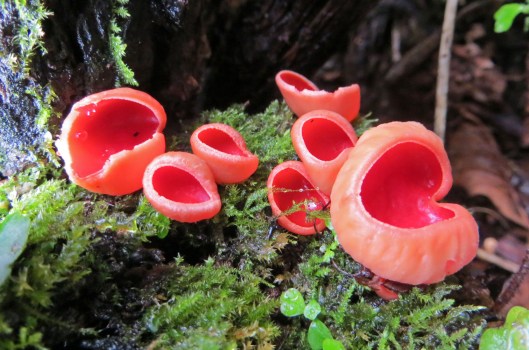
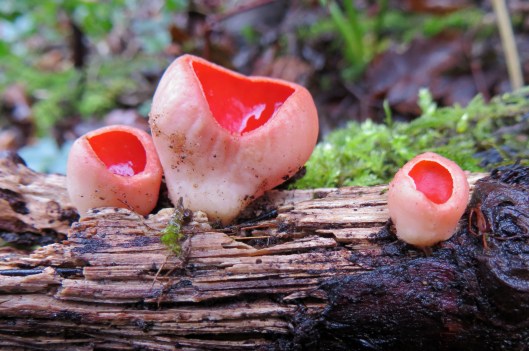
Just as the Scarlet waxcaps are the jewels of the autumn meadows so the Elfcups are the jewels of the wet winter woodlands. Though they’re tiny (no more than 7cm across) and frequently half buried in moss, their eye-catching bright red colour makes them easy to spot in the damp shady places where they live on dead wood, particularly beech, hazel, hawthorn, willow and elm.

160104 elfcups (3)

Two Elfcups can be found in Britain – the Scarlet Elfcup (Sarcoscypha austriaca) and the Ruby Elfcup (Sarcoscypha coccinea). They are so similar in outward appearance that a microscope is required to distinguish between them and, even then, it’s not easy. With a goblet-shaped cup and short stem when young, which flattens into a cup shape as they mature, it’s not difficult to see where they got the name Elfcup, nor their other common name of Fairies’ Baths.

160104 elfcups (1)

In fact, that ‘bath’ is where the spores can be found. These fungi don’t drop their spores from gills like regular mushrooms; instead, they fire spores from structures called asci, a bit like a cannon fires cannon balls and, apparently, they make a tiny puffing sound when that happens. So, listen closely next time you see them.

160104 elfcups (2)

Like Loading...

The waxcap of the meadows

01 Friday Jan 2016

Posted by sconzani in fungi, nature, nature photography

≈ Leave a comment

Tags

fungi, fungus, meadow waxcap, waxcap

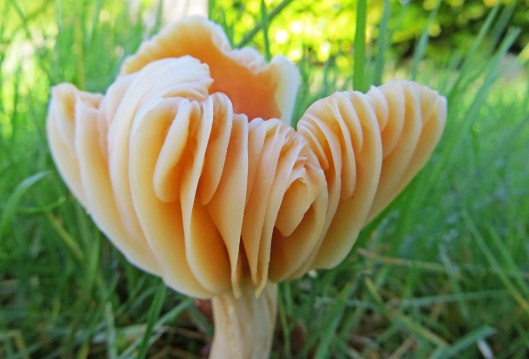
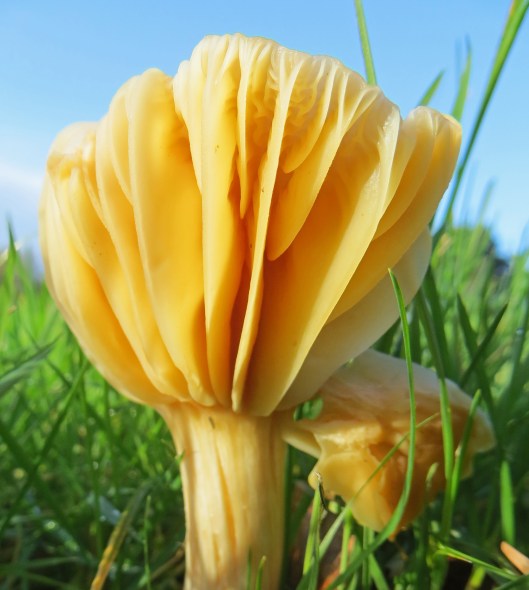
Though a very pretty and quite delicate shade of apricot, the Meadow waxcap is one of the less colourful waxcaps. Yet what it lacks in vibrancy it more than makes up for in the sculptural elegance of its shape, even more so as it ages. From a straight robust stem, its gills soar skywards, like a sharp-edged version of the fluting on a Greek temple column, and the edge of its cap undulates like the rolling of the ocean waves.

151231 meadow waxcap (2)

Hygrocybe (‘watery head’) pratensis (‘of meadows’) is one of the larger mushrooms in the waxcap family and is also more tolerant of fertilisers than most, so is a relatively common find in Britain and Europe on mown grassland and cropped pastures where the soil tends towards the acidic. It can also be found growing in woodland areas in northern Asia, in Australia and New Zealand, and in both South and North America – in the latter, it is more commonly known as the butter meadowcap or the salmon waxy cap.

151231 meadow waxcap (1)

Like Loading...

The sexual habits of lichen

28 Monday Dec 2015

Posted by sconzani in fungi, lichen, nature, nature photography

≈ Leave a comment

Tags

fungi, fungus, lichen

Lichen have two methods of reproduction: one is asexual – they simply expand to cover more of the surface on which they’re living; the other is sexual but, it’s not the actual lichen that is reproducing sexually, it’s the fungus the lichen is in a symbiotic relationship with.

151228 lichen sex pontcanna trees (1)

The saucer-shaped discs in my photos are apothecia, one of the two main types of sexual fruiting bodies of the fungi in the Ascomycota group, to which the majority of lichens belong. Spores (the correct term is propagules) are dispersed from these discs by air, water or attaching themselves to minibeasties, and must then meet up with an algal partner in order to form new lichen.

151228 lichen sex pontcanna trees (2)

The yellow- and orange-coloured lichen in these photographs are, I believe, Xanthoria parietina, which is very common on both tree bark and stonework throughout Britain, and has a particular liking for Elder trees and coastal rocks.

Like Loading...

The trooping of the funnels

26 Saturday Dec 2015

Posted by sconzani in fungi, nature, nature photography

≈ 2 Comments

Tags

fungi, fungus, Monk's Head, Trooping funnel

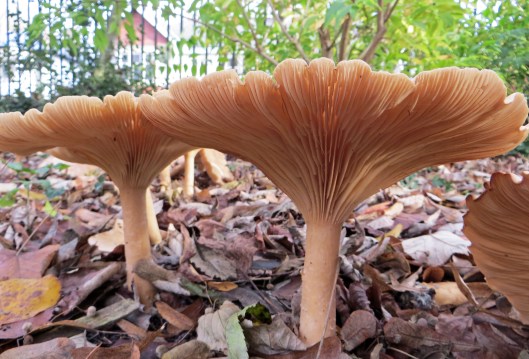
My photos of this most majestic of mushrooms were taken on 16 November, yet these fungi have only just disappeared, succumbing eventually to the almost constant rain we’ve had in the past month. But what a show they put on! Clumped together in twos or threes and standing up to eight inches tall, they trooped grandly across a garden bed at my local park in an arc that was at least five metres long, as if they were parading for royalty!

Clitocybe geotropa Trooping Funnel (2)

This is the aptly named Trooping funnel, until recently known by the scientific name Clitocybe geotropa – clitocybe means ‘sloping head’ and geotropa, in ancient Greek, means ‘towards the earth’ – but now reclassified Infundibulicybe geotropa. Such reclassifications are common in the fungi world now that their individual characteristics can be more accurately identified with the benefit of modern technology. This fungus also has other common names: Monk’s Head (I guess its soft leathery texture does look a bit like a shaven pate) and, in Scotland, the Rickstone Funnel-cap (its shape resembles a particular method of stacking corn, straw or hay).

Clitocybe geotropa Trooping Funnel (1)

The Trooping funnel is a common enough woodland fungus but is most famous for its impressive fairy rings. One such ring in France was recorded at more than half a mile wide and was believed to be 800 years old!

Clitocybe geotropa Trooping Funnel (5)

Like Loading...

The quintessential mushroom

20 Sunday Dec 2015

Posted by sconzani in fungi, nature, nature photography

≈ Leave a comment

Tags

autumn, autumn colour, Fly agaric, Fly amanita, fungi, fungus, Scarlet flycap

I was living in Auckland, New Zealand, when I first spotted one of these mushrooms and I admit to having had a ‘wow’ moment. It was like walking into a fairytale … I half expected fairies and elves to emerge and perform a magical dance amongst the leaf litter. This is, after all, the classic what-every-kid-would-draw-if-you-asked-them mushroom.

151220 Amanita muscaria fly agaric (1)

The Fly agaric (Amanita muscaria), also known as the Fly amanita and the Scarlet flycap, isn’t native to New Zealand but was unintentionally introduced there due to its rather intimate relationship with pine trees. Since its arrival, it has been quite wanton and, as it has now begun forming relationships with native trees, to the detriment of native fungi, it is considered a pest.

151220 Amanita muscaria fly agaric (2)

On the left, a young mushroom; on the right, an aging specimen

As the flesh of the Fly agaric contains psychoactive substances it has been used for centuries in religious and shamanistic rituals in Asia and parts of northern Europe. This fungus is, however, classified as poisonous, so forget the hallucinogenic adventure and feast with your eyes only!

Like Loading...

When is a parrot not a bird?

14 Monday Dec 2015

Posted by sconzani in autumn, fungi, nature, nature photography

≈ 2 Comments

Tags

autumn, cemetery, fungi, fungus, parrot toadstool, parrot waxcap, waxcap

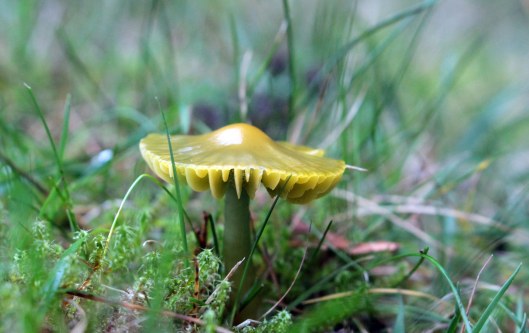
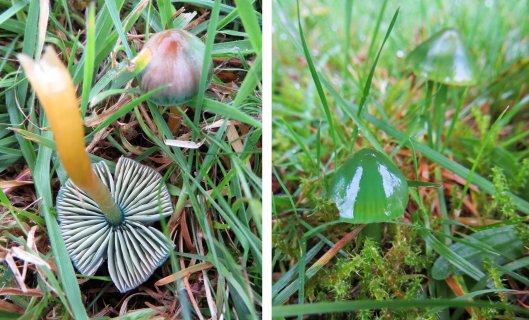
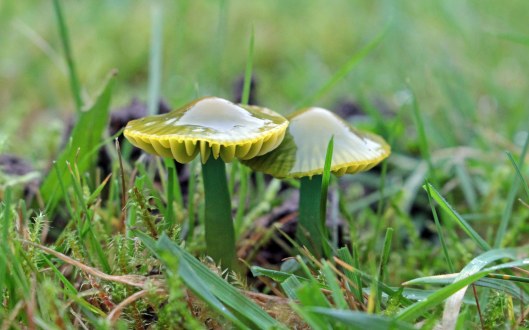
When it’s a waxcap, of course. Still none the wiser? Well, meet Gliophorus psittacinus (the fungus formerly known as Hygrocybe psittacina), the gorgeous little Parrot waxcap or toadstool.

151214 parrot waxcap (2)

Latin names are a bit of a mouthful but both gliophorus and hygrocybe (tissue carrying / watery head) refer to the tendency for all waxcaps to look and feel quite slimy. Psittacinus is Latin for parrot, and it’s easy to see where this little fungus gets that name – it’s just as colourful as any parrot you’ll ever see, ranging in colour from green, yellow and orange through to pink, purple and brown. Bright green seems to be its predominant hue when young, then the other colours are more easily seen as the green slime washes off its cap.

151214 parrot waxcap (3)

Like all waxcaps it can be found in summer and autumn in grassy areas that have received no artificial fertilisers for 30 years or more, so look for it on roadside verges, in cropped paddocks and in older cemeteries, often in mossy areas. In Britain, it’s more likely to be found in the western counties and in Wales, and it also grows in the cooler parts of mainland Europe and in parts of North America.

151214 parrot waxcap (1)

Like Loading...

Feeling sluggish

11 Friday Dec 2015

Posted by sconzani in fungi, nature, nature photography, slugs

≈ 2 Comments

Tags

cemetery, fungi, fungus, gastropod mollusc, Leopard slug, slug

Once the rain stopped this afternoon, I went out for a wander, looking to see if there were any new fungi after the dampness of recent days. What I found were shell-less terrestrial gastropod molluscs, big fat slippery slimy slugs that had at least partially devoured many of the tasty-to-them, newly sprouted mushrooms.

151211 slugs (2)

Isn’t it interesting that we use a lot of ‘slug’ idioms and expressions in the English language? If we are fighting, we are also slugging it out. If we’re working hard at a task, we’re slugging away at it. If we’re having a shot of alcohol, we’re having a slug of the drink. Well, today I saw many literal illustrations of the word sluggish: all those terrestrial gastropod molluscs, like the Leopard slug (Limax maximus) in my photos, were looking decidedly sluggish as they sleepily digested the hefty portions of fungi they’d consumed for their lunch.

151211 slugs (1)

In case you’re a gardener and think I should have killed this creature, this slug is actually one of the good guys. It won’t damage healthy living plants, preferring fungi, rotting plants and even other slugs, and it recycles nutrients, helping to fertilise the soil.

151211 slugs (3)

Like Loading...
← Older posts
Newer posts →

About me

sconzani

sconzani

I'm a writer and photographer; researcher and blogger; birder and nature lover; countryside rambler and city strider; volunteer and biodiversity recorder.

View Full Profile →

Follow earthstar on WordPress.com

Enter your email address to follow this blog and receive notifications of new posts by email.

Recent blog posts

  • O is for Odonata December 20, 2025
  • N is for nest December 19, 2025
  • M is for mite December 18, 2025
  • L is for lepidopteran lifers December 17, 2025
  • K is for Keeled skimmers December 16, 2025

From the archives

COPYRIGHT

Unless otherwise acknowledged, the text and photographs on this blog are my own and are subject to international copyright. Nothing may be downloaded or copied without my permission.

Fellow Earth Stars!

  • Unknown's avatar
  • Unknown's avatar
  • Unknown's avatar
  • Unknown's avatar
  • Unknown's avatar
  • Unknown's avatar
  • Unknown's avatar
  • Unknown's avatar
  • Unknown's avatar
  • Unknown's avatar
  • Unknown's avatar
  • Unknown's avatar
  • Unknown's avatar
  • Unknown's avatar
  • Unknown's avatar
  • Unknown's avatar
  • Unknown's avatar
  • Unknown's avatar
  • Unknown's avatar
  • Unknown's avatar
  • Unknown's avatar
  • Unknown's avatar
  • Unknown's avatar
  • Unknown's avatar
  • Unknown's avatar
  • Unknown's avatar
  • Unknown's avatar
  • Unknown's avatar
  • Unknown's avatar
  • Unknown's avatar
  • Unknown's avatar
  • Unknown's avatar
  • Unknown's avatar
  • Unknown's avatar
  • Unknown's avatar
  • Unknown's avatar
  • Unknown's avatar
  • Unknown's avatar
  • Unknown's avatar
  • Unknown's avatar
  • Unknown's avatar
  • Unknown's avatar
  • Unknown's avatar
  • Unknown's avatar
  • Unknown's avatar
  • Unknown's avatar
  • Unknown's avatar
  • Unknown's avatar
  • Unknown's avatar
  • Unknown's avatar

Blog at WordPress.com.

Privacy & Cookies: This site uses cookies. By continuing to use this website, you agree to their use.
To find out more, including how to control cookies, see here: Cookie Policy
  • Subscribe Subscribed
    • earthstar
    • Join 667 other subscribers
    • Already have a WordPress.com account? Log in now.
    • earthstar
    • Subscribe Subscribed
    • Sign up
    • Log in
    • Report this content
    • View site in Reader
    • Manage subscriptions
    • Collapse this bar
 

Loading Comments...
 

You must be logged in to post a comment.

    %d