• ABOUT
  • BIRDING 2018
  • Birding 2019
  • BLOG POSTS
  • Butterflies 2018
  • Resources

earthstar

~ a celebration of nature

earthstar

Tag Archives: fungus

Spore prints

29 Sunday Jan 2017

Posted by sconzani in fungi, nature

≈ 3 Comments

Tags

fungus, mushroom, spore print, spores, ways to identify fungi

One of the things that helps identify types of fungi is their spore colour so, though I try to avoid collecting fungi – preferring instead to leave them for everyone to enjoy, for the fungi themselves to release their spores and thus multiply, and for insects to feast upon – I do occasionally collect a specimen to bring home to spore print. For the uninitiated, this is usually a simple matter of turning the mushroom upside down on a white or coloured piece of paper (or a glass slide, if you’re also planning microscopic examination), covering it with something like a glass jar, and waiting several hours. (If your fungus is not mushroom-shaped, the process can vary but let’s keep it simple today.)

170129-spore-print-cortinarius-cinnamomeus
170129-spore-print-tricholoma-fulvum

The reward after those several hours have elapsed is not only discovering what spore colour your mushroom has produced but also, if you’re lucky, getting the added benefit of a very pretty spore print. Spores are like tiny spots of dust so can easily be disturbed by the slightest waft of air but it is possible to preserve your print by spraying it with a very light sealant. I’m still experimenting with this process – I’ve tried hairspray but the spray droplets contained too much moisture which ruined the print. If you’ve ever tried this and have some ideas to share, please do add a comment below, and PLEASE DO NOT go out and pick every mushroom you see just to try this. Fungi are not like blackberries or apples, they need to be left where they are to send out their spores!

170129-spore-print-lepista-sordida
170129-spore-print-boletus-impolitus
Like Loading...

Fungi Friday: The Cobalt crust challenge

27 Friday Jan 2017

Posted by sconzani in fungi, nature

≈ 14 Comments

Tags

Cobalt crust, crust fungus, fungus, Glamorgan Fungus Group, Terana caerulea

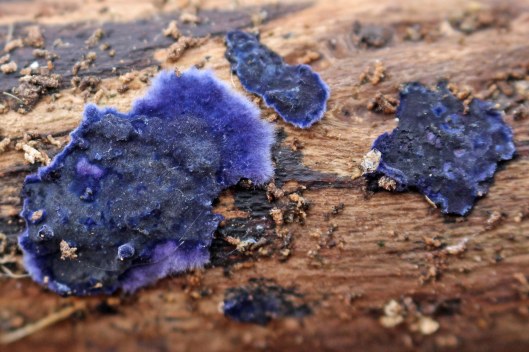
My fellow Glamorgan Fungus Group members and I are taking part in another challenge this month, hunting far and wide within the county to see how many specimens we can find of the supposedly rare Cobalt crust fungus (Terana caerulea). You may remember that I blogged about this special, once-seen-never-forgotten fungus back in February. It’s generally classified as rare but, here in Glamorgan, it most certainly isn’t.

170127-cobalt-crust-terana-caerulea-1

Here are the latest stats: for the 14 days from 13 to 26 January inclusive, 14 of our group had made a total of 45 separate finds on 16 different host plants, ranging from elder, bramble and buddleja to hazel, oak, ivy and even Japanese knotweed. Our results just go to show that this fungus is not actually rare but rather rarely recorded, and our participation in challenges like these also highlights the benefits of ordinary folk like you and I making the effort to record the biodiversity we see around us every day. We’re helping to rewrite science!

170127-cobalt-crust-terana-caerulea-2

Like Loading...

Pick-up sticks

17 Tuesday Jan 2017

Posted by sconzani in fungi, nature, winter

≈ 8 Comments

Tags

Bleeding broadleaf crust, crust fungus, fungus, picking up sticks, Stereum rugosum, weeping crust fungus

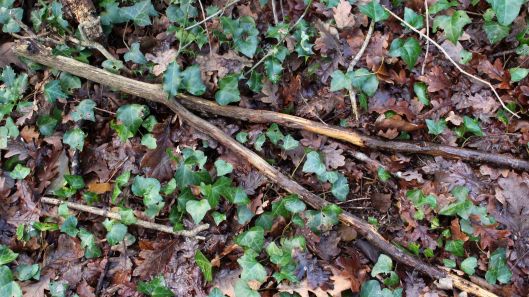
Did you play pick-up sticks as a child? Do you still play it, perhaps with your own children or your grandies? Well, I play pick-up sticks quite often too, but not quite the way you might imagine. You see I pick up sticks sometimes to find out what’s scurrying around underneath them or, especially at this rather moist time of year, to see what might be growing on them.

170117-bleeding-broadleaf-crust-1

You might’ve looked at this first stick lying on the ground in my local woodland and thought, ‘Nah! Nothing on that’ but you would’ve been wrong …

170117-bleeding-broadleaf-crust-2

… because if you had looked closer …

170117-bleeding-broadleaf-crust-3

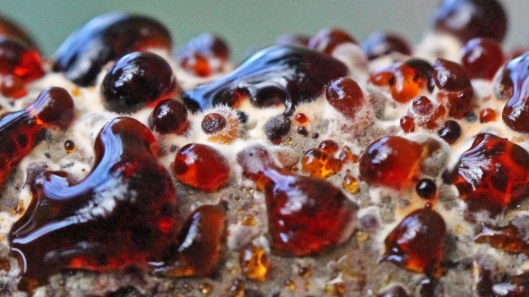
… a little bit closer, you would’ve seen this! Isn’t it gorgeous? This oozing mass of loveliness is a fungus, the Bleeding broadleaf crust fungus (Stereum rugosum) to be precise.

170117-bleeding-broadleaf-crust-4

I admit that I can sometimes spend an hour or more, bending down and examining stick after stick and finding nothing but, when I discover little gems like this, they make the effort totally worthwhile. So, next time you go to the woods, try playing a little game of pick-up sticks. You might get a pleasant surprise! (Oh, and take tissues or wet wipes, as you’ll almost certainly get a bit dirty, as well.)

Like Loading...

Fungi Friday: Disco lights

13 Friday Jan 2017

Posted by sconzani in fungi, nature

≈ 7 Comments

Tags

ascomycete, Bisporella citrina, fungus, Lachnum virgineum, Lemon disco, Snowy disco

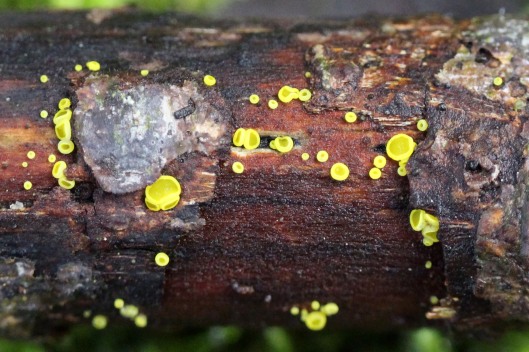
There are 22 species of fungi called disco, according to the British Mycological Society’s list of English Names for Fungi 2016, and they have some delightful names, mostly referring to what they grow on, I think: Larch, Conifer, Larch canker, Rush, Heath sedge, Mast, Juniper, Fir and, my personal favourite, Hairy Nuts Disco!

170113 Bisporella citrina Lemon Disco.jpg

So far I’ve only found two. My excuse is that they’re tiny, only a few millimetres across, so they’re difficult to spot, and many are quite rare. This first one is probably Lemon Disco (Bisporella citrina), and is actually one of the more common discos. It’s a wood-rotter that can be found growing – often in the thousands – on decaying deciduous trees, particularly oak.

170113-lachnum-virgineum-snowy-disco-1
170113-lachnum-virgineum-snowy-disco-2

This second fungus may be Snowy disco (Lachnum virgineum) – like so many fungi, it requires microscopic examination for a definite ID, and I haven’t reached that level in my mycological evolution … yet! Snowy disco also grows on dead and decaying wood, and is said to be frequent, though I’ve only found it once in 18 months of foraying.
Like Loading...

Fungi Friday: Velvet shanks

06 Friday Jan 2017

Posted by sconzani in fungi, nature

≈ 9 Comments

Tags

#FungiFriday, Enoki mushroom, Enokitake, Flammulina velutipes, fungus, Velvet shank

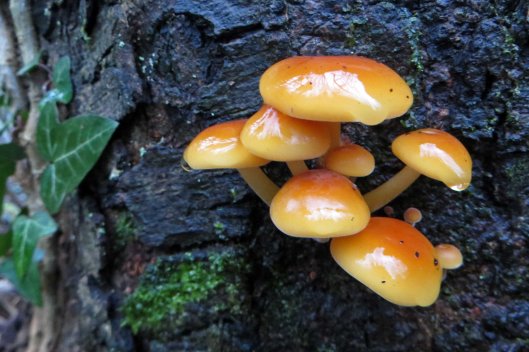
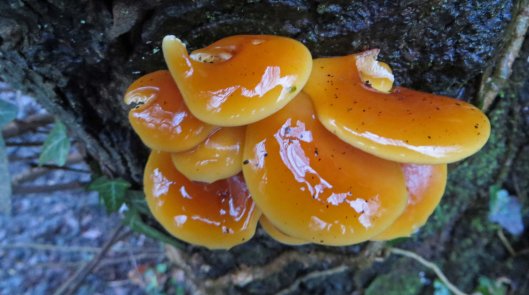
Starting as I mean to continue, I braved the chill wind and annoying drizzle on New Year’s Day for a walk around one of my local parks and was rewarded with the sight of these lovely fungi Flammulina velutipes, otherwise known as Velvet shanks (due to their velvety lower stems).

170106-flammulina-velutipes-velvet-shank1

They’re wood rotters, and it might surprise you to know that these are exactly the same fungi as the white Enoki (or Enokitake), much favoured by the Japanese and occasionally available in supermarkets in Britain and other countries. As they’re commercially grown in a dark environment Enoki are longer, smaller and very pale but the natural colour of the Velvet shank is the vibrant golden orange shown in my photos (flammulina means little flame).

170106-flammulina-velutipes-velvet-shank2

Like Loading...

Scarlet elfcups

03 Tuesday Jan 2017

Posted by sconzani in fungi, nature

≈ 5 Comments

Tags

British fungi, Elfcups, fungus, Ruby elfcup, Sarcoscypha austriaca, Sarcoscypha coccinea, Scarlet elfcup

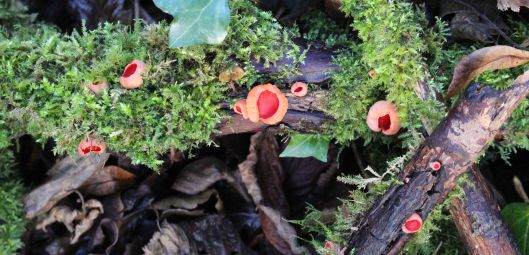
It’s elfcup fruiting time! There’s a spot in one of my local woodlands where these vibrant Scarlet elfcups (Sarcoscypha austriaca) grow in profusion so I made sure to head that way on yesterday’s wander, and I was not disappointed. In their hundreds, these little beauties are pushing up through the dense moss that covers the rotting branches and logs on the forest floor.

170103-scarlet-elfcup-1

I blogged about these gorgeous fungi last year and noted then that there are two species of red elfcups, the Scarlet (Sarcoscypha austriaca) and the Ruby (Sarcoscypha coccinea). They can only be differentiated, one from the other, through microscopic examination, but I know that the elfcups in my favoured spot are the Scarlet variety as a friend very kindly checked them for me. My mission now is to find the Ruby.

170103 Scarlet Elfcup (2)
170103 Scarlet Elfcup (3)
170103 Scarlet Elfcup (4)
170103 Scarlet Elfcup (5)
Like Loading...

Once was a tree

30 Sunday Oct 2016

Posted by sconzani in fungi, nature, trees

≈ 8 Comments

Tags

Brittlestem, Burgundydrop bonnet, fungus, Hairy curtain crust, honey fungus, Oysterling, Porcelain Fungus, slime mould, Trichia varia, Turkeytail

It’s always sad to see a mighty old tree fall, no more to see its bare branches flush with green in early spring or hear the blackbird singing in the evening dusk from its high branches.

161030-once-a-tree-1

This huge old tree came down one wild and stormy night last winter and was soon sawn into manageable, though still huge logs by council staff. Fortunately, those logs were not removed, but merely hauled off the woodland path so, though the tree is dead, its wood is now home to an amazing display of fungi.

161030-once-a-tree-2
161030-once-a-tree-3
161030-once-a-tree-4

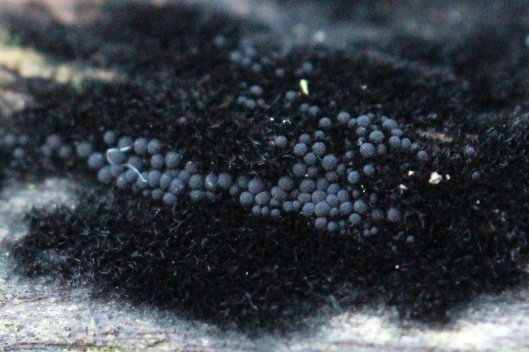
I suspect fungi may have contributed to its demise as there is an enormous amount of wood-rotting Honey fungus spouting forth around its roots. It’s a little difficult to separate out this tree and its branches from the surrounding small trees and old stumps but the whole small area is now awash with fungal growth, including Burgundydrop bonnet, Hairy curtain crust and Turkeytail, the Porcelain fungus that I blogged about recently, a species of Oysterling and another of Brittlestem, as well as at least one slime mould, Trichia varia. The poor old tree lives on by providing nutrients to all these other living organisms.

161030-once-a-tree-5
161030-once-a-tree-6
161030-once-a-tree-7
161030-once-a-tree-8
161030-once-a-tree-9
161030-once-a-tree-10
161030-once-a-tree-11
161030-once-a-tree-12
Like Loading...

The fungus that looks like porcelain

10 Monday Oct 2016

Posted by sconzani in autumn, fungi, nature, parks, trees

≈ 8 Comments

Tags

beech trees, fungus, Heath Park, Oudemansiella mucida, Porcelain Fungus, strobilurins

I saw my very first Oudemansiella mucida, the Porcelain Fungus, last Friday, during a wander around Cardiff’s Heath Park and knew at once what it was. Such immediacy of identification does not happen often in the world of the fungi fanciers so this was a rare and much-valued moment. But this is one fungus that is easy to recognise.

161010-porcelain-fungus-1

Firstly, it lives exclusively on beech, and I have been keeping a close watch on a huge old beech tree that came down in a big storm last winter, which, much to their credit, was sawn into huge chunks and left at the woodland edge by Cardiff Council staff. The beech is now providing a home to many small creatures, not just to fungi. Secondly, it is a clean, almost translucent white, like my granny’s tea cups used to be, and its caps are frequently covered in a thin layer of slime (hence the second part of their scientific name: mucida refers to this transparent mucus). That’s not as revolting as it sounds – the shiny surface makes these little beauties shimmer in the sunshine.

161010-porcelain-fungus-2
161010-porcelain-fungus-3

Interestingly, this fungus produces chemicals called strobilurins, which have anti-fungal properties. The Porcelain Fungus uses them to inhibit and even attack opposition fungi in order to protect its territory but scientists have refined these same chemicals to produce anti-fungal agents that can protect crops from fungal attacks. Like so many fungi, the Porcelain fungus is beautiful and utile.

161010-porcelain-fungus-4
161010-porcelain-fungus-5
Like Loading...

UK Fungus Day 2016

09 Sunday Oct 2016

Posted by sconzani in fungi, nature

≈ 5 Comments

Tags

#UKFD16, #UKFungusDay, fungus, Glamorgan Fungus Group, Parasol mushroom, Parc Slip Nature Reserve, UK Fungus Day

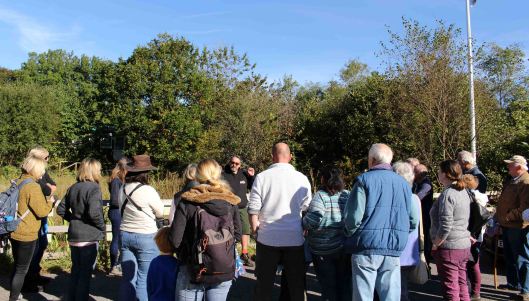
The sun shone and the people came, full of interest and enthusiasm … but where were the fungi? It had been a dry week and, as Parc Slip Nature Reserve sits on top of an old coal spoil tip, the ground doesn’t retain moisture well, so the fungi were nowhere to be found.

161009-uk-fungus-day-3

Luckily, Glamorgan Fungus Group president Mike Bright is a man of forethought and ingenuity. When he checked the site of the walk yesterday and found it virtually barren, he spent the rest of the day – six whole hours! – scouring other locations for fungi specimens and, thanks to his super-human efforts, today’s walk was a huge success. Mike led us on a wander in the woods and combined that with a ‘show and tell’ of what he’d found the previous day, and everyone was mightily impressed. I reckon he must take the prize for the best organiser for UK Fungus Day 2016, and for finding the biggest parasol mushroom!

161009-uk-fungus-day-1
161009-uk-fungus-day-2
161009-uk-fungus-day-4
161009-uk-fungus-day-5
161009-uk-fungus-day-6
161009-uk-fungus-day-7
161009-uk-fungus-day-8
161009-uk-fungus-day-9
161009-uk-fungus-day-10
Like Loading...

Fun with fungi

08 Saturday Oct 2016

Posted by sconzani in fungi, nature

≈ 2 Comments

Tags

#UKFungusDay, fungus, UK Fungus Day

Here in Britain tomorrow, Sunday 9 October, is UK Fungus Day. I’ll be joining my friends from the Glamorgan Fungus Group at the Wildlife Trust’s Parc Slip Nature Reserve for fungi fun and forays, and I hope you can all get out and enjoy some fungi spotting this Fungus Day. Check out the website for all the events that are happening throughout Britain.

161008-coprinopsis-atramentaria-common-inkcap

‘Fungi are tremendously important to human society and the planet we live on. They provide fundamental products including foods, medicines, and enzymes important to industry. They are also the unsung heroes of nearly all terrestrial ecosystems, hidden from view but inseparable from the processes that sustain life on the planet.’ ~ Kew Royal Botanic Gardens website

Like Loading...
← Older posts
Newer posts →

About me

sconzani

sconzani

I'm a writer and photographer; researcher and blogger; birder and nature lover; countryside rambler and city strider; volunteer and biodiversity recorder.

View Full Profile →

Follow earthstar on WordPress.com

Enter your email address to follow this blog and receive notifications of new posts by email.

Recent blog posts

  • City Hall Peregrine January 12, 2026
  • Blackthorn in bloom January 11, 2026
  • Weevil: Mecinus pyraster January 10, 2026
  • Red in beak and claw January 9, 2026
  • Who’s watching who? January 8, 2026

From the archives

COPYRIGHT

Unless otherwise acknowledged, the text and photographs on this blog are my own and are subject to international copyright. Nothing may be downloaded or copied without my permission.

Fellow Earth Stars!

  • Unknown's avatar
  • Unknown's avatar
  • Unknown's avatar
  • Unknown's avatar
  • Unknown's avatar
  • Unknown's avatar
  • Unknown's avatar
  • Unknown's avatar
  • Unknown's avatar
  • Unknown's avatar
  • Unknown's avatar
  • Unknown's avatar
  • Unknown's avatar
  • Unknown's avatar
  • Unknown's avatar
  • Unknown's avatar
  • Unknown's avatar
  • Unknown's avatar
  • Unknown's avatar
  • Unknown's avatar
  • Unknown's avatar
  • Unknown's avatar
  • Unknown's avatar
  • Unknown's avatar
  • Unknown's avatar
  • Unknown's avatar
  • Unknown's avatar
  • Unknown's avatar
  • Unknown's avatar
  • Unknown's avatar
  • Unknown's avatar
  • Unknown's avatar
  • Unknown's avatar
  • Unknown's avatar
  • Unknown's avatar
  • Unknown's avatar
  • Unknown's avatar
  • Unknown's avatar
  • Unknown's avatar
  • Unknown's avatar
  • Unknown's avatar
  • Unknown's avatar
  • Unknown's avatar
  • Unknown's avatar
  • Unknown's avatar
  • Unknown's avatar
  • Unknown's avatar
  • Unknown's avatar
  • Unknown's avatar
  • Unknown's avatar

Blog at WordPress.com.

Privacy & Cookies: This site uses cookies. By continuing to use this website, you agree to their use.
To find out more, including how to control cookies, see here: Cookie Policy
  • Subscribe Subscribed
    • earthstar
    • Join 669 other subscribers
    • Already have a WordPress.com account? Log in now.
    • earthstar
    • Subscribe Subscribed
    • Sign up
    • Log in
    • Report this content
    • View site in Reader
    • Manage subscriptions
    • Collapse this bar
 

Loading Comments...
 

You must be logged in to post a comment.

    %d