
• ABOUT
  • BIRDING 2018
  • Birding 2019
  • BLOG POSTS
  • Butterflies 2018
  • Resources

earthstar

~ a celebration of nature

earthstar

Tag Archives: Helophilus pendulus

170/366 Misc hoverflies

18 Thursday Jun 2020

Posted by sconzani in insects, nature

≈ 4 Comments

Tags

British hoverflies, Cheilosia illustrata, Chrysotoxum bicinctum, Episyrphus balteatus, Eupeodes corollae, Helophilus pendulus, hoverfly, Sphaerophoria scripta, Volucella pellucens, Xanthogramma pedissequum, Xylota species

Hoverflies seem particularly numerous this year … or maybe it’s just that I’ve been keeping more of an eye out for them. Here are some of the species I’ve clocked in the past couple of weeks. Looking through my photos again now, I’m struck by how diverse these lovely creatures are.

OLYMPUS DIGITAL CAMERA

Volucella bombylans: One of the bumblebee-mimicking hoverflies. This one was snoozing on a cool day, which is how I managed to get a nice close shot.

200618 chrysotoxum bicinctum

Chrysotoxum bicinctum: Its distinctive yellow bars make this hoverfly reasonably easy to identify.

OLYMPUS DIGITAL CAMERA

Episyrphus balteatus: Also known as the Marmalade hoverfly. Despite its small size, this species is known some years to migrate en masse to Britain from continental Europe.
OLYMPUS DIGITAL CAMERA

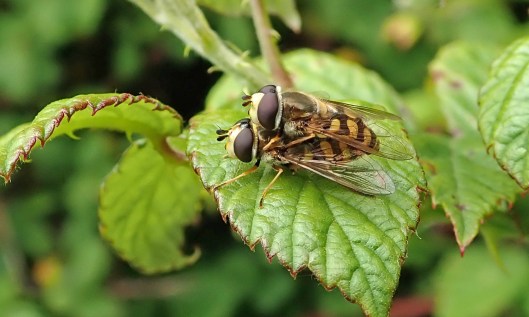
Eupeodes corollae: These two were otherwise occupied, which allowed me to get quite close to them.

OLYMPUS DIGITAL CAMERA

Helophilus pendulus: The ‘footballer’, because of the striped ‘footballers’ kit’ markings on its abdomen.

OLYMPUS DIGITAL CAMERA

Sphaerophoria scripta: Apparently, the yellow colouration is influenced by the temperature at which the larvae develop, so Spring-born individuals can be darker than those hatching later in the year.

OLYMPUS DIGITAL CAMERA

Volucella pellucens: One of Britain’s larger hoverflies; also known as the Great Pied hoverfly and the Pellucid fly.
200618 xanthogramma pedissequum

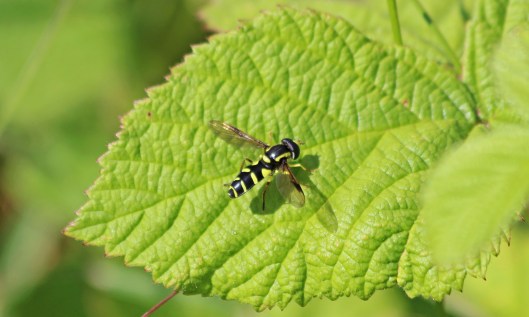
Xanthogramma pedissequum: This used to be easy to identify from its distinctive markings but, in 2012, the very similar Xanthogramma stackelbergi was added to the British list so now the thoracic markings need to be carefully checked to ensure the correct identification.

OLYMPUS DIGITAL CAMERA

Xylota species: I didn’t get good enough photos of this one to be able to work out whether this was X. segnis or X. sylvarum – you need very clear views of its hind tibia to work out which is which.


Like Loading...

269/365 Still hovering

26 Thursday Sep 2019

Posted by sconzani in 365DaysWildin2019, autumn, insects, nature

≈ 2 Comments

Tags

British hoverflies, Cosmeston Lakes Country Park, Eristalis nemorum, Eristalis species, Helophilus pendulus, hoverfly, Syrphus species

Despite the wind and rain of recent days, which continued through part of today, when the sun came out at Cosmeston there were still a few hoverflies about. I’ve forgotten everything I ever knew about hoverflies, which wasn’t much, but I think these are Syrphus sp. (these usually need microscopic examination to identify to species), Eristalis sp. (my photo doesn’t show enough details to be sure which species this is – maybe E. tenax), Eristalis nemorum, and ‘The footballer’, Helophilus pendulus.

190926 hoverflies (1) 

190926 hoverflies (2)
190926 hoverflies (3)

190926 hoverflies (4)

Like Loading...

152/365 Hovering

01 Saturday Jun 2019

Posted by sconzani in 365DaysWildin2019, insects, nature

≈ 4 Comments

Tags

#365DaysWild, British hoverflies, Chrysotoxum bicinctum, Episyrphus balteatus, Helophilus pendulus, hoverfly, Volucella bombylans, Volucella bombylans subsp. plumata, Xanthogramma pedissequum

I found a new path today, which led me through swathes of long grass bordered by brambles and low shrubby bushes. I emerged with wet shoes and trousers from the dew still coating the grass but with lots of photos of hoverflies, so I will definitely be going back to explore further. Here are the hovers …

190601 1 volucella bombylans
190601 2 volucella bombylans subsp plumata

Volucella bombylans and Volucella bombylans subsp. plumata
At first glance you might think these two hoverflies were bumblebees, and that’s exactly what they want you to think – or, rather, what they want bumblebees to think, because they don’t want to be caught out when sneaking in to lay their eggs in the nests of the bumblebees they mimic (which are the Red-tailed bumblebee Bombus lapidarius and the White-tailed bumblebee Bombus lucorum respectively).

190601 3 helophilus pendulus
190601 4 chrysotoxum bicinctum

Helophilus pendulus and Chrysotoxum bicinctum
Do you see why the hoverfly on the left is known as The Footballer? I’m not sure which football team his colourful markings are meant to represent – perhaps Helophilus pendulus has its own team. Its distinctive bands of bright yellow make Chrysotoxum bicinctum one of the easier hoverflies to identify.

190601 5 Xanthogramma pedissequum
190601 6 episyrphus balteatus

Xanthogramma pedissequum and Episyrphus balteatus
Xanthogramma pedissequum is another hoverfly with reasonably easy to identify markings – believe me, not all hoverflies are so easy! And with its rich orange colouring, Episyrphus balteatus looks almost edible, which is probably why it’s called the Marmalade hoverfly.

Like Loading...

Hoverflies: handsome and harmless

31 Thursday Mar 2016

Posted by sconzani in insects, nature, nature photography

≈ 3 Comments

Tags

Eristalis pertinax, Helophilus pendulus, hoverfly, Platycheirus albimanus, Tapered Drone Fly, The Footballer, The Sunfly, White-footed Hoverfly, Wood anemone

How is it that I am only just discovering hoverflies? Of course, I’ve seen them before, hovering silently over the garden bed and feeding on flower nectar, like the humming birds of the insect world, but I wasn’t aware of all their good qualities. For one thing, they’re clever – they mimic wasps and bees to deter predators, but they don’t sting. For another, because they feed on nectar and pollen, they’re excellent pollinators. And, for a third, many types of hoverfly larvae eat aphids and other plant-suckers so they’re every gardener’s friend and can potentially be used for biological control of those hugely damaging pests.

What I also discovered last weekend was that hoverflies love wood anemones and I found three species feasting on the beautiful drifts of plants currently flowering in my local cemetery. These are they – and I’m sure this is just the start of a beautiful new fascination!

Eristalis pertinax

Meet Eristalis pertinax, otherwise know as the Tapered Drone Fly. It’s a common sight throughout Britain, from March right through to November, and loves hedgerows and woodland trails.

Helophilus pendulus

As it’s a lover of fine sunny days, Helophilus pendulus is commonly known as The Sunfly, though some call it The Footballer because its stripy thorax resembles a team strip. Personally, I prefer its scientific name, which means ‘dangling marsh-lover’, a reference to its liking for watery places.

Platycheirus albimanus

And last and smallest for today is Platycheirus albimanus, the White-footed Hoverfly (though only the swelling on the front foot of the male is, in fact, pale). It’s another to be found throughout Britain, in gardens and hedgerows, from March to November.

Like Loading...

About me

sconzani

sconzani

I'm a writer and photographer; researcher and blogger; birder and nature lover; countryside rambler and city strider; volunteer and biodiversity recorder.

View Full Profile →

Follow earthstar on WordPress.com

Enter your email address to follow this blog and receive notifications of new posts by email.

Recent blog posts

  • N is for nest December 19, 2025
  • M is for mite December 18, 2025
  • L is for lepidopteran lifers December 17, 2025
  • K is for Keeled skimmers December 16, 2025
  • J is for Jersey tiger December 15, 2025

From the archives

COPYRIGHT

Unless otherwise acknowledged, the text and photographs on this blog are my own and are subject to international copyright. Nothing may be downloaded or copied without my permission.

Fellow Earth Stars!

  • Unknown's avatar
  • Unknown's avatar
  • Unknown's avatar
  • Unknown's avatar
  • Unknown's avatar
  • Unknown's avatar
  • Unknown's avatar
  • Unknown's avatar
  • Unknown's avatar
  • Unknown's avatar
  • Unknown's avatar
  • Unknown's avatar
  • Unknown's avatar
  • Unknown's avatar
  • Unknown's avatar
  • Unknown's avatar
  • Unknown's avatar
  • Unknown's avatar
  • Unknown's avatar
  • Unknown's avatar
  • Unknown's avatar
  • Unknown's avatar
  • Unknown's avatar
  • Unknown's avatar
  • Unknown's avatar
  • Unknown's avatar
  • Unknown's avatar
  • Unknown's avatar
  • Unknown's avatar
  • Unknown's avatar
  • Unknown's avatar
  • Unknown's avatar
  • Unknown's avatar
  • Unknown's avatar
  • Unknown's avatar
  • Unknown's avatar
  • Unknown's avatar
  • Unknown's avatar
  • Unknown's avatar
  • Unknown's avatar
  • Unknown's avatar
  • Unknown's avatar
  • Unknown's avatar
  • Unknown's avatar
  • Unknown's avatar
  • Unknown's avatar
  • Unknown's avatar
  • Unknown's avatar
  • Unknown's avatar
  • Unknown's avatar

Blog at WordPress.com.

Privacy & Cookies: This site uses cookies. By continuing to use this website, you agree to their use.
To find out more, including how to control cookies, see here: Cookie Policy
  • Subscribe Subscribed
    • earthstar
    • Join 667 other subscribers
    • Already have a WordPress.com account? Log in now.
    • earthstar
    • Subscribe Subscribed
    • Sign up
    • Log in
    • Report this content
    • View site in Reader
    • Manage subscriptions
    • Collapse this bar
 

Loading Comments...
 

You must be logged in to post a comment.

    %d