• ABOUT
  • BIRDING 2018
  • Birding 2019
  • BLOG POSTS
  • Butterflies 2018
  • Resources

earthstar

~ a celebration of nature

earthstar

Tag Archives: Merodon equestris

Five big hovers

12 Thursday Jun 2025

Posted by sconzani in insects

≈ Leave a comment

Tags

British hoverflies, Chrysotoxum cautum, hoverfly, large hoverflies, Merodon equestris, Volucella bombylans, Volucella inflata, Volucella pellucens

I’ve come to the conclusion, rightly or wrongly, that large hoverflies are like buses: you don’t see any at all and then they all come along at once. At least that has been my recent experience (it’s probably more to do with the weather and the time of year, but I like my buses theory). The five big beasties shown here were all seen over just four days, between 29 May and 1 June.

With its black-and-yellow striping, it’s easy to see that Chrysotoxum cautum is one of the wasp-mimicking hoverflies. The eight British species of Chrysotoxum all have quite long antennae, and it is the relative lengths of the segments of those antennae that are used to differentiate between the five most similar species.

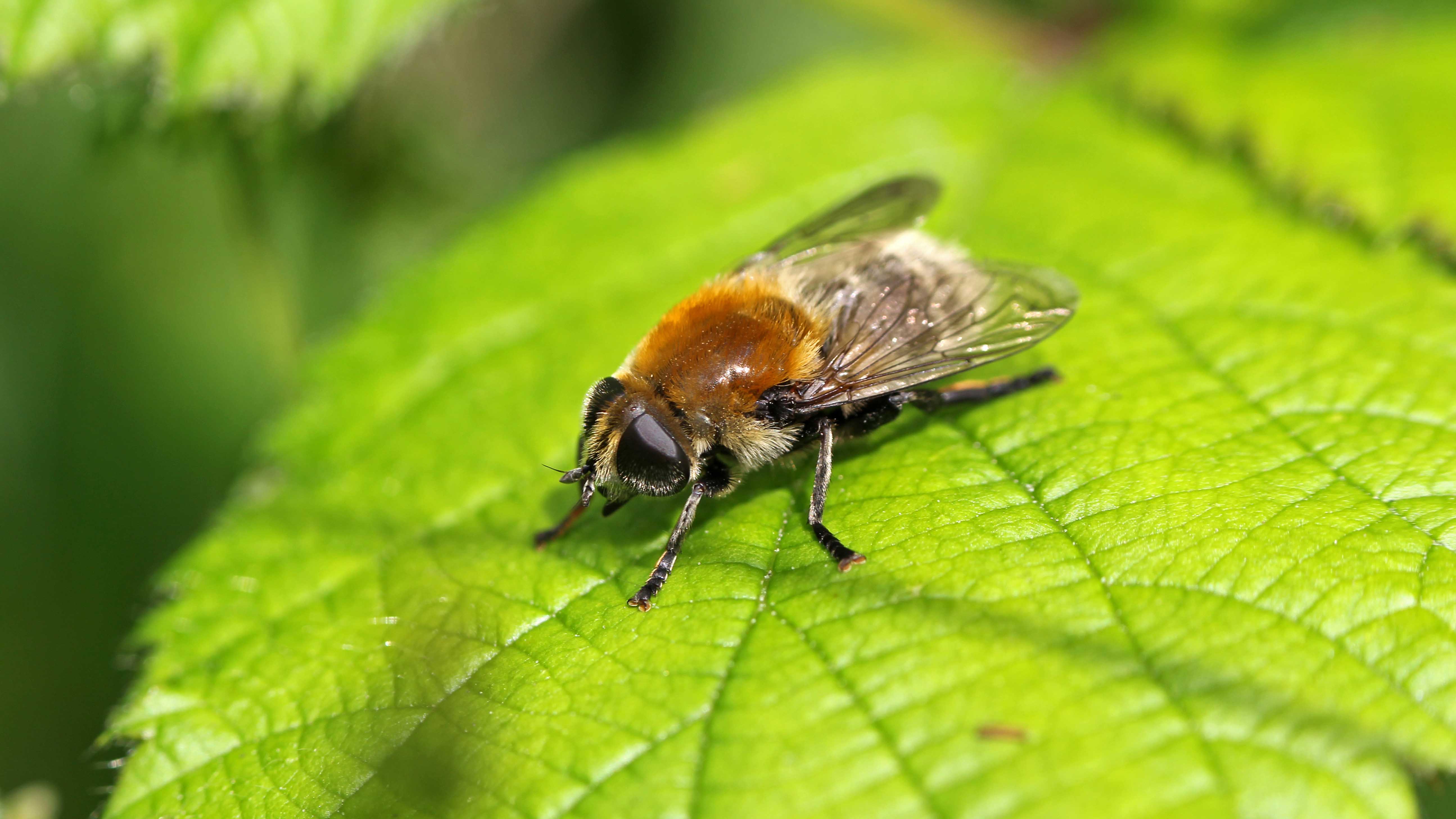
Merodon equestris comes in a variety of colour forms, each of which mimics bumblebees. The one pictured above is a rather worn specimen of form validus, which has a totally dark thorax and a grey-buff coloured bottom.
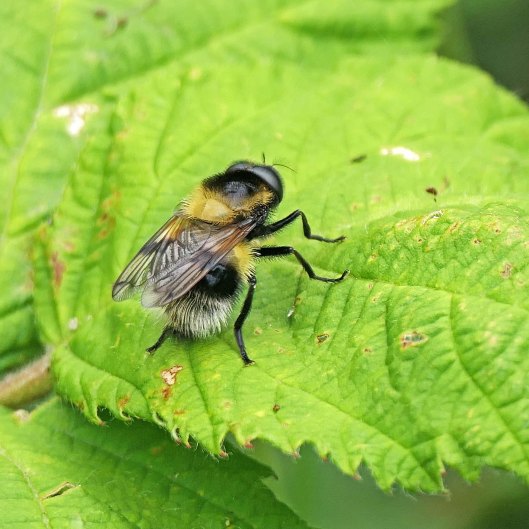
These final three are all members of the Volucellini, of which there are five British species. Like Merodon equestris, Volucella bombylans is a bumblebee mimic; which bumblebee it is attempting to mimic depends on which of the colour variations you see. This yellow-and-black form mimics Bombus lucorum, the White-tailed bumblebee, but there is also a mostly black, orange-bottomed variation of Volucella bombylans that mimics Bombus lapidarius, the Red-tailed bumblebee.
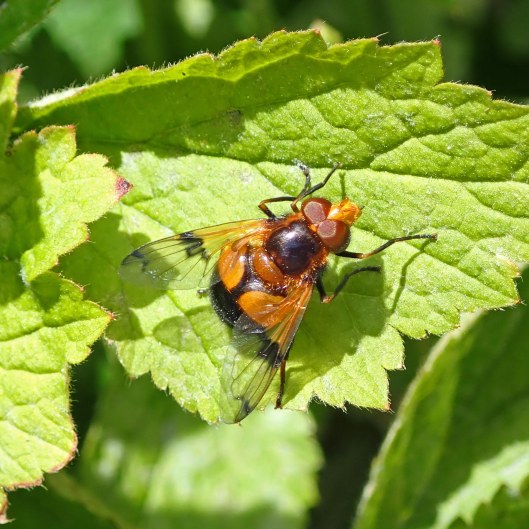
I was particularly pleased to see Volucella inflata as I’ve only found it once before. With its vivid and very distinctive markings, its round body, and protruding yellow snout, it’s a stunning hoverfly to encounter. Sadly for those of you in northern Britain, it’s mostly found in the southern counties and south Wales.
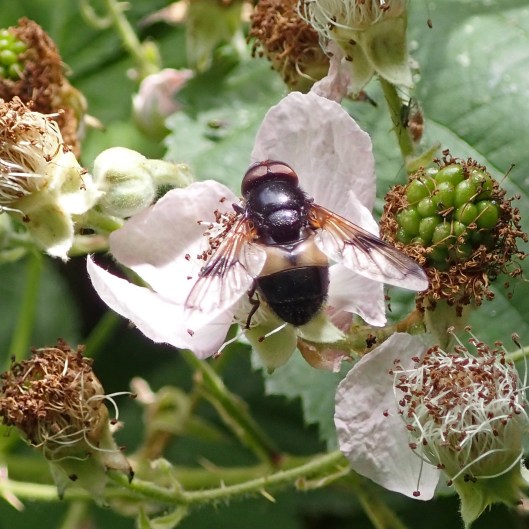
Volucella pellucens, on the other hand, is common and abundant throughout Britain, often seen hovering around head height along woodland rides and forest tracks. Due to its black-and-white colouring, it’s also known as the Great pied hoverfly.

Like Loading...

A little hoverating

13 Thursday Jul 2017

Posted by sconzani in insects, nature

≈ 4 Comments

Tags

British hoverflies, hoverflies, hoverfly, Leucozona glaucia, Leucozona laternaria, Merodon equestris, Xylota segnis, Xylota sylvarum

I admit to not taking as many photos of hoverflies this year as last. This is partly due to an overwhelming fascination with everything, meaning I tend not to focus on one family for long (I’m sure this will pass once I’ve lived in Britain a few more years and have seen a lot of the more common species of everything), but also because the area where I now live has less hoverfly-friendly habitats. Still, I do photograph them when I see them, especially any newbies. Here are a few …

170713 Leucozona glaucia
170713 Leucozona laternaria

Leucozona glaucia and Leucozona laternaria
These are not hoverflies I see very often but they are quite distinctive and that makes them easy to identify, not something you can say about many invertebrates. They’re woodland species but can often be found grazing on the hogweed flowers that frequently grow along woodland rides and edges. The two species are almost identical, except for the colour of their front legs (not always easily seen) and their scutellum (much easier – that’s the half moon shaped bit on their backs between their wings). The scutellum is yellow in Leucozona glaucia (above left) and dark in L. laternaria (above right).

170713 Merodon equestris

Merodon equestris
This medium-sized hoverfly looks a lot like a bumblebee, but the shape of its head and its large eyes are easy ways to tell that it’s not. In their top-notch field guide Britain’s Hoverflies, Stuart Ball and Roger Morris note that Merodon equestris is ‘believed to have been introduced into Britain in daffodil bulbs imported from Europe around the end of the 19th century’. That’s because the larvae of this hoverfly develop inside bulbs and have a particular liking for daffodils.

170713 Xylota segnis
170713 Xylota sylvarum

Xylota segnis and Xylota sylvarum
These are just two of the seven members of the Xylota genus – I have yet to see the others. With their lanky legs, they look a bit like sawflies and they also prefer gathering pollen and honeydew from leaves rather than flowers, so they’re not your run-of-the-mill hoverflies. I find these quite difficult to tell apart but X. segnis has a black bottom (above left) whereas X. sylvarum’s is yellow (above right) (not easy to see when they’re resting and covering their bottoms with their wings, as in my photo).

Like Loading...

About me

sconzani

sconzani

I'm a writer and photographer; researcher and blogger; birder and nature lover; countryside rambler and city strider; volunteer and biodiversity recorder.

View Full Profile →

Follow earthstar on WordPress.com

Enter your email address to follow this blog and receive notifications of new posts by email.

Recent blog posts

  • N is for nest December 19, 2025
  • M is for mite December 18, 2025
  • L is for lepidopteran lifers December 17, 2025
  • K is for Keeled skimmers December 16, 2025
  • J is for Jersey tiger December 15, 2025

From the archives

COPYRIGHT

Unless otherwise acknowledged, the text and photographs on this blog are my own and are subject to international copyright. Nothing may be downloaded or copied without my permission.

Fellow Earth Stars!

  • Unknown's avatar
  • Unknown's avatar
  • Unknown's avatar
  • Unknown's avatar
  • Unknown's avatar
  • Unknown's avatar
  • Unknown's avatar
  • Unknown's avatar
  • Unknown's avatar
  • Unknown's avatar
  • Unknown's avatar
  • Unknown's avatar
  • Unknown's avatar
  • Unknown's avatar
  • Unknown's avatar
  • Unknown's avatar
  • Unknown's avatar
  • Unknown's avatar
  • Unknown's avatar
  • Unknown's avatar
  • Unknown's avatar
  • Unknown's avatar
  • Unknown's avatar
  • Unknown's avatar
  • Unknown's avatar
  • Unknown's avatar
  • Unknown's avatar
  • Unknown's avatar
  • Unknown's avatar
  • Unknown's avatar
  • Unknown's avatar
  • Unknown's avatar
  • Unknown's avatar
  • Unknown's avatar
  • Unknown's avatar
  • Unknown's avatar
  • Unknown's avatar
  • Unknown's avatar
  • Unknown's avatar
  • Unknown's avatar
  • Unknown's avatar
  • Unknown's avatar
  • Unknown's avatar
  • Unknown's avatar
  • Unknown's avatar
  • Unknown's avatar
  • Unknown's avatar
  • Unknown's avatar
  • Unknown's avatar
  • Unknown's avatar

Blog at WordPress.com.

Privacy & Cookies: This site uses cookies. By continuing to use this website, you agree to their use.
To find out more, including how to control cookies, see here: Cookie Policy
  • Subscribe Subscribed
    • earthstar
    • Join 667 other subscribers
    • Already have a WordPress.com account? Log in now.
    • earthstar
    • Subscribe Subscribed
    • Sign up
    • Log in
    • Report this content
    • View site in Reader
    • Manage subscriptions
    • Collapse this bar
 

Loading Comments...
 

You must be logged in to post a comment.

    %d