• ABOUT
  • BIRDING 2018
  • Birding 2019
  • BLOG POSTS
  • Butterflies 2018
  • Resources

earthstar

~ a celebration of nature

earthstar

Tag Archives: slime mould

False puffball

28 Friday Mar 2025

Posted by sconzani in fungi, nature

≈ Leave a comment

Tags

Enteridium lycoperdon, False puffball, Reticularia lycoperdon, slime, slime mould, slime mould on dead tree

It’s been a while since slime featured here but, as it’s Fungi Friday (yes, I know slime isn’t exactly a fungus) and I happened to spot some slime yesterday, slime it is for today’s post, folks.
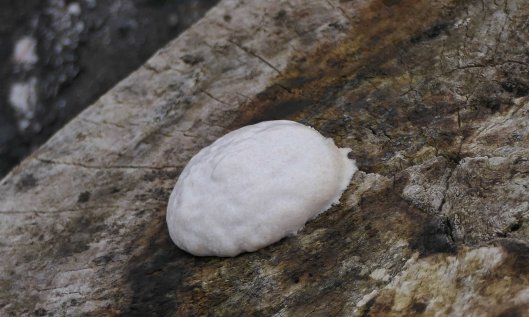
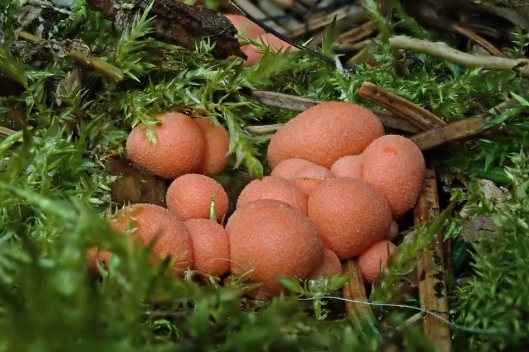
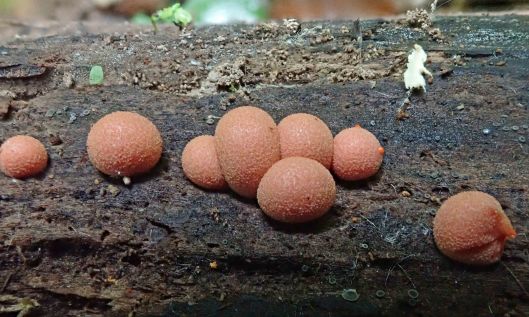
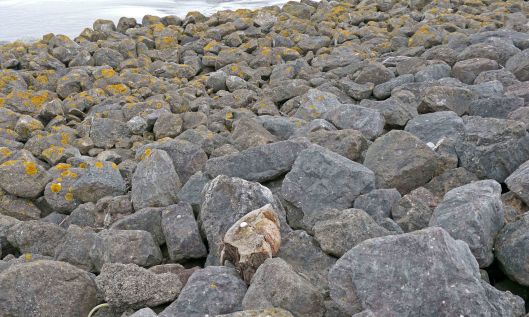
This particularly slime doesn’t really look like your typical example, which is presumably why its common name is False puffball; its scientific name is Reticularia lycoperdon (also known as Enteridium lycoperdon). And I spotted it in rather an odd place, growing on a stump that must have been thrown up on to the outer Barrage rocks in Cardiff Bay during a particularly high tide. You can read more about these intriguing organisms and see examples of the various stages of their life cycle on the excellent NatureSpot website.
Like Loading...

Great suffering slime balls

19 Friday Apr 2024

Posted by sconzani in fungi

≈ Leave a comment

Tags

British slime moulds, Lycogala species, Red raspberry slime, slime, slime mould, Tubifera ferruginosa

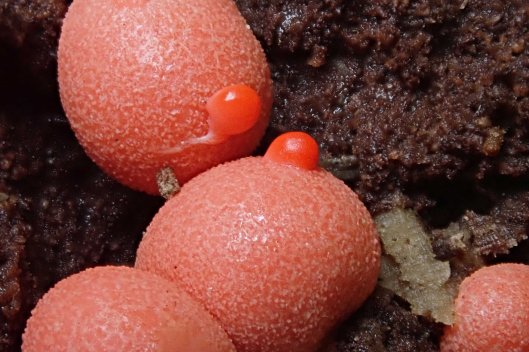
This fallen log was half covered in slime, balls and balls of orange-red-coloured slime. At first I thought they were all the same species but, after looking more closely at my photos, I think there are two. The majority were these Red raspberry slime balls (Tubifera ferruginosa).

240419 slime (1)

And the others were one of the Lycogala species of slime. Both looked delicious … but you wouldn’t want to eat them.

240419 slime (2)

Like Loading...

Dog sick

16 Thursday Nov 2023

Posted by sconzani in fungi

≈ Leave a comment

Tags

British slime moulds, Dog sick, Dog sick slime on grass, Dog vomit, Dog vomit slime on wood, Fuligo septica, Mucilago crustacea, slime mould

There are two slime moulds that are named for their resemblance to dogs’ vomit. One is called Dog sick (Mucilago crustacea), which starts off yellow but fades to white, then eventually looks much darker due to its mass of black spores. The key thing with this slime mould is that it grows on grass or other vegetation.

231116 Mucilago crustacea

The other is Fuligo septica, commonly known as the Dog vomit or Scrambled egg slime (though, obviously, it’s not something anyone would ever want to eat, regardless of how much its yellow lumpy appearance resembles scrambled egg). Although it can look very similar to Mucilago crustacea, it grows on wood, on dead trees and branches in woodland areas but also on wood chip and bark mulches, according to the Naturespot website.

231116 Fuligo septica

The Dog sick shown here was found in a cemetery last week; the Dog vomit image is from my photo library. (I hope you weren’t having your breakfast when you read this!)

Like Loading...

Lycogala slime mould

19 Friday May 2023

Posted by sconzani in fungi

≈ Leave a comment

Tags

British slime moulds, Lycogala species, slime mould, Wolf's milk, Wolf's milk slime mould

A train journey to a woodland in the next county earlier this week didn’t turn up the butterflies I was hoping for but I took consolation in the fact that I did see several things I don’t usually see locally. The first of these (the next couple of blogs will feature others) is usually found on rotting trees, so there’s no real reason I don’t see it in local woodlands – maybe it’s just a matter of timing. This is the enigmatic slime mould, Wolf’s milk. It could either be Lycogala epidendrum or L. terrestre but I won’t know which unless I revisit the site in a week or so. I explained the reason for this in two previous blogs (the initial find featured in Wolf’s milk, 16 June 2021, followed by the species reveal Wolf’s milk update, 2 July 2021).

230519 wolfs milk slime mould

Like Loading...

Springtail and slime

17 Friday Feb 2023

Posted by sconzani in fungi, insects, leaves

≈ Leave a comment

Tags

British springtails, Dicyrtomina ornata, insects on Sycamore, leaf litter, slime, slime mould, slime on Sycamore leaf, springtail, Sycamore leaves

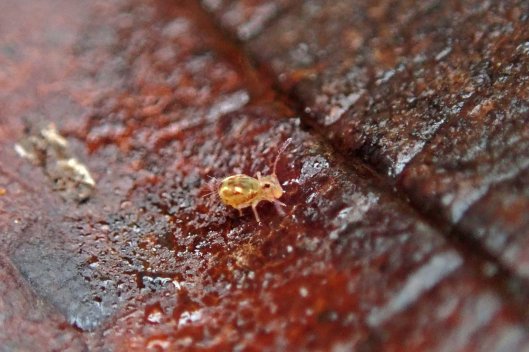
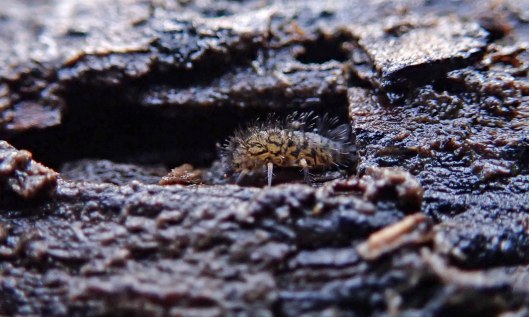
My most recent leaf-diving session in my favourite slimy Sycamore leaf spot turned up these two tiny treasures. This first is a miniscule springtail with a very hairy bottom which I think is Dicyrtomina ornata. There is another very similar springtail, Dicyrtomina saundersi, but that has distinct orange patches on its antennae and I’m not seeing that in my photos of this little critter.

230217 springtail

The second treasure was a lovely bit of slime, which may or may not be Metatrichia floriformis. Slime moulds can be tricky to identify accurately and I’m well out of practice.

230217 slime

Like Loading...

Coral slime

15 Friday Oct 2021

Posted by sconzani in autumn, trees

≈ 4 Comments

Tags

British slime moulds, Ceratiomyxa fruticulosa, Coral slime, slime mould, slime mould on dead tree

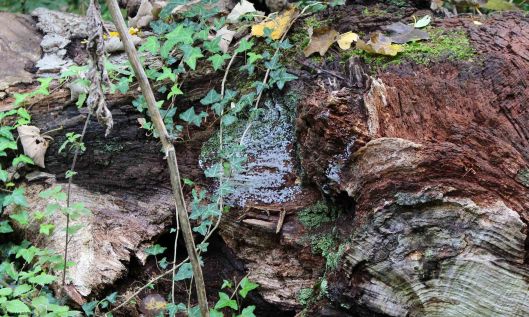
While out walking on Wednesday I spotted this large expanse of something white on the side of a huge old fallen tree and, of course, I had to investigate.

211015 ceratiomyxa fruticulosa (1)

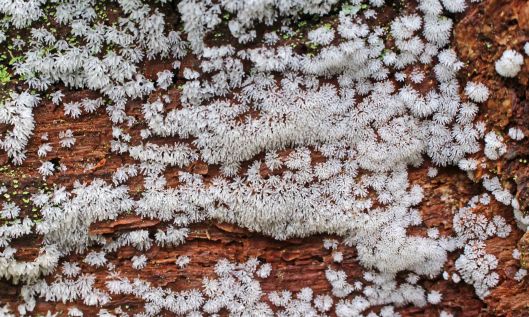
As I got closer, I realised it was the slime mould Ceratiomyxa fruticulosa, a mass of tiny translucent white tubes, often branched, clustered together like terrestrial coral or sea anemones.

211015 Ceratiomyxa fruticulosa (2)

As this plasmodium stage of a slime mould often only lasts a day or two, the timing of my walk was very lucky indeed.

211015 Ceratiomyxa fruticulosa (3)

Like Loading...

Wolf’s milk update

02 Friday Jul 2021

Posted by sconzani in fungi

≈ 4 Comments

Tags

British slime moulds, Lycogala slime mould, Lycogala terrestre, slime mould

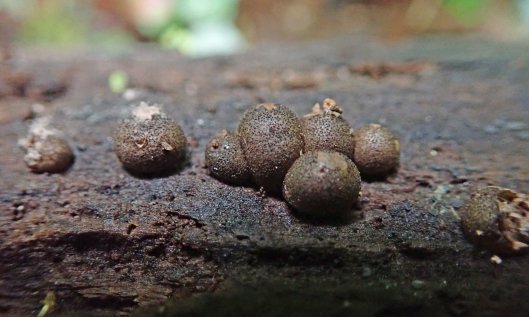
You might remember that on 18 June I blogged about Wolf’s milk, one of the Lycogala species of slime moulds, and noted that I couldn’t positively identify it until I saw the colour of its spores. Well, I’ve been back to recheck these slime balls. They took a bit of finding, as the dense tree canopy of the woodland makes the area quite dark and their change of colour as the slime balls have matured made them blend in with the log they were growing on, as you can see below.

210702 Lycogala terrestre (1)

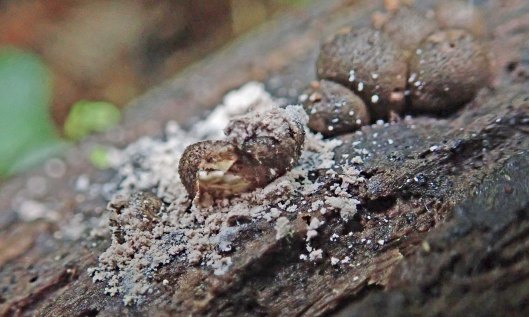
The good news is that I have been able to identify them. I ‘popped’ one – not a bad thing for the slime as this released its spores for distribution – and found the spore colour to have a pinkish hue, which confirmed the species as Lycogala terrestre.

210702 Lycogala terrestre (2)

Like Loading...

Wolf’s milk

18 Friday Jun 2021

Posted by sconzani in fungi

≈ 3 Comments

Tags

Lycogala slime mould, Lycogala sp., slime mould, Wolf's milk

Two species of the slime mould Lycogala can be found in Britain, Lycogala epidendrum and Lycogala terrestre, and it’s only possible to distinguish one from the other by checking the colour of their spores, grey and pink respectively. To do that I’d need to revisit these lovely globules of Lycogala in a week or so – I’ll try to remember, and update this post accordingly.

210618 wolfs milk

Both Lycogala species are commonly known as Wolf’s milk, though I’m not sure why that is. Perhaps someone thought the orange-pink substance they secrete when poked resembled the milk of wolves? North American’s apparently call it Toothpaste slime, which makes me glad I don’t use their brands of toothpaste!

Like Loading...

321/366 Springtails and slime

16 Monday Nov 2020

Posted by sconzani in fungi, insects

≈ Leave a comment

Tags

Comatricha nigra, Comatricha slime mould, Dicyrtomina saundersi, fungi on rotting wood, Neanura muscorum, slime, slime mould, springtail, Trichia persimilis, Trichia slime mould

Springtails and slime, a colourful combination, currently to be found on and under many old branches and rotting logs, in a saturated woodland near you, right now!

201116 springtails and slime (1)

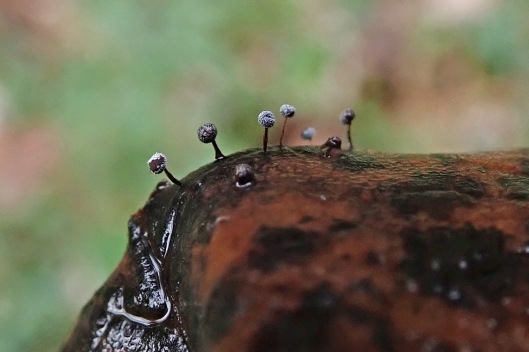
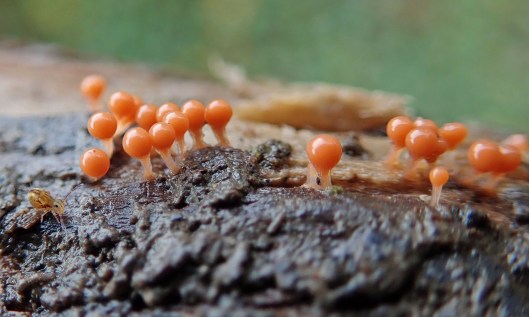
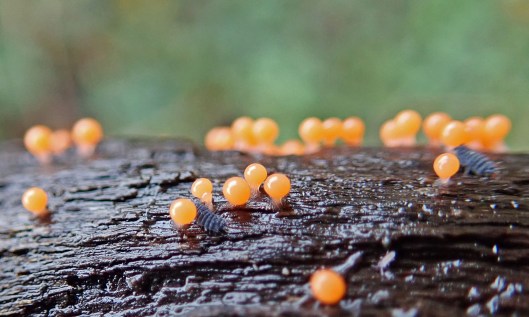
The orange slime is probably one of the Trichia species, possibly Trichia persimilis, and the white blobs on black sticks are one of the Comatricha species, perhaps Comatricha nigra.

201116 springtails and slime (2)

And the springtails? The brownish one with the hairy bottom is likely to be Dicyrtomina saundersi, and the blue-grey-coloured ones may be Neanura muscorum, but my photos are not good enough to make positive identifications.

201116 springtails and slime (3)

Like Loading...

16/366 Beneath

16 Thursday Jan 2020

Posted by sconzani in insects, molluscs, nature, winter

≈ 5 Comments

Tags

Hairy snail, slime mould, slugs, springtail, under a log

When wet weather forces a change of plan, sometimes the only thing for it is to head to the woods and turn over some logs, because there’s never nothing to see under a log!

200116 1 slug
200116 2 slug

Two slugs, possibly even the same species despite their obvious colour differences.

200116 3 eggs
200116 4 eggs

Eggs? Those on the left might well be slug or snail eggs but the ones on the right were much smaller and seemed caught up in a web or perhaps just strands of slime. I didn’t poke them – didn’t want to disturb them – so I’m not sure of their texture.

200116 5 slime

A slime mould, though not as much slime as I was hoping for. Possibly one of the Trichia species, perhaps Trichia persimilis.

200116 8 springtail

A springtail, probably one of the Entomobrya species but I really needed a photo of its upper side to be able to confirm its identification.

200116 7 hairy snails

Hairy snails (Trochulus hispidus), I believe, as the only other hairy snail has a more conical shell. It always seems odd to me for a snail to have hairs … but odd is good, interesting, never boring!

Like Loading...
← Older posts

About me

sconzani

sconzani

I'm a writer and photographer; researcher and blogger; birder and nature lover; countryside rambler and city strider; volunteer and biodiversity recorder.

View Full Profile →

Follow earthstar on WordPress.com

Enter your email address to follow this blog and receive notifications of new posts by email.

Recent blog posts

  • M is for mite December 18, 2025
  • L is for lepidopteran lifers December 17, 2025
  • K is for Keeled skimmers December 16, 2025
  • J is for Jersey tiger December 15, 2025
  • I is for Ichneumon December 14, 2025

From the archives

COPYRIGHT

Unless otherwise acknowledged, the text and photographs on this blog are my own and are subject to international copyright. Nothing may be downloaded or copied without my permission.

Fellow Earth Stars!

  • Unknown's avatar
  • Unknown's avatar
  • Unknown's avatar
  • Unknown's avatar
  • Unknown's avatar
  • Unknown's avatar
  • Unknown's avatar
  • Unknown's avatar
  • Unknown's avatar
  • Unknown's avatar
  • Unknown's avatar
  • Unknown's avatar
  • Unknown's avatar
  • Unknown's avatar
  • Unknown's avatar
  • Unknown's avatar
  • Unknown's avatar
  • Unknown's avatar
  • Unknown's avatar
  • Unknown's avatar
  • Unknown's avatar
  • Unknown's avatar
  • Unknown's avatar
  • Unknown's avatar
  • Unknown's avatar
  • Unknown's avatar
  • Unknown's avatar
  • Unknown's avatar
  • Unknown's avatar
  • Unknown's avatar
  • Unknown's avatar
  • Unknown's avatar
  • Unknown's avatar
  • Unknown's avatar
  • Unknown's avatar
  • Unknown's avatar
  • Unknown's avatar
  • Unknown's avatar
  • Unknown's avatar
  • Unknown's avatar
  • Unknown's avatar
  • Unknown's avatar
  • Unknown's avatar
  • Unknown's avatar
  • Unknown's avatar
  • Unknown's avatar
  • Unknown's avatar
  • Unknown's avatar
  • Unknown's avatar
  • Unknown's avatar

Blog at WordPress.com.

Privacy & Cookies: This site uses cookies. By continuing to use this website, you agree to their use.
To find out more, including how to control cookies, see here: Cookie Policy
  • Subscribe Subscribed
    • earthstar
    • Join 667 other subscribers
    • Already have a WordPress.com account? Log in now.
    • earthstar
    • Subscribe Subscribed
    • Sign up
    • Log in
    • Report this content
    • View site in Reader
    • Manage subscriptions
    • Collapse this bar
 

Loading Comments...
 

You must be logged in to post a comment.

    %d