
• ABOUT
  • BIRDING 2018
  • Birding 2019
  • BLOG POSTS
  • Butterflies 2018
  • Resources

earthstar

~ a celebration of nature

earthstar

Tag Archives: Volucella bombylans

Five big hovers

12 Thursday Jun 2025

Posted by sconzani in insects

≈ Leave a comment

Tags

British hoverflies, Chrysotoxum cautum, hoverfly, large hoverflies, Merodon equestris, Volucella bombylans, Volucella inflata, Volucella pellucens

I’ve come to the conclusion, rightly or wrongly, that large hoverflies are like buses: you don’t see any at all and then they all come along at once. At least that has been my recent experience (it’s probably more to do with the weather and the time of year, but I like my buses theory). The five big beasties shown here were all seen over just four days, between 29 May and 1 June.

With its black-and-yellow striping, it’s easy to see that Chrysotoxum cautum is one of the wasp-mimicking hoverflies. The eight British species of Chrysotoxum all have quite long antennae, and it is the relative lengths of the segments of those antennae that are used to differentiate between the five most similar species.

Merodon equestris comes in a variety of colour forms, each of which mimics bumblebees. The one pictured above is a rather worn specimen of form validus, which has a totally dark thorax and a grey-buff coloured bottom.
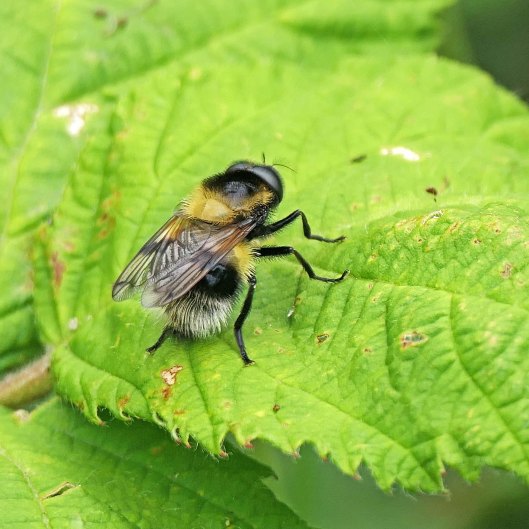
These final three are all members of the Volucellini, of which there are five British species. Like Merodon equestris, Volucella bombylans is a bumblebee mimic; which bumblebee it is attempting to mimic depends on which of the colour variations you see. This yellow-and-black form mimics Bombus lucorum, the White-tailed bumblebee, but there is also a mostly black, orange-bottomed variation of Volucella bombylans that mimics Bombus lapidarius, the Red-tailed bumblebee.
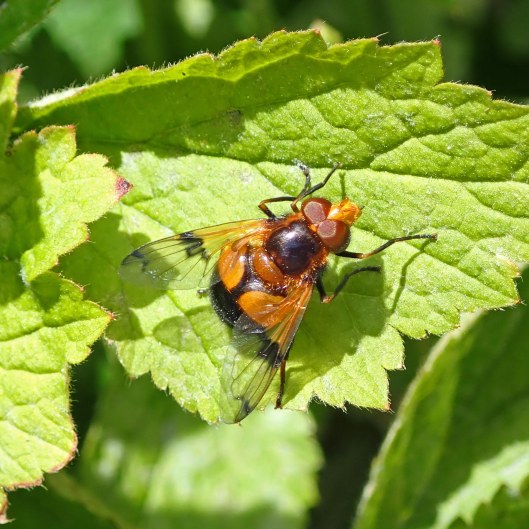
I was particularly pleased to see Volucella inflata as I’ve only found it once before. With its vivid and very distinctive markings, its round body, and protruding yellow snout, it’s a stunning hoverfly to encounter. Sadly for those of you in northern Britain, it’s mostly found in the southern counties and south Wales.
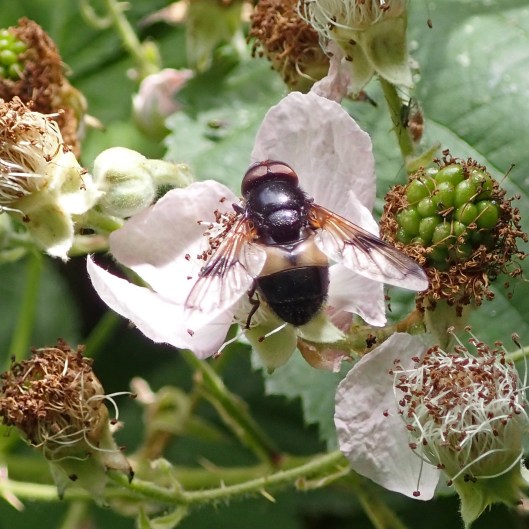
Volucella pellucens, on the other hand, is common and abundant throughout Britain, often seen hovering around head height along woodland rides and forest tracks. Due to its black-and-white colouring, it’s also known as the Great pied hoverfly.

Like Loading...

The mimics

01 Thursday Jun 2023

Posted by sconzani in insects

≈ Leave a comment

Tags

British hoverflies, hoverflies mimicking bumblebees, hoverfly, insect mimicry, Red-tailed bumblebee, Volucella bombylans, Volucella bombylans var. bombylans, Volucella bombylans var. plumata, White-tailed bumblebee

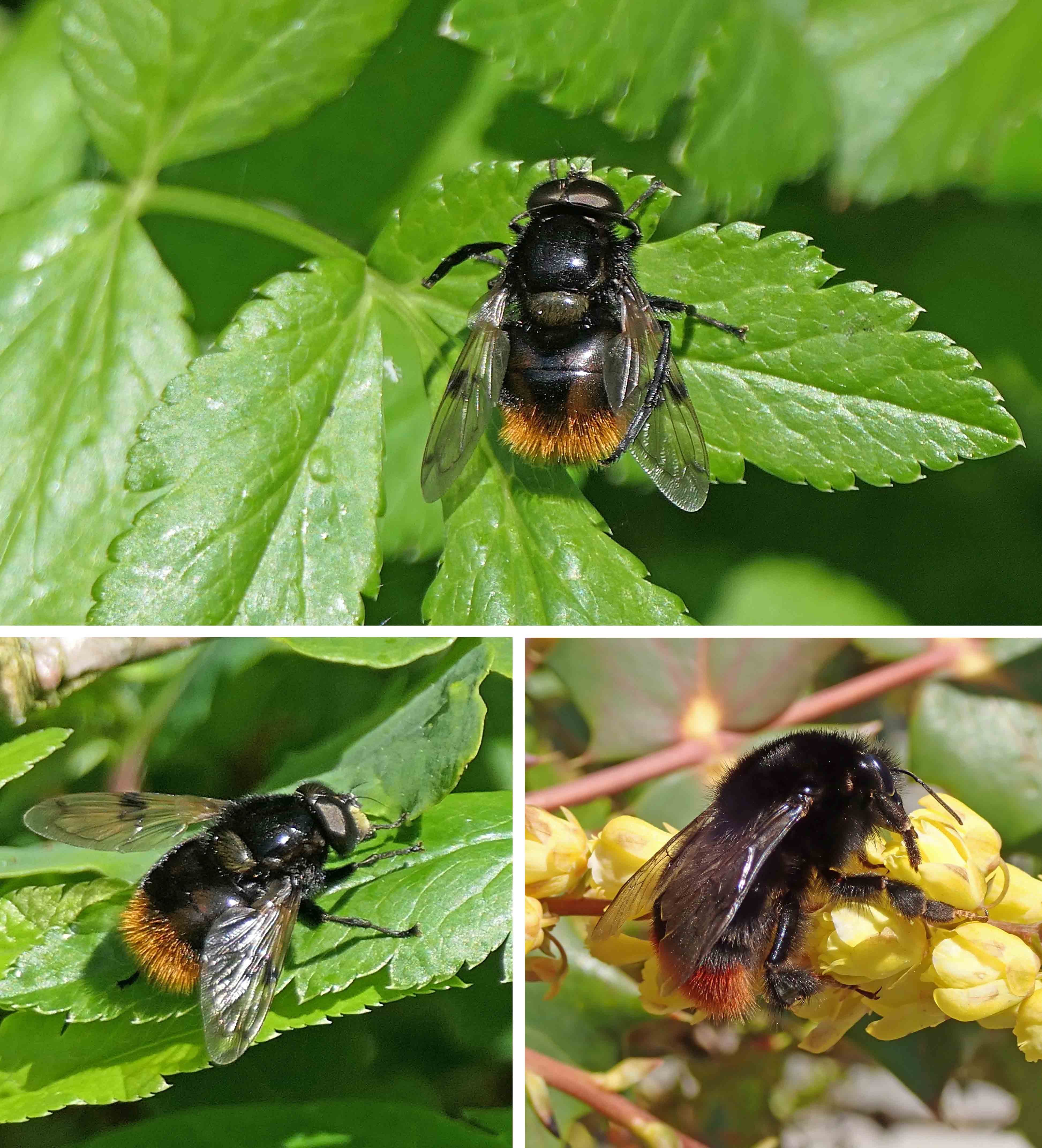
You may have seen on social media and, indeed, be experiencing for yourself our ‘silent spring’, where the lamentably small numbers of invertebrates are causing grave concern. I have also found this – places where I would normally be seeing good numbers of bees, flies, butterflies and bugs are almost empty of life. So, I was even more pleased than usual last Monday when I spotted two Volucella bombylans hoverflies, one of each of the two colour variations, in a corner of a local field. These are bumblebee mimics, deliberately imitating bumble species so as to enter the nests of bumblebees to lay their eggs within.

230601 volucella bombylans (1)

Volucella bombylans var. plumata above mimics the White-tailed bumblebee (Bombus lucorum). I’ve included a photo of Bombus lucorum, above right, so you can see the two side by side. And, as you can see, the colouring of the second Volucella bombylans below is quite different. This is Volucella bombylans var. bombylans, which mimics the Red-tailed bumblebee (Bombus lapidarius) shown lower right. The mimicry isn’t perfect but it obviously works – if it didn’t, these hoverflies wouldn’t exist.

230601 volucella bombylans (2)

Like Loading...

The big four

23 Tuesday Aug 2022

Posted by sconzani in insects

≈ Leave a comment

Tags

British hoverflies, hoverfly, Volucella bombylans, Volucella inanis, Volucella pellucens, Volucella species, Volucella zonaria

These are the big beasties of the hoverfly world, the bumblebee, wasp and hornet mimics. Though their size can be a little intimidating, they are all completely harmless to humans, and wonderful to watch going about their daily lives. There are actually five Volucella species in Britain – the woodland species Volucella inflata does occur locally (see A new hoverfly, June 2020) but I’ve not noticed one this year. The big four below are Volucella bombylans, Volucella pellucens (commonly known as the Great pied hoverfly, due to its colouring), Volucella inanis and Volucella zonaria – these are the two mostly easily confused with each other but the most obvious difference is the chestnut colouring of V. zonaria‘s thorax.

220823 volucella hoverflies

Like Loading...

152/365 Hovering

01 Saturday Jun 2019

Posted by sconzani in 365DaysWildin2019, insects, nature

≈ 4 Comments

Tags

#365DaysWild, British hoverflies, Chrysotoxum bicinctum, Episyrphus balteatus, Helophilus pendulus, hoverfly, Volucella bombylans, Volucella bombylans subsp. plumata, Xanthogramma pedissequum

I found a new path today, which led me through swathes of long grass bordered by brambles and low shrubby bushes. I emerged with wet shoes and trousers from the dew still coating the grass but with lots of photos of hoverflies, so I will definitely be going back to explore further. Here are the hovers …

190601 1 volucella bombylans
190601 2 volucella bombylans subsp plumata

Volucella bombylans and Volucella bombylans subsp. plumata
At first glance you might think these two hoverflies were bumblebees, and that’s exactly what they want you to think – or, rather, what they want bumblebees to think, because they don’t want to be caught out when sneaking in to lay their eggs in the nests of the bumblebees they mimic (which are the Red-tailed bumblebee Bombus lapidarius and the White-tailed bumblebee Bombus lucorum respectively).

190601 3 helophilus pendulus
190601 4 chrysotoxum bicinctum

Helophilus pendulus and Chrysotoxum bicinctum
Do you see why the hoverfly on the left is known as The Footballer? I’m not sure which football team his colourful markings are meant to represent – perhaps Helophilus pendulus has its own team. Its distinctive bands of bright yellow make Chrysotoxum bicinctum one of the easier hoverflies to identify.

190601 5 Xanthogramma pedissequum
190601 6 episyrphus balteatus

Xanthogramma pedissequum and Episyrphus balteatus
Xanthogramma pedissequum is another hoverfly with reasonably easy to identify markings – believe me, not all hoverflies are so easy! And with its rich orange colouring, Episyrphus balteatus looks almost edible, which is probably why it’s called the Marmalade hoverfly.

Like Loading...

About me

sconzani

sconzani

I'm a writer and photographer; researcher and blogger; birder and nature lover; countryside rambler and city strider; volunteer and biodiversity recorder.

View Full Profile →

Follow earthstar on WordPress.com

Enter your email address to follow this blog and receive notifications of new posts by email.

Recent blog posts

  • Autumn trees: Whitebeam November 30, 2025
  • Recent Robins November 29, 2025
  • Location location location November 28, 2025
  • A disabled Coot November 27, 2025
  • Hawthorn flowering in November November 26, 2025

From the archives

COPYRIGHT

Unless otherwise acknowledged, the text and photographs on this blog are my own and are subject to international copyright. Nothing may be downloaded or copied without my permission.

Fellow Earth Stars!

  • Unknown's avatar
  • Unknown's avatar
  • Unknown's avatar
  • Unknown's avatar
  • Unknown's avatar
  • Unknown's avatar
  • Unknown's avatar
  • Unknown's avatar
  • Unknown's avatar
  • Unknown's avatar
  • Unknown's avatar
  • Unknown's avatar
  • Unknown's avatar
  • Unknown's avatar
  • Unknown's avatar
  • Unknown's avatar
  • Unknown's avatar
  • Unknown's avatar
  • Unknown's avatar
  • Unknown's avatar
  • Unknown's avatar
  • Unknown's avatar
  • Unknown's avatar
  • Unknown's avatar
  • Unknown's avatar
  • Unknown's avatar
  • Unknown's avatar
  • Unknown's avatar
  • Unknown's avatar
  • Unknown's avatar
  • Unknown's avatar
  • Unknown's avatar
  • Unknown's avatar
  • Unknown's avatar
  • Unknown's avatar
  • Unknown's avatar
  • Unknown's avatar
  • Unknown's avatar
  • Unknown's avatar
  • Unknown's avatar
  • Unknown's avatar
  • Unknown's avatar
  • Unknown's avatar
  • Unknown's avatar
  • Unknown's avatar
  • Unknown's avatar
  • Unknown's avatar
  • Unknown's avatar
  • Unknown's avatar
  • Unknown's avatar

Blog at WordPress.com.

Privacy & Cookies: This site uses cookies. By continuing to use this website, you agree to their use.
To find out more, including how to control cookies, see here: Cookie Policy
  • Subscribe Subscribed
    • earthstar
    • Join 669 other subscribers
    • Already have a WordPress.com account? Log in now.
    • earthstar
    • Subscribe Subscribed
    • Sign up
    • Log in
    • Report this content
    • View site in Reader
    • Manage subscriptions
    • Collapse this bar
 

Loading Comments...
 

You must be logged in to post a comment.

    %d